

Wilton Archaeologist Seeks Public Help Locating Colonial Shipwreck Pieces
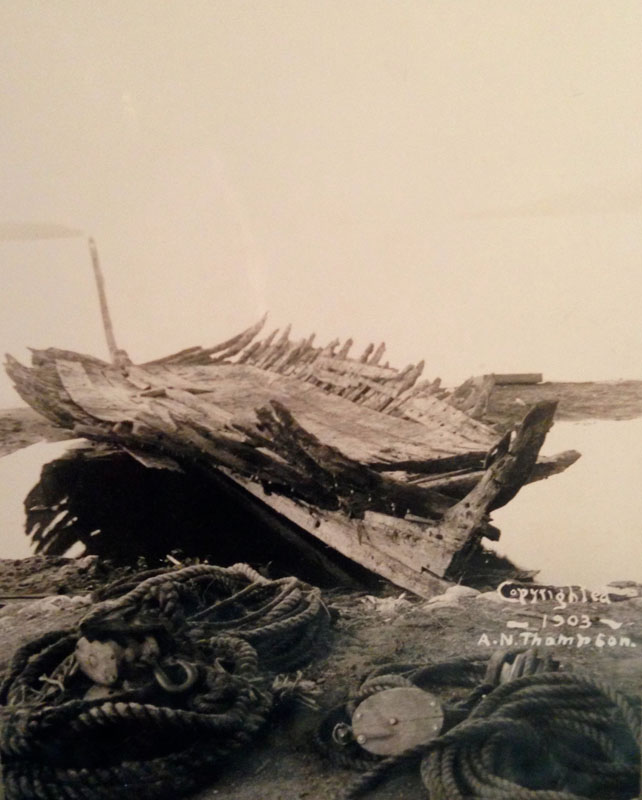
A mid-18th century British sloop, shortly after it was pulled from the waters of Lake George, off the grounds of Fort William Henry. The naval craft was burned and sank in a March 1757 raid by French forces on British-occupied Fort William Henry. 1903 Photo: A. N. Thompson.
WILTON — Maritime archaeologist and Wilton resident Joseph W. Zarzynski, is seeking the local public’s help to locate three artifacts crafted from a colonial shipwreck that were seen in a Saratoga Springs storefront over a century ago.
The back story: in March 1757, a British warship was burned and sank off the south end of Lake George, during a French attack on Fort William Henry. The French burned 300 bateaux (25–35 ft. long vessels) pulled up on shore, and four sloops in the water. The garrison held out, but five months later the French returned. After a siege of several days, the British surrendered, and the fortification was torched.
Nearly a century-and-half later, in July 1903, a sunken sloop from the March 1757 attack was raised from Lake George by a Glens Falls entrepreneur. The state legislature approved the recovery as long as the vessel predated the American Revolution (1775–1783), and that no state funds were used. The wooden sloop was pulled from 20 feet of water by a D&H locomotive, taken ashore, and cut up for souvenirs. Some hull fragments were carved into household objects.
A clock case and two candlesticks were fashioned from shipwreck pieces in 1919 by W. L. Adee, a Saratoga Springs carpenter who lived on Van Dam Street. The repurposed items, were later exhibited in the F. C. Maynard jewelry store on Broadway in Saratoga Springs.
“For over 35 years, I’ve been intrigued with this unlucky vessel,” said Zarzynski, who has studied Lake George shipwrecks since the mid-1980s, and taught Social Studies in the Saratoga Springs City School District for 30 years. “During the 1800s and early 20th century, before there was a historic preservation ethic, gavels and canes were sometimes crafted from shipwreck timbers.”
Earlier this year, Zarzynski directed a team of volunteers who have been inventorying maritime artifacts in Fort William Henry Museum. The artifacts included hull timbers from the ill-fated French & Indian War (1755–1763) battlecraft. Several-surviving pieces of the French & Indian War warship are in Warren County museums.
Zarzynski hopes Adee’s 1919 artifacts were passed on to a Saratoga Spring-area family member or friend or bestowed to Adee’s local Baptist church. The maritime archaeologist would like to photograph and measure the relics to gain a better understanding about repurposing historic-ship parts. Anyone with information on W. L. Adee or these three artifacts is asked to contact Joseph W. Zarzynski at: (zarcuws@aol.com).