A Broadalbin man has been arrested after he allegedly crashed into another vehicle while driving under the influence, causing two people to need hospitalization.
The Saratoga County Sheriff’s Office said the crash occurred on Jan. 31 at 12:39 p.m. in the Town of Galway. The driver, Timothy P. Magagnos was arrested on charges of DWI and failure to yield.
According to the Sheriff’s Office, Magagnos was traveling south on Greens Corner Road when he failed to stop at a stop sign, striking another vehicle which was traveling East on Route 29. The crash injured four people in the other vehicle, causing two to be transported to Saratoga Hospital with non-life-threatening injuries.
Magagnos was not injured in the collision and allegedly refused a chemical test at the scene. He was arraigned in Galway Town Court and released on his own recognizance pending further proceedings.
A Corinth man has been arrested after he allegedly assaulted the driver of a vehicle he was riding in.
Daniel Tubbs, of Corinth, was arrested by the Saratoga County Sheriff’s Office on Jan. 31 in the Town of Corinth. According to Deputies, Tubbs repeatedly punched the victim in the face and abandoned them on the side of the road.
The victim, who was not identified by the Sheriff’s Office, subsequently went to nearby residence and informed the homeowner of the assault. The victim was initially transported by EMS to Saratoga Hospital for treatment but later transferred to Albany Medical Center for head and facial injuries.
Tubbs was charged with second degree assault and 2nd degree assault and 2nd degree reckless endangerment. He was arraigned in the Corinth Town Court and is currently being held in the Saratoga County Jail awaiting further proceedings.
Ballston Spa Mayor Frank Rossi has announced that he is taking a leave of absence for health reasons.
The announcement came at a village meeting on January 26. Rossie said realization that he had to take his health more seriously came after the death of former Ballston Spa Mayor Christine Fitzpatrick.
“Health becomes paramount, and right now my health is not in great shape,” Rossi said. “I’m not looking for sympathy on that, but we are at a point where I have to sort of look out for myself a little bit.”
Rossi said he doesn’t know when he will be back and said that being a public official can have a drastic impact on your mental and physical health.
“It’s one of those times in my life that I need to take care of me,” Rossi said. “ I apologize to the community for that fact because I feel like I’m letting you all down in that respect. At the same time, it’s what you have to do sometimes.”
During the leave of absence Rossi has advised people seeking information and regular updates to go to the Village Facebook page and website, as opposed to his. While initially Rossie had planned on unpublishing his page, he later put it back up after he said someone threatened him with a lawsuit.
Rossie’s announcement came after a controversial bill removing a residency requirement for Village appointed board positions — such as the planning board — was tabled for further consideration after public outcry.
It’s unclear when Rossi will return to day-to-day duties. While during the meeting he said that he wasn’t stepping away permanently, he also said that he couldn’t provide any more specifics about when he was returning.
In the meantime, he’ll still handle things like signatures while other duties he can’t complete will be handled by Deputy Mayor and Village Trustee Bernadette VanDenise-Perez, according to News10.
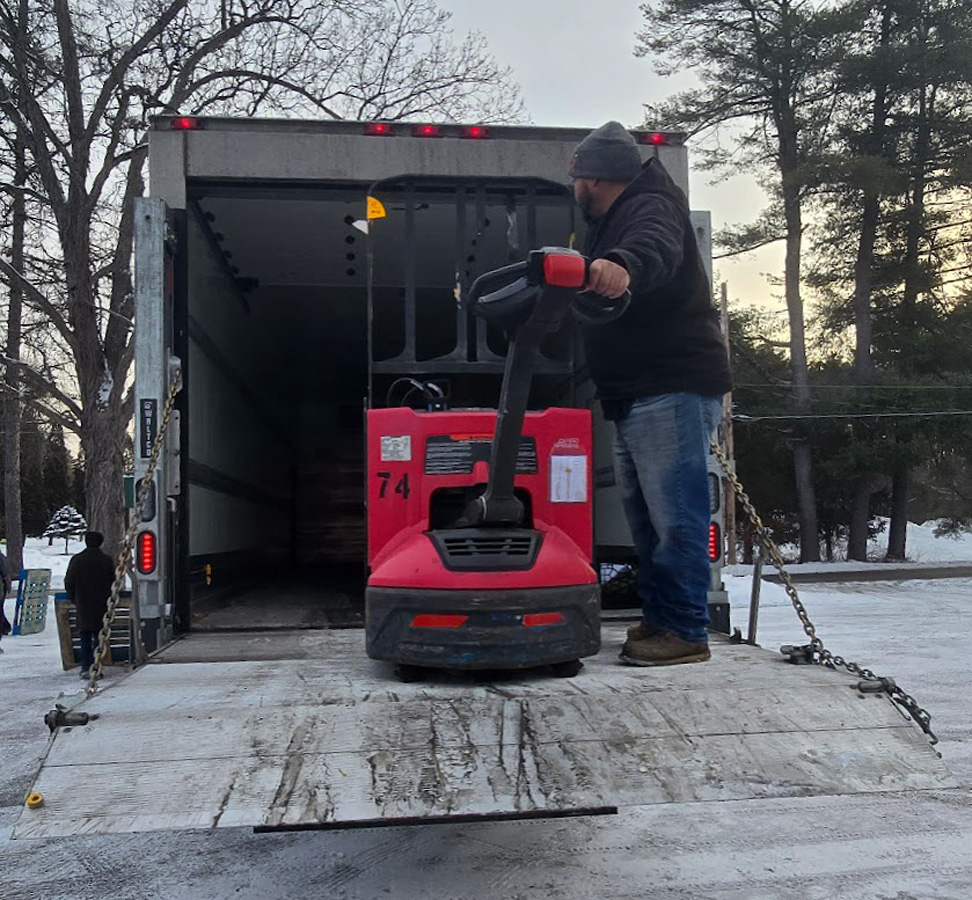
A truck from The Regional Food Bank delivered 12 pallets of food to Saratoga County (Aidan Cahill)
On Thursday, Jan. 22 a truck delivered 12 pallets of food — about 18,000 pounds — to Saratoga County food banks.
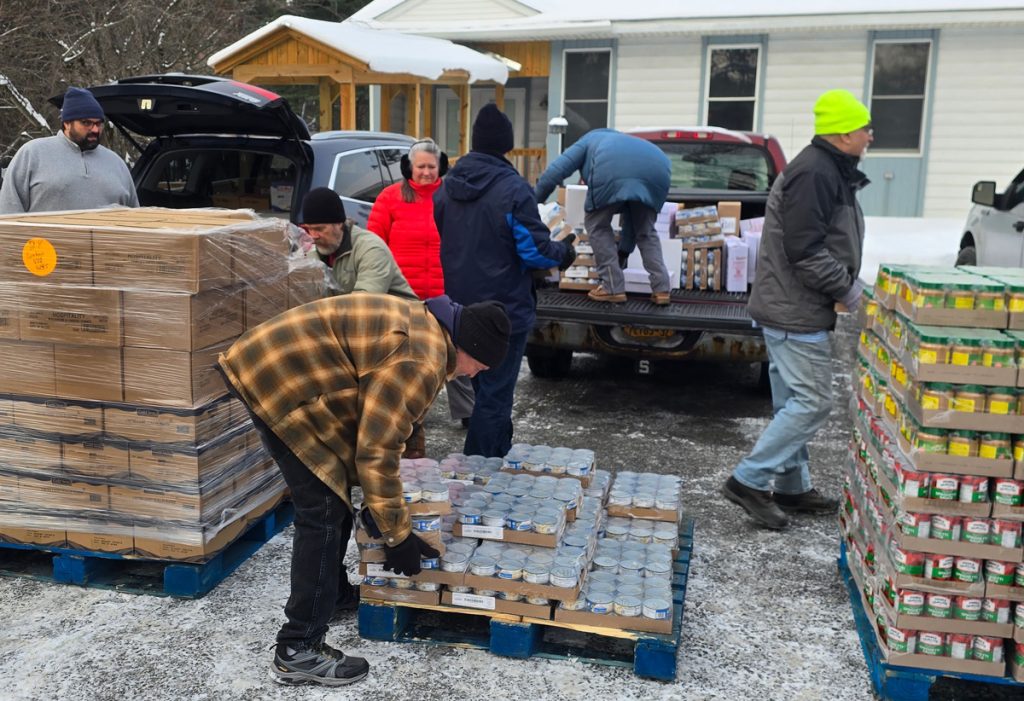
The food was distributed as part of the Regional Food Bank’s “Restock Our Pantries” program to help local food pantries restock after a busy holiday season. This is the first year The Regional Food Bank has implemented the program.
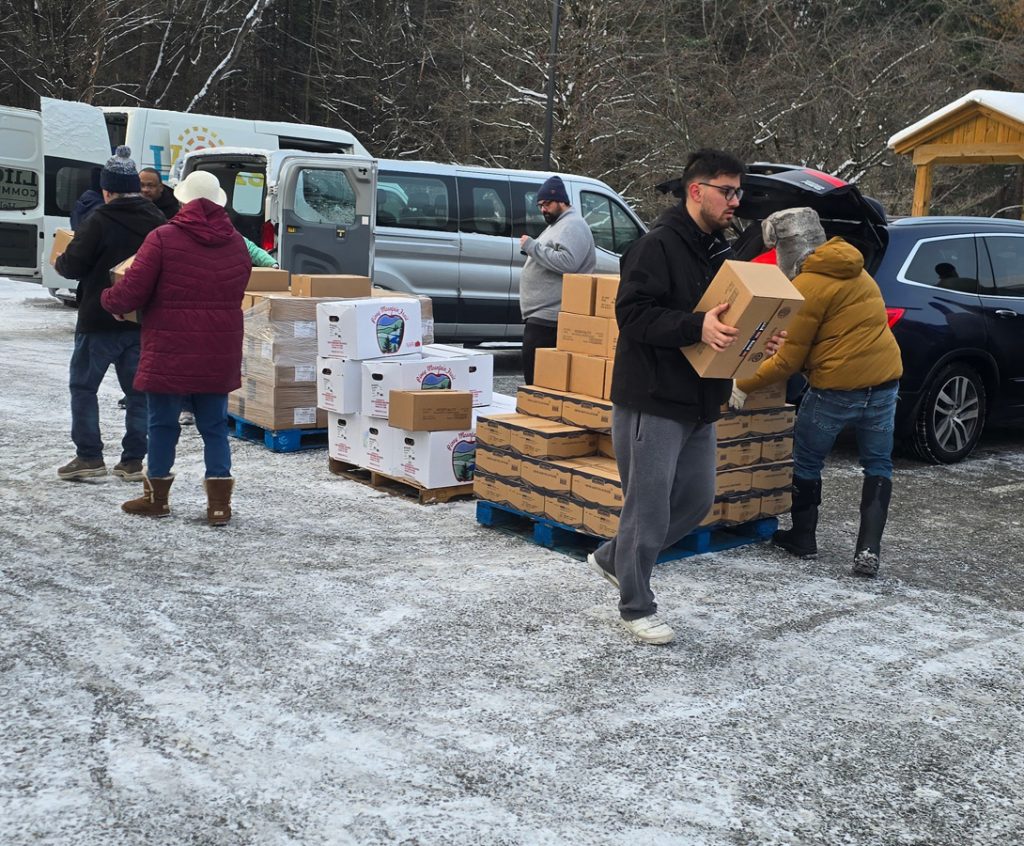
The food was distributed to local food pantries operating in Saratoga County in an effort to help them restock after the holidays (Aidan Cahill)
“The Regional Food Bank facilitated New York State’s largest Thanksgiving meal distribution and had a hugely successful Holiday Hunger Appeal thanks to generous community support,” Tom Nardacci, CEO of the Regional Food Bank said. “The holidays have notoriously left our shelves and partner’s shelves bare during January and February, this much-needed distribution program will directly support agencies by delivering food to where it is needed and in turn benefit communities.”
Ryan Hughes from Life Works Community Action in Ballston Spa said that more people than normal are relying on food pantries due to the recent government shut down which temporarily left people without SNAP benefits as well as greater food insecurity.
“Our local community members rely on us to provide food for their families and during this time when shelves are emptier than usual, we are so thankful for this Restock Our Pantries Program,” Hughes said. “We are grateful for the support of the Regional Food Bank and to state leaders for funding this gap and providing assistance to feed our communities.”
Governor Kathy Hochul has announced that the planned Metro North train between Albany and New York City has been shelved.
An announced MTA train running from Albany to New York has been canceled as Amtrak resumes full service between the Empire State Capital and its largest city.
The announcement was made in a statement released by New York Governor Kathy Hochul on January 27. In it, she said that because of the full restoration, Amtrak would no longer sanction the MTA trains to run between Poughkeepsie and Albany.
Hochul didn’t close the door to an MTA line to Albany, however, especially given the excitement surrounding the initial announcement.
“I remain fully committed to short and long-term proposals to bring better transit – including expanded Metro-North service if the demand exists – beyond Poughkeepsie and into the rest of the Hudson Valley and Capital Region,” Governor Hochul said. “New Yorkers rely on high quality rail transit like no other state, and I will always fight to save commuters time and to make service better.”
The limited service didn’t stop ridership on Amtrak in 2025. While New York City makes up 84% of all Amtrak travel in the state with 13,037,414 people getting on and off at Penn Station in 2025, the Capital region dominates the rest of the state.
The five stations in the Capital Region — Albany, Schenectady, Saratoga Springs, Amsterdam and Glenns Falls — account for a combined 1,142,152 people transiting through on Amtrak. Albany makes up the majority of this total with 920,779 people transiting through.
In addition to ridership, Amtrak spent $16,074,743 on station improvements in the Capital Region in 2025 with $9,131,070 being spent on Saratoga Springs alone — the most of any station in the state.
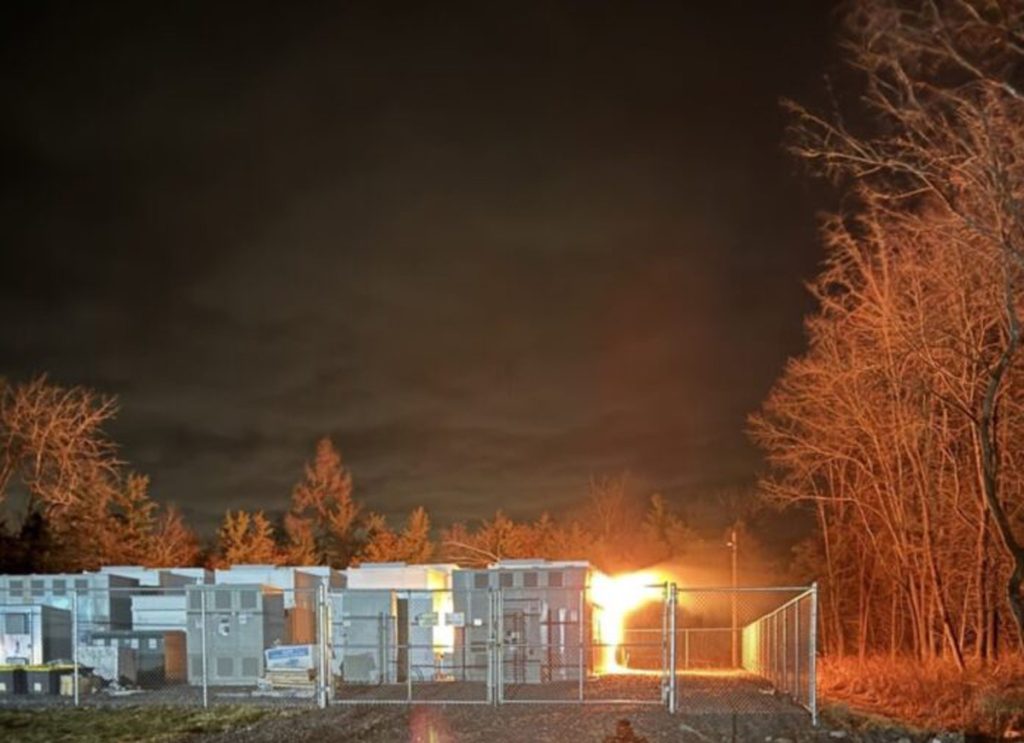
A 2025 fire in Warwick, New York (seen here) was one of the main drivers behind Clifton Park’s decision to ban battery storage facilities in the town (Courtesy of the Village of Warwick)
The Town of Clifton Park has voted to ban battery energy storage in the town — effectively preventing future projects from going forward.
The ban came after two public hearings to consider whether to just extend the current moratorium put in place last year or outright ban the structures within Clifton Park.
During the hearings, most of the people who spoke were in opposition to battery storage facilities, arguing that the technology was too new to be considered safe and had significant environmental concerns. They included engineers and three fire chiefs who said that if one of the systems were to catch fire, then they would have limited ability to fight it.
“If really you think that it’s a good idea to put these systems in our town, I invite you when it does catch on fire to show up with me and all of our folks, put an air pack on and try and fight that fire,” Tim Kimball, Chief of Vischer Ferry Volunteer Fire Company, said. “I don’t care if it’s an energy storage system, a Tesla, a cell phone that’s caught fire in somebody’s pants, whatever it is. It’s the tech. You can’t put them out.”
Kimball also warned that should a fire happen at one of these sites, there would be potentially miles wide evacuations due to toxic smoke from the fire. He also said that it would require firefighters to be on scene for days to try and ensure the fire doesn’t spread, and people don’t get too close to the burning battery.
An incident cited by multiple commenters was the December 19, 2025, fire at a battery storage facility in Warwick, New York. According to Warwick Mayor, Michael Newhard, this fire was caused by possible moisture infiltration of the units. This fire was left to burn out on its own with local responders monitoring air, water, and soil contamination.
This incident wasn’t the first such incident in Warwick with a 2023 fire prompting more regulations from the Village with which Mayor Newhard alleges they did not comply.
It was these concerns that led the Town Council to pass both the moratorium and the outright ban of battery storage facilities, with members saying that without further research on the impact of these facilities, they can’t support allowing them in Clifton Park.
While Clifton Park is one of many towns to ban these energy storage facilities, a bill currently in the State Assembly and State Senate would place authority for these facilities under the prevue of State Office of Renewable Energy Siting and Electric Transmission — limiting the power of local communities to regulate the matter.
Phil Barrett announced that 2026 will be his last year on the Saratoga County Board of Supervisors. He has been in office as Clifton Park Town/County Supervisor for 26 years. (Aidan Cahill)
For 26 years, Clifton Park has been consistently represented at the county level by one man: Republican Phil Barrett.
In that time Saratoga County’s population went from 200,635 when he started to 240,360 today, while the GDP went from $5,461,772 in 2001, the earliest year available to $14,870,710 in 2023, the last year available.
Throughout all this growth and subsequent change, Barrett has represented Clifton Park in the Saratoga County Board of Supervisors and served as its chair on four separate occasions.
In 2027, however, that will change.
On Jan. 12, Barrett announced that this term will be his last. Barrett made the announcement on his personal blog in a post entitled “Never a Good Time,” in which he talked about his career and some of the challenges he faced.
“I will not be seeking a 15th term as Town/County Supervisor in 2026,” Barrett said in the post. “I agreed to run in 2025, knowing the new term would be a one-year term as opposed to the historical two-year term. Although I completely disagree with the altering of the election schedule, it was a more enticing time frame based on my personal interests.”
The former Army officer and Commercial Lender began his tenure in the position in 1999 and was subsequently elected 14 times. In 2010, he passed Henry J. Kinns for longest tenured supervisor in town history. During his tenure in office, he was only primaried once however his opponent, Dale Kelley, dropped out before the primary.
Barrett is currently serving his fourth term as Chairman of the Saratoga County Board of Supervisors — his third consecutive after a previous term in 2007.
In the blog post Barrett talked about his longevity in office and said he always viewed the position as a job with two-year contracts given to him by the voters.
“I have always viewed this position as a job,” Barrett said. “It’s an important job and a public job, but at the end of the day it’s a job. The voters have provided me the opportunity to do the job on a series of 14 two-year contracts. Perform and you may earn another contract. If you don’t perform the short-term contract may expire, permanently.”
Barrett’s announcement comes at a time when Clifton Park will see many changes. Democrats swept all the elections they contested in 2025 in Clifton Park, leaving Barrett in the minority in the Town Board. Meanwhile, a state law goes into effect shifting elections for most jurisdictions from odd numbered years to even numbered ones — resulting in a shortened one-year term.
As for what’s next, Barrett didn’t offer specifics but said he would still be around and won’t be leaving the area.
A Malta man has been charged with several traffic offenses after trying to hide in a creek while feeling from a DWI.
Bradley Crannell of Malta was charged with felony DWI, felony unlicensed operation of a motor vehicle, misdemeanor fleeing a police officer in a motor vehicle, speeding, improper plates, uninspected motor vehicle, uninsured motor vehicle, failing to keep right and passing a red light.
According to Saratoga County Sheriff’s Deputies, Crannell was initially stopped for erratic driving on East High Street in Malta. While he initially stopped for Deputies, he is alleged to have fled the area. He later abandoned the car at the former location of Spa Brahuas Restaurant on High Street and fled into the woods.
The Sherriff’s Office subsequently deployed a drone with a thermal camera and spotted Crannell lying next to a creek. He was subsequently taken into custody without further incident.
Crannell’s DWI was elevated to a felony due to a prior conviction. He was arraigned in Malta Town Court and remanded into the Saratoga County Jail pending further proceedings.
– Saratoga Springs Supervisor Sarah Burger was arrested for DWI on January 11 by New York State Park Police. (Aidan Cahill)
Newly elected Saratoga Springs Supervisor Sarah Burger has been arrested for DWI.
The arrest occurred in the early hours of Jan. 11, 2026. Burger was pulled over by New York State Park Police around 11:46 p.m. Jan. 10 and placed under arrest shortly after. She was arraigned, issued an appearance ticket, and subsequently released.
In a statement put out after the arrest, Mattew Chavin, Burger’s lawyer, said that his client respects the rule of law and is entitled to due process.
“I have instructed her not to comment on this matter. We are very early in the process and awaiting discovery materials,” Chauvin said. “Accordingly, I will not be making further comment beyond this statement at this time.”
Burger’s arrest was first reported by WNYT. She is due in court on Feb. 5.
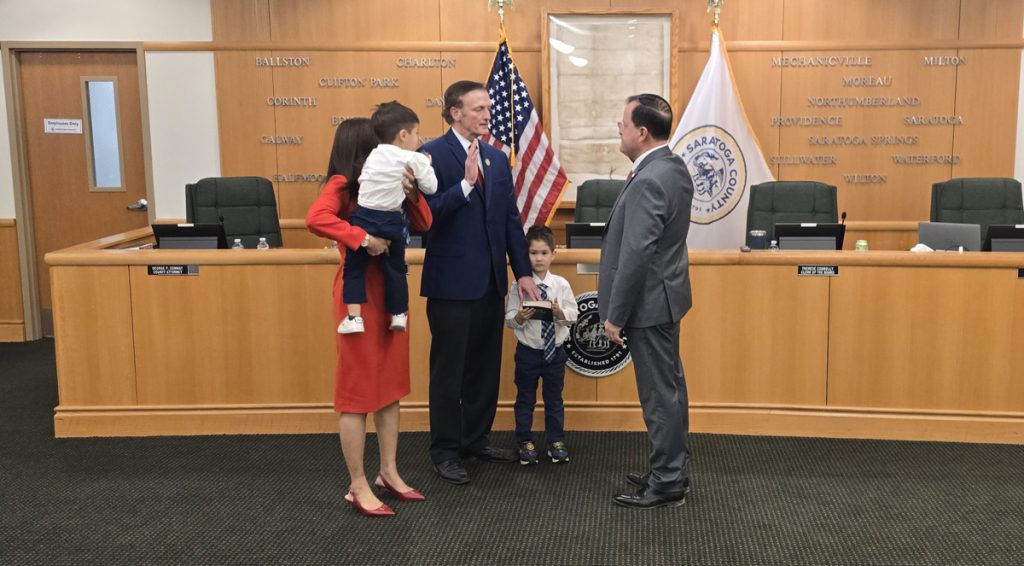
Burger won her seat on the Saratoga County Board of Supervisors this past November and was sworn in on January 1 of this year. In her election, she received the most votes of any candidate running in a competitive race with 5,458 across the One Saratoga and Democratic party lines.
Outside of politics, Burger is a partner at her own law firm, Burger Law Group, and served as Saratoga Springs City Attorney in 2014.
The Saratoga Springs Police Department arrested a fugitive from Texas after receiving a report of someone driving erratically on Caroline Street.
Jody Harr, 47, was arrested by SSPD on a slew of charges after he was caught by Saratoga Springs Police during a DWI investigation.
According to SSPD, around 11:00 p.m., they received a report from a concerned citizen about a driver who was possibly intoxicated near the intersection of Caroline Street and Henry Street. When officers approached on foot, the driver, later identified as Harr, fled the scene. This triggered a chase which ended near the intersection of West Circular Street and Union Street.
Harr was initially taken into custody for DWI but further investigation revealed that he was wanted in Texas related to child pornography offenses.
He was charged with being a fugitive from justice, felony DWI- two prior convictions in the last 10 years, felony aggravated DWI, felony operating a motor vehicle with BAC over .08, misdemeanor reckless driving, and misdemeanor unlawful fleeing a police officer in a motor vehicle. In addition, he received several traffic violations including passing a red light, failure to stop at a stop sign, driving to the left of pavement markings, and driving on a sidewalk.
In an email to Saratoga TODAY, SSPD confirmed that the warrants for Harr’s arrest were issued by the Grand Prairie Police Department in Dallas County, TX. While the SSPD couldn’t cite Texas law specifically, they did state that the warrant was related to child pornography charges in Texas.
A review of court records from the Dallas County District Court shows that Harr has been charged with one count of 3rd degree possession of child pornography. During the course of the case, prosecutors alleged in court filings that Harr sent harassing messages to an individual involved and her son.
While bond for this case was set at $20,000, it has since been revoked. The last action related to the case took place on July 8, 2024, and the case is currently listed as inactive. This inactive status is done when something court can’t resume is due to factors beyond the control of the court — such as when a warrant is issued for the arrest of the defendant, according to the State of Texas Judicial Branch.
As for Harr’s other charges, this is far from his first time being arrested for DWI. A review of his criminal record from the Texas Department of Public Safety shows four arrests for DWI in the state — the latest two coming in 2023 and 2017.
Harr was remanded into the custody of the Saratoga County Sheriff’s Office pending extradition back to Texas.