The Saratoga-North Country Continuum of Care (SNCCoC) is launching the “Myths Hurt. Facts Help.” campaign, seeking to dismantle harmful stereotypes surrounding homelessness and replace them with clarity, compassion, and hope.
The SNCCoC, a HUD-designated regional planning body serving Saratoga, Warren, Washington, and Hamilton Counties, works to coordinate funding, services, and housing solutions with a goal of preventing and ending homelessness.
“To effectively address homelessness, we must begin with facts,” state SNCCoC Co-Chairs Lindsey Connors and Amber Beaudet.” Robust data collection and analysis are the foundation of evidence-based interventions that not only respond to immediate needs but also drive long-term solutions. When stakeholders and the public have access to accurate, transparent data, they can better understand the reality of homelessness — not just its scale, but its root causes — and support the strategies that are proven to work. Without data, we’re guessing. With it, we’re making informed decisions that change lives.”
“This campaign aims to shift the narrative from blame to understanding, from isolation to inclusion,” said Joan Spector, MST, Lead of the SNCCoC Planning Team. “Homelessness stems from systemic challenges, not character flaws. When we embrace facts, we pave the way for effective solutions.”
Over the next three months, the campaign will roll out across social media and community channels, shining a spotlight on common myths about homelessness alongside fact-based responses, amplifying messages of empathy, evidence, and engagement.
Community members, service partners, and organizations are encouraged to participate, share content, and foster conversations grounded in truth and respect.
For campaign graphics, partner resources, and more information, contact Joan at jspector@caresny.org or visit the website, endhomelessnesssaratoga.org.
On September 25, 2025, State Police of Wilton, with the assistance of the Troop G Computer Crimes Unit, the Internet Crimes Against Children Taskforce, and the U.S. Department of Homeland Security, arrested Zachary Taylor, 20, of Moreau, NY, for Promoting a Sexual Performance by a Child, a class “D” felony, and Possessing a Sexual Performance by a Child, a class “E” felony.
Taylor is accused of promoting and possessing images consistent with child sexual exploitation. His arrest followed an investigation and the execution of a search warrant at his residence in Moreau, NY on September 25, 2025. The investigation stemmed from a cyber tip from the National Center for Missing and Exploited Children (NCMEC).
Taylor was transported to SP Wilton where he was arrested and processed. He was arraigned at the Moreau Town Court where he was released under the supervision of the Saratoga County Probation Department.
The Town of Clifton Park is conducting a Public Open House on Thursday, October 23, 2025, from 4 p.m. to 6 p.m. at the Town of Clifton Park Town Hall, in the Wood Room. The public is invited to drop in anytime during the period of 4 p.m. to 6 p.m. at their convenience.
The Town’s engineering consultants, town staff, and town officials will share draft plans for and be available to discuss two local projects:
1. Pedestrian and bicycle transportation improvements for Route 146, Route 146A & Vischer Ferry Road near neighborhoods, town parks, and schools, PIN 1085.48.
2. Pedestrian and bicycle transportation improvements for Clifton Country Road, from its intersection with Rt 146 at its north end, all the way to its end at its southern intersection with Clifton Park Center Road, in the Town Center area, PIN 1762.60.
The intention for both projects is to connect additional neighborhoods and destinations to the existing pedestrian and bicycle facilities along these roadways and close the pedestrian and bicycling transportation gaps in the network. The Town’s engineering consultants will have visuals and information to share about the locations and layouts of the proposed sidewalks, multi-use trail segments, bicycling facilities, and crosswalks. Project engineers, town staff, and town officials will be available to listen to feedback and public comments on the project plans.
The Town sought and was awarded federal transportation grant funding for each of these local projects administered through NYS Department of Transportation to cover about 80% of the project costs, with remaining local match funding being provided by the Town of Clifton Park.
More project information is available online at: https://engage.cliftonparkny.gov/
Call (518) 371-6651 if you have any questions or comments on these transportation proposals.
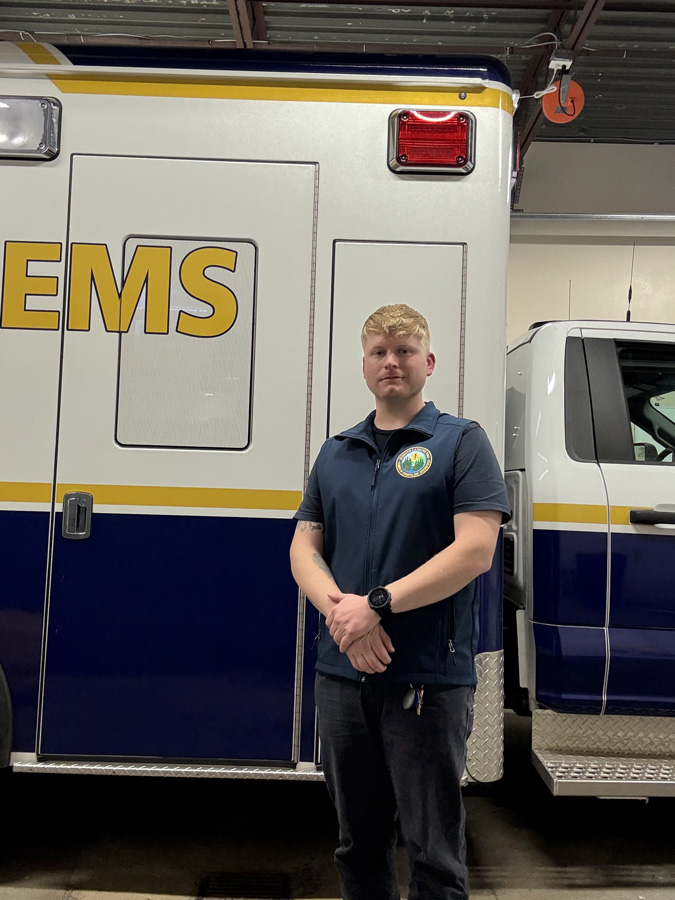
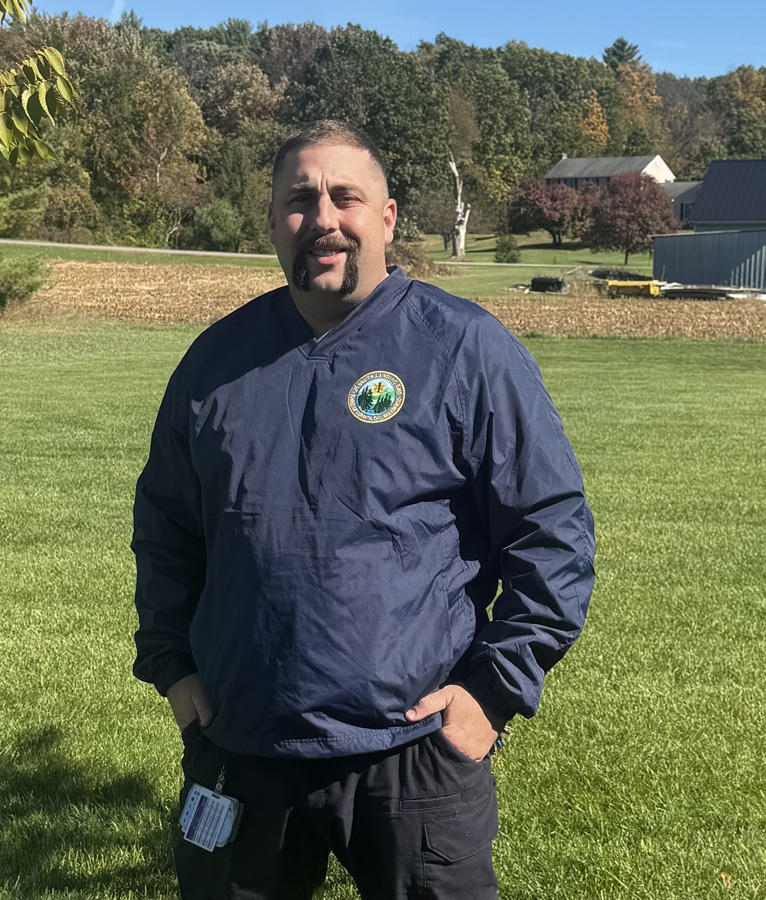
Corinth and Greenfield have named two deputy directors to their shared Emergency Services team. Anders Olsen (left) will become deputy director of Greenfield Ambulance and Derek Briner (right) will become deputy director of Corinth Ambulance Service. (Towns of Corinth and Greenfield)
The Town of Greenfield and Corinth, who partner to provide emergency services to both communities, have appointed Anders Olsen to deputy director of Greenfield Ambulance and Derek Briner to deputy director of Corinth Ambulance Service. Both will report to Director Matt Fogarty.
Olsen, a resident of Corinth, will lead the Greenfield operation. He has been a paramedic for 12 years and has worked for Corinth for four. Olsen is a leader in peer support and mental health, serving on a Saratoga County Peer Support Team, where he assists with critical incident stress management debriefings. He also has worked as a volunteer firefighter for 15 years.
“A large portion of the calls this year have been in Greenfield,” Olsen said. “I’m happy to report our staffing levels have significantly improved in recent weeks. We’ll continue to carefully monitor the data and use it to reduce response times and mutual aid responses in our district.”
Briner, a resident of Corinth, will head up the Corinth operation. He served as an EMT for three years and a paramedic for 13, all of which he spent with Corinth. Briner also serves as assistant chief of the Corinth Fire Department and paramedic supervisor at Wilton EMS.
“I’m excited to work with the outstanding staff and leadership in Corinth to build upon the strong foundation in place and help advance the mission of providing high-quality emergency medical services to residents and visitors to the town,” Briner said.
The new leadership structure will help both teams continue improving service during a time of national EMT shortages. The deputy directors will focus on staffing, scheduling, compliance, inventory management, and morale-building in their respective locations.
The squad employs 15 full-time and 15 part-time employees and operates a fleet of four ambulances and one first-response vehicle. The service covers 192 square miles and serves approximately 12,000 residents. Officials say the partnership, which began in 2022, has steadily grown and successfully delivered top-tier emergency assistance to the residents of Corinth, Greenfield and Day, with minimal response times.
“It has been three years of continual growth and improvement,” said Corinth Town Supervisor Eric Butler. “Together with Supervisor Veitch and our Director Matt Fogarty, we routinely monitor our success and identify areas for improvement. There is nothing more important than providing stellar service to our residents.”
“Greenfield is thrilled to have such a competent team providing EMT and paramedic care right in the center of our town,” said Greenfield Town Supervisor Kevin Veitch. “We will continue to adapt to community feedback and make necessary improvements to our station and our staffing.”
In addition to 24/7 emergency services, the two stations offer first-aid and CPR classes, Narcan training, and the distribution of take-home Narcan kits. The stations are located at 101 Sherman Ave in Corinth and 14 South Greenfield Rd. in Greenfield.
The League of Women Voters of Saratoga County will moderate “Meet the Candidate” forums in advance of the general election for the Saratoga Springs candidates listed below as a zoom webinar. Members of the public may register using the links listed for each forum. www.lwvsaratoga.org for current election information.
10/20 Monday at 7pm – Commissioner of Accounts – NEW LINK https://us02web.zoom.us/webinar/register/WN_Icjea3v9RF-YLNtIE6yqpw
10/20 Monday at 8pm – Commissioner of Public Works https://us02web.zoom.us/webinar/register/WN_QgkK23pvSSeqVBZuQ7F44w
10/22 Wednesday at 6:30 to 7:30 – Mayor – NEW LINK
10/22 Wednesday at 8:00 – Commissioner of Finance https://us02web.zoom.us/webinar/register/WN_7sSrebE_SiiiaEAcdgSilg
The LWVSC will post the recording of the forum on our website, lwvsaratoga.org/candidates, and our voter guide, VOTE411.org. The public is encouraged to submit questions for candidates to: lwvscquestions@gmail.com no later than two days prior to each forum. Please put the Candidate Title, Saratoga Springs in the subject line of your email.
Question Criteria
• Questions will be reviewed by an impartial group of League members based on relevancy to the office and topic/redundancy. No questions will be taken at the event.
• Questions should be clear, concise and appropriate to the office being sought.
• Questions must be directed to all the candidates seeking the office, not just to one candidate.
• Questions should reflect the issues of greatest interest to the entire community and cover a broad range of topics.
• Questions must not include or imply personal attacks on any candidate.
Registered voters may vote in the election on Nov. 4th. Early voting begins on October 25th
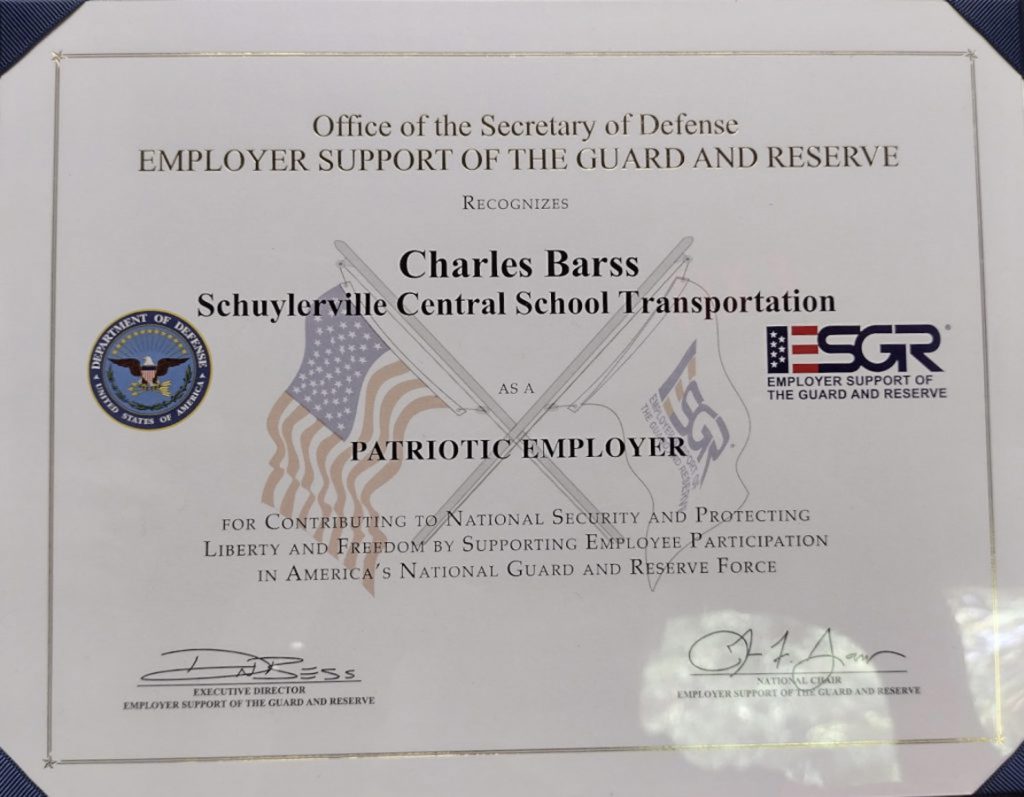
A photo of the award received by Barss (Courtesy of Schuylerville School District).
Schuylerville Central School District Transportation Supervisor Chuck Barss was recognized by the U.S. Department of Defense with the Patriotic Employer Award, presented through the Employer Support of the Guard and Reserve (ESGR) program.
The distinction honors employers who show exceptional support for employees serving in the National Guard and Reserve. Barss was nominated by Erin Bryant, a Schuylerville Class of 2018 graduate and former bus driver, who is currently a crew chief for LC-130H and C-130H aircraft in the Air National Guard.
Bryant said she nominated Barss for his outstanding encouragement and understanding as she pursued her goal of joining the military — a journey he supported long before she ever left for training.
“Chuck understood that I wasn’t going to be there forever — that the military was my goal — but he still took the time to train me, employ me, and encourage me,” said Bryant. “He listened to me talk about joining for months and was genuinely excited for me.”
When Bryant left for basic military training, Barss stayed in contact with Bryant’s family, regularly checking in with her mother, a retired Schuylerville bus driver. He also ensured Bryant had a place to return to when her training ended.
“He kept me as a substitute driver so I would have a job waiting if I didn’t go on active duty orders,” Bryant explained. “When I was activated for a DOCCS [Department of Corrections] mission, he texted to make sure I was doing okay. That meant a lot.”
Bryant credits Barss for helping her take her first steps toward a military career — both by helping her earn her CDL Class B license and by giving her valuable mechanical training.
“Because of the CDL training Chuck helped me get, I was able to support my mission by driving transportation for airmen and soldiers to bring them home for a couple weeks,” she said. “He also gave me some mechanical background that helped me excel in my current career field.”
The Patriotic Employer Award recognizes Barss and the Schuylerville Central School Transportation Department for their ongoing commitment to supporting employees who serve.
The accompanying Statement of Support for the Guard and Reserve, signed by the Department of Defense, reaffirms the district’s pledge to uphold the rights and well-being of service members, veterans, and their families.
“Overall, Chuck went above and beyond as a boss to make sure I was taken care of while serving our country,” said Bryant. “He truly deserves this recognition.”
Barss will be recognized by the Board of Education during its Oct. 20th meeting.
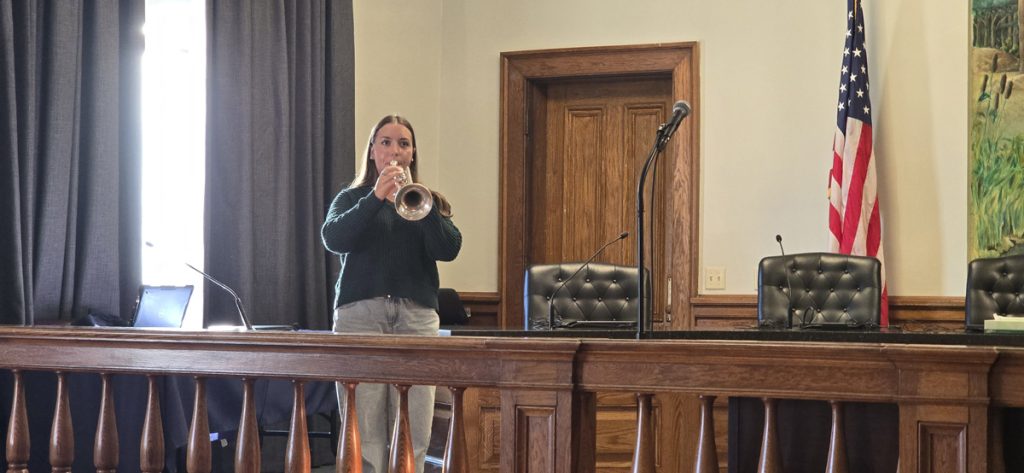
A Trumpeter plays taps to honor those from the area killed the line of duty during the World War II. ( Aidan Cahill)
It has been over 80 years since World War II ended, and Saratoga Springs High School students are making sure the memory of those who fought in the war is remembered.
The students gathered in the Saratoga Springs City Council room to read the names of 77 men from the city who were killed during the conflict. They were led by social studies teacher Timothy O’Brien.
The reading took place a week before the city celebrates 80 years since the end of World War II. Two different dates mark the end of the conflict, depending on where in the world the fighting took place. In Europe, V-E Day, Victory in Europe Day, was celebrated May 8, 1945 — commemorating victory over Germany. Meanwhile in Asia, V-J Day, Victory over Japan Day, was celebrated September 2, 1945.
The war was one of the deadliest in world history with over 15 million military personnel killed across all sides and over 38 million civilians killed, according to the Department of Defense. On the U.S. side, over 16 million troops were mobilized with casualties totaling 405,399 dead and 670,846 wounded in the conflict. Of the Americans who died, over 37,000 came from New York, according to the U.S. Army.
O’Brien said part of the reason for the reading was to keep the living memory of the conflict alive even as veterans and others who lived through it pass away.
“It’s just tough,” O’Brien said. “You lose connections and friends you’ve been working with for so long. That’s the kind of the downside of this. But to have their stories to tell is really what matters.”
O’Brien said reading the names was their way of putting a human face to the conflict. He said that even if they don’t have the full story behind the person’s life and death, just having the name acknowledges that there is a story and a person behind it.
Similar sentiments were echoed by one of the students who read the names, Olivia Howe. Howe said she volunteered in part because of the service of her grandfather who served in the military. She said she hopes students continue to remember those who made the ultimate sacrifice for the country.
“It’s something that should never be forgotten, and I don’t think will ever be forgotten,” Howe said.
In addition to the 77 lost in the war, O’Brien highlighted the work of veterans who came home and contributed to the community. Over 300 World War 2 veterans were connected with Saratoga County at one time or another, O’Brien said. Many of them brought back the skills they learned from the service or took advantage of the GI Bill to get an education and further improve their communities, according to O’Brien.
Saratoga Springs is home to the New York State Military Museum, a former armory that hosted many National Guard companies throughout its history. During World War II it hosted L company of the 105th Infantry Regiment, 27th Infantry Division. The regiment fought in the Pacific against the Japanese in the Battles of Makin, Saipan and Okinawa, according to a unit history.
One of the ways troops got home from the war was on a ship named for Saratoga, the USS Saratoga ( Courtesy of the US Navy)
In addition, the army history, a ship which draws its name from the region, the USS Saratoga (CV-3), also served with distinction, according to the U.S. Navy. Commissioned in 1927, the aircraft carrier served in many battles and operations across the Pacific during the war, earning seven battle stars for her service.
Her most notable achievement, however, arguably came after the war when she helped ferry over 29,000 personnel home after the war as part of Operation Magic Carpet. She also held the record at the time for landing the most planes on her deck of any aircraft carrier at over 98,000 landings.
In addition to the reading of names, a festival celebrating the end of the war will take place on Sat. Oct. 18 at the Military Museum. The event will feature reenactors, a USO-style show and World War II era films and media.
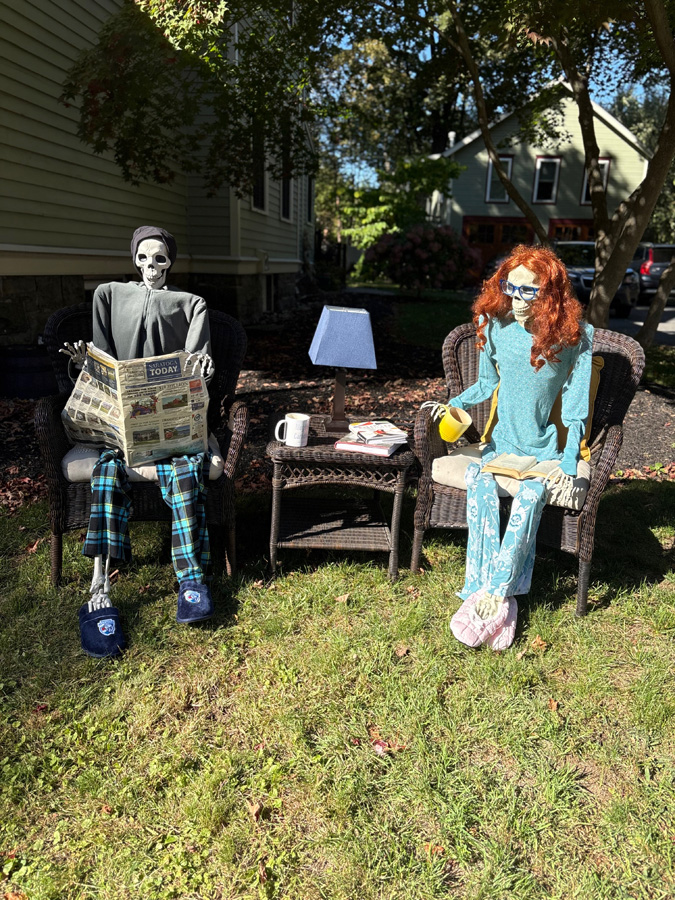
Allison Rhodes (and occasionally Mark Hodge!) dress up MITZI and MILO every few days, but how lucky were we that we caught them while reading a Saratoga TODAY??!!
Swing by 39 North Street, Saratoga to see what they’re up to today!
Join the Brookside Museum on October 25 from 2–4PM to celebrate Halloween at Brookside Museum with our festive Trunk or Treat Halloween Party!
Kids will enjoy trick-or-treating, a spooky story time, and a scavenger hunt learning activity with historical twists. Children can also take part in Halloween-themed games and crafts, decorate their own pumpkin on site with a small fee for pumpkins, and show off their costumes in a parade beginning at 3:30PM.
Kids of all ages are welcome to join. Live Halloween music will be provided by the Scotties Quartet, a talented string ensemble from Ballston Spa High School.
Table Sponsors Wanted. If you are interested in sponsoring a trunk or treat table, please contact Charlene DuBuque at charlene@brooksidemusuem.org. Parental supervision is required. This is a drop-in event. Free admission. Parental supervision is required. Rain date: October 26, 2–4PM
The 4th Annual Witch Walk & Dance, an exciting community event blending fun, philanthropy, and Halloween spirit, returns to Saratoga Springs on Saturday, October 18, 2024. Hosted by Witch Walk SOSA (Southern Saratoga), this event will raise crucial funds to support local animal rescue efforts while offering participants a magical day filled with entertainment, costumes, and more.
Participants are encouraged to wear their best witch costumes and join the enchanting walk and dances through downtown Saratoga Springs. The festivities will begin at 37 High Rock Ave, Lower-Level Parking Garage and culminate in a lively celebration featuring local vendors, live performances, and Halloween-themed activities.
“This event has become one of our most anticipated fundraisers,” said Phaedra Stasyshyn, Head Witch of Witch Walk SOSA. “It brings the community together in a fun and creative way to support our mission of helping animals and their people in need across the Saratoga Springs area.”
Event Highlights Include:
• Witch Dancers: Be mesmerized by live performances from local witch dancers, adding a magical touch to the day’s festivities.
• Witches Market: Explore the Witches Market, where local vendors will be selling unique, witch-themed crafts, jewelry, and other magical treasures.
• Local Drink Specials: Participating local establishments will offer exclusive Witch Walk drink specials to celebrate the occasion. Be sure to visit your favorite spots along the route!
• Basket Raffle: Local artisans and donors, organized by The Witch Way Wanderers Dancers, Mackenzie and Rana, will be on-site from 2:00 to 5:00 PM selling raffle tickets. “Witchy” baskets will be raffled off between 2:00 and 4:30 PM in the registration area. Raffle tickets can be purchased during registration.
• Entertainment: The Witch Way Wanderers Dance Troupe will keep the energy high with live performances of “The Witches Dance” thank you to the Wolfshagen Hexenbrut Witch group of Germany throughout the event. The troupe will be dancing around town from 2:00 to 9:00 PM, teaching the dance along the way for others to join in.
Witch Dance Practice Sessions:
Get ready for the big day with Wednesday evening 5-7pm witch dance practices at Ferndell Pavillion in Spa Park:
• October 16th at 5:00 PM at 37 High Rock Avenue, City Center Park. Join in to learn the moves and have some fun before the event!
Ticket Information:
• Wristband/Donation: $25 per person (before 10/15), $30 after.
Wristbands can also be purchased in advance via Venmo or Cash, at the Wednesday dance practices, or on the day of the event at the registration booth.
Tickets are available online at Eventbrite. All proceeds directly support Witch Walk SOSA’s mission to raise funds for animal organizations in the Saratoga Springs area.
Whether you’re a local resident or a visitor, this year’s Witch Walk promises a spellbinding day of fun with plenty of opportunities to support a great cause. Don’t miss your chance to dress up, join the fun, and make a difference!
To inquire about participation, donations, or sponsorship opportunities, please visit https://www.discoversaratoga.org/witch-walk-sosa/ https://witchwalksosa.squarespace.com/ or contact Wylda “Head Witch” at witchwalksosa@gmail.com