

City Awarded $100k Grant In The Spirit of Keeping Officers Safe
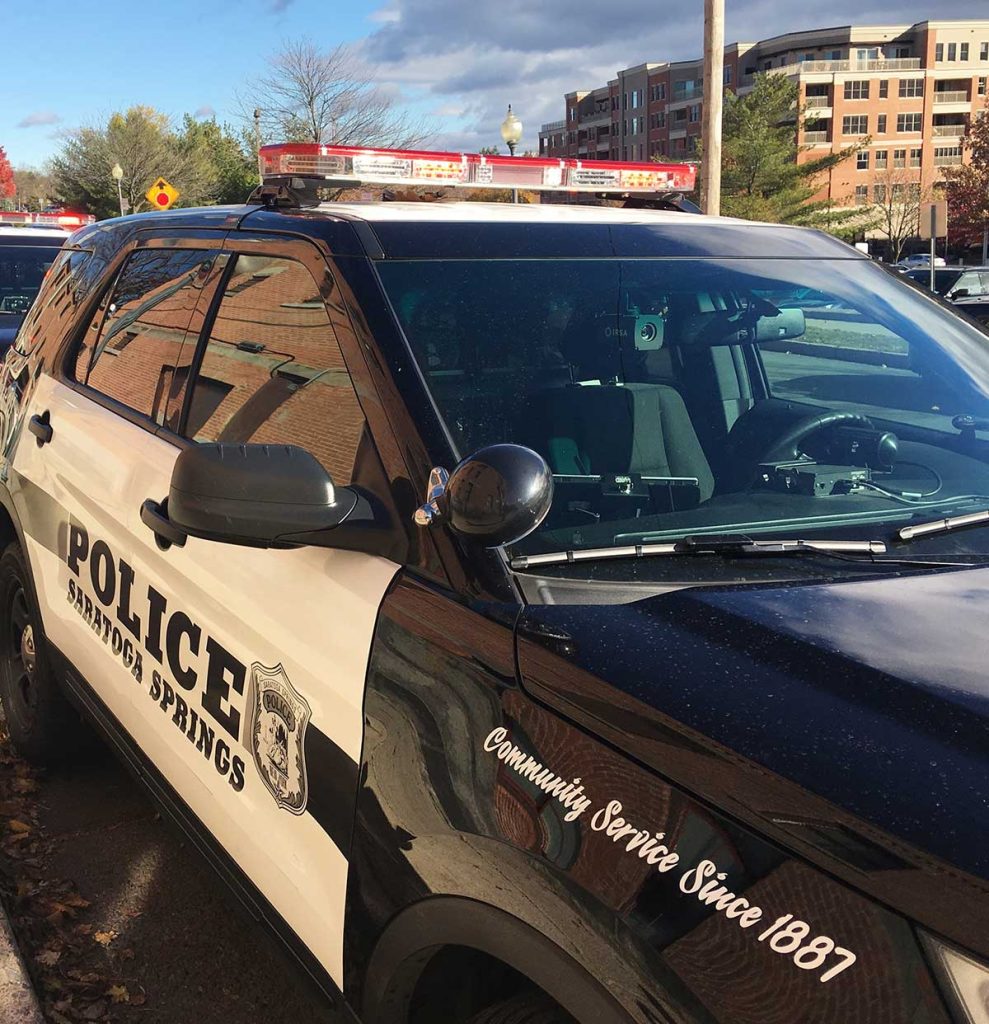
Saratoga Springs Polce Department has been awarded a $100,000 Edward Byrne Memorial Justice Assistance Grant. Photo by Thomas Dimopoulos.
SARATOGA SPRINGS — The man went simply by the name Arjune – his identity secreted away to first-name status only, best evidenced by the patrol car that sat outside his residence to provide protection. Inside the police car sat rookie officer Edward Byrne. Everyone called him “Eddie.”
Nine months earlier Officer Byrne became a member of the New York City Police Department, accomplishing a life-goal that began with his studies as a criminal justice major at Nassau Community College, and led to a path through the Police Academy, the transit police and eventually his being assigned to the 103rd Precinct serving the Jamaica area of Queens.
What links the near 40-year-gap between the events of February 1987 in Queens and Saratoga Springs in April 2025 were the recent statements of Public Safety Commissioner Tim Coll at the council table.
“Edward Byrne. I’m very familiar with the case,” Coll explained to his fellow councilmembers last week.
1987
Five days after celebrating his 22nd birthday, Officer Byrne sat alone in his patrol car on 107th Avenue in South Jamaica in the early morning hours of a Friday that February, guarding the house where Arjune lived, located about three miles north of JFK Airport.
The previous year, Arjune, a Guyanese immigrant, had moved into the vacant three-story house in the once peaceful neighborhood growing increasingly plagued with drug trafficking. The police department’s recently initiated crackdown, called “Operation Queens,” resulted in 2,350 drug arrests during its first four months of operation covering seven southeastern Queens precincts.
Immediately after moving into the neighborhood, Arjune repainted the home and cleaned up the adjoining lot left “unkempt and overgrown with weeds and littered with whisky bottles and vials for crack,” the New York Times reported Feb. 27, 1988. Arjune’s complaints about the drug dealers returned threats from the dealers themselves. His house was firebombed on at least one occasion and when he became a key witness in a trial involving crack dealing Officer Byrne was assigned to park his patrol car outside the home to act as a deterrent to whomever may have wanted to cause the witness harm.
Byrne sat alone behind the wheel of the idling radio car when a brown 1976 Oldsmobile Cutlass glided up alongside it at 3:30 a.m. that Friday in February, reported the Daily News. Five shots were fired at close range. Byrne was rushed to a nearby hospital where he died of his wounds.
A $30,000 reward was announced the next day for information leading to the arrest and conviction of those involved in the slaying. The private organization COP-SHOT, city Mayor Ed Koch, and the Daily News each contributed equally to the reward fund.
Four suspects were captured within a week of the murder. The four men were found to be members of a gang instructed by a jailed drug dealer to kill a police officer. Each was sentenced to serve 25 years to life. The man who had given the order was later sentenced to life in prison for his conviction on drug-racketeering charges that included ordering the officer’s murder. Four of the men remain incarcerated to this day. The getaway driver was paroled in 2023.
Aftermath
In the immediate aftermath of the killing, then-President Ronald Reagan personally called the Byrne family to offer his condolences. Vice President George H.W. Bush carried Byrne’s badge with him during his 1988 presidential campaign and later kept it on his desk in the Oval Office.
Byrne’s death motivated the creation of the Tactical Narcotics Team in South Jamaica. The program’s success led to its expansion throughout the city. Local government allocated nearly $2 million to turn a debris-filled lot in Queens where drug dealings were known to occur into a community park named in honor of the slain officer. The park opened in 1995 and today its nearly five acres site multiple basketball, tennis and handball courts, a running track and a playground for children. In 2018, the NYPD rededicated the street sign in front of the 103rd Precinct honoring Byrne’s service and sacrifice to the city.
The U.S. Department of Justice named a local police funding program the Edward Byrne Memorial Justice Assistance Grant Program. It is the leading source of federal justice funding to state and local jurisdictions and since 2005 has awarded more than 20,000 grants that total more than $7 billion, according to the New York State Division of Criminal Justice Services.
Byrne JAG grants have helped launch a program in Connecticut that prepares incarcerated women ages 18–25 for reentry into society, and another in California that enables youthful offenders to avoid incarceration by completing rigorous, individually tailored rehabilitation programs. The grants have supported and promoted improvements in every aspect of the justice system and provide critical funding necessary to support a range of program areas.
The city of Saratoga Springs was awarded a $100,000 New York State FY 2024 Edward Byrne Memorial Justice Assistance Grant, which it will use to fund law enforcement equipment Commissioner Coll told the council.
“Edward Byrne in 1988 was executed by drug dealers in South Jamaica Queens. He was a rookie. Twenty-two years old.” said Coll, explaining the origins of the grant. “It will be used to provide additional tactical equipment – such as helmets, shields and vests – and in the spirit of the grant will provide additional equipment to keep our officers safe.”