

Racing Museum Announces 2025 Hall of Fame Inductees
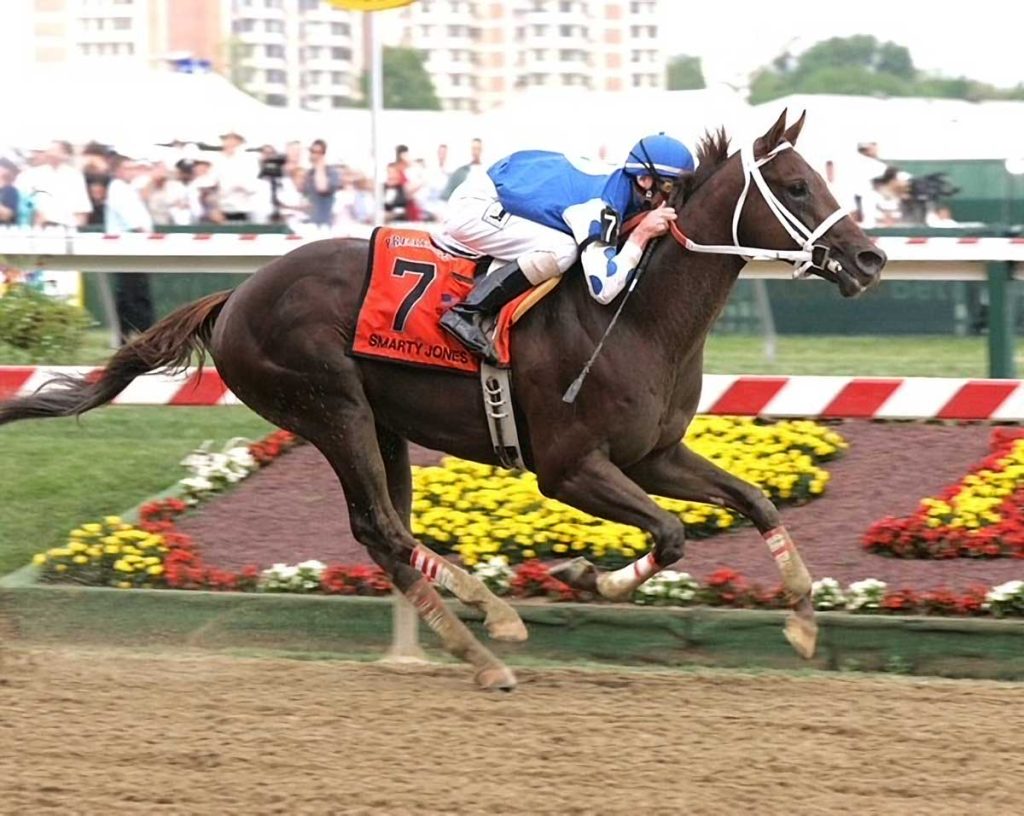
Smarty Jones at the 2004 Preakness Stakes. Photo by Jim McCue/Maryland Jockey Club. Photo provided by the National Museum of Racing and Hall of Fame.
SARATOGA SPRINGS — The National Museum of Racing in Saratoga Springs added seven inductees to its Hall of Fame last week.
- Racehorse Smarty Jones, a finalist for the first time, was the lone selection in the contemporary category
- Racehorses Decathlon and Hermis, as well as trainer George H. Conway, were chosen by the 1900-1959 Historic Review Committee
- Edward L. Bowen, Arthur B. Hancock III, and Richard Ten Broeck were elected by the Pillars of the Turf Committee
The 2025 Hall of Fame class will be enshrined on Friday, Aug. 1, at the Fasig-Tipton Sales Pavilion in Saratoga Springs at 10:30 a.m. The ceremony will be broadcast live on the museum’s website. The event is open to the public and free to attend. Tom Durkin will serve as the master of ceremonies.
Smarty Jones
Bred in Pennsylvania by Someday Farm, Smarty Jones (Elusive Quality—I’ll Get Along, by Smile) raced from 2003 through 2004, winning eight of his nine career starts, including the Kentucky Derby and Preakness Stakes in his sophomore season, and he won the Eclipse Award for Champion 3-Year-Old Male in 2004. Owned by Roy and Pat Chapman under their Someday Farm banner, Smarty Jones was trained by John C. Servis and ridden exclusively by Stewart Elliott. On May 1, 2004, Smarty Jones became the first undefeated Kentucky Derby winner since Seattle Slew in 1977, with a 2¾-length victory over Lion Heart before a crowd of 140,054 at Churchill Downs. Two weeks after his Derby victory, Smarty Jones romped by a record margin of 11½ lengths in the Preakness Stakes at Pimlico Race Course with 124,351 in attendance. He earned a career-best 118 Beyer Speed Figure for the effort, the fifth of six times he achieved a Beyer of 100 or higher. Smarty Jones was retired after a failed attempt at a Triple Crown sweep in the 2004 Belmont Stakes. He earned a record of 8-1-0 from nine starts and earnings of $7,613,155. He won his eight races by a combined 47½ lengths.
Decathlon
Bred in Kentucky by the Nuckols Brothers, Decathlon (Olympia—Dog Blessed, by Bull Dog) raced from 1955 through 1957, compiling a record of 25-8-1 from 42 starts and earnings of $269,530. Purchased at Keeneland in 1954 for $15,500 by Robert J. Dienst (the president of Ohio’s Beulah Park) and campaigned under his River Divide Farm banner, Decathlon was trained by Rollie Shepp. In his three years of racing, the bay colt won 18 stakes and was twice named Champion Sprint Horse (1956, 1957). He set track records at Monmouth Park, Suffolk Downs, and Tropical Park, equaled two track standards at Tropical, and matched the world record for 5½ furlongs (1:031/5) at Tropical in the first division of the Inaugural Handicap in 1956. Following his racing career, Decathlon stood at Darby Dan Farm in Kentucky, where he sired 165 winners from 253 foals, including 12 stakes winners. Decathlon died in 1972 at the age of 19.
Hermis
Bred in Kentucky by Hiram Berry, Hermis (Hermence—Katy of the West, by Spendrift) raced from 1901 through 1905 with a record of 28-8-6 from 55 starts and earnings of $84,155. A chestnut colt, Hermis was trained by Charles Hughes (July 1901 through August 1902), Jack McCormick (August 1902 through October 1902), and Alexander Shields (June 1903 through July 1905). He raced for a variety of owners, including H. M. Ziegler, L. V. Bell, and Edward R. Thomas (who paid a record $60,000 for the horse), among others. Hermis was retrospectively recognized by The BloodHorse-published book “The Great Ones” as Horse of the Year in 1902 and 1903; Champion 3-Year-Old Male in 1902; and Champion Older Male in 1903 and 1904. Overall, he won 14 stakes, earned victories at eight tracks (Aqueduct, Brighton Beach, Gravesend, Hawthorne, Latonia, Morris Park, Saratoga, Sheepshead Bay), and carried 132 pounds or more in four of his wins. He was exported to France in 1910 and was sent to Belgium three years later. What became of Hermis is a mystery, as all knowledge of the horse’s whereabouts were lost during World War I.
George H. Conway
Conway (1873-1939) is best known for training Hall of Famer War Admiral to a sweep of the 1937 Triple Crown and to an overall record of 21-3-1 from 26 starts and earnings of $273,240 from 1936 through 1938. A native of Oceanport, N.J., Conway also conditioned Hall of Fame member Crusader, as well as standouts Speed Boat, War Glory, and War Hero, among others. In addition to the Triple Crown, Conway trained War Admiral to victories in the Eastern Shore Handicap, Chesapeake Stakes, Washington Handicap, Pimlico Special, Widener Handicap, Queens County Handicap, Wilson Stakes, Saratoga Handicap, Whitney Handicap, Saratoga Cup, Jockey Club Gold Cup, and Rhode Island Handicap. Suffering from heart trouble, Conway announced his retirement a week after War Admiral was retired to stud in 1938. Conway died on June 20, 1939, at his sister’s home in Oceanport.
Edward L. Bowen
Bowen (1942-2025) was a prolific racing journalist and historian for more than 60 years and served the sport in various other capacities, including 24 years as president of the Grayson-Jockey Club Research Foundation. A native of Welch, W. Va., Bowen was an Eclipse Award-winning journalist, editor in chief of The BloodHorse, author of 22 books about horse racing, and chairman of the National Museum of Racing’s Hall of Fame Nominating Committee from 1987 through 2024. He was the inaugural recipient of the Cornelius Vanderbilt Whitney Award for meritorious contributions to the Museum in 2023. The prior year, Bowen was the Thoroughbred Club of America’s Honor Guest.
Arthur B. Hancock III
Hancock III was born in Nashville, Tenn., and for six decades has been a significant presence in American racing and breeding through his establishment of Stone Farm in 1970 near Paris, Ky. A member of one of the sport’s most distinguished families, Hancock’s grandfather, Arthur B. Hancock, Sr., founded Claiborne Farm, while his father, Arthur B. “Bull” Hancock, Jr., expanded the business to where it became arguably the most important breeding farm in the U.S. during the 20th century. In his capacity as an industry leader, Hancock has served on the Kentucky Horse Racing Commission, as a director of Keeneland Association and Fasig-Tipton Company, and as a member of The Jockey Club. He co-founded the Water Hay Oats Alliance (WHOA), a group dedicated to eliminating performance-enhancing drugs in racing. Hancock is also a devotee of bluegrass music and has written songs that have been recorded by artists such as Grandpa Jones, Willie Nelson, and Ray Price. He released an autobiography in 2024 titled, “Dark Horses: A Memoir of Redemption.”
Richard Ten Broeck
Ten Broeck (1811-1892) was one of American racing’s most prominent and accomplished figures in the 19th century, enjoying success as a racehorse and racetrack owner, thoroughbred breeder, and international racing pioneer. During the 1830s, Ten Broeck became associated with Col. William R. Johnson, one of America’s most renowned racing figures. By 1840, Ten Broeck was racing horses in his own colors in St. Louis, New Orleans, and New York. Ten Broeck’s stable began to rise to prominence and he was known as a leading turfman in the South when he took over management of the Bingaman (Louisiana) and Bascombe (Alabama) courses in 1847. In 1851, he purchased Metairie Race Course in New Orleans for $27,000. Under his management, Metairie became the premier track in the country in the decade prior to the Civil War. Ten Broeck later purchased Lecomte, Prioress, and Starke to race in England and became the first American owner to win an important race in that country. Ten Broeck raced in England for around 30 years. He became the first American member in the English Jockey Club. Ten Broeck regularly returned to America between English racing seasons and purchased 525 acres near Louisville, Ky., naming it Hurstbourne Stud in honor of the Duke of Portland’s estate in England. He eventually sold Hurstbourne and moved to Oakland, Calif., where he died a recluse in a small cottage.