

Saratoga Springs Is Facing A Major Financial Crisis After Three Years Of Mismanagement By Finance Commissioner Minita Sanghvi

Just A Few Highlights From Minita Sanghvi’s 2026 proposed budget.
· Senior citizen center support = zeroed out
· Funding for Judge Vero’s homeless (outreach court) = zeroed out
· Crossing guards for our city schools = zeroed out
· Funding for RISE for the homeless = zeroed out
· Most part-time staff and seasonal staff = zeroed out
· Money for training the planning staff or the building department = zeroed out
· Secretary for the planning board = zeroed out
· The overtime budget for special events = zeroed out
· Uniforms: funding cut from $57,000.00 to $15,000.00, leaving inadequate funds to meet contractual obligations to the union.
Reader, You Were Warned
Under the commission form of government, the Commissioner of Finance is responsible for crafting the budget for the following year. Unless a majority of the Council votes to overrule the Finance Commissioner to amend the budget, the original budget becomes the final budget.
As should be obvious, preparing budgets requires a solemn commitment on the part of the Finance Commissioner to be deeply informed about city finances and to oversee the collection of key information. This is an enormously demanding process.
I have repeatedly warned that Finance Commissioner Minita Sanghvi has been derelict in her duties in running her office. What motivated her was performing in the drama at Council meetings in her role as Commissioner. She has been uninterested in or unwilling to take on the highly demanding job of managing the city’s finances.
Sanghvi’s automatic email response informs whoever has written to her that the Commissioner of Finance position is part-time and that, if the correspondence is important, contact Sanghvi’s Deputy. This is truly emblematic of how she views her job and how we got here.
The critical issue is that unless a majority of Council members agree to a different budget, the one crafted by the Finance Office will be the budget for the following year. This is why crafting a good budget in the first place is so important.
Before Commissioner Sanghvi, the budget was crafted over many months. The Budget Director would meet with the Deputies and their Commissioners to review what they were spending money on, their contractual obligations to vendors and city unions, and the legal limits on the respective departments’ obligations. There was also an analysis by the Budget Director working with the Deputies to project potential revenue for their respective departments. The finance people would also correlate their findings with the budgets from previous years. All of this required multiple follow-up meetings over a protracted period.
Beginning in October, budget workshops were held for each department. The purpose of these budget workshops traditionally was to fine-tune a thoroughly prepared budget. Not with Commissioner Sanghvi; her colleagues at the Council table received a rudimentary document listing slashed items meant to balance the city’s revenues with its expenses.
As it takes a majority vote to amend Sanghvi’s budget, the other Commissioners begin scrambling to negotiate not only with her but also with each other to secure a majority to fix her mess.
Basically, this budget is being written largely from scratch. That is how, in this case, the city got a budget with no money for school crossing guards.
Taking Care of Herself and Her Friend Dillon Moran
What Sanghvi has done over the past three years is to arbitrarily cut items and exaggerate income until she arrives at a budget that appears to balance with the anticipated city income.
These policies have reflected who her allies are.
Consider this chart that shows how much she anticipated each department would raise in income to contribute to her budget. It documents not only her favoritism but also how little she understood the alleged revenue streams for her department and Dillon Moran’s.
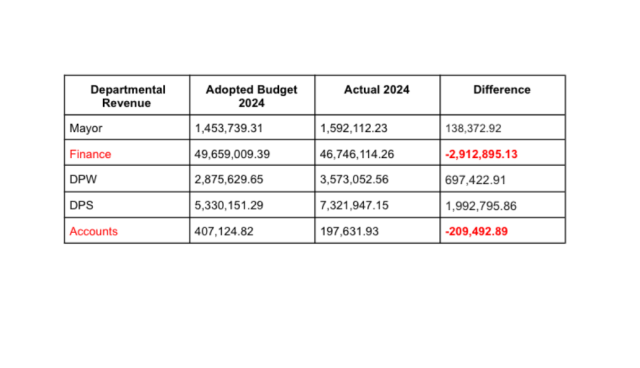
For example, her 2024 budget projected that the short-term rental program in the Accounts Department would raise $250,000.00. It raised zero. It budgeted $250,000.00 in cannabis tax revenue. It raised zero. (Not coincidentally, both these projections came from her ally, Dillon Moran)
During her first years in office, when her Democratic party ran the Council, her generosity was breathtaking. Anything that her colleagues, Ron Kim, Jim Montagnino, Jason Golub, and Moran, wanted was no problem.
During this period, Sanghvi showered repeated bonuses on their deputies and funded numerous new positions in their departments and in hers.
Magical Thinking Instead Of Real Analysis
Commissioner Sanghvi’s approach to budgeting is more about chaos than rigorously crafting how the city should spend its money.
This is no exaggeration; it is the grim reality. Each fall, as the budget was coming due, Sanghvi would throw together budgets that ignored contracts, state law, and the lobbying of her fellow Commissioners. If you watch the budget workshops for each department, you will see that Sanghvi relied on these meetings rather than her staff’s own research to identify which budget items violated city contracts, state law, or required the replacement of key equipment.
Forget planning; what followed were crazy events in which the departments tried to reason with Sanghvi about why her appropriations were not workable. Sanghvi, who is truly clueless, would arbitrarily fund some activities while rejecting others.
Take overtime in the Public Safety Department. Sanghvi slashed overtime. This money is essential for special events, as event venues must operate in a safe environment that requires additional police and fire protection.
This is no way to run a city the size of Saratoga Springs. The proof of Sanghvi’s folly is the 2025 budget. This city is running out of money.
Important Deadline Missed
The city’s quarterly financial report is a key document because it provides an ongoing status report on the fiscal condition of the city.
From the city charter:
4.4.9 of the city charter requires that “the commissioner of finance shall submit to the Council, for each quarter, a written financial report on the status of the City’s financial plan. Such financial plan shall include a comparison of estimated and actual income and expenditures to date and shall be submitted within 45 days after the end of each quarter. Each quarterly summary shall be forwarded to the City Clerk’s office and shall be available for public review.
This is a bit in the weeds. The final quarterly report has been routinely delayed for many years beyond the 45-day requirement. It is submitted after the report on the city’s finances to the New York State Comptroller, which is due on April 30 each year. Past Finance Commissioners, upon filing the city’s annual report on its financial condition with the Comptroller, have then submitted the report summary to the City Council shortly thereafter, as required by the charter.
This is an essential report for assessing the city’s fiscal health. It includes the fund balance. The “fund balance” is the amount of money the city has in reserve. It assesses how each department did in staying within its department budget.
This year, Sanghvi never submitted the preliminary financial report (fourth quarter for 2024). Sanghvi quietly posted the report on October 17, 2025, almost 6 months after it should have been submitted to the Council.
This report provides key information on trends in the city’s financial condition. It should have revealed that the city’s spending rate was unsustainable. It should have prompted a serious discussion months ago as to what needed to be done in light of excess spending over revenue.
Hang On!
I have no idea where all this will end up. I am sure there will be a large tax increase (Sanghvi raised taxes in her first two budgets, but for obvious political reasons, she refused to raise taxes when she was running for the state Senate, and now that she is running for Supervisor), and Sanghvi will draw money from the city’s reserves–if she can figure out how much money is there.