

Science for Saratoga Lake: SLA and Skidmore Launch Annual Water Quality Study
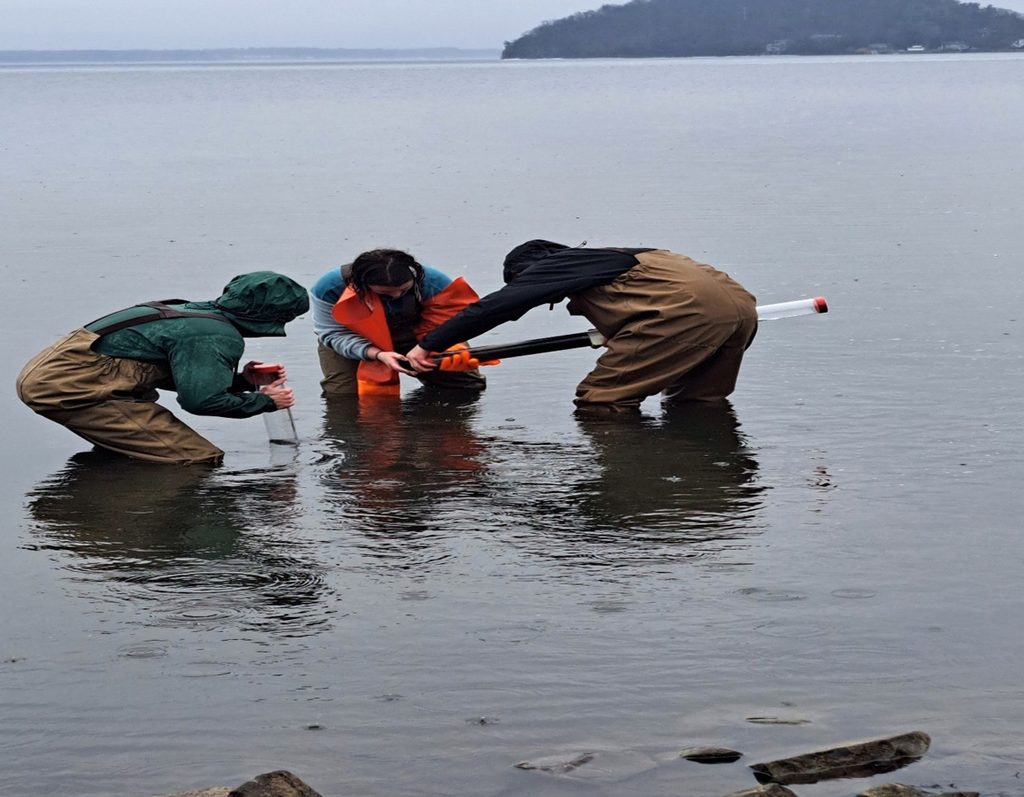
Skidmore students anchoring monitors in the south end of Saratoga Lake (Courtesy of SLA)
Protecting Saratoga Lake begins with understanding what enters its waters—and what happens after it arrives. That goal brought Saratoga Lake Association President Jim DeMasi and board member John Cashin together with eight Skidmore College Environmental Studies majors and their mentor, hydrologist Patrick Phillips, and Skidmore College Associate professor Kurt Smemo, to launch this year’s water quality research.
The annual SLA–Skidmore collaboration will focus on chloride loading from road salt throughout the lake’s watershed. This year, students will also investigate potential effects on organisms at the lower end of the aquatic food chain, connecting water chemistry with the health of the lake’s living community.
Phillips brings the experience of a 40-year career with the U.S. Geological Survey to the project. His service is an invaluable part of the partnership, helping students turn field observations into reliable scientific evidence that can inform public understanding and lake protection.
Using monitors funded by the Lake Association, students will deploy monitoring stations in Saratoga Lake and its principal tributaries. The equipment will record conductivity, temperature and other critical water quality measurements. Data gathering will culminate in a student Capstone Report in May.
Conductivity measures how readily water carries an electrical current and provides an indicator of dissolved salts. It is a useful monitoring tool, but interpreting it requires care: chloride and other dissolved substances can contribute to the readings. Conductivity alone does not identify how much chloride is present or establish its source.
That distinction emerged in Skidmore’s earlier research. The 2025 Capstone project, The Effect of Road Salt on Conductivity of Saratoga Lake: Public Perception and Ecological Consequences, identified contributions from both chloride and carbonate to conductivity, along with preliminary correlations with areas of high road density. The researchers also examined public attitudes, finding awareness of salt pollution alongside concerns about maintaining winter safety.
A companion 2025 study, Roadways, Runoff, and Repercussions: Road Salt and Soil Dynamics in the Saratoga Lake Watershed, examined roadside soils. Researchers found February spikes in sodium and chloride near roads and reported uneven salt reduction efforts among the counties they examined. Together, these projects underscore the value of studying both the waterways and the surrounding land.

The next step is to build a fuller picture. Where are chloride concentrations highest? How do conditions change with weather and season? What differences appear between tributaries and the lake itself? And what do those conditions mean for aquatic life?
The new biological component will address that last question by assessing chloride’s impact at the lower end of the aquatic food chain. Pairing biological observations with water quality measurements will help the students investigate whether chemical conditions are associated with changes in the organisms that support the broader ecosystem.
For residents and public officials, dependable data provides a common foundation for discussion. Measurements must be interpreted in context: a reading from one tributary or one runoff event cannot, by itself, describe conditions throughout Saratoga Lake. Repeated observations across locations and seasons can help distinguish localized problems, short-lived changes and longer-term patterns.
That knowledge can support informed conversations among residents, highway departments, businesses and municipal leaders about protecting water quality while maintaining safe winter travel. It can also provide a basis for evaluating whether changes in salt use produce measurable improvements.
The partnership’s ambitions extend beyond the May report. SLA and Skidmore plan to use this year’s study as the launching project for a Concerned Citizens initiative to monitor the lake year-round. Sustained community participation could help carry the research forward between student projects and strengthen public awareness of changing conditions.
Through student research, experienced scientific mentorship and community investment, the SLA–Skidmore partnership is building the knowledge needed to care for Saratoga Lake—one season, one monitoring station and one carefully interpreted finding at a time.