

Sports History: Playing Ball in Saratoga Springs
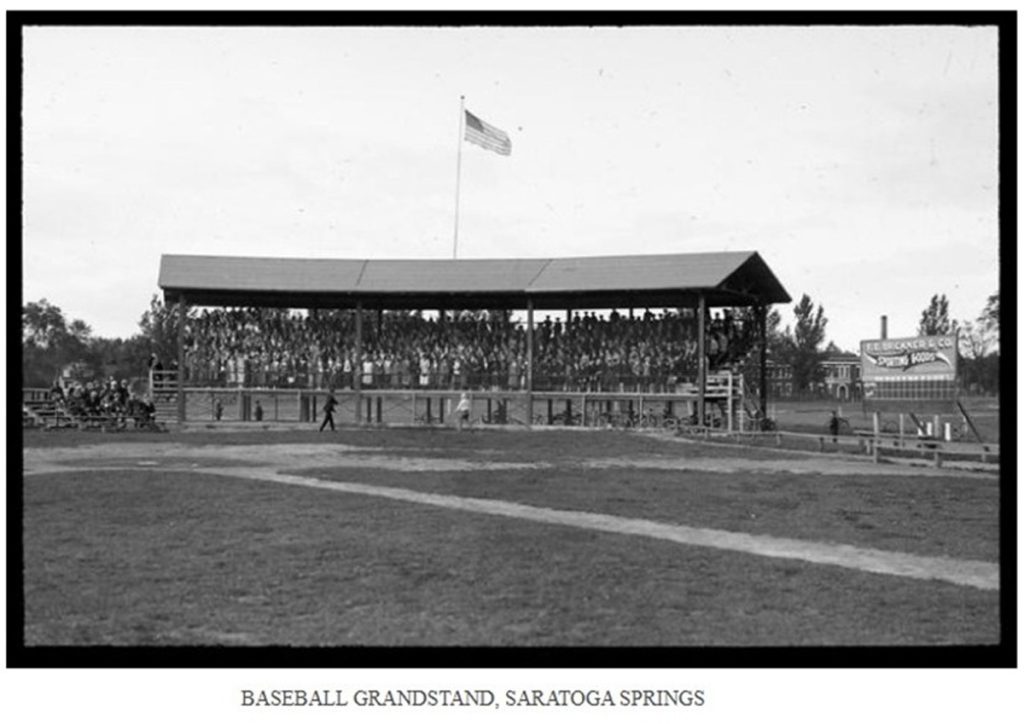
SARATOGA SPRINGS — A wonderful tonic effect, following a long and frigid winter, is provided when sunshine unlocks the soils and we once again hear a bat and ball, along with the slap of a glove. Hearing of pitchers and catchers reporting to camp buoys the spirit of eventual survival, and ignites that hope which springs eternal, as our season accelerates toward baseball.
During the dark days of the Second World War, due to restrictions for preserving all resources for the war effort, ballplayers were not allowed to travel south for spring training. Teams were restricted to northern climes, close to their home fields. These same strictures prevented thoroughbred racing in Saratoga in 1943-45.
The teams hurriedly developed facilities which included a large indoor structure for inclement days. The Red Sox drilled in Tufts University’s Cousens Gym, and when conditions allowed, nearby Fenway Park. The Phillies held training at the hockey arena at Hershey Park. The New York Giants and Yankees utilized large recreation facilities in New Jersey, and the Brooklyn Dodgers at Bear Mountain in the Hudson Highlands, with easy access to the vast field house of the U.S. Military Academy at West Point.
Following the end of hostilities, the spring of 1946 saw nearly all teams returning to their pre-war southern locations, yet one operation considered the merits of remaining north. The Albany Senators had invited 50 players to their camp, nearly all of whom were returning servicemen, who had been away from their homes for extended periods.
For the reason of not demanding long-distance travel, the management of the team looked toward Saratoga Springs, and liked the juxtaposition of Recreation Field, the Armory on Lake Avenue and Convention Hall, the many operational restaurants and recreations, excellent rail connections and the dormant summer hotels awaiting track season.
The Albany Senators, defending champions of the Eastern League, were affiliated with the Pittsburgh Pirates and played their home games at Hawkins Stadium in Menands, which was a very large minor league facility. The grandstand was so extensive that it obstructed morning sunshine, where the overnight dew was slow to evaporate, preventing workouts until late in the day.
The Saratoga County Chamber of Commerce—which since 1918 has played a key role in advocating for local businesses, fostering economic growth, and highlighting the region’s unique assets—was fully in favor of the Senators establishing camp at the Spa. Mayor Addison Mallery led team owner Tom McCaffrey on a tour of the local facilities, and the club president chose to domicile at the Normandie Hotel, a three-structure complex at that time on North Broadway.
Jim Collins, manager of the Senators, had been a first basemen on the Cardinals “Gashouse Gang” championship teams of the 1930s and during the manpower shortage of the war-years needed to insert himself into the lineup, where he was twice voted Eastern League MVP. A former Pennsylvania coal miner, Collins’ nickname was “Ripper,” as in “tear the cover off the ball.” The skipper, entering his fifth year in that position, was very enthusiastic over the new arrangement, citing many advantages over the team’s pre-war camp at Barnwell, South Carolina.
The Senators would be at their Saratoga camp for the entire month of April, beginning first getting their legs and wind into shape with drills, running, calisthenics, and pepper games that sharpened agility and built stamina. The latter part of the month involved exhibition games at Hawkins Stadium against teams returning north, with series scheduled against the Toronto Maple Leafs and Binghamton Triplets. The Eastern League season would begin in early May.
White cardboard signs with red lettering extending a welcome to the Albany Senators were placed on store fronts and in restaurant and tavern windows. The weather was far from perfect, yet the welcome was warm and sincere from Spa City residents.
Manager Ripper Collins had his pitchers try out a rubberized, electrically-heated jacket for the first time at Recreation Field, which he had developed to keep his hurlers warmed up when a game was delayed. The enterprising manager was also known for his clowning antics, both on and off the field, and proved to be a popular motivational speaker at many of the city’s civic functions.
Just prior to the Senators’ arrival, Saratoga Springs had voted to build a public library, and the team played an intersquad game at Recreation Field to help raise funds for the valuable facility that we enjoy in our time.
The Albany Senators finished the 1946 season as Eastern League runner-up, losing to the Hartford Chiefs in the playoffs. The entire year proved to be one of transition back to peacetime, with thoroughbred competition returning to Saratoga Springs, and yielding a single season as a spring training camp.