

Starting Gate Inventor
American artists and illustrators have documented events through the nation’s history, which have become a vital visual record of collective experiences. One illustrator, who can still be called upon to look back through time, was Edwin Forbes, who lived in the Long Island village of Flatbush, before it was annexed into Brooklyn, and eventually New York City.
Mr. Forbes is best known for his work during the Civil War, where from the field with the Union Army, he provided the public with a plethora of graphic sketches from the midst of camp, march, hospital, bivouac and battlefield, through the illustrated newspapers of the day. This eyewitness to the War of Secession was only twenty-one years old when Fort Sumter erupted, and he began faithfully and sympathetically capturing all aspects of those who followed the flag.
Frank Leslie had an estate that stretched from Saratoga Lake to Lake Lonely, known as Interlaken, and published much of Forbes’ work in his Illustrated Newspaper, which enjoyed a national distribution.
Edwin Forbes was a pioneer embedded reporter in wartime, and after the war many of his fine illustrations found their way into what is considered the first sporting paper in the country, which was titled The Spirit of the Times. The name for this respected broadsheet came from a quotation in Shakespeare’s King John, “The spirit of the times shall teach me speed.”
As an artist, Edwin Forbes took not only an interest in the animals, but also in the dynamics of racing and how events were staged. Thoroughbred racing of that era employed a person with a signal flag to hold horses in check at the start until all had reached the equitable datum of a chalk line, before they were sent on their way with the drop of the pennant. False starts were frequent, and occasionally some starters were left at the post while others were able to gain the starting line with a slight edge over their foes. In a game of inches, with money in the balance, a suspect start was an undesirable situation at any track.
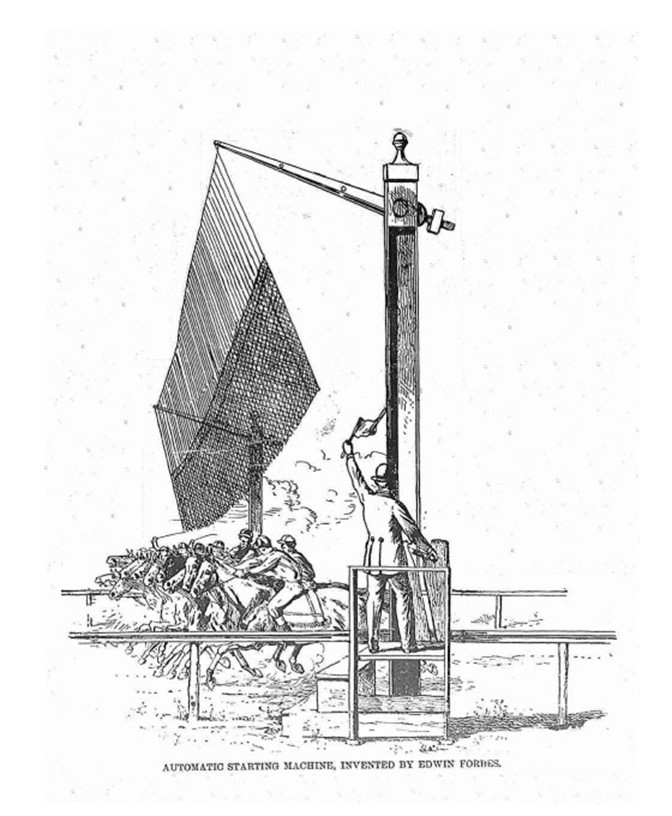
Besides his art, Edwin Forbes was also a practical inventor, and in 1891 devised a starting gate which he hoped would improve the fairness of thoroughbred racing. The operation of his apparatus might be described as a mechanically re-tooled cuckoo-clock, with the notion of assisting the traditional human starter. He conceived of two upright hollow posts, on either side of the track, that supported lift arms and were joined by a rod which held a screen. With the release of a lever by the starter, counterweighs would drop over pulleys inside the hollow posts which fairly noiselessly and rapidly lifted the screen vertically, sending the horses on their way. The quiet sweep motion caused less upset to the excited horses at the post than the flapping of the start flag.
On January 9, 1892 The Spirit of the Times, which even at that time had a global distribution, published an accurate rendering of Mr. Forbes’ starting device. THE SPIRIT, publishing on this subject, placed Edwin Forbes in an awkward position with an important economic patron. The editors further mentioned that Mr. Forbes device had failed to impress in a test at Brighton Beach race course in Brooklyn. Edwin Forbes felt his device was not given a fair trial, due to certain powerful betting owners preferring to take their chances of getting the best of the start in the old fashioned way, where they might gain an occasional advantage.
The Spirit of the Times on March 24, 1894 wrote,
“The successful trials of starting machines in Australia will no doubt impress racing men here favorably with the apparatus invented by Mr. Edwin Forbes, of Flatbush, L. I. especially as Mr. Forbes claims that the Australian machines are constructed upon the same principles that are embodied in his invention.”
The following year on January 12, 1895, THE SPIRIT placed the patent drawing of Mr. Forbes “Ideal Starter” on their cover. This depiction illustrated an article about what they termed the “automatic staring machine” he designed and those from Australia, then arriving at California tracks. This excellent rendering makes clear that, in any era, an inventor who could illustrate their own design has a large advantage. This edition also mentioned the likelihood that the matter would be taken into the courts before the question of the legal right in the patent was settled.
Less than a year after Edwin Forbes’ March 1895 death, The Spirit of the Times ran a story with various expressions of opinion discussing the Australian starting machine in use by prominent turfmen at San Francisco. Starter J. F. Calder was quoted,
“The machine is all right enough, but the boys [jockeys] have to be educated up to it, and perhaps the horses also. I have no fear of its ultimate success.”
Prophetic words indeed, as the much-evolved starting gate, with jockeys and horses training and using the apparatus daily, is a common sight across the country, into our time.