

A Determined Trailblazer
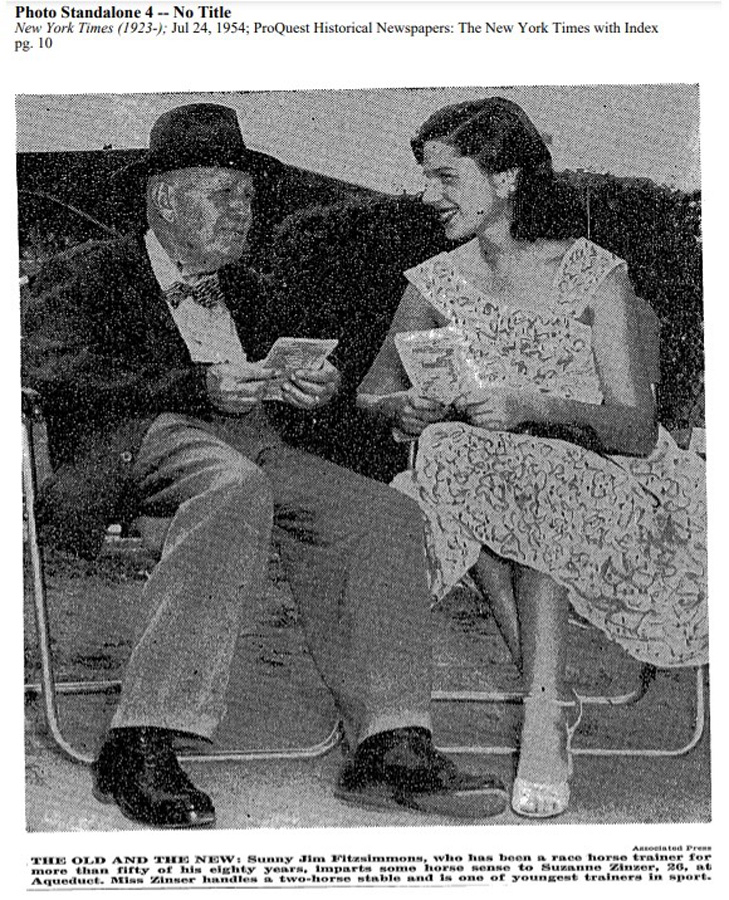
One of the all-time legends had time for an interested pupil
The first week of the 2025 race meet at Saratoga saw trainer Michelle Nevin notch a victory, and Linda Rice win four. Also the two-year-old bay colt named for the late veterinarian, Dr. Bob Agne, and trained by Cherie DeVaux, achieved a storybook win.
Saratoga has proven a fortunate location for women trainers with an interesting and early example being Suzanne Zinser. She certainly had a fascinating trip on her way to the saddling paddock, having been born in Stuttgart, Germany where her father was an art collector and merchant.
When the Second World War broke out in 1939, following the invasion of Poland and prior to US involvement, her father Richard H. Zinser was in New York on business. Fourteen year old Suzanne and her mother fled to Belgium, staying ahead of the Nazis by moving to France, Spain, Portugal and North Africa before the family was reunited in Forest Hills, New York, a suburban section of Queens.
At high school during the War, a girlfriend took her to Belmont Park, not for the races but because they could visit and pet the horses along the backside there. Trainer Frank Moore saw Suzanne’s enthusiasm for the animal and handed her the lead shank. Soon after that, she began walking hots for Mr. Moore, before and after school. Eventually she joined his string, via city bus, at Gotham’s other two racetracks, Jamaica and Aqueduct. Following her high school graduation at Forest Hills, Suzanne continued her education at Skidmore, where she graduated with the Class of 1949.
By time she arrived at Skidmore, or perhaps due to the unbelievable influence of the Spa, Suzanne knew she wanted a career in the equine industry. She studied English and Journalism in college with the notion of becoming a turf writer. She worked hard in Saratoga, correcting papers and doing office work, as well as working mornings around what had been the old Beverwyck Stable on East Ave, where some owners wintered their horses. Suzanne built a savings account while away at school.
The press box of the 1950s was an all-male domain, with powerful guilds in place to protect their membership. The New York Turf Writers Association would find temporary positions for out-of-work scribes as pari-mutuel clerks, in the publicity department, as ushers or hot-walkers, to keep these guys on the track and their hand in the game. Their editors were reluctant to introduce a pretty young woman into that cloistered environment.
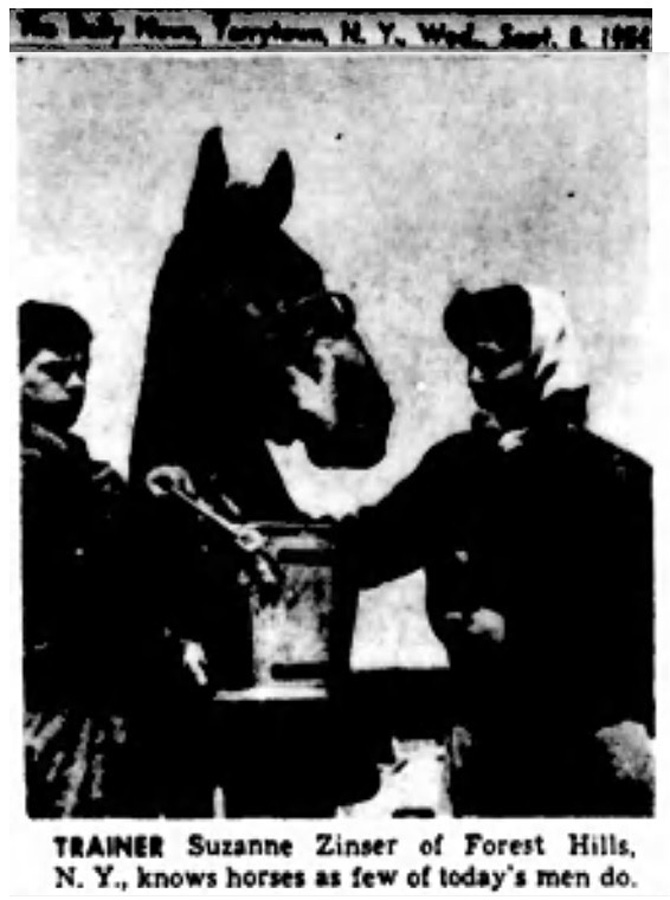
In the Press
Suzanne Zinser exercised an option no one could prevent; she bought a thoroughbred, a brown filly named Give Thanks, price $1,000. An amazing bit of irony and coincidence regarding female conditioners needs to be noted here, Give Thanks was a daughter of Thanksgiving, who won the 1938 Travers Stakes for trainer Mary Hirsch, the very first female trainer. Give Thanks ran well for Suzanne, and she made a profit, retiring the mare when she detected her maternal desire taking over.
Suzanne’s next step in 1952 was to take out a trainer’s license and condition for clients on the New York circuit, supplementing her income by also striding the sales floor of B. Altman. Suzanne owned horses most of her life and was one of just a few female thoroughbred trainers in America in the 1950s.
She appeared on the popular TV shows What’s My Line and Wide World of Sports because she was performing an unusual occupation at the time for women, which also opened unique advertising opportunities for her. Returning to Saratoga Springs to conduct her professional duties, Suzanne frequently roomed at the venerable Race View structure on Nelson Avenue, directly across from the Wilson Chute.
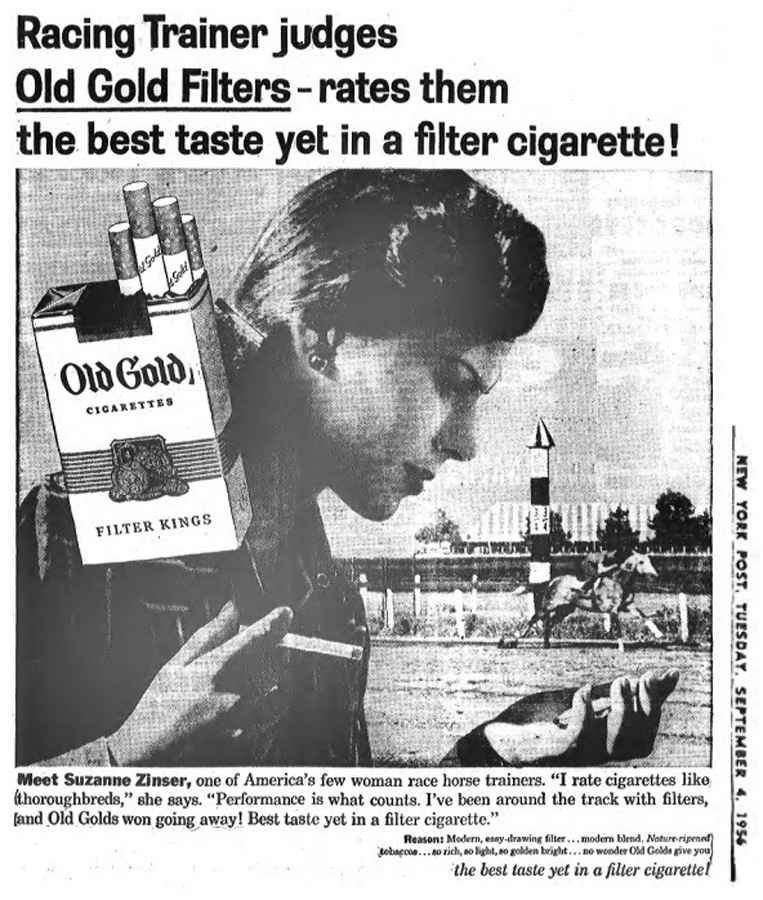
An income supplement for the horse trainer
Suzanne married Rutger Rosenborg in 1957 and they operated Pennfields Farm in Stockton, New Jersey for many years. Suzanne Zinser Rosenborg died of lung cancer at her farm July 9, 2005, but only weeks before, on May 29, 2005 wrote in the New York Times:
“To the Sports Editor: I resisted commenting until now on Bill Finley’s article (“A Good Rider’s Looks Can Get in the Way,” May 18) elevating a girl jockey on the basis of harassment without ever establishing what abilities she brings to the sport. I speak from personal knowledge because I was a horse trainer in 1952 – one of at most three female trainers before women were accepted in the game. But I found that when I established my abilities and desire to work in that male-dominated field, I received respect and never heard a derogatory word spoken in my presence. I think we dwell on harassment and never mention that it is our own attitude that brings these things to pass. Let’s ask jockeys Julie Krone, Donna Barton and others how they managed to succeed. When I returned as a horse owner in 1988, my trainer and I never hesitated using girl riders based on their abilities in handling a horse.”