A Saratoga County man has been charged with possession, receipt and distribution of child pornography.
Conner Buskey, 20, of Saratoga Springs was arrested by federal authorities on Aug. 22 after an investigation by the Saratoga County Sherriff’s Office and U.S. Department of Homeland Security Homeland Security Investigations (HIS) found multiple images and videos of child pornography on his phone.
Federal authorities were first tipped off to the incident after Snapchat reported that a video of child pornography had been sent across its network. In March the tip was passed along to the New York Internet Crimes against Children Task Force with the IP address of the sender being traced to Saratoga Springs, according to the criminal complaint.
That same month, Buskey was arrested by the Sherriff’s Office for rape and sexual abuse of a then 12-year-old girl. The girl reported the incident to her school leading to Buskey’s arrest. At the time of the arrest, Buskey’s phone was seized — leading to the charges, according to a statement by the Department of Justice.
On March 11, 2025 Buskey was arraigned in the Town of Greenfield and posted bail. While an order of protection was placed on Buskey ordering him not to contact the victim, New York State Child Protective Services has received credible information that he violated the order at least once, according to the complaint.
“Conner Buskey is accused of abhorrent crimes against an innocent child, and would be roaming free if not for the federal charges brought last week,” Erin Keegan, Special Agent in Charge of the HSI Buffalo Field Office, said in a statement “I applaud our HSI Albany personnel, the Saratoga County Sheriff’s Office, and the U.S. Attorney for the Northern District of New York for ensuring the wellbeing of the public, including and especially victims and vulnerable communities, remains the priority above all else.”
A search warrant of Buskey’s phone found multiple images and videos of child pornography and a later search warrant for his snapchat account found a video which matched the one from the original Snapchat tip. The same warrant also found chat logs where Buskey allegedly sent the video to a minor.
If convicted, Buskey could face up to 20 years in Federal prison for each of the charges and a maximum fine of $250,000. Once out of prison, Buskey would be required to register as sex offender and have a period of supervised release of five years to life.
Schuylerville is the latest Saratoga County School District to adopt a state mandated phone ban in schools.
The policy was adopted on Aug. 18 and details both how students are supposed to store their devices and the potential consequences for violating the policy.
Under the policy, students in elementary school are required to store their devices in their lockers if they bring them to school. While the lockers don’t have locks built in, students can bring their own personal locks under the condition that they submit the key or combination to the school.
In addition to phones, students are barred from bringing in smartwatches, tablets and all headphones and earbuds — both wired, and Bluetooth enabled devices.
Students in middle and high school have a similar policy. Students are required to keep their phones off and in their lockers during the school day. Under the policy, students aren’t allowed to use their phones during rest period including lunch, study halls and in the hallways in between classes.
Students who need to contact their parents can do so in the main offices of their respective schools. Parents can also contact the school and request to speak to their student.
The policy also laid out the consequences of violation.
• 1st Offense: Student or teacher brings phone to office where it is held until the end of the day.
• 2nd Offense: Student or teacher brings phone to office where it is held until a parent/guardian can pick it up.
• 3rd Offense: Student or teacher brings phone to office where it is held until a parent/guardian can pick it up, student is assigned a detention.
• 4th Offense: Student or teacher brings phone to office until parent/guardian can pick it up, further consequences are provided at the discretion of the administration.
A sample of the dust first responders and residents were exposed to around the collapse of the World Trade Center ( Courtesy of World Trade Center Health Program)
A retired New York State Trooper from Saratoga Springs has died from a 9/11 related illness.
Retired Sergeant Frederick Scheidt died on Aug. 13 at the age of 67 of cancer, according to his obituary.
Originally from Greenwich, Connecticut, Scheidt joined the State Police in 1979 and served for 30 years, eventually settling in the Saratoga Springs area and retiring in 2009. He is survived by his wife, son and two grandchildren.
Scheidt is one of 34 State Troopers to die from illnesses related to 9/11, according to the New York State Trooper Police Benevolent Association. This number makes it the second most common type of line of duty death experienced by Troopers since the agency’s founding in 1917 and the most common line of duty death in the nearly 24 years since the attacks. Scheidt is the fourth Trooper from Saratoga County to die from illnesses related to the attacks.
The attacks on Sept. 11 represented the single deadliest day in US history for both law enforcement and fire personnel. 72 law enforcement officers were killed in the attacks, the majority coming from the NYPD which lost 23 members and the Port Authority Police which lost 37. In addition, four members of the New York State Office of Tax Enforcement, three members of the New York State Office of Court Administration, one fire Marshall, one member of the FBI, one member of the Secret Service, one member of the New York Fire Patrol and one member of the EPA were all killed in the attacks.
On the fire department side, 343 members of the FDNY were killed along with six on-duty EMS providers and two volunteer EMTs who responded to the disaster on their own.
In the years since, however, the number of first responder deaths from 9/11 related illnesses have surpassed those from the attacks. In addition to the 34 State Troopers, NYPD lists over 370 officers who’ve died as a result of illness, the FBI lists 29 agents who died and the FDNY has lost over 360 members.
The losses are due to the toxic debris first responders and residents were exposed to while working and living near the site of the attack. According to the CDC’s World Trade Center Health Program, the attacks exposed people to over 300 chemical hazards, 14 physical hazards and 26 hazards that could result in mental health issues down the road. Of the 400,000 potential exposures, over 145,000 have signed up for health monitoring through the program.
The most common ailment faced by those in the program is cancer with over 48,000 certified reports. Other ailments include respatory illnesses like asthma and COPD, and mental health conditions like PTSD and depression, among other conditions.
As for Scheidt, his funeral was held Aug. 21 in Saratoga Springs. In advance of the funeral, Saratoga closed streets and restricted parking along the processional route.
The Galway man charged with threatening the family of United Healthcare CEO Brian Thompson allegedly threatened to shoot ICE agents in Saratoga Springs.
Shane Daley of Galway was allegedly found with emails threatening that he would shoot ICE agents in Saratoga Springs, according to court documents.
“If someone in a mask without proper law enforcement identification aggressively approaches me anywhere in Saratoga Springs, they better have their affairs in order as they’re going to catch two slugs from a legally owned firearm,” Daley allegedly said in the email “ if you want shootouts in your city, feel free to continue doing nothing. But I’d rather leave in a body bag than in cuffs so consider the above message. Hope no one catches a stray!”
The court docs didn’t indicate who the email was sent to or whether they would lead to official charges.
The emails came as a result of a visit to Daley’s home by U.S. Probation and Pretrial Services officers. While at the home, officers found a loaded shot gun, numerous beer cans throughout his home and vehicle, nitrous oxide containers known as “whip-it” — a means of inhaling the substance for recreational use — and quantities of marijuana.
Daley was initially charged with cyberstalking after he left four messages threatening the wife of murdered United Healthcare CEO Brian Thompson. According to court documents, Daley made several graphic threats to the family, saying that Thompson deserved his death and his family deserved the same.
“You deserve to due begging for your life on the cold concrete, just like your pathetic [expletive] [ expletive] of a [ family member]” Daley allegedly said, among other threats and insults in the messages.
While Daley initially asserted that he hadn’t made the calls in interviews with FBI agents, he later said it was possible given his heavy drinking around the time the threatening calls were allegedly made. Agents were able to match his voice with that on the calls as well as match phone records which came from a phone Daley said he was the sole user of, according to court documents.
Daley was initially held in the Albany County jail, due to the belief that he was a danger to the public. During a hearing on Aug. 19, Daley was ordered released from the jail and into the custody of an addiction treatment facility with an electronic monitoring device attached.
Daley will next be in court upon completion of the program.
The New York State Public Service Commission recently approved a rate proposal by National Grid which would see rates for electricity go up by 11% and rates for gas go up by 10%.
The Commission approved the proposal on Aug. 14. The proposal was signed by multiple agencies, companies and other organizations including the US Department of Defense, Walmart, The New York Solar Energies of New York, The New York Geothermal Energy Organization, and the International Brotherhood of Electrical Workers Local Union No. 97 — among others.
Under the proposal, rates across the areas National Grid serves would go up for residential customers by around 11- 12% for year one, five percent for year two and three percent for year three. In terms of gas expenses, National Grid states in its proposal that rates will go up by around eight percent across all three years it covers.
The rate increase comes after over a year of negotiations between National Grid and various stakeholders.
Under the initial proposal rates would’ve increased electricity rates for residential consumers by 15% and gas rates for residential consumers by 20%. These rates were reduced through the negotiating process to where they are in the current proposal.
Under the approved proposal, revenues for National Grid from electricity would increase by $167.3 million in year 1, $297.4 million in year 2 and $243.4 million in year 3.
“The main rate drivers of the recommended increases are due to increases to operations and maintenance (O&M) expense, return on and return of (i.e., depreciation expense) capital investments, and a change in the return on equity to reflect market conditions offset by lower than previously forecast property taxes and a forecasted increase in revenue,” The proposal said.
The increased rate isn’t without controversy. The report detailed how in hearings across the state during the year of negotiations, 62 individuals spoke up about the rates and nearly 9,000 people submitted written comments.
“Many speakers opposed the proposed rate increases, stating that bills are already unaffordable and suggesting that executive compensation and shareholder dividends be reduced prior to raising rates,” the proposal stated “Others noted that the requested rate increases outpace inflation and suggested that there should be methods for funding necessary infrastructure improvements without rate increases.”
Despite these comments, The Commission ultimately decided to approve the rate increases.
“While reflecting a considerable reduction from National Grid’s original request, the Joint Proposal nonetheless provides sufficient funding for the Company to maintain safe, adequate and reliable utility service at just and reasonable rates; thus, the Joint Proposal appropriately balances the interests of ratepayers, the Company, and its investors,” The Commission stated.
The approval was met with swift backlash from many New York lawmakers and other politicians. Governor Kathy Hochul released a statement criticizing the decision.
“While I appreciate that the New York Public Service Commission worked to significantly lower the outrageously high initial rate proposals, it’s still not enough,” Governor Hochul said. “I have been crystal clear that utilities must make ratepayer affordability the priority.”
In response to the rate hike, Assemblyman Angelo Santabarbara, whose represents parts of Schenectady and Amsterdam, announced he would introduce legislation which would allow the legislature to review any rate hike by the Public Service Commission.
“Utility costs are already a significant burden for New Yorkers,” Santabarbara said. “This bill makes sure that when major decisions like this are made, elected representatives have the chance to step in on behalf of the people they serve – even if the PSC has already approved it. In this case, we still have time to review and potentially reverse this increase before it becomes permanent.”
This isn’t Santabarbara’s first time introducing legislation to exert legislative control over the Public Service Commission. Back in January, Santabarbara proposed legislation which would require legislative consent on all proposed rate hikes. The same bill was proposed in the senate by Senator James Tedisco, who represents all of Saratoga County and parts of Schenectady and Kevin Parker who represents parts of Brooklyn.
The legislation was referred to committee in both houses and no action has been taken since.
With the start of classes just around the corner, Ballston Spa Central School District is the latest school district to enact a state-mandated man on cell phones and other personal electronic devices.
Under the policy, students in middle and high school are expected to keep their mobile devices turned off and, in their lockers, while students in elementary school will be required to keep the devices in their backpacks.
Students who need to contact their parents though out the day can use a phone in the main office of each building while parents can reach out to their specific child’s school if they need to contact them.
The policy also outlines specific exceptions:
• Where necessary for the management of students’ healthcare after approval by building administration;
• If authorized by a teacher, principal, district, or BOCES for a specific educational purpose;
• For translation purposes;
• On a case-by-case basis, upon review and determination by the building administration, for student caregiver who is routinely responsible for the care and wellbeing of a family member; or
• In the event of an emergency, with approval of the building administration;
• Where required by law;
• If a student’s IEP or 504 plan deems it necessary.
In addition, when students are on field trips, whether students have their phones out will be left to the discretion of the teacher in charge of the trip.
Shane Daley of Galway is alleged to have harassed the family of Brian Thompson, pictured here ( United Health Care)
A Galway man has been charged in federal court for allegedly harassing the family of Brian Thompson, a health care CEO killed in 2024.
Shane Daley, 40, of Galway was charged with cyberstalking after he allegedly placed multiple calls to a phone line used by a member of Thompson’s family. Daley allegedly made the calls between Dec. 4 and Dec. 7, 2024, with the first calls starting just hours after Thompson’s death.
According to the U.S. Department of Justice, Daley expressed satisfaction over Thomspon’s death and said his family and children deserved a similar fate.
“Daley threatened and harassed a grieving family in the immediate aftermath of a loved one’s murder,” Jay Clayton, United States Attorney for the Southern District of New York, said. “These selfish, harmful, and callous actions undermine public safety and will not be tolerated. This Office, together with our law enforcement partners, will pursue and prosecute those who seek to intimidate victims and their families.”
At the time of his death, Brian Thompson was the CEO of United Health Care, one of two subsidiaries of United Health Group. United Health Care is one of the largest health insurance companies with over 50 million people served according to an outlook release by the company. In 2024, United Health Care alone brought in over $400 billion in revenue.
On the morning of Dec. 4, 2024, Thompson was killed while visiting New York City. Luigi Mangione of Towson, MD was arrested and charged for the murder although he has pleaded not guilty and as of Aug. 13, a trial date hasn’t been set.
As for Daley, he was arraigned in Albany before US Magistrate Judge Daniel Stewart. If convicted, he will potentially face a maximum of five years in federal prison, a fine of up to $250,000 and term of supervised release of up to three years.
“The recurrent calls and messages in the days following Brian Thompson’s murder were more than callous and cold-hearted harassment – they were threatening and terrified a family already suffering following the violent death of their loved one,” Christopher G. Raia, Assistant Director in Charge of the New York Office of the FBI said. “The FBI will continue to bring to justice any individual attempting to stalk and harass innocent Americans.”
Fire fighters in Saratoga Springs recently responded to a chemical spill at the Grande Industrial Park.
The spill occurred on Friday Aug. 8 around 4:20 p.m. and involved a chemical later identified by the Saratoga Springs Fire Department as copper sulfate. The fire department said the incident was isolated and posed no hazard to the public.
According to the fire department, the spill originated from a truck traveling to the industrial park and was first reported by an off duty first responder who noticed a blue liquid spilling from the truck heading North on Interstate 87. The fire department said that the responder had also contacted State Police regarding the matter. In addition, hazmat teams from Saratoga and Schenectady Counties were also requested on scene.
On social media, multiple people complained about eye and throat irritation around the time and area of the leak. The fire department said they first became aware of these reports when someone came into a station complaining of eye irritation which started in the area of the Grande Industrial Park, however, the department said they couldn’t confirm or assess the cause of the symptoms.
Copper sulfate is a compound comprised of copper and sulfuric acid which is used in a variety of applications, according to the National Institute of Health. Its uses include pesticides, dyes, medications, fertilizers and many others.
The chemical is considered an irritant with short term exposure potentially resulting in irritation to the eyes, skin and respiratory system. According to NIH, first aid for these symptoms includes getting rest and fresh air if inhaled and washing impacted areas if one comes into contact with it.
Are you planning on running your sprinkler every day or washing your car this month? If so, then the City of Saratoga Springs is asking you to reconsider.
The city is implementing voluntary water restrictions on outdoor watering due to increased strain on the water system, lower than average rain and inadequate rain forecasted in the future. The public works department said the restriction was a precautionary measure to decrease water usage.
Under the restrictions, residents are asked to only run water on landscaping every other day based on their house numbers — with odd numbered houses watering on odd numbered days and even numbered houses watering on even numbered days. For example, someone who lives at house number 201 would water on August 13, 15, 17, 19, etc. — while some at 210 would water on August 12, 14, 16, 18, etc.
In addition, the city is asking all residents not to water or wash cars between 10 a.m. and 6 p.m. due to increased evaporation rates which the city says can represent a loss of 30%.
The Department of Public Works said the restrictions do not apply to handheld watering devices, however, they did ask residents to ensure water remains on lawns and gardens and not on paved areas.
“Help from residents to conserve water will go a long way to preserve the reservoir levels until it’s replenished with some heavy rainstorms,” Department of Public Works Commissioner Chuck Marshall said. “This is a precautionary measure to reduce the volume of water being used for landscape watering and we appreciate the public’s cooperation.”
According to the Department of Public Works, the city’s water treatment plant pumped 5.2 million gallons of water per day in June and 6.6 million gallons of water per day in July, an increase from the 4.3 million gallons of water per day averaged in 2024.
Saratoga Springs isn’t the first jurisdiction to implement voluntary water restrictions. The Town of Ballston implemented similar water restrictions on July 16, and the Town of Charlton implemented the measures on July 17. In addition, the Town of Moreau issued a water restriction order on Aug. 12 — although this notice was due to repairs to the water supply in Queensbury.
The voluntary water restrictions come at a time when Saratoga Springs has seen higher than average temperatures with steady or below average precipitation. According to the National Weather Service, June saw 4.41 inches of precipitation, compared to the average of 4.18 inches while July saw 3.91 inches compared to an average of 4.24 inches.
Meanwhile in terms of temperature, Saratoga Springs saw an average temperature of 71.4 degrees in June, compared to the average of 67.2 overall, and an average temperature of 77.3 — the highest average temperature for July on record — compared to the typical average of 71.8 degrees.
For the second week in a row, a haze fell over Saratoga County as wildfire smoke continued to penetrate the landscape.
On Aug 4 and 5 Federal and private monitors in the capitol region showed air quality index levels above 100 — making the air unsafe for sensitive groups — while some monitors in Saratoga County showed air quality levels above 150 — dangerous for all people.
With the continued downturn in air quality, Saratoga TODAY looked at what’s causing this problem and whether it will get worse.
What’s causing drops in air quality?
In the US, air quality drops have been associated with smoke coming from wildfires currently taking place in Canada. Smoke from fires over 1000 away from Saratoga has been travelling southeast, across the Midwest and into New York.
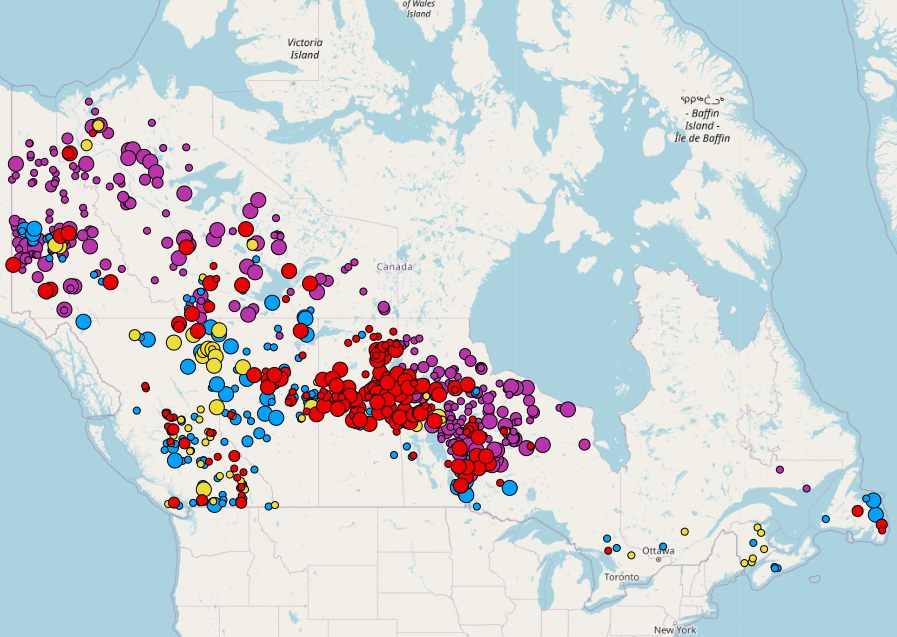
According to the latest situation report from the Canadian Interagency Forrest Fire Centre (CIFF), there are currently 737 active fires impacting the country. Of those, 504 are considered out of control with 199 receiving a full response and 305 receiving a monitored response.
Where are the fires taking place?
The fires are taking place largely beyond where most of the population of both Canada and the US would be directly impacted by the blazes. According to CIFF, most of the fires are taking place out west in the northern parts of Western Ontario, Manitoba, Saskatchewan, Alberta and British Columbia. There are also clusters of fires in Canada’s Northernmost territories of Yukon and Northwest Territories, as well as out east on the island of Newfoundland.
A map of the wildfires in Canada. Red dots indicate a fire that’s out of control and receiving a full response, purple indicates a fire that’s out of control but being monitored, yellow indicates a fire that’s been held to a specific area and blue indicates a fire that’s been contained and in the process of being extinguished ( Courtesy of CIFF)
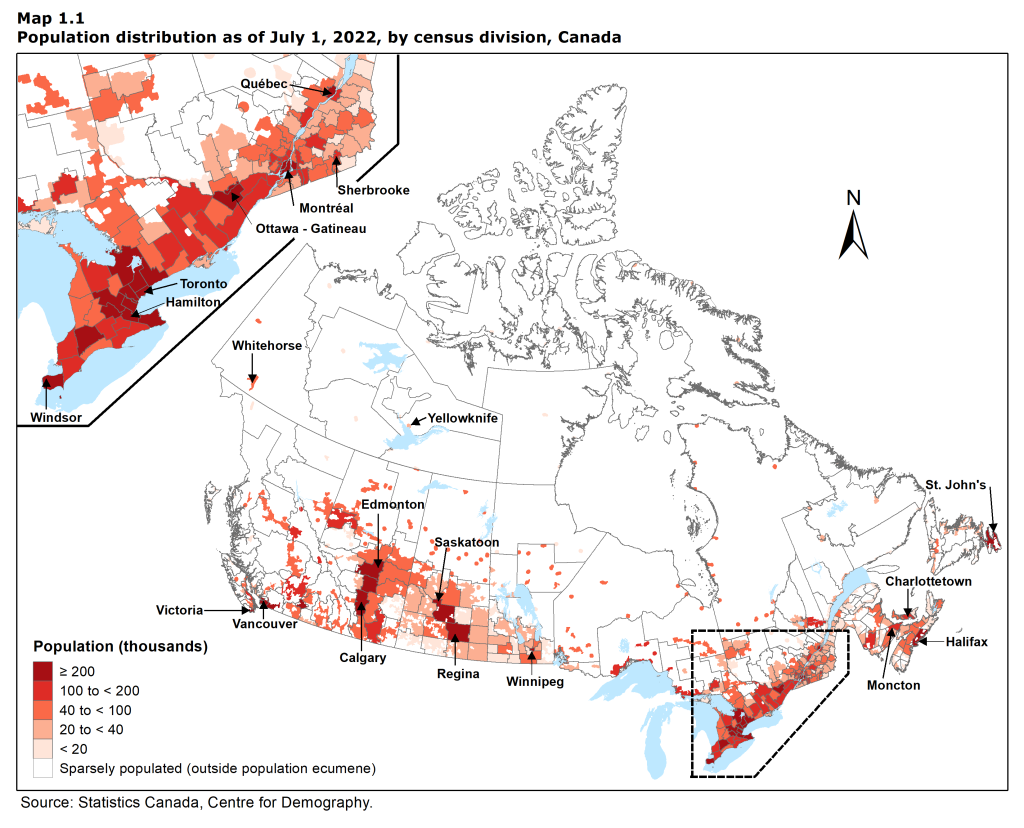
While Canada is the second largest country in the world by landmass, most of it’s population is clustered in major cities such as Toronto and Montreal in the east and Calgary, Edmonton and Vancouver in the west, according to population maps from statistics Canada.
As a result, most of the fires are taking place far away from population centers. While there have been multiple evacuation orders in the provinces impacted by the blazes, many of these are primarily in small rural communities.
Is this normal?
Across North America, wildfires are a natural phenomenon. In Canada specifically, the fires serve to help a forest recycle debris and prevent build up, according to Parks Canada.
Fire is also one of the ways forestry services deal with wildfire conditions. As part of many forest management plans, agencies will start fires in what are prescribed burns, according to the National Park Service. These fires reduce fuel build up and allow an area to go through its natural processes in a more controlled way. Fires are even used locally in Saratoga National Park to help keep the battlefield in similar condition to what it was during the battle 250 years ago.
While fires themselves may be natural, the current conditions aren’t. Since 1983, when data on wildfires was first collected and reported in Canada, there has been only two fire seasons worse than the one currently being experienced — 1994 and 2023.
These worsening fire conditions have been attributed to climate change. According to Natural Resources Canada, because the air is becoming warmer and drier, wildfire seasons have been getting longer and more intense. This can be seen in drought conditions which show much of Canada experiencing abnormally high levels of dryness — particularly in areas currently dealing with the fires.
Canada has also had to deal with “zombie fires” or fires that lay dormant beneath the permafrost and snow for months before sparking back up when conditions are ripe for fires, according to NOAA.
How does this compare to the US?
Despite sharing a long border and working together on many wildfire responses, there are some notable differences between how the US and Canada experience and deal with fires.
The first major difference is human settlement in fire prone areas. In the US, settlement in wildland areas has gone up by nearly 50% in the last 40 years, according to a study funded by the US Forest Service. This number equates to 32% all housing in the US being in the wildland areas as of 2020.
Meanwhile in Canada, according to data from the Canadian Journal of Forest Research, 12.1% of Canadians live in wildland areas with an estimated 17% of those being in wildfire prone areas.
Beyond just having a lower population in wildland areas, Canada also has fewer fires started by humans. In the US, an estimated 85% of fires are started due to human interaction — be it accidental or due to negligence, according to the US Forest Service. Canada meanwhile sees the majority of their fires sparked by lightning strikes. In 2023 — the worst fire season on record — 93% of fires were as a result of lightning strikes with the remaining 7% caused by humans according to a study by Canada’s natural resource department.
What’s the impact on Saratoga?
In light of the of these fires, the New York Department of Health has advised residents to keep an eye on air quality levels and consider moving events inside — especially for those in high-risk groups.
“Poor air quality can pose serious health risks — especially for those with heart conditions, lung diseases, such as asthma, young children, those over 65 years old and pregnant individuals,” New York State Health Commissioner Dr. James McDonald said “To reduce exposure, limit strenuous activity outdoors. We encourage all New Yorkers to visit airnow.gov for the latest air quality forecast and be on the lookout for Air Quality Health Advisories from the Department of Environmental Conservation and the Department of Health.”