WILTON — Alan E. Liggett died December 3, 2024. Born on December 26, 1951, in Dayton, Ohio, Alan was the firstborn of Geneva and Irving Liggett and the eldest of four siblings. At the family’s request there will be no calling hours or service at this time. For online condolences, visit www.compassionatefuneralcare.com
GREENFIELD CENTER —Marguerite Esopi, 58, peacefully passed away surrounded by her children on December 6, 2024. A celebration of life will be held from 2:00 p.m. – 6:00 p.m. on Saturday, December 14, at the Greenfield Fire House, 13 S Greenfield Road, Greenfield Center, NY. For online remembrances please visit: www.burkefuneralhome.com
SARATOGA SPRINGS — Burton E. Farbstein, 77, passed away December 4, 2024, at Albany Medical Center due to complications from a car accident. A memorial service was held December 6, at Burke Funeral Home. Memorial donations to: The Wounded Warrior Project, Worldwide Kitchen, or the American Diabetes Foundation. Please visit www.burkefuneralhome.com.
SOUTH GLENS FALLS —Charles H. Perry, 84, passed away peacefully at his home on Friday, November 29, 2024, surrounded by his loving family. At Charles’ request, there will be no formal services at this time. For online condolences, visit www.compassionatefuneralcare.com
COLONIE — Marie D. “Curly” Burke passed peacefully on December 4, 2024 surrounded by her family. Visitation was on December 9, at Burke Funeral Home. Mass was on December 10, at St. Clement’s Church followed by burial in Gerald B. H. Solomon Saratoga National Cemetery. Online remembrances may be made at www.burkefuneralhome.com
SPRING HILL, FL— Caroline E. Hilpertshauser, 92, of Spring Hill, FL passed away on November 19, 2024. She was born at home on January 27, 1932 in the Bronx, NY to Charles and Evelyn (Ackermann) Hilpert. She grew up in Brainard, NY under the love and care of her grandparents Charles and Edith Hilpert. She graduated New Lebanon Central School in 1951 and married soon after.
In 1962 she settled in Saratoga Springs, NY. Caroline worked as a waitress and hostess for many years at the Holiday Inn and later became a Customer Service Manager for Dime Savings Bank. She retired in 1997 and moved to Spring Hill, FL.
Caroline had a beautiful soprano voice. She sang in her church choirs as well as the Burnt Hills Oratorio Society and The Nature Coast Singers of FL. She even took on the challenge to join a Russian Choral Group. She also enjoyed working in her flower gardens, collecting rocks, traveling, cooking, sewing and caring for her cats. She was an active member of St Paul’s Lutheran Church in Saratoga as well as Forest Oaks Lutheran Church in Spring Hill, serving on Church Council, Financial Committee, Sunday School teacher, LWML, choir and bell choir.
Caroline is survived by her children Lynn Hilpertshauser (Mark Zienert) and Glenn Hilpertshauser (Kathy); grandchildren Jeremy, April, Cheryl, Krista, Carrie; great-grandchildren Damian, Sage, Aidyn, Tristen, Ashton, Noah, Landon, Addison; her favorite brother-in-law Robert Hilpertshauser (Patricia); cousins and several nieces and nephews.
She is predeceased by her sister Dorothy Hensley (Hilpert), brother Robert Hilpert, her niece
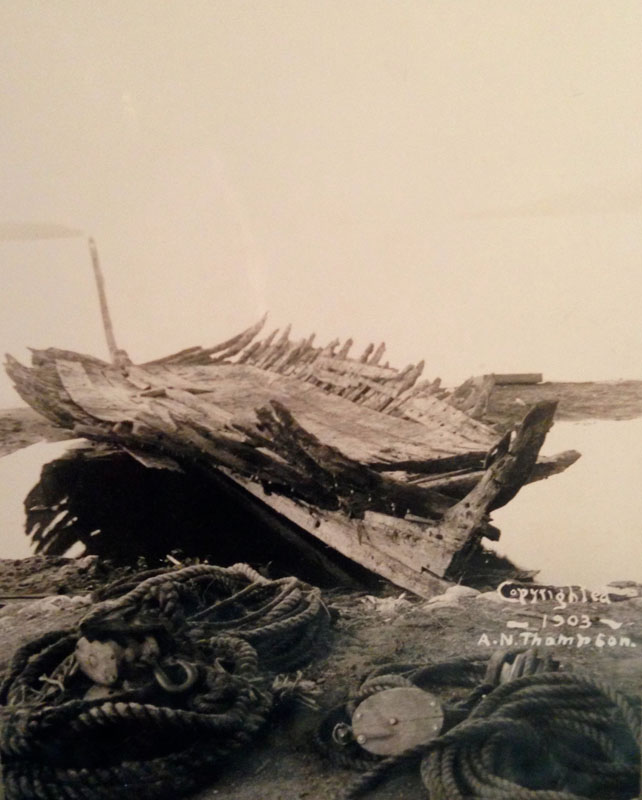
A mid-18th century British sloop, shortly after it was pulled from the waters of Lake George, off the grounds of Fort William Henry. The naval craft was burned and sank in a March 1757 raid by French forces on British-occupied Fort William Henry. 1903 Photo: A. N. Thompson.
WILTON — Maritime archaeologist and Wilton resident Joseph W. Zarzynski, is seeking the local public’s help to locate three artifacts crafted from a colonial shipwreck that were seen in a Saratoga Springs storefront over a century ago.
The back story: in March 1757, a British warship was burned and sank off the south end of Lake George, during a French attack on Fort William Henry. The French burned 300 bateaux (25–35 ft. long vessels) pulled up on shore, and four sloops in the water. The garrison held out, but five months later the French returned. After a siege of several days, the British surrendered, and the fortification was torched.
Nearly a century-and-half later, in July 1903, a sunken sloop from the March 1757 attack was raised from Lake George by a Glens Falls entrepreneur. The state legislature approved the recovery as long as the vessel predated the American Revolution (1775–1783), and that no state funds were used. The wooden sloop was pulled from 20 feet of water by a D&H locomotive, taken ashore, and cut up for souvenirs. Some hull fragments were carved into household objects.
A clock case and two candlesticks were fashioned from shipwreck pieces in 1919 by W. L. Adee, a Saratoga Springs carpenter who lived on Van Dam Street. The repurposed items, were later exhibited in the F. C. Maynard jewelry store on Broadway in Saratoga Springs.
“For over 35 years, I’ve been intrigued with this unlucky vessel,” said Zarzynski, who has studied Lake George shipwrecks since the mid-1980s, and taught Social Studies in the Saratoga Springs City School District for 30 years. “During the 1800s and early 20th century, before there was a historic preservation ethic, gavels and canes were sometimes crafted from shipwreck timbers.”
Earlier this year, Zarzynski directed a team of volunteers who have been inventorying maritime artifacts in Fort William Henry Museum. The artifacts included hull timbers from the ill-fated French & Indian War (1755–1763) battlecraft. Several-surviving pieces of the French & Indian War warship are in Warren County museums.
Zarzynski hopes Adee’s 1919 artifacts were passed on to a Saratoga Spring-area family member or friend or bestowed to Adee’s local Baptist church. The maritime archaeologist would like to photograph and measure the relics to gain a better understanding about repurposing historic-ship parts. Anyone with information on W. L. Adee or these three artifacts is asked to contact Joseph W. Zarzynski at: (zarcuws@aol.com).
by Sandy McBride | Sponsored byThe Saratoga County History Roundtable
One of the fun things about living in a very old house is that every now and then, stashed away in a dark corner, you find a completely fascinating remnant of the past. Such was the case when Bill and Bev Betts found a firemen’s convention booklet from 1902 in their 128-year-old Halfmoon farmhouse. They have graciously shared it with us.
The convention was held in Mechanicville over Labor Day weekend. The commemorative booklet is loaded with pictures and ads not just from Mechanicville, but from neighboring communities as well. Although many of the names ring a bell, none of the industries or businesses mentioned save the struggling Delaware and Hudson Railroad, has survived into this century.
When I began reading the text, I found myself laughing out loud. Now, usually when you read one hundred year old material about such a prestigious event as this convention apparently was, you expect complete seriousness. Not so. Whoever penned the text for this booklet had a lively sense of humor. I quote: In the beginning God created the heavens and the earth, and the earth was without form and void, because Mechanicville did not yet appear on the face thereof.
Now, even the city’s most enthusiastic supporters would have to recognize that the writer’s tongue was firmly planted in his cheek when he wrote that line.
He also discussed discovery of the river on which Mechanicville lies, saying “During the anti-colonial days, a marine tramp by the name of Henry Hudson brought his schooner named the HalfMoon to the head of this tail race and to this day they have called it the Hudson River, and the choice part of the surrounding country Halfmoon. The style of Hudson’s vessel left its impress on the nomenclature and size of drinking vessels, yet much used in Mechanicville.”
He was speaking humorously, of course, of the bars and saloons that graced the community back in its formative years, but in spite of the sharp wit, there is a great deal of marvelous local history contained in the booklet, a vivid picture of our fair city one hundred and twenty-two years ago. The writer talks about the building of canals, and indeed, the Champlain Canal did bisect the village. The growth of railroads is discussed at length, beginning with the incorporation of the Rensselaer and Saratoga Railroad Company on April 14, 1832 which had tracks from Troy to Ballston through Mechanicville. Photos, including the original depot near the canal bridge, the Delaware and Hudson (Union) Depot at Depot Square and the vast freight yards, show the energy these railroads provided our community in 1902.
The many mills that once dominated the city’s landscape, including the Duncan Company paper mill, American Linen Thread, Mechanicville Knitting Mill and the J. B. Orcutt Company are also represented. Three local brick manufacturers are advertised and their plants pictured, including the Champlain Brick Company, Mechanicville Brick Company and Best Brick Company. Friction matches were also made in Mechanicville for a time, as were razor strops, flutes, fifes, Britannia teapots, whips, bolts and cistern pumps.
The village had its share of hotels . . . Hotel Hawley, Hotel Leland, Hotel Ellsworth, and the Grand Central Hotel. The First National Bank proudly proclaimed capital of $50,000 while the Manufacturers’ National Bank, which touted itself as “an institution which wields a powerful influence in the business affairs of this community . . .” claimed it had deposits of $325,000 and loans outstanding of $320,000.
Within the village proper you could buy beef, pork, lamb, poultry and lard at H.B. Dugan’s Market, and there were numerous stores that variously featured groceries, fresh baked goods, cigars, shirts, collars and cuffs, horse harness, spring beds, ice cream and candy. There was no shortage of places to eat, and no shortage of drug stores. If you needed to travel, you could hire a horse and buggy at a livery stable on Mabbett Street, or you could have a wagon of your own built to order by Charles H. Burns, the village blacksmith on School Street. Edward LaDoux would paint that wagon up for you, too.
Residents of the village at the turn of the century were justifiably proud of the village’s three modern brick school buildings . . . the high school on Main Street (on a site now occupied by the Mechanicville Area Community Services Center), School 2 on Chestnut Street and School 3 on Saratoga Avenue. None of these school buildings are with us today.
William C. Tallmadge, who gave the city the lovely park bearing his name, had passed away in August of that year, not long after his 85th birthday. A photo of Mr. Tallmadge seated on the porch of his Mechanicville home is shown, as is a shot of the park taken from the top of the hill.
William H.Van Ness sold pure milk and cream, C.A. Howland had an insurance office on Main Street, C.M. Fort and Son sold “groceries, crockery, glassware and lamps, wallpaper, paints and oils, field and garden seeds, trunks, bags, etc.” at their store on the corner of Park Avenue and Main Streets. F. E. Partridge of Third Street was a carpenter and builder, as was W. D. Tweedy of Spring Street. Golden’s Opera House Café was located at 50 Park Avenue, and A. Buchdahl sold clothing, caps and shoes in the Opera House block. If you picked up your phone and told the operator you’d like to call 26-A, you could order ice from Smith on Saratoga Avenue, and if you needed any staining, painting, glazing, varnishing, kalsomining or paperhanging done on short notice, P. A. Mawbey was your man.
All five of the village’s beautiful churches of that era are pictured, with both interior and exterior views. Although each has been altered a bit, all of them remain to this day except for the Presbyterian Church which was demolished many years ago for a parking lot which now belongs to the CVS Pharmacy.
A number of elegant Victorian homes, street and river scenes, and panoramic views of the village grace the pages. Proud railroaders standing alongside state-of-the-art steam engines, baseball teams, merchants, barbers, and folks on the street . . . faces of people who forged a thriving community . . . all are depicted in captured moments of a different time, giving us a vivid and nostalgic glimpse of the Mechanicville that used to be, one hundred and twenty-two short years ago.
Source: Souvenir of Mechanicville, New York: Tri-County Firemen’s Convention, Mechanicville, New York, August 30, 31, September l, 2. 1902. Publisher: Troy Times Art Press in Troy, NY
Sandy McBride is a native of Mechanicville, and lives in the Town of Halfmoon. Writing has always been her passion, and she has won numerous awards for her poetry. For the past 17 years, she has written feature stories for The Express weekly newspaper and has published four books of feature stories and two poetry collections, and also a children’s historical novel on the Battles of Saratoga entitled “Finding Goliath and Fred”.
Photo provided by the Saratoga County Chamber of Commerce
GANSEVOORT — Holy Moses Tavern, which offers drinks and pub-style food in a rustic country setting, recently celebrated its grand opening with a ribbon-cutting ceremony hosted by the Saratoga County Chamber of Commerce.
The establishment is owned by husband-wife duo Mike and Angela Moses. They reside in Corinth, where they raised their two sons.
The tavern’s food offerings include signature nacho fries, hot dogs, pizza, salad, charcuterie board, and chicken wings. Their menu is available entirely gluten-free.
Holy Moses Tavern is located at 847 Saratoga Road Route 9 in Gansevoort.
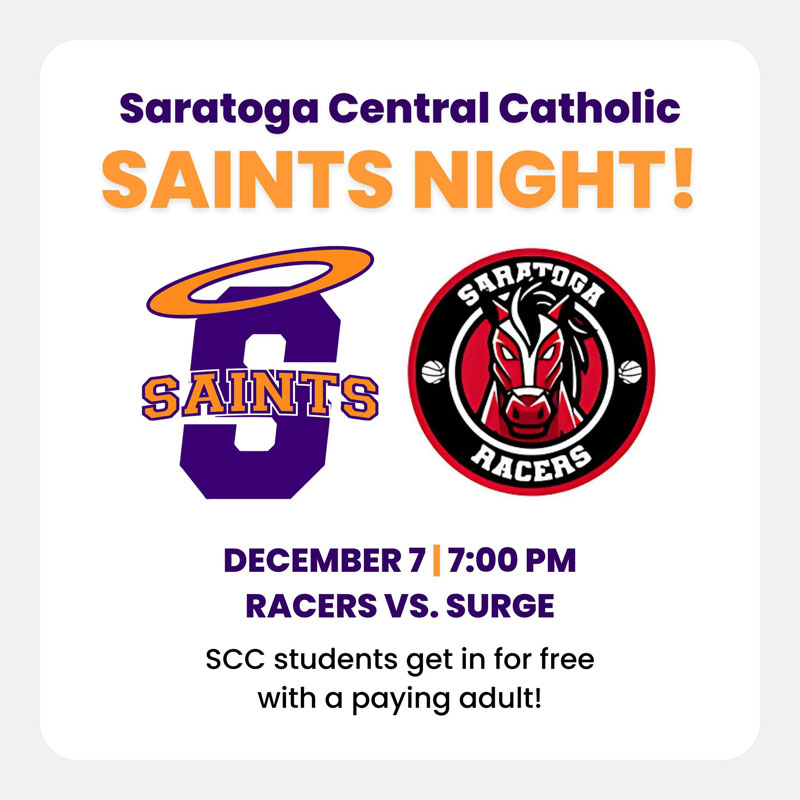
The Saratoga Racers will host “Saints Night” on Saturday, December 7 when all Spa Catholic students can attend a Racers game for free with a paying adult. Image via Saratoga Central Catholic.
SARATOGA SPRINGS — The Saratoga Racers of the American Basketball Association (ABA) hit the road last month after beginning their inaugural season with three straight home games played at Saratoga Central Catholic.
The team avenged a home loss earlier in the season by defeating the Herkimer Originals 124-114 on December 1. Three weeks prior, the Originals topped the Racers 140-120.
Coach Bob Catherwood credited the Racer’s second half defense as a key to the victory.
“They have a tremendous shooter in [Josh] Gregory. He didn’t miss. But we found him in the second half and played much better defense,” Catherwood said in a team press release. “I scouted them in-person last weekend and watched other teams on film against them and decided I was going to go zone and it worked very well. It was a good move for us. The guys played it well.”
Tobias Holmes led Saratoga with 25 points. RJ Rosa added a season-high 22 points including a 5 for 7 effort from behind the arc. Big man Shaheem Sanders contributed a double-double with 17 points and 15 rebounds.
With the victory, Saratoga improved to 4-2 on the season.
The Racers will be back at home this Saturday, December 7 when they host the Connecticut Surge at 7 p.m. at Saratoga Central Catholic. All Spa Catholic students will be admitted free to the game with a paying adult.
Racers Nationally Ranked for First Time
Last month, the Racers were nationally ranked for the first time in team history in the ABA’s weekly Power Rankings. Saratoga earned the No. 24 spot out of 150 teams for the week of November 18.
“Teams try for years to crack the ABA Power Rankings,” said Racers owner Keith Harrington. “We did it in just our fourth game of existence.”