Russ VanDervoort is the Waterford Town Historian, leader of the Waterford Canal and Towpath Society and a Trustee of the Saratoga County History Center. He is the author of several books on Waterford history and can be reached at russvandervoort@gmail.com
What symbolizes the month of July? We addressed that question on Google. This was their reply. All in all, the symbolism of July speaks of boldness, regality, and outdoor adventures; joy, contentment, and a great deal of fun in the sun. Is this month going to be one of contentment, fun and/or adventure for you? We believe that Fred Currier of Waterford would have had a different response.
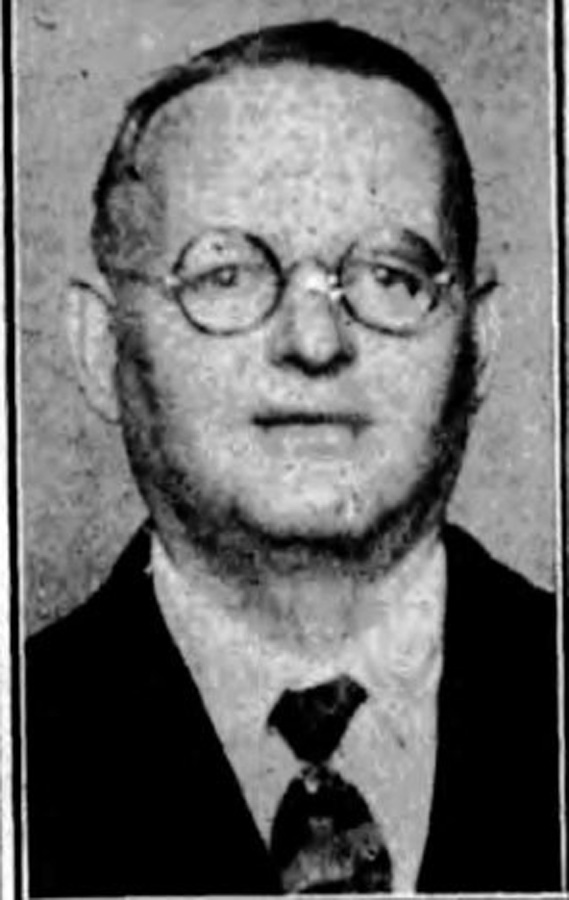
Fred was a man of many interests. His actual name was Alfred, but he was known as Fred. For seventeen years, he was a Waterford Town Constable. In 1921, Governor Nathan Miller appointed him Division Superintendent of Canals. When that commission was up, he returned to law enforcement as a Deputy Sheriff, later becoming a Day Jailer. It was his work in law enforcement that would cause Fred to have a different outlook on July than Google’s definition.
Our story begins in late evening on June 30, 1919. It would be July 1, by the time this story ended. Pietro Corso, a recent Italian immigrant, had found employment at the Eddy Valve in Waterford, had bought a small lot in the Dial City Section, and by all accounts was doing well. So well that the local Black Hand had taken an interest in his well-being. The Black Hand was reputedly an American branch of the Mafioso extortion group. Pietro, fearing for his family’s safety after they were visited by several Black Handers, roughed up, threatened and scared, contacted local authorities for help. The County Sheriff and Waterford Constables devised a plan for Pietro’s safety. On this night, Deputy Sheriffs Clarence Hovey, Patrick McCarthy, and Howard Dodge, all of Ballston Spa, along with Constables Fred Currier and William Naylor of Waterford, were dispatched to Dial City to protect Pietro and family.
It should be noted that neither Pietro nor his wife was well-versed in English; none of the listed people were known to the Corsos, and they didn’t know they were coming. It was reported in the July 1, 1919 Saratogian that Pietro saw five men approaching his property, three from the front, and two from the side. The street was poorly lit, and it was very dark. Fearing they were the “Blackhanders,” he opened fire with a shotgun and a revolver. As Currier and Naylor approached, they were fired upon. They were both struck. Dodge and McCarthy fell to the pavement as the second shots rang out, filling Hovey’s legs with shot as he was running behind a tree. Pietro then fled the scene; it was many days before he was located. As anticipated, Pietro thought the men were the Blackhanders he feared. All the wounded officers recovered. Fred, who was shot in the right eye, did lose the use of that eye.
After Pietro fled the scene, Mrs. Corso, who could speak some English, offered her account to the officers. She stated the following. Her husband had obtained a small piece of property, a short time ago. He soon bought a house and had it moved from the Village to the Dial City area. They obtained a cow, some chickens, and two pigs. This seeming prosperity attracted the attention of some avaricious foreigners who sent threatening letters asking for money.
On Saturday night, about midnight, two men went to the Corso home, forced an entrance, and threatened to kill the wife. They slapped one of the children, and when Corso ran for his gun, they left. On Sunday night, someone burned out the eyes of their watchdog. Yesterday, another threatening letter was received, and Corso notified the police that he was expecting another attack would be made during the night. He obtained a shotgun and positioned himself near a window, while his wife and children hid in the back room. After firing twice, he ran from the house. A search for Corso was conducted for two days. When it was learned that the neighbors in Dial City, as well as the local constables, believed that Corso was a law-abiding citizen, no charges were levied, and Corso returned. Apparently, the Black Handlers sought a less combative target. No other activity was reported.
As far as we know, Fred’s Julys thereafter were relatively uneventful until July 28, 1928. He was now with the Sheriff’s Department in the capacity of Day Jailer. Incarcerated that day was Roy Brown, alias George Erwell Fellows, alias George Frank. Brown was jailed as the ringleader of a car-theft group operating out of a barn in Moreau. It was discovered he was wanted in Vermont for car stealing, New Hampshire for assault with attempt to kill, and Tennessee for murder. In the hours that followed, after a visitation by his alleged wife, someone reported they heard the sounds of sawing. Undersheriff George Knight, Night Jailer Benjamin Simon and Day Jailer Fred Currier entered Brown’s cell; Simon pulled the blanket off Brown, who displayed a pistol. He fired four shots, hitting Fred with each bullet.
In our time, we have to wonder how this could occur for a prisoner to come up firing while in custody. It was discovered, after the fact, that Brown had the practice of carrying a cleverly concealed, small-caliber pistol that hung from an interior worn belt, with a cloth holster between his legs. In those days, jailers didn’t check there. It was further discovered that, indeed, two bars on the exterior window of his cell had been sawn through. It was suspected that his alleged wife’s visit had been the source of the saw. Brown would later state that he had carried that in as well. Jailing procedures have advanced since 1928.
Although Fred Currier hovered near death for several days, he did make a recovery. He returned to work and eventually ran in a primary election for the office of Saratoga County Sheriff. He failed in the primary; it wasn’t held in July.
No charges were filed against Corso in the first Fred Currier shooting. Let’s examine the second shooting. George Edwell Fellows, alias Roy Brown, a notorious New England gunman, who shot the undersheriff, Fred Currier of Waterford, was arraigned in Ballston Spa on a charge of first-degree assault. It was soon determined he was also wanted in the state of New Hampshire. He was also wanted in Vermont, as Roy Brown, for automobile theft.
In some accounts, Fellows, or whoever he might be, was listed as a mild-mannered Vermont School Teacher, as well as a sharpshooter in the Marines.
Dell Fellows was charged with assault, to which he pleaded guilty and was sentenced to twenty-five years in prison. In early November, the doors of Clinton Prison in Dannemora, New York, closed behind George “Dell” Fellows, and he settled into the daily prison routine.
Fred enjoyed his retirement and suffered no more shootings.
Michael Murray is a 4th generation Saratogian fascinated by the history of Saratoga Springs and the people who made that history. Mike’s previous articles include “A West Side Story” about growing up near Woodlawn Oval and “Henry Hilton and Woodlawn.”
In 2026, the Saratoga Performing Arts Center marks its sixtieth anniversary of presenting classical and popular entertainment. For six decades it has served as the summer home of the New York City Ballet and the Philadelphia Orchestra. Its stage has welcomed touring Broadway musicals –“Your Own Thing” (1969) – “Fiddler on the Roof” (1970) – “Jesus Christ Superstar” (1971) – D’yoly Carte Opera Company (1976) – first opera “Boris Godunov” (1974) – Saratoga Newport Jazz Festival (1978) and in 1999 the theatrical spectacle “Riverdance”. Among its many milestones are record attendances exceeding 30,000, the first canceled performance, and, of course, the raising of the curtain for the very first time.
That curtain was raised for that first time in June 1966 for Governor Nelson Rockefeller’s dedication of the new Arts Center by three young college students, Andy (Yo-Yo), Pat, and Mike from Saratoga Springs. The young men were hired through the local chapter of the International Theatrical and Stage Employees Union as half of a six-man union crew that assembled the theatre’s stage. The local union negotiated with the Arts Center for a contract to supply a skilled work force for the theatre. After 2 weeks of work the Arts Center agreed to a three-year contract with the union local, insisting the three college kids work every show.
The college kid’s initial task was to move more than forty tons of stage counterweight – 32 pound cast iron ingots – from the loading dock across the building to stage right (audience left) and then up , via rope and bucket, 110 feet to the loading bridge.
The three young men had grown up together in Saratoga Springs, played football at Saratoga High and were in the same graduating class. In 1966 they were attending the same local community college and working as bartenders in various Saratoga Springs bars and restaurants. The local union made the young men apprentice stagehands and they were taught their craft by three veteran New York City stagehands, Artie, Bernie, and Roger, men who might have stepped out of a Damon Runyon story.
The three veterans invited the apprentices out for a night of carousing which ended when the bars closed. That first night on the town and other nights, the senior members of the sextet required the guidance of the young men to get to their beds. The following mornings, bright and early the three young men were on the job and hard at work when the veteran stagehands showed up, much the worse from the previous night. The New York City stagehands began referring to the young college kids as “the three bad kids”, a nickname that stuck for years and friendships that lasted a lifetime! The apprentices raised the curtain and helped prepare for every performance that inaugural season, including the opening ballet “A Midsummer Night’s Dream”.
The 1971 season – the Arts Center’s sixth – featured an August 2nd performance by The Who before 33,000 fans, as well as a scheduled June 25th concert by Mary Travers. A violent midday storm, on the 25th, changed everything. High winds toppled trees, limbs crashed onto power lines, and just under 2 ½ inches of rain fell in roughly an hour. Lightning struck repeatedly, Saratoga Spa Park lost more than 800 trees, and the Avenue of Pines became impassable. Yet, “the show must go on”.
The Arts Center itself was undamaged. At 3:30 p.m. the six man stage crew reported as usual to prepare for Mary Travers. The three young men who had begun as apprentices in 1966 were now veteran hands. The Arts Center had not yet announced any cancelation, and the performers had not arrived. The stage crew waited on the loading dock.
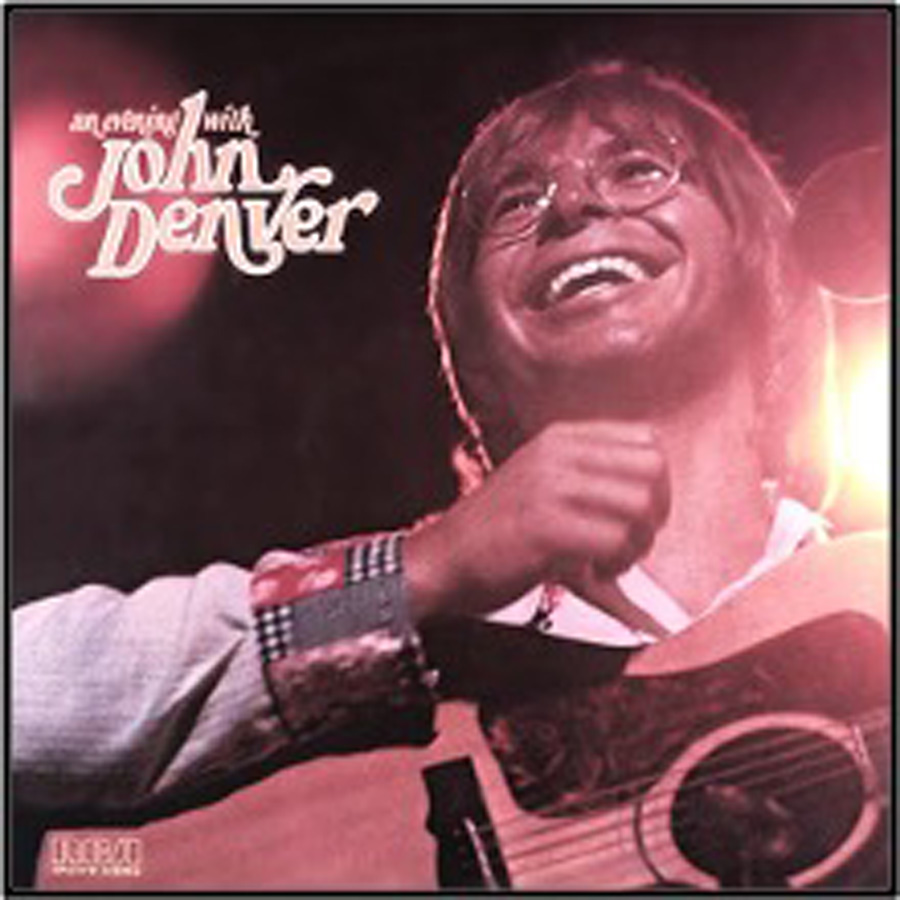
A little before 4 p.m. an older station wagon pulled up to the loading dock. A young man with long blonde hair stepped out and took two guitars from the station wagon’s rear – the signal, the crew thought to begin work. He only had four guitars and no useful information. The hands adjourned to the crew room for coffee. Five minutes later the same long-haired guitarist appeared at the door, asked for a cup of coffee and if he could join them.
He sat down, introduced himself as John Denver (“who?”) and spent the afternoon and early evening with the crew, sharing their dinner of pizza and beer. Eventually the Mary Travers concert was formally canceled, however 1,400 ticket holders had taken their seats in the auditorium. Travers and Denver were called into a meeting with Arts Center management. They agreed to perform a short set for the waiting audience. The full Mary Travers concert was rescheduled for September. For just under an hour, the two folk singers turned the amphitheater into a coffeehouse. “The show did go on…”
Three years later, on August 4, 1974, John Denver returned to the Arts Center as a superstar. He arrived not in a station wagon but with four tractor trailers of scenery, sound and lights. Early in the load-in he stepped onto the stage, got everyone’s attention and shouted the names of all six stagehands from that rainy late afternoon in 1971 – followed by a jubilant “Far Out” as he gestured to the trucks at the loading dock. The long-haired guitar player had remembered his Saratoga time with the stage crew – and every single name.
The three “bad kids” continued to work at the Arts Center for many summer seasons – Mike served as the local union’s president for 20 years – while enjoying successful careers in unrelated fields. Through their years as stage hands the “bad kids” worked with and met many show business personalities and savored many wonderful memories. Memories like playing volleyball with the band “Huey Lewis and the News” after the band’s sound check, or advising Hal Holbrook about where to go for dinner, or having a chat with Frank Sinatra after his performance (“great show kid”) while his security men anxiously urging him out the door, and many more such memories.
More than the memories are the relationships formed through the often intense teamwork of putting on a show. Those relationships lasted lifetimes and often touched multiple lives. Many family members of stagehands became stagehands through family contacts, and thus the original relationships live on into the next generation.
Two of the seven men – six stage hands and one future superstar – who shared pizza and beer on June 25th 1971 are still living. Pat and Mike, former “bad kids” – and yes, they are of Irish descent – cherish their life-long friendship and shared memories.
Photo provided by The Saratoga County History Center.
Don Carola Is a local history buff and Revolutionary War reenactor. He is a retired manager for the NYS Office of Information Technology. Don lives in the Town of Halfmoon and is married with two daughters.
When Leon “Frog” DeCelle left his small hometown of Mechanicville, N.Y., on December 10, 1942, for induction into the U.S. Army, he set out on a journey that eventually took him to some of the toughest fighting in Italy during World War II, including the Gothic Line and the Po Valley campaigns.
Upon his return home in the winter of 1945, he started a yearly reunion with a life-long friend.
Leon was born November 4, 1915, in Corinth, N.Y., in the foothills of the Adirondacks. He was the ninth child of Albert and Mary DeCelle. In the mid 1920’s the family moved to Mechanicville where the DeCelle name would be synonymous with local baseball as the DeCelle boys – older brothers Alfred and Edward – were very good ballplayers – and Leon was the bat boy.
Leaving with Leon on that cold December day was George Luther, who was also heading into the Army. I am sure they had a lot to talk about but also sure they shared hope that they would see each other and their families again.
Leon did basic training at Fort Jackson in South Carolina, followed by Ranger training and assignment to the Ranger detachment of the100th Infantry Division, known as the “Century Division.”
Leon was transferred to the 91st “Powder River” Division as a replacement in Company I, 3rd Battalion of the 363rd Regiment. At this time, the 363rd took significant casualties during the Rome-Arno campaign in the battles of Channi and Bagni. Leon arrived in Italy on July 15, 1944, and was sent up to the front.
The Gothic Line was series of fortifications, machine gun nests and minefields extending across northern Italy’s Apennine Mountain range from the Tyrrhenian Sea on the west coast to the east coast on the Adriatic Sea. The Line prevented the Allies from accessing the Po Valley and eventually advancing into southern Germany. The line would fluctuate and move at each Allied advance, making for tough defenses and difficult fighting.
On September 12, 1944, the 363rd started out to capture the Il Giogo Pass by taking Monticelli to the west of the pass and Monte Altuzzo to the east. On September 13, Company I stormed the 2,390-foot crest of Monticelli to within 400 feet only to be turned back by accurate machine-gun fire and barb wire.
The regiment returned to base with 25 wounded, including the company commander, Captain Willie Kriel. Their base at I’ Uomo Morto was in direct sight of the defensive heights of Monticelli and received much attention from the Germans for the next few days.
Multiple attempts were made over the next week to reach the top of the two mountains. On September 17, at 2 p.m., the 3rd battalion advanced behind a rolling artillery barrage with Company I following Company K up the hill. Just before 3 p.m., Captain William B. Fulton of Company K radioed that he was on the top of Monticelli with 10 men.
Lieutenant Joseph Wessendorff of Company I heard the same message and rallied six platoons to the top by dusk to help hold Monticelli. Leon, physically unscathed, was among that group. The Germans had to withdraw, leaving the pass open for Allied troops to eventually move forward into the Po Valley.
Two of many heroic actions stood out.
Sergeant Joseph D. Higdon, Company A, was wounded by advancing Germans. He rose from his fox hole with his light machine gun blazing to drive back the enemy. The Germans retreated but not before mortally wounding him. He died 30 yards from his fox hole trying to return to his buddies.
Another example was described by Private First Class Ben Kelley, Company I machine gunner, who described a night attack on their forward position. Low on ammunition and with only two grenades, the Americans started to toss mud balls. The moonlit night caused the Germans to think they were grenades and retreated. Kelley’s squad would then toss a live grenade to keep them guessing. Eventually the Germans gave up the attack.
For their heroics during the Italian campaign, Lieutenant General Mark Clark, American commander of the Fifth Army, wrote a congratulations letter to the Fifth and Eighth Armies praising them for their courage and victories. Later, Clark’s replacement, Lieutenant General Lucian Truscott Jr. awarded the Distinguished Unit Citation to Leon’s battalion. Leon and Frank Michon, of Green Island, N.Y., received the Distinguished Unit Badge for taking part in the conquest of Monticelli Ridge
Leon would continue the fight in Italy, seeing some of the fiercest combat in World War II. He would be a part of the Po Valley campaign, at Armigo and Cologna, in April 1945. At the end of the war in Europe, his regiment was moved to Treviso in northeastern Italy for occupation duty. He sailed home on August 14, 1945, from Naples on the S.S. Pachaug Victory and discharged from the Army on November 20,1945 at Fort Dix in New Jersey.
During the Italian campaign, I Company’s 3rd Battalion had a peak muster roll of 492 soldiers. They would serve 127 days on the front line and 121 days in reserve. The company’s casualties were listed as 17 missing in action, 57 killed in action, three deaths from wounds, 48 serious wounds, 94 lightly wounded and 17 injured for a total of 236. That represented a 50% casualty rate.
Battalion soldiers were awarded 10 Distinguished Service Crosses, 147 Silver Stars, 13 of which went to Company I soldiers, including four posthumously. A Medal of Honor was awarded to Sergeant Oscar Johnson of B Company, 1st Battalion, for his bravery during the battle for the Il Giogo Pass.
Leon and George Luther, who set out for the Army on the same day in 1942, both arrived back in Mechanicville on the same day in December of 1945. George attained the rank of sergeant while serving in the Pacific. They would go on to celebrate this day each year by meeting at a local bar or VFW post for a beer.
Leon married Elizabeth Burton and have three children: Dawn, Doreen and Dan. He passed away on St. Patrick Day 1979. Betty would join him on February 9, 2014.
While I knew my Uncle Leon (aka Uncle Frog) was in the war, I never knew details about his service. My cousin Doreen shared a box of his war records with me so that I could preserve them electronically. “He never talked about the war,” she said. “When the topic arose, he would simply say, ‘I’m a vet, I served my country.’” To ensure that statement stands for all time, his granddaughter, Janine Iamunno, enrolled his name in the World War II memorial in Washington D.C.
If you drive down Main Street in Mechanicville and look at the Hometown Heroes banners hanging from telephone poles, in front of the old school you will find Leon and George Luther’s banners next to each other – just like they were when they left home in 1942. Source: History of the 363rd Infantry Regiment by Ralph E. Strootman
While the most notable contribution of Saratoga County to the American story may be the battles that took place here, it’s not where our contributions end.
Saratoga County has been home to some of the most influential Americans to ever live, people who contributed to our shared success in numerous wars, and blazed trails that have been followed by millions of Americans.
While the battle may have ended on October 7, 1777, our story didn’t. Here are some events, people and innovations that shaped the history of this nation from Sea to Shining Sea.
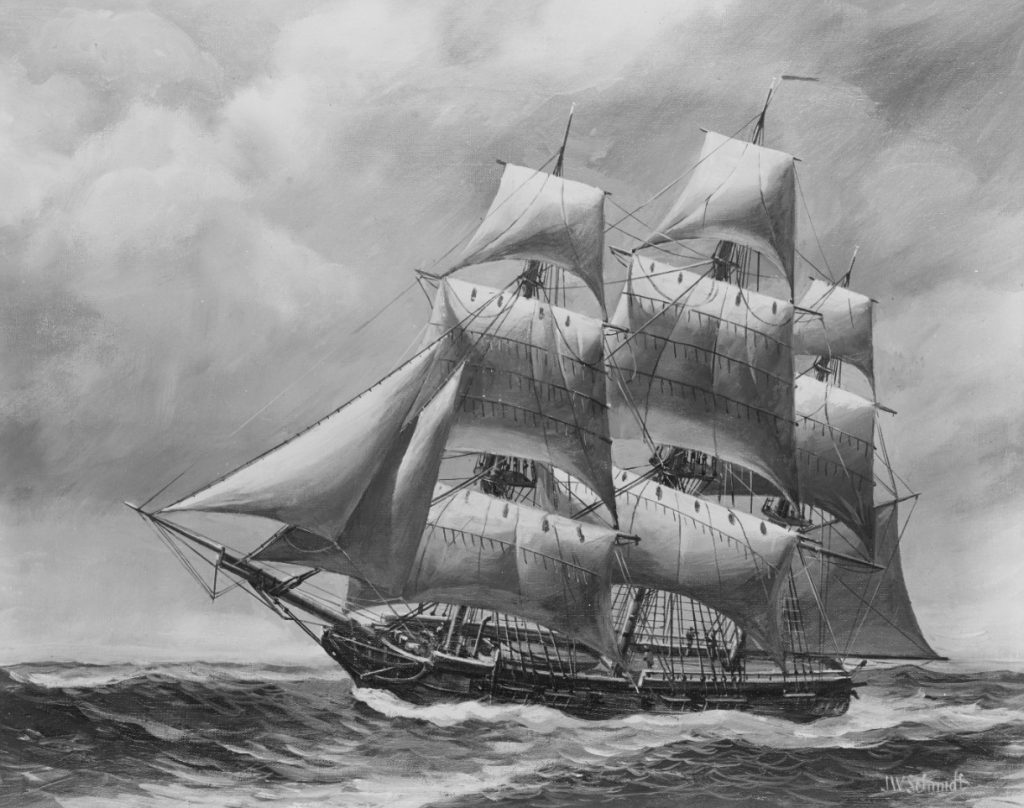
1780 – Saratoga I is Launched Less than three years after the Battle of Saratoga, Saratoga’s name would be placed on a U.S. Navy warship for the first time. The Saratoga I was a 68 ft, 150-ton sloop armed with 16 nine-pound cannons and two four-pound cannons. It had a crew of 86 personnel and was launched from Philadelphia on April 10, 1780. During its career the ship was responsible for capturing or recapturing 12 British or American ships. She was lost on March 18,1781 and was the first of six ships to bear her name.
These ships include a Corvette launched in 1814 which saw action in the Battle of Plattsburgh, a sloop of war which saw constant decommissioning and recommissioning from the time it was launched in 1842 to when it was sold for scrap in 1907, a cruiser which was renamed three times, and two aircraft carriers — the first of which deserves its own entry on this timeline.
The First ship to bear Saratoga’s name served for only a year but managed to capture 12 ships (Courtesy of US Navy Heritage Command)
1802- Gideon Putnam Builds what becomes Grand Union Hotel- One of the most prominent features of Saratoga County is the mineral springs. World renowned for their health benefits, the springs brought thousands of visitors, including prominent aristocrats and world leaders, to Saratoga County — specifically Saratoga Springs and Ballston Spa. While it’s true that Ballston Spa was the first to take advantage of this, building two hotels in 1792, Saratoga Springs would have more staying power.
The first to take advantage of this was Gideon Putnam who built what would become the Grand Union Hotel in 1802 in the vicinity of the Congress Spring. Putnam would lay out much of what would become Saratoga Springs, tubing and connecting its springs. Putnam was in the process of building Congress Hall when he died in 1812.
While the opening of a hotel may seem like a trivial event in the broad story of the American mosaic, its impact can be seen both in what Saratoga became and the places it inspired. The list of famous figures to visit Saratoga Springs and their significance on American history could go on for pages, and the legacy of Saratoga Springs can be seen in the places named for it in Utah, Nebraska, California and Disney World. And, yes, the paper does regularly get calls from people thinking we are in Utah or California.
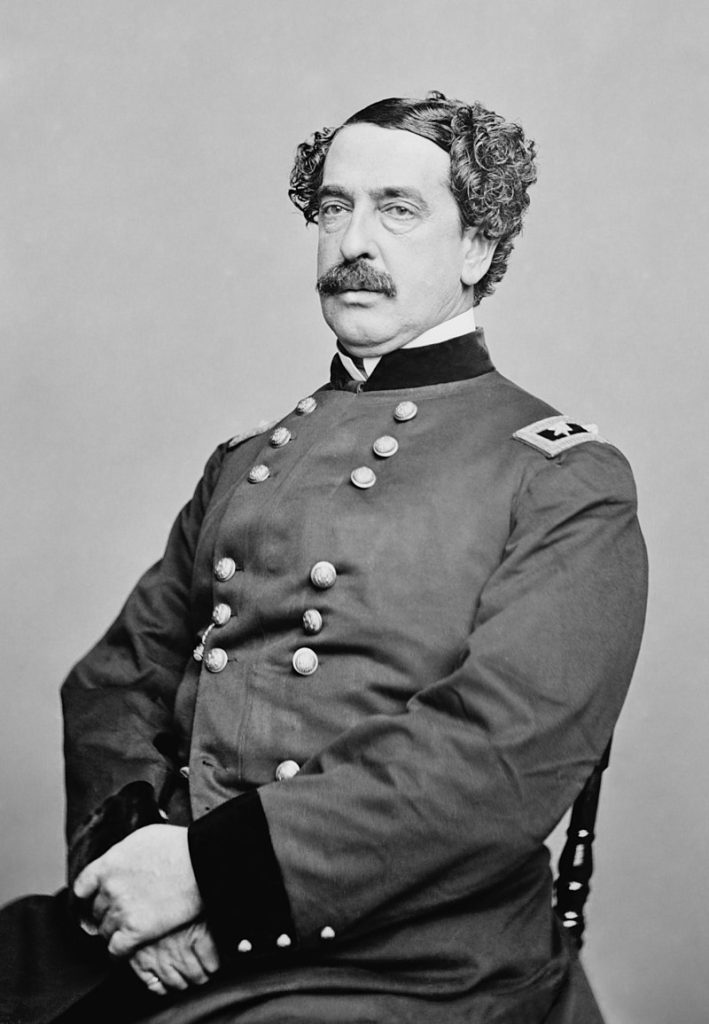
1819- Abner Doubleday is Born in Ballston Spa- As legend goes, baseball was created by Abner Doubleday in Cooperstown, New York in 1839. This story is based on the 1907 Mills Commission report which was largely influenced by Abner Graves’ testimony.
While the story has been refuted due to the fact that Doubleday’s diaries make no mention of baseball, he never claimed to invent baseball and would have been in his plebe year at West Point when the story is supposed to have happened, what is true is that Doubleday had a pretty remarkable life, even without inventing baseball.
Doubleday was the second-in-command at Fort Sumpter at the very start of the Civil War and fired the first shots of the Union Army. Doubleday commanded troops throughout the conflict in many notable battles. His most famous moment came in the Battle of Gettysburg when he took command of I Corpe and repelled a numerically superior force. Throughout his career, Doubleday is reported to have ordered baseball bats and balls for his troops because he believed sports were a good way to build unit cohesion.
While Cooperstown may be the birthplace of Doubleday’s myth, the man himself was born in Ballston Spa.
Baseball or no baseball, Abner Doubleday’s story is still worth telling, and that story began in Ballston Spa. (Courtesy of Library of Congress)
1825- Erie Canal Completed- The Second of the two Canals in Saratoga County, the Erie Canal was completed in 1925 with the ceremonial dumping of water from Lake Erie into New York Harbor on November 4, 1825. The canal’s completion would fundamentally shape New York and connect New York City to Midwest markets in Michigan, Indiana, and Ohio. It drastically reduced the cost of transporting goods, meaning that agricultural products made in those Midwest states could be shipped to New York.
The cost of transporting a ton of goods from Lake Erie to New York City went from $100 to $9, and freight traffic surpassed that of the Mississippi River. This prosperity propelled New York to become the largest port in the country within five years and led to the boom in cities such as Syracuse, Utica, and Rochester.
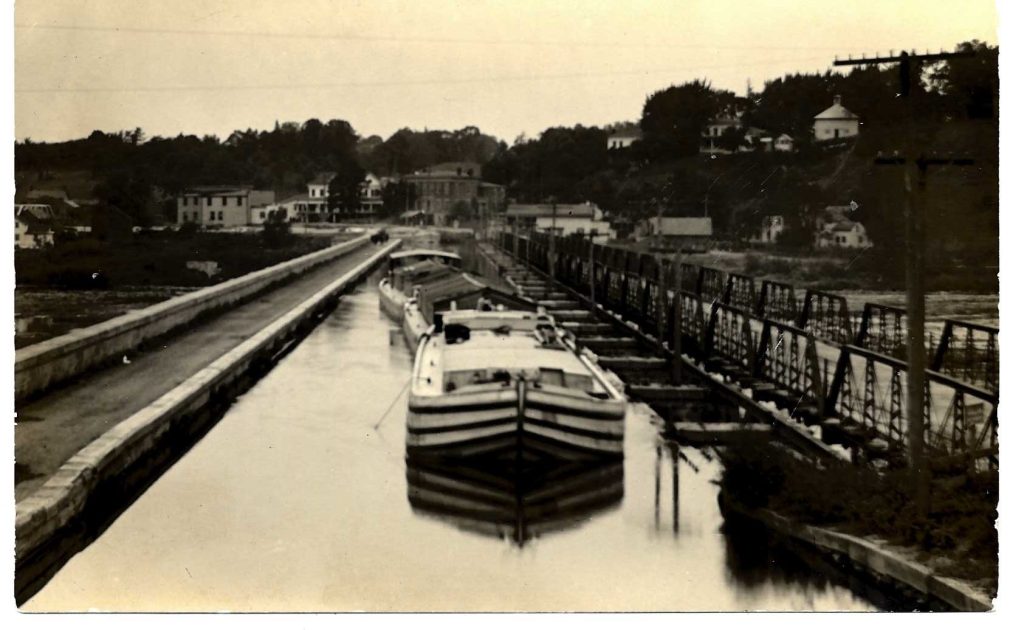
Saratoga’s connection to this route can be seen in the southern part of the county in Halfmoon and Waterford. Originally the Erie Canal bypassed the Cohoes Falls through a series of locks in Cohoes before crossing the Mohawk River at the Lower Mohawk Aqueduct in Halfmoon — today the site of the Crecent Bridge. In 1918, new locks to facilitate barge traffic were completed which bypassed the Cohoes Falls to the north in Waterford.
Canal Boats transit the Lower Mohawk Aqueduct in the Town of Halfmoon (Courtesy of CPH Library Local History).
1841- Saratoga Springs Resident Solomon Northup is Kidnapped into Slavery – In April 1841, Solomon Northup, a free Black man living in Saratoga Springs and working various jobs was enticed by two circus men to travel with them to Washington, DC as a traveling musician.
In Washington, Northup was drugged and kidnapped into slavery beginning a 12-year ordeal. Northrup was held in slavery in Louisiana under the name Platt Hamilton. In 1842 Northup was sold to plantation owner Edwin Epps for $1,500, where he would remain in bondage until 1853. Northup’s ordeal ended after Epps hired a Canadian Carpenter by the name of Samuel Bass. Bass in June 1852 managed to get two letters to William Perry and Cephas Parker who were friends of Northup in Saratoga. The two men contacted Northup’s wife and an attorney named Henry Bliss Northup whose relatives had at one point owned his father.
Henry Northup soon gathered documents to show that Solomon Northup was a free man and in bondage in Louisiana and received permission from New York Governor Washington Hunt to travel to Louisiana and rescue Northup in accordance with New York law. Henry Northup first went to DC to receive the backing of the Secretary of War and one of Louisiana’s senators. He contacted Bass in Louisiana who instructed him on where to find Solomon Northup and successfully freed him on January 3, 1853. That year Solomon Northrup and David Wilson would publish a book “Twelve Years a Slave,” which recounted his time in bondage. In 2013, the book was adapted into a movie which was nominated for 315 awards and won 145 of them — including three Academy Awards.
12 years a Slave Solomon Northup, as depicted in Twelve Years a Slave
1861- Malta Man is First Union Officer Killed in Civil War- The first officer to give his life in support of the Union cause was a man from Malta — Elmer Ellsworth. Ellsworth was born in Malta in 1837, grew up in Mechanicville and made his way to Illinois in 1854. Ellsworth, who had a fascination with all things military history, formed a militia company based on the French Zouave Regiment. The Company was known for its discipline and soon grabbed the attention of a Springfield lawyer by the name of Abraham Lincoln. The two became close friends with Ellsworth working in Lincoln’s law office as a clerk and participating in his 1860 presidential campaign.
When war broke out, Ellsworth returned to New York and recruited a 1,100-man unit, the 11th New York Infantry Regiment. Known as the “Fire Zouaves” due to its heavy recruitment of New York City firefighters, this unit was tasked on May 24, 1861, with crossing the Potomac River to seize Alexandria, VA. After the city was secure, Ellsworth went to a hotel to take down a Confederate flag that flew over it. While he was carrying down the captured flag, Ellsworth was shot and killed by the hotel owner, James Jackson. Jackson was then immediately killed by one of Ellsworth’s men who later received the Medal of Honor for this action.
Ellsworth’s death became an early rallying cry for the Union cause. His body lay in State in the White House before being buried in Mechanicville. Spurred by his death, another regiment, the 44th New York, was formed with the nickname “Ellsworth’s Avengers.”
1863- Thoroughbred Racing Begins at Saratoga- The so-called “Mecca of American horse racing” got its start mere weeks after the battle of Gettysburg. At the time, horseracing wasn’t new in Saratoga Springs as harness racing had been going on since 1847 at the Saratoga Trotting Course. In August 1863, the track would see something new to the Spa City and put its place on the map for the next 166 years: thoroughbred racing.
On August 3, 1863 — a month to the day after the Civil War’s turning point — the Irish born bare-knuckle boxer John “Old Smoke” Morrissey held the first thoroughbred race in Saratoga Springs at the Trotting Course. While the number of horses was limited, the crowd wasn’t, with 15,000 people attending. The next year Morrissey along with Leonard Jerome, John Hunter and William Travers would build the Saratoga Race Course as the Trotting Course was deemed to be too small for their operations.
Morrissey’s race paid off for the city. Already a resort town with its spas and springs, Saratoga Springs became a hub of gambling and horse racing for years to come. In 2024 with its normal home down for maintenance, the Belmont Stakes were held in Saratoga Springs, adding a jewel to the Saratoga Race Course’s history of excellence.
1885- Ulysses S. Grant Dies in Moreau – While Ellsworth and Doubleday may have commanded troops when the Civil War began, it was Ulysses S. Grant who commanded its conclusion. And as the two Saratoga County born officers started their stories Upstate, Grant would end his here — both literally and figuratively.
Dying of throat cancer, the former 18th president and General of the Army made his way to a cottage on Mt. McGregor in the Town of Moreau in June 1885. The cottage was owned by a friend of his who offered it as a quiet respite to spend his finals days. It was here where Grant finished his memoirs on July 18, 1885, and died on July 23. His body would be transported to New York City where it lies in a grand tomb in Upper Manhattan.
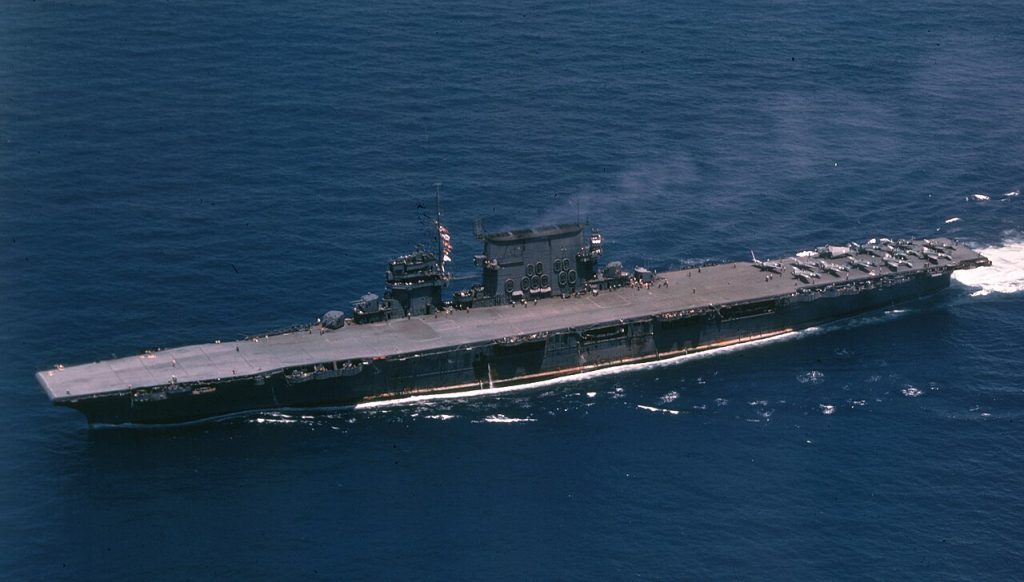
1925- USS Saratoga (CV-3) Launched- The fifth ship to carry the name Saratoga, the USS Saratoga (CV-3) had arguably the most interesting service run of the six “Saras.” She was originally designed and laid down to be a battle cruiser, but post-World War 1 naval limitations forced Navy planners to find a new role for her. That new role was to become one of the Navy’s first fast aircraft carriers. Launched in 1925 and commissioned in 1927, the Saratoga helped the Navy develop its tactics and train aircrews in the leadup to World War 2. She was in San Diego when Pearl Harbor was attacked and sortied to Pearl Harbor shortly after. In January 1942, she was struck by a torpedo and missed the Battle of Midway due to subsequent repairs.
The ship would take part in the invasion of Guadalcanal and the subsequent Battle of the Eastern Solomons, sinking a light carrier in the process. Throughout 1943 and 44, she would take part in several campaigns throughout the Central and South Pacific, striking targets and providing air cover to invasions. In February 1945, Saratoga was providing air cover for the invasion of Iwo Jima when she was struck by five bombs and three aircraft. After repairs in Washington, she spent the rest of the war as a training ship.
At war’s end, Saratoga was used to ferry troops home from the Pacific theater as part of Operation Magic Carpet. She ended up transporting 29,204 personnel, the most of any ship. When she retired from service, aircraft had completed 98,549 carrier landings on her deck, the most of any ship at the time. Her end would come in 1946 when she was sunk by the second of two atomic bombs during Operation Crossroads.
The USS Saratoga served for nearly 20 years and was one of the US Navy’s first modern carriers
1945- Malta Test Site Begins Operations-
In order to test rocket rockets seized from the Germans in World War II and develop our own capabilities, the nation turned to Saratoga. In 1945, General Electric established the Malta Rocket Test Station to test rocket engines, fuels and other weapons for the military. At the site, rockets would be held in the gantries and tested prior to flight tests elsewhere the United States. Rockets tested at the site included the Bumper, Vanguard Vega, Discoverer, Centaur, Polaris and Skybolt rockets. In 1964, GE sold the site to the New York State Energy Research Authority and later the Wright-Malta Company.
The site continued to test ordinance for the US Army when Global Foundries took over the site as part of their technology campus making semi-conductors.
1955- Kesselring Site begins Operations. It’s not just the USS Saratoga that ties Saratoga County to nukes and the navy. While initially built as a test site for nuclear reactors, it was quickly transformed into a training center and research facility to assist sailors and officers training for duty on-board nuclear-powered Navy ships. Over 50,000 sailors have trained at the site, including future President Jimmy Carter. The site is still in operation today, training sailors on the S8G nuclear reactor in use on Ohio Class Submarines.
This Independence Day, it is worth reflecting on what the Founding Fathers meant when they used the term “independence.” On one level, July 4th is about our national independence, securing for America the “separate and equal station” befitting of a sovereign country. On another level, the founders sought to recognize and promote the political and economic independence of the American people, setting forth the continuous project of maintaining an independent American mind.
For a first glance at what the Founders meant by “independence, it may actually be helpful to consider Noah Webster’s 70,000-word American dictionary from 1828, which is often cited by the Supreme Court to evidence the original meaning of the Constitution and is credit with, “capturing the language of the new nation.” That dictionary offers these varying definitions of independence:
1. A state of being not dependent; complete exemption from control, or the power of others; as the independence of the Supreme Being.
2. A state in which a person does not rely on others for subsistence; ability to support one’s self.
3. A state of mind in which a person acts without bias or influence from others; exemption from undue influence; self-direction. independence of mind is an important qualification in a judge.
These versions of independence are related, interact in important ways, are grounded in nature, and have limits, as can be discovered by examining the writings of the Founders further. Exemption from control is the right of self-government, which is accompanied by corresponding duties. Economic independence is freedom to use one’s talents and abilities to obtain property and support one’s self, but also to secure the good life. Independence of mind, which enables one to direct the will toward justice, is the culminating freedom of an economically independent, self-governing citizen.
While Founders like Thomas Jefferson, James Wilson, and Mercy Otis Warren used “independence” in varying ways, none of their definitions is synonymous with the radical autonomy that progressives push today. When considering the conditions of the time and place that the Founders found themselves in—that is, putting their ideas in the proper context—this becomes obvious. Individual independence for the Founders is always situated within a transcendent moral order, human nature, and an understanding of what enables human flourishing.
The first usage of the term “independence” refers to the right of self-government. In Thomas Jefferson’s original draft of the Declaration of Independence, he wrote that, “all men are created free and independent,” reflecting the language of the Declaration of Rights in his home state of Virginia. “Equal,” which was the word used in Jefferson’s final draft, is related to this understanding of “independence.” Both carry with them the connotation of self-ownership or self-government. As James Wilson explained, “All men are, by nature, equal and free: no one has a right to any authority over another without his consent: all lawful government is founded on the consent of those who are subject to it: such consent was given with a view to ensure and to increase the happiness of the governed, above what they could enjoy in an independent and unconnected state of nature.” The Founders considered that mankind’s independence exempted him from the arbitrary rule of fellow human beings and that his nature fortified him with the dignity of self-government.
But exemption from undue human rule does not elevate mankind above the dictates of nature. As Wilson further explained, “Justice, I tell him, is a part of the law of nature; give me a reason drawn from human authority… Humanity is a duty; generosity is a virtue; but neither is to be referred to human authority.” In other words, citizens are obliged to fulfill the obligations they have consented to undertake through the social compact. However, certain virtues and duties are not derivative of consent but rather ingrained in the nature of human beings, meaning that men and women can never will themselves to become independent of a higher order. As Jefferson succinctly articulated, the people “are inherently independent of all but moral law.” While each individual is free to govern his or herself, he or she is also obliged to aim towards virtue and strive for reason to govern passions, impulses, and desires.
This understanding of man’s nature forms the basis of another kind of independence the Founders believed characteristic of republican citizens: economic independence. Per the Declaration of Independence, all citizens, being naturally equal, have the right to pursue happiness. That is, they have the right to pursue “something like occupying one’s life with the activities that provide for overall wellbeing,” as professor of political science James R. Rogers put it. What it doesn’t constitute, though it is often taken to mean as much, is a prescription to a licentious or morally relativistic pursuit of economic success at all costs.
Of course, economic freedom includes a right to “material things,” but—as always with the Founders—this freedom is imbued with an ethical dimension and thus goes beyond the material to touch on “humanity’s spiritual and moral conditions.” Individuals’ talents and abilities are justly utilized in securing temporal prosperity and security, but also in fostering virtues within themselves so they are more capable of fulfilling the obligations of self-government. The Founders’ understanding of what individuals can and cannot do was always placed in the broader context of a moral order consistent with the life well lived. In short, the pursuit of happiness is both a right, and prescription to live the good life.
This understanding of the pursuit of happiness, and American natural rights more broadly, is especially clear in James Madison’s view of property. As he put it, property is not just physical land. An individual also has “equal property in the free use of his faculties and free choice of the objects on which to employ them. In a word, as a man is said to have a right to his property, he may be equally said to have a property in his rights.” As noted in Federalist 10, the primary object of government is to protect the faculties of men, which are diverse and naturally give rise to differences in property. Which is to say, because men and women are equal, they own their unique talents and abilities, and should be able to utilize those gifts without any hinderance by arbitrary barriers.
This definition of economic independence is brought into clearer focus when we place it in context by contrasting the American regime with the British aristocratic system the Founders were seeking to replace. In aristocratic societies, gentlemen rely on those under their auspices to work; having leisure time is a mark of status and labor is looked down upon. Republics, in contrast, elevate the dignity of honest work and merit-based achievement. The many are independent and free to rely on their own talents and abilities rather than being dependent on the patronage and whims of a few aristocrats whose rule results from an accident of birth. Consequently, individuals in the American system were far more economically independent and upwardly mobile than was possible or permissible in the United Kingdom.
This emphasis on individual talents, however, did not lead to radical autonomy. The absence of aristocratic hierarchies in America demanded interdependence within families and communities. French political philosopher Alexis de Tocqueville observed that:
In aristocratic societies men have no need to unite to act because they are kept very much together. Each wealthy and powerful citizen in them forms as it were the head of a permanent and obligatory association that is composed of all those he holds in dependence to him, whom he makes cooperate in the execution of his designs. In democratic peoples, on the contrary, all citizens are independent and weak; they can do almost nothing by themselves… They therefore all fall into impotence if they do not learn to aid each other freely.
Clearly, being an independent American is not equivalent to being an autonomous individual, but rather a competent and industrious one who labors to take responsibility for him or herself, family, and community. With the severing of feudal ties and the rise of nuclear families over intergenerational ones, the republican citizen is, in a sense, even more dependent on those closest to him.
The third definition of independence invoked by the Founders was independence of will, which is a mind directed towards justice and supported by the moral qualities fostered by self-government and economic independence. The first two definitions of independence are prerequisites for independence of will, the culmination of their interaction.
Historian and Founder Mercy Otis Warren provided a robust description of people who achieved this independence of will. Writing approvingly of a Boston assembly, she noted that it was “composed of the principal gentlemen and landholders in the province; men of education and ability, of fortune and family, of integrity and honor; jealous of the infringement of their rights, and the faithful guardians of a free people. Their independency of mind was soon put to the test.” Individuals with independent minds know what they are about. Their self-direction (a qualifier in Webster’s third definition) can survive being tested by others because it is fortified by and directed towards a justice superior to human will. Such citizens have upstanding characters, are committed to republican principles, and put the common good above their own self-interest. By pursuing a liberal education and being well-informed about public affairs, they can be elevated above the deception of conniving, self-interested individuals.
As economic independence and political self-government inculcate and reinforce one another, independence of will gradually forms. Equal citizens, for example, are free to use their talents to secure their stability and advance prosperity to better fulfill the obligations of self-rule. In turn, those who are economically free tend to develop the spiritedness characteristic of republican citizens. As Warren (and John Adams) argued, “both public and private virtue sink with the loss of liberty, and that the nobler emulations which are drawn out and adorn the soul of man, when not fettered by servility, frequently hide themselves in the shade, or shrink into littleness at the frown of a despot.” Living under tyranny enfeebles men and women whose behavior and spoken opinions are influenced by those upon whom their livelihoods depend. Individuals who cannot freely set their opinion against others can be deprived of a deliberative mind. Being economically free helps guard citizens against political tyranny and supports the development of an independent will.
Independence of will had serious implications for voting regulations, but many such regulations were matters of condition. To be clear, the Founders did not believe any human being is naturally inferior, but they did believe that some people were more likely to be subject to undue influence. As Alexander Hamilton, wrote:
If it were probable that every man would give his vote freely, and without influence of any kind, then, upon the true theory and genuine principles of liberty, every member of the community, however poor, should have a vote… some who are suspected to have no will of their own, are excluded from voting; in order to set other individuals, whose wills may be supposed independent, more thoroughly upon a level with each other.
Hamilton felt, in other words, that the circumstances necessary to insulate the everyday individual from undue influence had not been realized and remained infeasible prior to America’s founding. Indeed, without the Revolution—not to mention America’s expansive territory, which Madison and Jefferson suggested introduced the possibility of everyday citizens becoming landowners—aristocratic societies might have remained the norm. But that’s what makes the American story so remarkable, and the Fourth of July worth celebrating. Declaring that “all men are created equal” (and by “men” they meant “mankind”) at the nation’s birth provided the philosophical reasoning to extend full citizenship to all.
Today, we enjoy the fruits of that founding vision. Despite our nation’s problems, America’s core principles remain true. Suggesting otherwise, and reading radical autonomy into the founding, is to read the story out of context. Forming and maintaining an independent country composed of an independent people was never an easy task and always a continuous and impermanent one. America has been secured as a sovereign nation, a nation that respects economic freedom and enjoys unprecedented prosperity. Citizens’ political rights of self-government have been recognized. The work of fostering a people replete with the moral resolve, spiritedness, and character of an independent will perpetually remains unfinished. For its ever-invoking realization is dependent on the choices and conduct of each generation of Americans.
This piece originally appeared in Law & LIberty on July 4, 2023
As we celebrate the 250th anniversary of our country, it’s a perfect time to reflect on some of the events that led to America’s Independence from British rule.
The Saratoga area played an important role and was considered ground zero as the “Turning Point of the Revolutionary War.” The clash of arms that took place here in Stillwater during 1777 changed the trajectory of the war in the favor of the thirteen newly christened states.
The Battle of Saratoga is considered one of the most important battles of world history.
Although not on the massive scale of Waterloo or Stalingrad, it had similar repercussions that were felt around the globe. Let’s take a look at the events that led up to the battle, the combatants, the battle itself and the aftermath that helped shape our great country.
Independence Day
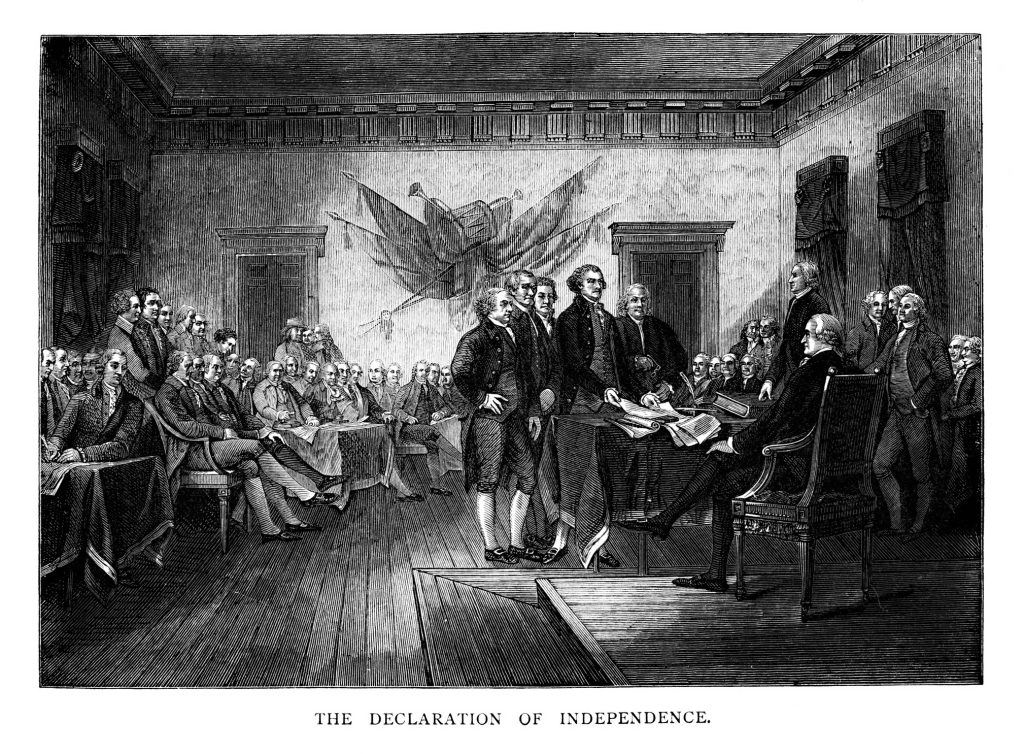
It was on the Fourth of July in the year 1776 that the thirteen colonies declared their independence from British rule. The Declaration of Independence formalized the breaking of all political ties with Great Britain. From that day forward the colonies would be free and independent states. Two months later the country was formally named The United States of America.
The document had been a long time coming. It was a culmination of the many years of harsh and unfair laws and tariffs that the British had placed on their subjects here in the colonies. “Taxation without Representation” empowered the revolutionists and became their rallying cry for freedom.
The most famous phrase in the document are the words of Thomas Jefferson, “Life, Liberty and the Pursuit of Happiness.” The American patriots would shed blood, sweat and tears over the next 7 years to achieve that ultimate goal.
The conflict..It’s beginnings
From the colonies’ viewpoint the Declaration formalized the break from British rule. The actual hostilities began a year earlier with the battle of Lexington and Concord. In the Spring of 1775, the battle was fought outside of Boston. Using guerrilla style tactics, the colonists were able to push the enemy back to Boston Harbor.
The battle of Bunker Hill later that year was a victory for the patriots. They inflicted heavy casualties on the redcoats while suffering much fewer of their own losses. The two battles gave the colonists the confidence that they needed early in the war. It simultaneously galvanized the British to put a military end to any thoughts concerning a sovereign nation here in America.
The Battles of 1776
It was two months after the Declaration of Independence was adopted that the adversaries clashed in the Battle of Brooklyn. In terms of numbers, it was one of the largest battles of the entire war.19,000 British troops faced off against George Washington’s much smaller force numbering approximately 10,000.
Washington’s forces were thoroughly beaten by the British. It gave the redcoats control of New York City and its gateway to the high seas for the rest of the war. There was one saving grace.
In a stroke of genius, Washington maneuvered his army out of harm’s way. It saved it from complete destruction and a war ending catastrophe.
The British victory at Brooklyn brought a time of low confidence to America’s cause. General Washington needed a victory for the army to regain much needed morale. On the day after Christmas of 1776, the general with a small portion of his army crossed the Delaware River and attacked the German mercenary post at Trenton, New Jersey. The surprise attack was a complete success. Although a minor victory by military standards, it gave the demoralized patriots the jolt it needed to continue the war. A week later Washington’s army soundly defeated a British garrison at Princeton. The victory there brought further encouragement to the patriots.
The best laid plans of mice and men
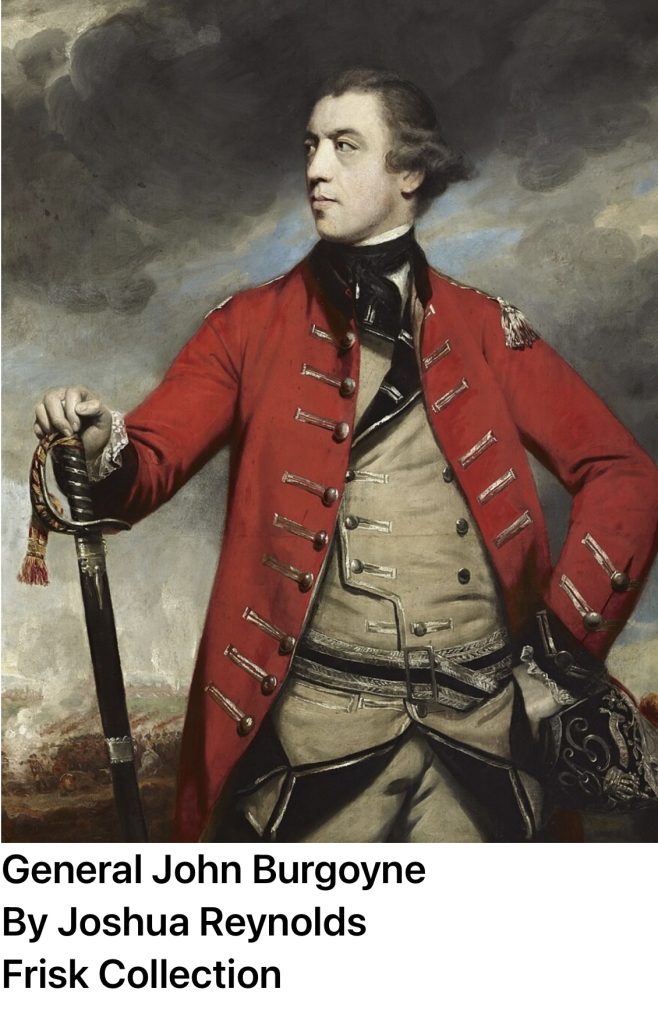
The British plans looked simple enough. Their goal in the Summer of 1777 was to seize the city of Albany. Its location made it a prime objective for control of the Hudson River while isolating New England from participating in the war. A plan was set in place to have three British armies converge on the city. The three-pronged assault appeared to be a brilliant plan. In reality, it was ill conceived. The British High Command located in London gave vague orders to their generals thousands of miles from home. In addition, communications between the British commanders involved with the plan moved at a snail’s pace. The only army that made it close to its objective was that of General John Burgoyne consisting of 8,000 combatants. He was put in the unenviable position of having to take on an American army that would swell to approximately 15,000 soldiers at the culmination of the battle of Saratoga.
Saratoga.. The Turning Point
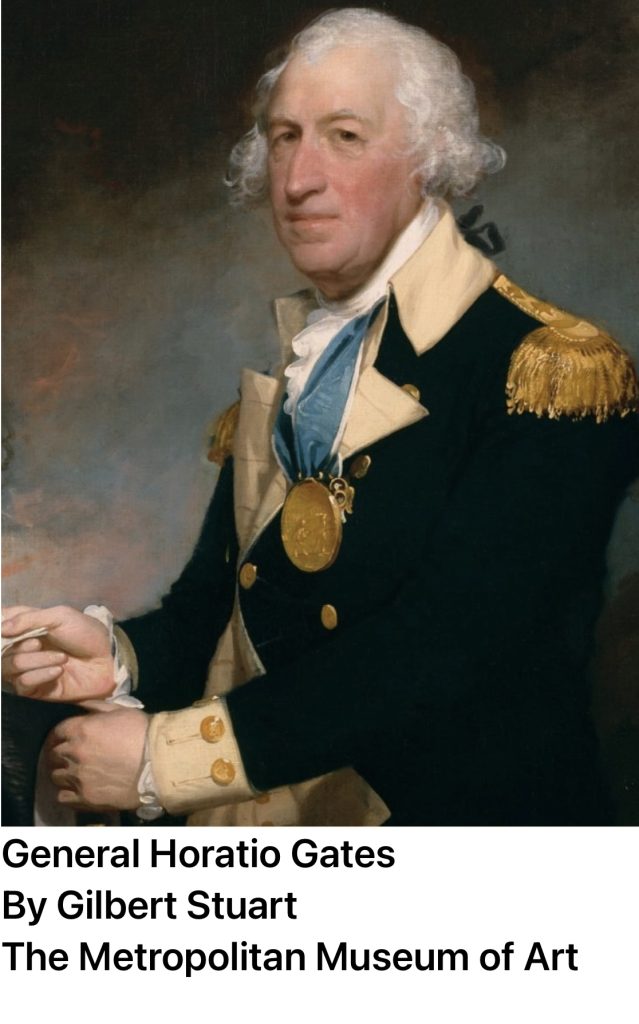
The American forces were commanded by Major General Horatio Gates. He had taken command of the army when Phillip Schuyler was relieved prior to the battle. Schuyler’s dismissal was unfair. He had been wrongfully blamed for losing battles in Quebec and at Fort Ticonderoga. He would be exonerated in 1778 from any fault in the two defeats. Schuyler deserves credit for slowing down the enemy’s advance, burning bridges, destroying food crops and blocking roadways hindering the British advance towards Albany.
The confusion as to the naming of the battle stems from the fact that in 1777 the village of Schuylerville was known as Saratoga. The battle actually took place in Stillwater. Since Old Saratoga was the nearest population center, the battle took on its name. In 1831, the village was renamed Schuylerville to honor Phillip Schuyler.
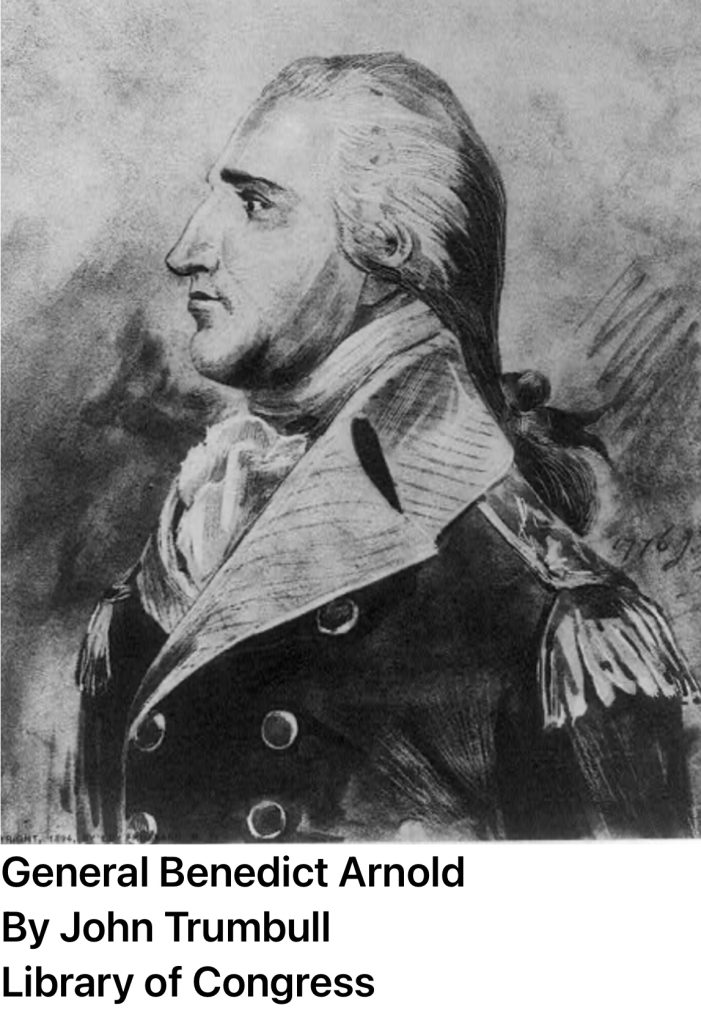
Gates, the newly appointed army commander, was a seasoned veteran having served as a general in both the British and American armies. It was his good fortune to have some of the best brigade commanders in the Continental Army at his disposal. The most important and senior in rank of Gates’ generals was Benedict Arnold. Later a traitor to the American cause, at the onset of the Battle of Saratoga he was in command of the left wing of Gates’ army.
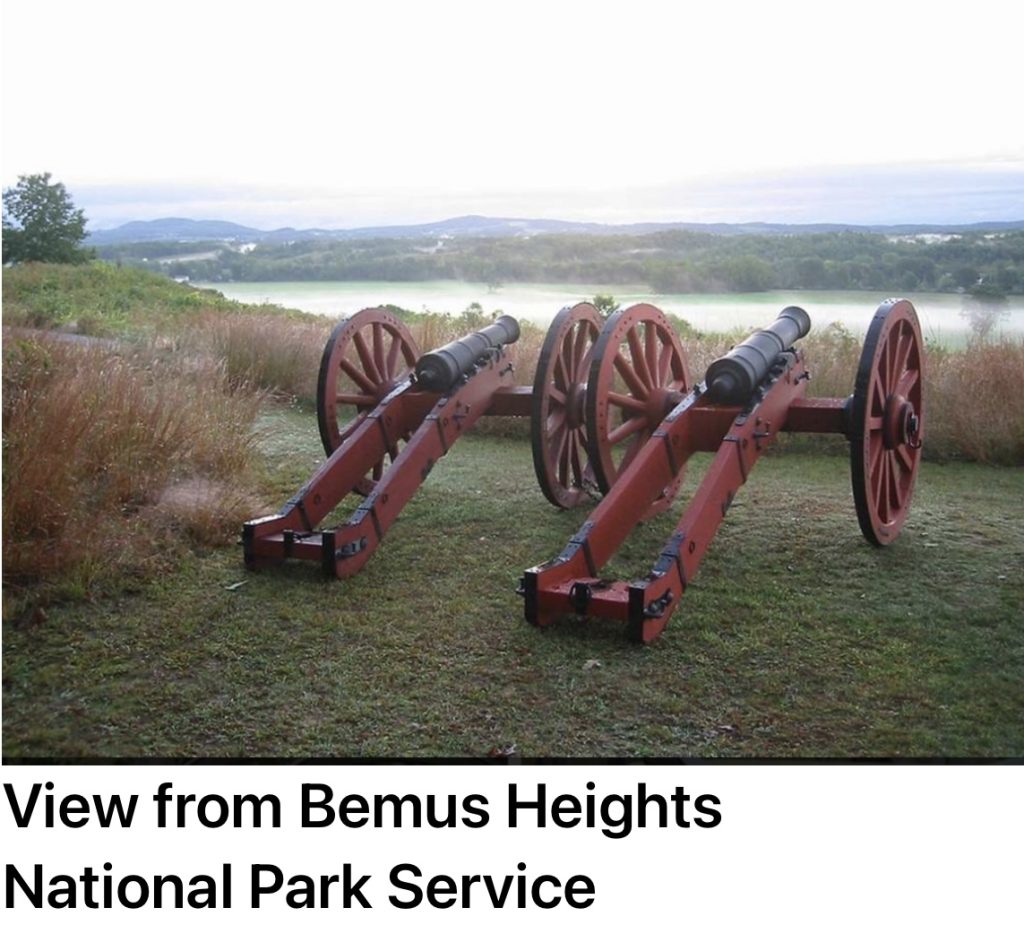
The first battle of the campaign commenced on September 19th. General Burgoyne led the British attack near Freeman’s Farm, located in Stillwater, approximately 8 miles from Schuylerville. He was met by Benedict Arnold’s command. The adversaries clashed in 4 hours of up-close combat. Arnold was sure that he could destroy Burgoyne’s army that day. He pleaded with Gates for reinforcements. They were denied. Arnold was forced to make an orderly retreat back to Bemis Heights. Gates, the more cautious of the two, had decided to place his entire army behind the fortified area at the Heights. There he could await any British attack in a strong defensive position. The British, although nominally the victor that day, suffered twice the casualties of the Americans. More importantly, many of the more capable officers of Burgoyne’s army were killed in the battle.
The refusal of reinforcements led to a serious rift between the two generals. Arnold was furious that he was denied the support to win the battle. Shouting matches between he and Gates over the correct approach to the battle brought about the dismissal of Arnold. Although relieved of his command, he refused to leave the camp. This would have a profound effect on the second battle of Saratoga less than a month later.
Who was right? In this case, both viewpoints were valid. Arnold most likely would have taken the day with more support. On the other hand, Gates’ plan placed the entire army in a strong defensive position. There, on the higher ground he could wait out any attack by the weakened British forces.
The Battle of Bemis Heights
After the Battle at Freeman’s Farm, both armies dug into their previous positions. Burgoyne was still hopeful that help from New York City would arrive to reinforce his army. He was building castles in the air. No such thing would happen. For three weeks the lull in the fighting continued. The demoralized redcoats, with a lack of food, ammunition and supplies, found themselves in a very precarious situation.
The realization crystallized in Burgoyne’s mind that he had no alternative other than to storm the stronghold at Bemis Heights. His original plan was to attack with his entire army. Hours before the battle Burgoyne met with his brigade commanders. They all had serious doubts that it would succeed. They feared that a flanking maneuver by Gates’ troops to their unguarded rear would put the entire army in great danger. Burgoyne agreed and left camp with a lesser force of his best troops. He decided to probe the left flank of the Heights. Gates, aware of his movements, sent out detachments of his army to meet the redcoats’ advance.
On October 7, 1777 the battle commenced. It quickly turned into a chaotic state. The British General, Simon Fraser led a bayonet charge against the Americans. He was mortally wounded, leaving his command in total disarray. At the same time sharpshooting riflemen were picking off many of the redcoat officers. The word got back to Arnold that Gates would not pursue the enemy, allowing the British to escape. General Arnold saw an opportunity to destroy Burgoyne’s detachment before they could reach their defensive position. His actions would cover him with glory. With no command and in Gates’ doghouse he mounted a horse and joined the fray. He rode into the teeth of the enemy. The men on the field cheered as he led them into pitched battle. In one heroic moment after another his tenacity drove the British into a frantic retreat. In the final moments of the battle Arnold was shot in the leg. Refusing doctors’ advice, he would not allow the leg to be amputated. Inept surgery left Arnold with one leg two inches shorter than the other. For the rest of his life, he walked with a painful limp.
In 1867 a stone monument was erected displaying a boot with no other markings on the exact ground of his injury. It symbolized recognition for the wound Arnold suffered at Saratoga. At the same time, it did not allow his name or any markings of honor on the stone. The betrayal of his country later in the war stripped Arnold of any heroics that preceded the disgrace of being branded a traitor.
After the disaster at Bemis Heights the British retreated to a defensive position at Schuylerville.
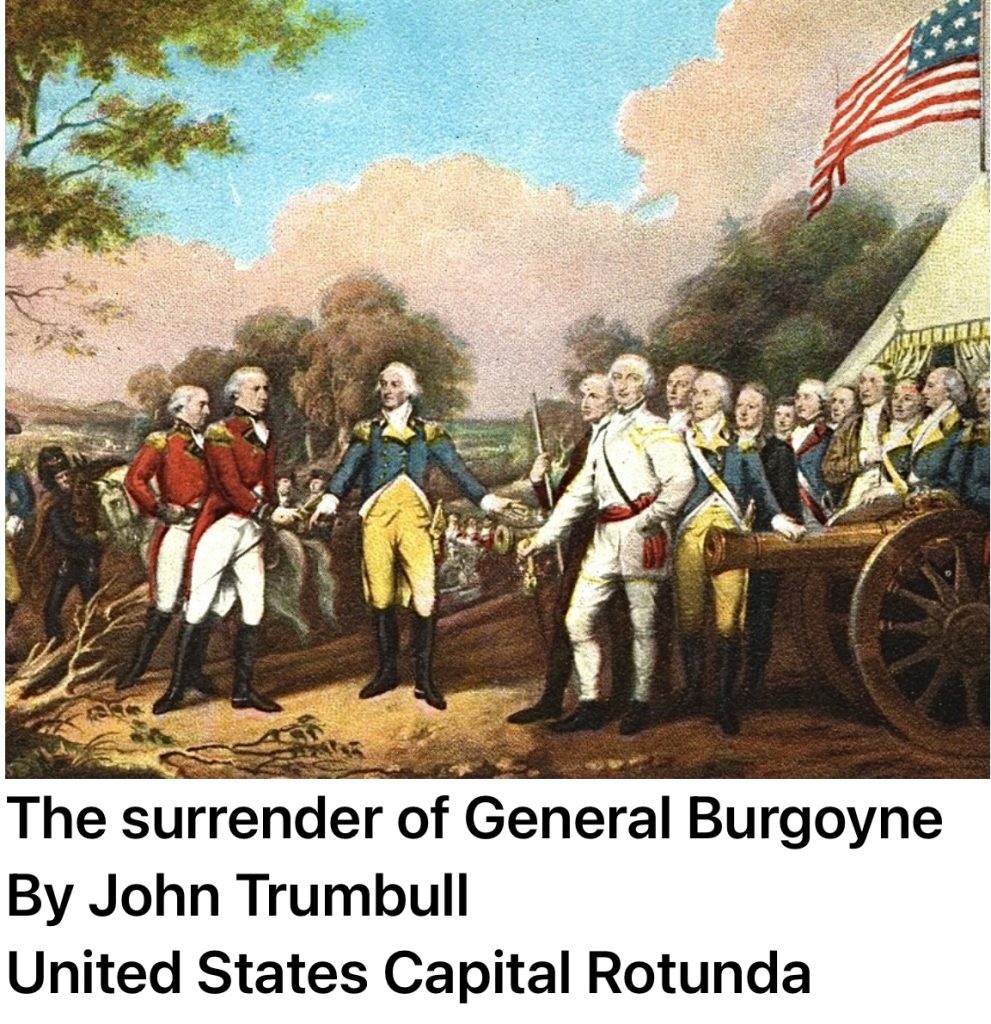
For eight days Burgoyne contemplated his next move. For him, the only exit was the complete capitulation of his army. On October 17, 1777, he met Gates on an open field in the village of Schuylerville and formally surrendered his army. The battle of Saratoga was over. Its repercussions were about to be felt around the world.
Victory has many fathers..Defeat is an orphan
The prying eyes of the European powers closely watched the events that took place at Saratoga. The patriots had proved beyond a doubt that they could win the war against their British counterparts. France decided to join the fray with a military presence. This was a major development to the cause. Spain and the Netherlands soon followed. America was now allied with three European powers against the British. The alliances would prove vital in gaining complete freedom from their long time masters.
As we celebrate the 250th anniversary of America’s Independence it can also be a time to contemplate the world changing events that took place here in 1777. Because of the fortitude and bravery of the men that fought for America’s freedom in those dark hours, we as citizens have reaped the rewards. To be born here is a blessing. We live in the country that Thomas Jefferson envisioned 250 years ago, a home of “Life, Liberty and the Pursuit of Happiness.”
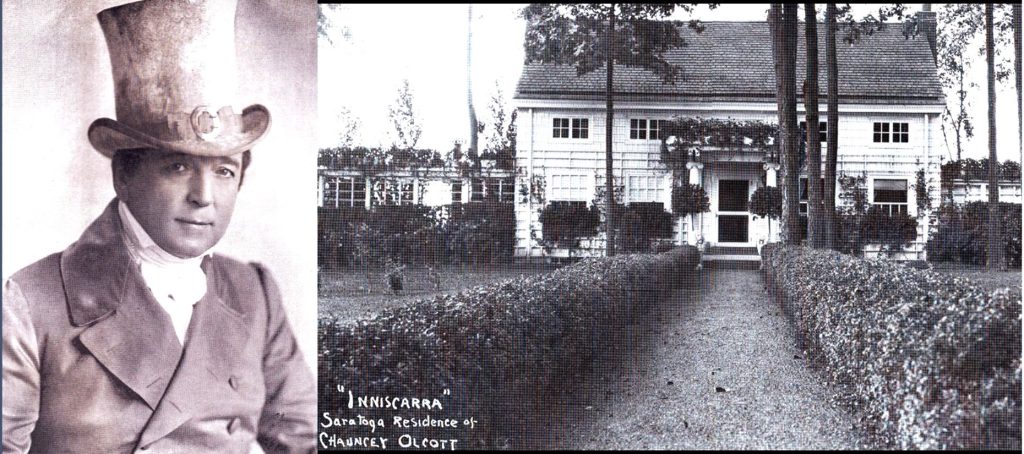
Chauncey Olcott and “Inniscarra” Courtesy of the Saratoga Springs History Museum
Mary Ann Fitzgerald, is the recently retired Saratoga Springs City Historian.
Chauncey Olcott celebrated his 71st birthday with a legion of friends at his home, Inniscarra, on July 21st, 1931. Greetings arrived by mail, telephone and telegram. Less than a year later Chauncey passed away leaving his wife Rita with a house full of memories and mementos that told the story of his life. Rita’s book Song in his Heart, The Story of Chauncey Olcott’s Life was published in 1939. She expressed the hope that her book would help the lost generation find its way back home.
Chauncey grew up in the Buffalo area where his parents Margaret “Peggy” Doyle and Mellen Whitney “Jack” Olcott met along the banks of the Erie Canal. As a child Chauncey learned the stories of the heart of Ireland from his Doyle grandparents who lived close by. Summers were spent with his Olcott grandparents in Ausable Chasm in the Adirondacks.
While in public school, Chauncey was known for singing Father Look Up and See the Flag on many occasions. When Chauncey was 12 years old, his father Jack passed away. Peggy was now the head of the family. Hoping to make a fortune, she went to Oil City PA where she turned her meager sum into $50,000. Returning to Buffalo she invested in real estate and tugboats. When asked about college or work plans after graduation, Chauncey replied: “I don’t want to work! I want to be a singer!” He sang his first Irish song on stage in a local show, “Where did you get that hat?” He was stage-struck and more eager than ever to follow his dream.
Chauncey set out to find a way to sing on stage by joining a minstrel show in a nearby town. Billie Emerson came to hear Chauncey sing Maggie May. Emerson invited Chauncey to join his minstrel show in Chicago where he experienced everything from singing ballads to counting the house. Bill Foote signed Chauncey on with Haverly Minstrels for an 18-week theatre tour of England. On opening night at Her Majesty’s Theater in London, Chauncey received a double encore singing Scotch Lassie Jean.
Despite this recent success, Chauncey was tiring of minstrels. One night while performing in a show at Niblo’s Garden in New York City, Lillian Russell was in the audience with her husband Edward Solomon, a composer. Impressed by the rich purity of Chauncey’s voice, they signed him on to the production of Pepita, or The Girl with the Glass Eyes, a comic opera. Although the operatic interlude ended abruptly for Chauncey, he would never again be satisfied with minstrels. He could do so much more with theatre.
New opportunities came along. In 1890 Chauncey returned to England for voice lessons and on to Ireland to learn the Irish brogue for his role as Patrick Julius O’Flanagan in the play “Miss Decima.” Although happy in London, he soon returned to the American stage.
In 1893 William J. Scanlan, the finest portrayer of Irish Characters at the time, was seriously ill, leaving Augustus Pitou, his manager, in need of a new actor and composer. Chauncey accepted Augustus Pitou’s offer to replace Scanlan in “Mavourneen.” Chauncey was an immediate success in his first role as a star. Chauncey’s composing career began at Pitou’s urging as more songs were needed for “The Irish Artist.”
Rita O’Donovan (1879-1949) met Chauncey in New York City, outside Delmonico’s after a show at the Fourteenth Street Theatre. They hit it off and met every day for Horseback riding in Central Park. When it was time for Chauncey’s show to move on to Boston, he invited Rita to join him there. They married in 1899. On a trip to Ireland a young boy was singing in Gaelic while rowing their boat. Rita inquired about a clump of pale pink flowers. “Why mam, those are wild Irish roses!” This was Chauncey’s inspiration for “My Wild Irish Rose” in a new play “A Romance of Athlone.”
They first came to Saratoga Springs in 1901 to look at property to build their home. Saratoga Springs was the perfect place for the Olcott’s to settle down and relax during the summer breaks from touring. Although a blizzard was raging the first time they saw the property out Clinton Street, they saw the outline of apple trees. A good omen! Architect Charles Barton Keen created a design that from its inception treated the house and garden just as the Olcott’s envisioned. The home was completed in 1902 and the Olcotts named it Inniscarra.
Saratoga Springs Town Hall Theatre was located two miles from Inniscarra making it a convenient venue for Olcott’s plays, rehearsals and openings. In August 1906, the Saratoga Daily Hotel Reporter announced the opening of “Eileen Asthore” (Eileen my treasure), music, lyrics, and play by Chauncey Olcott.
My Wild Irish Rose reached its greatest popularity when sung between acts of Ragged Robin. The play opened in 1910 in the Town Hall Theatre. Chauncey said it was the biggest first night of his life! The scenery was lovely, the apple tree was gorgeous, and the apple blossoms fell at just the right time.
On July 6, 1914, The Heart of Paddy Whack, Rachel Crothers’ new comedy, featuring a half-dozen new Olcott Songs opened at Town Hall Theatre. Brunner’s Book Store, located in the Arcade Building on Broadway, sold tickets for .50, $1.00 and $1.50 for the best seats in the house.
Henry Miller was Chauncey’s new manager after Pitou retired. They opened their new partnership in 1913 in Town Hall Theatre with the production of Isle of Dreams featuring the song When Irish Eyes are Smiling. The play made more money in a single year than any other play of Chauncey’s career. It ran for forty weeks in many locations and brought in $150,000!
Saratoga was Chauncey’s first love. Each afternoon of the Spa racing season found Chauncy at the track. Chauncey and Rita frequently entertained at Inniscarra after the races. Chauncey enjoyed playing golf at the Saratoga Golf & Polo Club since its opening in 1896. Rita chaired the St. Peter’s Parish annual summer bazaar, and Chauncey would sing for the crowds. In 1923 Rita, as vice chair of the Skidmore College campaign, arranged a benefit ball at the Canfield Casino in Congress Park.
Chauncey’s last stage role was in The Rivals in 1925. When the show had reached Ann Arbor, Michigan, he collapsed when the final curtain came down. When released from the hospital, Rita continued to nurse him back to health to enjoy his retirement years. The remaining summers of his life at Inniscarra provided more time for his garden, golfing and the races. Entertaining family and friends were the highlight of their summers.
Every November they returned to their winter home in Monte Carlo, where the view of the sea under a great blue sky was their constant companion. In the winter of 1932, Chauncey’s health declined. It was March 17th, and everyone was sending him shamrocks. He took one, blessing himself with it and tried to put it in his buttonhole. But there was none in his dressing gown, so he put it in his pocket and decided to lie down. “Good night, everybody” he said, “it’s late.” Chauncey passed away that night on what was still St. Patrick’s Day in America.
Saratoga Springs Town Hall Theatre is now named The Anthony “Skip” Scirocco Music Hall, located in today’s City Hall.
Based on Rita Olcott’s Book, Song in His Heart. The Story of Chauncey Olcott’s Life, 1939
$20,000 in 1968; estimated worth in today’s world- $190,000. Would you pass that up if it were offered to you, and it was legitimately yours? Clint Wescott would—and did. Missing from his hometown of Burnt Hills, NY for 15 years, when he was finally found and told of his windfall, he was dressed in rags and had 44 cents in his pocket. But his response to the windfall was “I’d rather stay at the bottom of the barrel. I’m not ready to go over to the other side. Not yet. Hand me a dollar. I’ll take it and buy a little drink, a little smoke. But I don’t want a wad of money like that.” How did it come to this? Why did he feel this way? Not sure we have all the answers to the story of Clint Wescott.
Wescott was born in 1916 in Burnt Hills, New York. Besides his mother and father, he had four siblings. The family lived near the corner of Church and Thomas Streets in Ballston Spa and, before 1939, Clint owned land in Burnt Hills, on the east side of South Street, now Kingsley Road. However, he lost part of that land due to unpaid taxes.
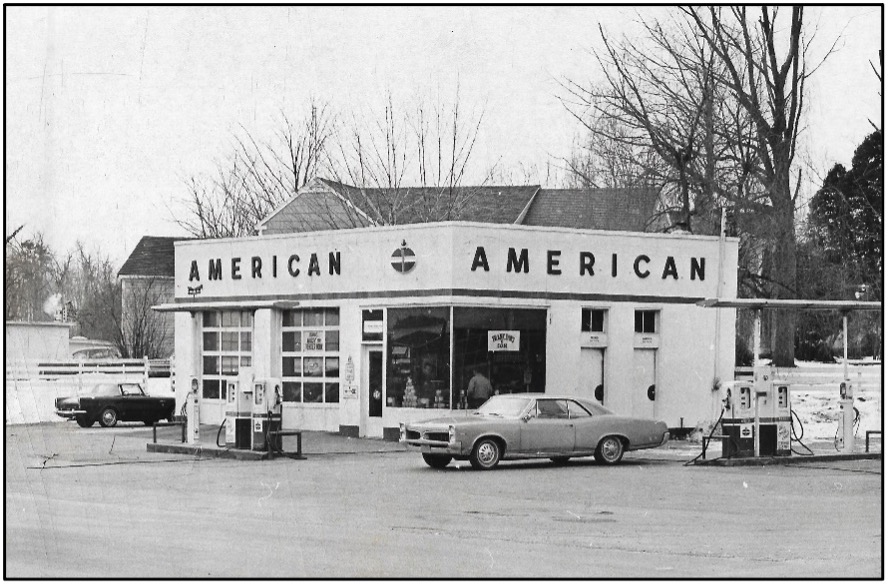
By 1943, he left the area and was off to Arizona because the weather there was better for his asthma. He worked in the copper mines there but shortly afterwards came back to Burnt Hills and built a gas station at the southwest corner of Route 50 and Lakehill Road on land he had purchased 20 years previously. But the gas station part of his life did not last long, and he was off again in 1953, travelling to Salt Lake City. This time, he was never to return to his hometown again.
For about 12 years, no one in his family heard anything from him- nothing, no mail, no calls. The gas station was leased and then closed. There was about $20,000 owed to Clint upon the sale of that property. But where was he?
Coincidentally, Charles Hillinger, a reporter for the Los Angeles Times, did a story about this odd, homeless man who was living in the weeds at the base of a cliff of Bunker Hill, under the 4th Street Bridge, in Los Angeles, California. It turned out to be Wescott and, when interviewed in the late 1960s, he had been there 10 years, longer than anyone else in the area and perfectly content to stay there forever. He got his clothes from trash barrels, read discarded newspapers, lived on donations of food, and had taken to drinking and smoking for entertainment. The police all knew him and let him be. Little did he know that the New York Supreme Court had hired a legal firm to find him and give him his legally-constituted $20,000—plus another $4000 that he had inherited upon his father’s death in 1967.
This LA Times news story about Wescott was syndicated and carried to newspapers all over the country. One paper that picked it up and printed it was the “Schenectady Gazette” which covered the Burnt Hills area. Attorney John Brown of Burnt Hills, who had been involved in the search for the missing Wescott, saw the report. At that point, Brown had been searching for Wescott for seven years and wanted to contact Wescott to tell him that he was now rich! $20,000 rich! Of course, the IRS came into the picture, too, and wanted a piece of the action. They inquired of Brown about this money. Brown responded to their questions about Wescott’s tax liability with: “I assume everything he received since he became a bum could be called a gift and not taxable.”
Hillinger went out in search of Wescott to give him the good news. And that’s when Wescott made it very clear he was not at all interested in the money and wanted to stay just right where he was. He wasn’t going back to Burnt Hills; and he wanted no money!
After using every possible strategy he could imagine to convince Wescott to accept the money, Hillinger gave up but others who had heard the story, which was in newspapers nationwide, did not. They bothered and badgered Wescott for a long time. Long lost “friends” volunteered to take his money and do various and sundry things with it. Others shamelessly said they could use the money to feed their kids. Others wanted to use it to create clubs for disadvantaged kids. Still others promised to marry him! Thousands of letters came to Wescott, some of the letters addressed to “The Man in the Weeds, Los Angeles California” or to “Clint Wescott, Under the Bridge at Flower Street.” Wescott’s peace and quiet had been broken by the news reports and people’s desire to “help” him spend his money.
Not all the requests were from people wishing to help themselves secure a better life. One man, awaiting a plane at San Francisco International Airport, wrote that he had “no requests, just admiration for sticking to your beliefs. I’m making $20,000 a year, working three jobs, keeping a family of four, a wife, and also a friend. I envy you. I may join you some day.”
An editorial in the Times Record of September, 1970, entitled “What is Happiness,” copied by other newspapers in the country, gave quite a bit of credit to Wescott: “There is no better illustration [of happiness] than Clint Wescott, who, up to 17 years ago, was an enterprising gas station owner in nearby Burnt Hills. Today he is a bum in Los Angeles. And he is happy to an extent that some of us might term idiocy…And yet, even though he has attained the state of happiness, he is different from others. He will remain so till the day he crosses over the Great Beyond. Nothing can ever take away from him one outstanding factor. He is happy, which is important. He is different, which is unusual. But above all he is a bum with a bank account.”
The Oswego Palladium Times in 1968 voiced much of the same sentiment when it posed the question about Wescott. “Clearly, Clint Wescott lacks a certain sense of values. Or does he?”
His sister, Minnie Gately, whom locals knew as the lady who worked at FoCastle Farms in Burnt Hills, NY for 46 years, expected that she and her family would hear from him because of all the hoopla. But she never did. The area he lived in was bulldozed and high-rise buildings were built there. Where did he go?
Wescott died in 1992 at the age of 76 and is buried in Los Angeles, where he spent so much of his life. Hillinger later wrote a book entitled “California Characters” and devoted one chapter to Wescott, the man who refused $20,000 and the man who stuck to his principles no matter what: I want no money!
Sources
-“California Characters,” Charles Hillinger, c 2000
Citizen Advertiser, Auburn NY, February 12, 1968
-Daily Times, Salisbury, MD, February 12, 1968
-Knickerbocker News/Union Star, November
-Los Angeles Times, November 20, 1970
-Nashua New Hampshire Telegraph, February 20, 1968
-Oswego Palladium Times, February 22, 1968
-Schenectady Gazette, January 31, 1968, February 15, 1968
-Times Record, February 13, 1968, February 22, 1968, November 13, 1970
-Watertown Daily Times, February 22, 1968
Contact The Saratoga County History Center at: saratogacohistoryroundtable@gmail.com
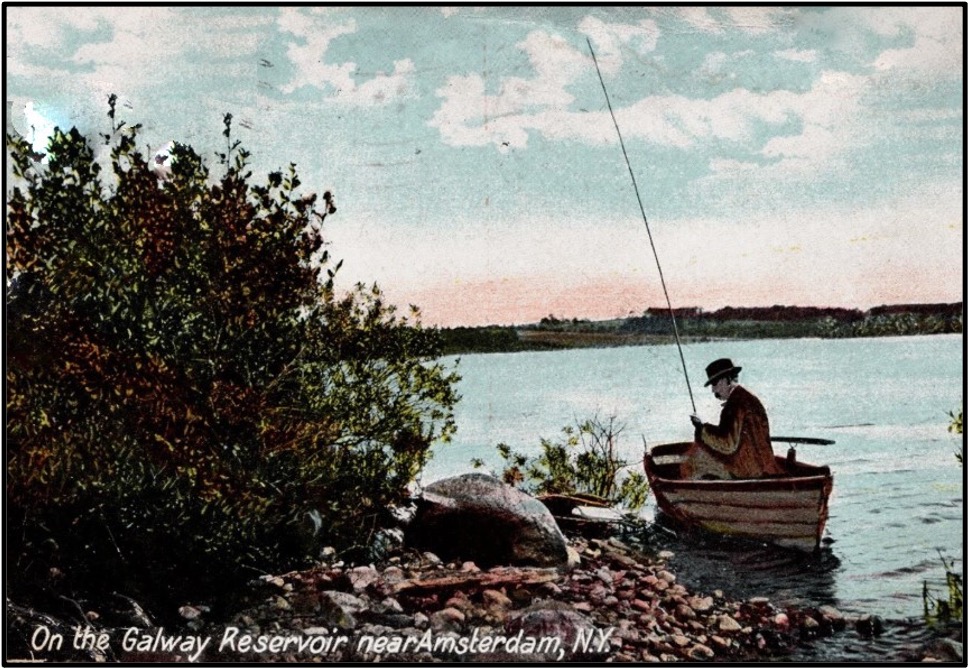
Fishing on the Galway Reservoir Photo provided b y Saratoga County History Center
Dave Waite has written many articles on upstate New York history, and has recently published two anthologies, Thrilling Attractions and Weird Wonders, and A Place called Pauley. Dave is also a videographer for several films produced by the Saratoga County History Center, including the Forgotten Crossroads series. He can be reached at davewaitefinearts@gmail.com
When Josiah Stratton was laid to rest in the Galway Village Cemetery in 1904, he left behind a life of service to his county, survival in war, and dedication to family spanning his 94 years on earth. His story is also one of tragedy and survival that should have ended his life 30 years too soon.
For Josiah Stratton, life in Saratoga County began when he moved to Saratoga Springs from Gratton, Windham County, Vermont, in the summer of 1846. Short in stature and weighing only one hundred pounds, Josiah was well known as a peaceful and inoffensive man, but one with a will that refused surrender.
When the call went out for volunteers to defend the country in the Civil War, Josiah immediately stepped up and in December of 1861, volunteered for three years’ service in New York’s 77th Infantry, the “Bemis Heights” Regiment. When he joined up, Josiah, then fifty-one years of age, left behind in Saratoga Springs his wife, Laurencia, and his three daughters, 15-year-old Sarah, 11-year-old Collista, and their youngest, Ella, age 8.
After spending that first winter serving in the defenses around Washington, the 77th was assigned to the 6th Corps, where, by May of 1862, they had fought at Yorktown and Williamsburg, followed by heavy fighting at Antietam, where thirty-two of their comrades were lost or wounded. In May 1863, the now battle-hardened troops of the 77th Infantry sustained heavy losses during the assault on Mary’s Heights, part of the Chancellorsville campaign.
At the end of 1863, Josiah was discharged due to disability, suffering from rheumatism so severely that he lost use of his left hand. Only weeks after his medical discharge, Josiah Stratton re-enlisted in the 77th Infantry and then went on to serve until the end of the war. During his second enlistment, the 77th fought in the Battle of the Wilderness and played a key role as part of the Union’s 6th Corps in the Siege of Petersburg and afterward in the pursuit of the Confederate army. As the 77th Infantry was present in Appomattox during the surrender of Lee at Appomattox Court House on April 9, 1865, it is possible that Josiah Stratton witnessed this historic event. The 77th New York Infantry was mustered out of service on June 27, 1865, and Josiah returned home.
Soon after returning from the war, Josiah moved his family to West Galway in Saratoga County, where he took up farming, supplementing his income as a tin peddler and gatekeeper at the Amsterdam Reservoir, what we now know as Galway Lake. By the early 1870s, with their daughters all grown and gone, the couple continued life in Galway, with Josiah often staying in a small cabin at the dam on the reservoir where he rented boats and sold food and cider to those who visited the area.
On Wednesday, May 20, 1874, sixteen-year-old William Betts and his twenty-one-year-old brother Charles Franklin arrived at the reservoir looking to spend the day fishing. When they approached Josiah Stratton to rent a boat, he reminded them of money they owed him from past visits. Franklin responded with a profane tirade of verbal abuse that ended the discussion, and the two took a boat and rowed out onto the lake.
When the Betts brothers returned from fishing, they demanded food from Josiah. Having nothing but cider available, Stratton opened a cask with a small hammer, which he set on the counter to pour their drinks. In an act of senseless brutality, Franklin grabbed the hammer and attacked Josiah, fracturing his skull in seven places. Having survived the attack and still conscious, their victim lay helpless as they rifled through his pockets, robbing him of five dollars and an old pistol. When they were satisfied that they had gotten everything of value, they fled, leaving Josiah in a state of near death behind the counter.
With what was later called “commendable pluck,” Josiah somehow found the strength to crawl from his store to the house of his son-in-law, George Webster, a distance of nearly half a mile away, Though physicians were quickly summoned, they could do little for the wounded man, and gave him no chance of recovery.
Though in critical condition, Josiah swore out a warrant for the arrest of both Franklin and William, and it was given to Constable Robert Shaw to be carried out.. When Shaw spoke to their father, Carmi Betts, he learned that while William was somewhere nearby, Franklin had not returned after going fishing at the reservoir. After getting assurances that Cami would bring William in for questioning, the constable left. The following week William stood before Galway Justice Crouch, who sent him to be held at the County Jail in Ballston Spa.
After William Betts was examined and locked up, and Josiah Stratton still hovering between life and death, a search was started for Franklin Betts. It took until June 6th, seventeen days after his assault on Josiah Stratton, for Franklin Betts to be captured. While the authorities had assumed that he had fled to either Hamilton or Warren Counties, in reality, he had headed further east to Whitehall on the lower edge of Lake Champlain. Once there, he stole a wagon and team, which he drove along the canal to Troy. From there, he exchanged the wagon for a horse and turned west, ending up in Hagadorn Mills in the town of Providence, just north of his family’s farm. He was soon seen in the vicinity of a barn, and during a careful search, he was found hidden in a large barrel he had pulled down over himself.
On July 20th, Betts had a short taste of freedom when he and two others escaped from the Ballston Spa Jail. After one of the prisoners overpowered a guard and took his gun, the three slipped out through an unlocked door. With officers and bystanders in close pursuit, the three headed towards the nearby fairground and the woods beyond. What the pursuers did not realize was that one of the escapees had separated himself from his companions and, pretending to be part of the crowd, directed the posse toward the other two and then snuck away in the opposite direction. Betts and his companion were quickly caught, but the third man was never apprehended.
Franklin Betts was sentenced to five years and four days in prison in October of 1874, and during his imprisonment was found to be insane and transferred to Auburn Prison in Auburn, New York. Only a short time after he was released, Betts committed suicide by drowning himself in the Sacandaga River near Batchellerville.
After Franklin was found guilty in the attack on Josiah Stratton, his brother William was exonerated of all blame in his brother’s actions and discharged. William later married and moved to Gloversville, where he took up work in a sawmill.
Over the days and weeks after the assault, Josiah Stratton, whose death was considered inevitable, made a miraculous recovery. For the next 30 years, Josiah and his wife continued to live in Galway for the rest of their lives, and on his passing in 1904 at the age of ninety-four, he was the oldest member of Galway’s E. B. Carpenter Grand Army of the Republic Post.
U.S. Army Pfc. Henry A. “Rocky” Marcelle of Mechanicville. Siciliano Photo Collection. Mechanicville Public Library.
The National WW II Museum in New Orleans is home to about 250,000 artifacts, including more than 100,000 photographs ranging from battlefield pictures captured by military and press photographers to individual albums full of wartime snapshots donated by veterans and their families.
The New York State Military Museum and Veterans Research Center located at the former National Guard armory on Lake Avenue in Saratoga Springs, is the repository of more than 16,000 photographs and photographic collections from multiple wars.
However, nowhere in those vast collection of images is there anything comparable to what currently resides in the local history room at the Mechanicville District Public Library: 600-plus photos of individual local World War II veterans in uniform, all of them taken by the same photographer in the same spot inside the same location — Siciliano’s Restaurant.
“The photographs are beautiful. This is a stunning collection,” Kimberly Guise, senior curator and director for curatorial affairs at The National WWII Museum, said in a recent phone interview.
“The faces of the men and women of Mechanicville and nearby towns and cities who went to war is a touching reminder of the service and sacrifice of all our New York communities,” said Richard Goldenberg, Director of Military History for the New York State Division of Military & Naval Affairs, which operates the Saratoga Springs museum. “As the Second World War and Korean War pass into written history with fewer and fewer living voices, these images give us context and perspective of the many young faces of service.”
The approximately 700 original black-and-white photographs that make up the Charles Siciliano Sr. WWII and Korean War Veterans Photo Collection are currently housed in eight large, handmade frames fashioned more than 40 years ago out of paneling and a backing material not conducive to preservation. Each 3-inch-by-3-inch photo and the accompanying name, typewritten by Siciliano on slips of paper, were glued to the matting.
After 60-plus years of being displayed at several local restaurants and more than 20 years in the library’s Col. Elmer E. Elsworth history room, the Siciliano collection is in need of attention. Some of the photos have taken on a sepia tone, others have become brittle. A couple of the frames are falling apart, and the glass on one is broken.
The library is planning to launch a campaign to raise the funds needed to properly remount the photos in museum-quality frames with glass that will protect the images from further light damage. While the final cost hasn’t been estimated, the campaign is a vital first step toward preserving a collection the National WWII Museum’s Guide referred to as “completely unique” in a story I wrote about the Siciliano photographs for The Associated Press in August 2015.
The collection started out as a hobby for Charles Siciliano, Sr., a photography buff known to everyone as Charlie, soon after the U.S. entered WWII following Japan’s surprise attack on Pearl Harbor on Dec. 7, 1941. As more local residents went into military service, Siciliano would ask the ones in uniform who came into his restaurant at 30 Warsaw Ave. to sit in the well-lit corner of the bar to have their photo taken.
Siciliano developed and printed his own photos, typically giving a copy to the servicemember or their family, then framing the pictures in groups of 25 that he hung inside the restaurant.
The majority of the approximately 700 photos in the collection were taken during WWII, which formally ended with Japan’s surrender on Sept. 2, 1945. Some were taken in 1946 as veterans continued to return from overseas.
All the U.S. military branches during WWII are represented in the collection: Army, Navy, Marine Corps, Coast Guard and Air Force (then part of the Army). Some of the men fought in the biggest and bloodiest battles of the war, from D-Day in Normandy to Iwo Jima in the Pacific.
Most of the men in the photographs hailed from Mechanicville, and about half of those identified have Italian American last names, a reflection of the influx of Italian immigrants to the city starting in the late 19th century and continuing into the early 1900s, including Siciliano’s parents. Men from nearby communities in Saratoga County – Stillwater, Waterford, Saratoga Springs, Ballston Spa – also were photographed, as were several from Schaghticoke and Troy in neighboring Rensselaer County.
The collection includes the photos of four women WWII veterans from Mechanicville: Lucille Ennello Marcelle, Doris Lazott Noonan, Mary DiBello West and Anna Cefalo. West and Cefalo were in the Women’s Army Corps (WACs), while Marcelle (Pacific Theater) and Noonan (Pacific and European Theaters) served in the Army Nurses Corps.
At least three men whose photos are in the collection are known to have died during WWII, including Army Pfc. Henry A. “Rocky” Marcelle, of Mechanicville, who died of wounds suffered in combat in Europe in March 1945.
Charlie Sr., who died in 1982, kept the framed photos on the walls of his tavern until he sold the business in the late 1970s to Frank Costanzo, who had the snapshots rearranged alphabetically in eight large frames. The collection went with Costanzo when he relocated his business to the town of Waterford. The photographs and negatives were eventually donated to the Mechanicville library.
Siciliano’s Restaurant was torn down years ago to make way for new apartments.
Starting in 2001, through an effort led by the late Michael Sullvian of Mechanicville, names were attached to more than 500 of the photographs when the collection was digitized on the library’s website (https://meclib.sals.edu/).
It’s not known if any of the WWII veterans in the Siciliano collection are still living. Anthony “Tony” Fortune, an Air Force veteran who died in December 2024, two weeks shy of his 101st birthday, may have been the last.
As part of the fundraising effort, at 7 p.m. on Thursday, May 7, at the Arts Center on the Hudson in Mechanicville, I’ll be doing the first in a series of free presentations on the Siciliano photo collection. Others are planned for 7 p.m. Thursday, June 18, at the Saratoga County History Center at Brookside Museum in Ballston Spa, and at the Saratoga Springs Public Library at 12 p.m. Sept. 10.
The talks are free. Registration is recommended to reserve a seat. For the Mechanicville talk, register here: https://forms.gle/8BAPY3J5dgo3Nwzx9. For the Saratoga County History Center talk, register at Charlie’s Heroes – Saratoga County History Center. Registration information for the Saratoga Springs library talk will be posted on its website.