

Ballston Spa School Officials Warn that Electric Bus Mandate Could Make Driver Shortage Worse
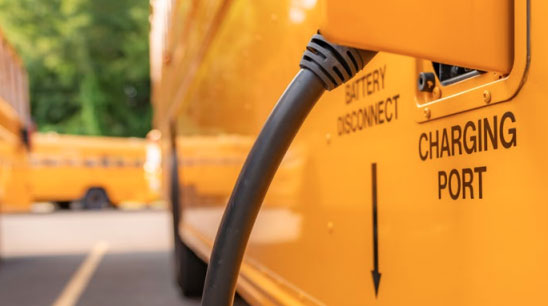
Photo of an electric school bus being charged via the The New York State Energy Research and Development Authority (NYSERDA).
BALLSTON SPA — The looming electric school bus mandate could make the ongoing driver shortage worse in the coming years due to the limited range of zero-emissions vehicles, warned two Ballston Spa School District officials at a Board of Education meeting last week.
Clerk of the Board and Records Access Officer Brian Sirianni, during his 2026 budget presentation, said he hopes that the mandate will be delayed, “not because the administration is anti-environment or anything like that; it’s just that those buses and the technology that they have today are not a good purchase and nobody is ready to pay for and implement all of the infrastructure that needs to be done to charge those buses.”
Sirianni said he supported attempts by various state legislators to delay the mandate’s implementation because in several years, the quality of electric buses is expected to improve. As it stands, a fully charged bus would be unable to cover the distance of some of the district’s runs.
School Board President Jason Fernau said that districts around the state, especially in more rural areas, are finding that they would have to increase the number of buses in their fleets if forced to use the current crop of electric vehicles because some runs previously handled by one bus would need to be covered by two. And if more buses are needed, so too would more drivers be required.
“Potentially, a conversion to [electric vehicles] is going to make [the driver shortage] issue worse in the future,” Fernau said.
“Yep, that’s exactly right,” Sirianni added.
Sirianni also said that if efforts to delay the mandate fail, the district may purchase one electric bus for next year to act as a pilot program.
State Senator Jim Tedisco (R,C-Ballston Lake) has criticized the mandate, stating that no provisions have been made for geographical disparities, diverse weather conditions, or unique travel demands.
“We need a reasonable approach, like the legislation I’m sponsoring Senate Bill 8467, to rescind the electric school bus mandate that will cost school districts in New York State billions of dollars, and replace it with a state-funded pilot program that enables school districts to test and evaluate how these electric buses perform,” Tedisco said in a statement in December.
The bus mandate requires school districts across the state to begin transitioning their transportation fleets to zero-emission vehicles in 2027. By 2035, all buses on the road must be zero-emission.
Electric buses can cost as much as $400,000, nearly three-times the cost of a diesel or gasoline bus. According to New York State’s Electric School Bus Roadmap report, “the total cost of [zero-emission school bus] ownership is expected to reach parity by 2027 due to advances in battery technology, increased supply chain outputs, as well as lower fuel and maintenance expenses.”