

Fraternal Twins
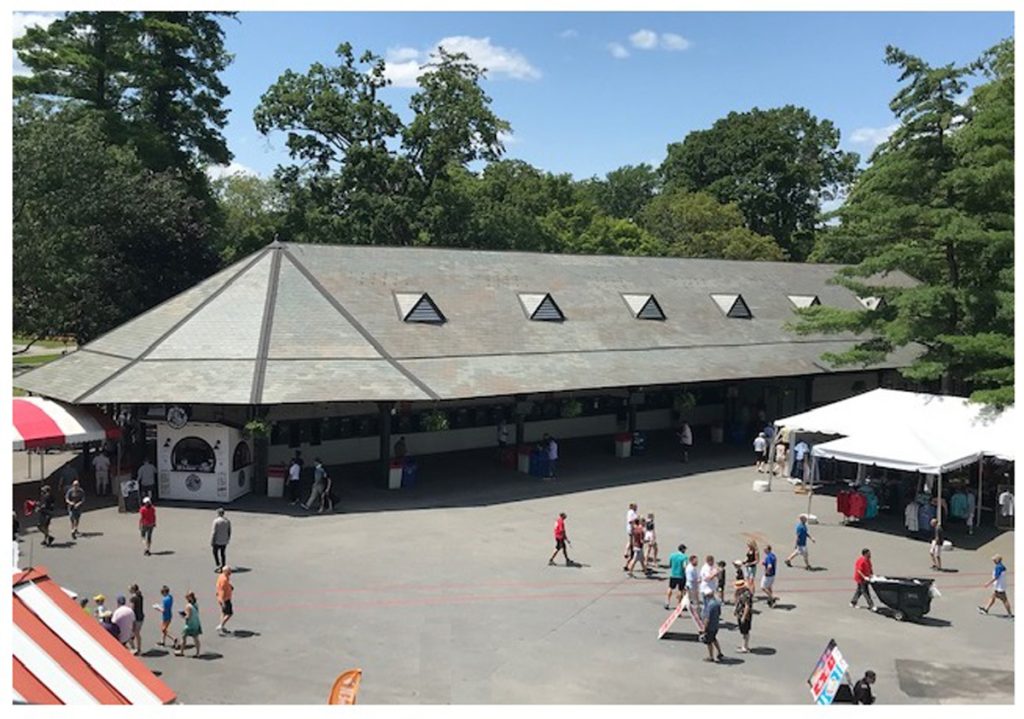
The Leavitt paddock, an original component of the 1902 W.C. Whitney rebuild of Saratoga Race course, which functions presently as the NYRA pari-mutuel annex and racing office. Author provided image.
William C. Whitney presided over a consortium which assumed ownership of the Saratoga Race Course during the late autumn of 1900. Under his leadership, the racing plant underwent a major improvement, entailing relocating and enlarging the track and repositioning all the structures surrounding it. His long-range vision of this development, which also involved purchasing additional acres, resulted in what we are familiar with presently, much to the benefit of a grateful posterity, who continue years and generations of enjoyment.
The track we know today, with its special mystique, was completed for the 1902 season under the direction of architect Charles W. Leavitt. During this same period, Mr. Whitney was simultaneously involved with building the new Belmont Park on Long Island, also under the design and direction of Mr. Leavitt.
As to be expected with two separate projects under the management of the same connections, some design coincidences occurred at the Spa and Belmont Park. This would dictate some shared designs at both facilities, with the paddocks being sensational examples of this fortuitous overlap.
Charles Leavitt designed the elliptical paddock building ready for the 1902 Saratoga season and also at the original Belmont Park, which opened in 1905, with a similar elliptical structure, only slightly larger. The New York version provided 36 stalls, while at Saratoga, 25 stalls sufficed.
The distinctive oval shaped roofs of these paddock buildings were supported by wood trusses with iron bracing, supported on simple posts. The unusual hip-ellipse roof employed slate and a series of dormers for ventilation. The shape of the structures’ form followed the function of their purpose, to allow for saddling and walking of horses before going to post, while providing shelter from the sun and elements. The structures provided an area of inspection for the paddock judge, owners, trainers, jockeys and spectators, with proper separation of all those scrutinizing the runners before proceeding to the walking ring. The picturesque setting and nearness of the horses being prepared under the fountain elms had long distinguished Saratoga’s charm and separated it from other race venues.

An additional successful use of the paddock buildings, which were a type of open-view barn, was their supplementary use as a horse auction ring.
Belmont Park had an unusual requirement for Architect Leavitt, where it had been decided to use the European-style clockwise direction on the race track, sometimes referred to as “Continental” style differing from the American-standard of counter-clock racing direction when the track was built.
Champion Man o’ War was sold at auction as a yearling at the Saratoga elliptical paddock in 1918, and was later saddled in the Belmont elliptical paddock in 1920 where the Hall of Famer won the Belmont Stakes, which was interestingly the last to be contested in the “Continental” style.
After the Belmont Fall Meet of 1920, the racing direction was revised from a clockwise direction. This placed the clubhouse and paddock on the wrong side of the finish line, and the unique paddock was cast-off for parking and later demolished for still more parking space.
The graceful elliptical Leavitt Paddock at the Spa was modified by NYRA into a pari-mutuel annex and racing offices in 1963, and continues in that use presently. Many have expressed the opinion that returning the paddock building to its original purpose would add yet another marvelous aspect to racing at Saratoga.