

Saratoga Beyond the Battlefield
Saratoga Beyond the Battlefield
Aidan Cahill
While the most notable contribution of Saratoga County to the American story may be the battles that took place here, it’s not where our contributions end.
Saratoga County has been home to some of the most influential Americans to ever live, people who contributed to our shared success in numerous wars, and blazed trails that have been followed by millions of Americans.
While the battle may have ended on October 7, 1777, our story didn’t. Here are some events, people and innovations that shaped the history of this nation from Sea to Shining Sea.
1780 – Saratoga I is Launched Less than three years after the Battle of Saratoga, Saratoga’s name would be placed on a U.S. Navy warship for the first time. The Saratoga I was a 68 ft, 150-ton sloop armed with 16 nine-pound cannons and two four-pound cannons. It had a crew of 86 personnel and was launched from Philadelphia on April 10, 1780. During its career the ship was responsible for capturing or recapturing 12 British or American ships. She was lost on March 18,1781 and was the first of six ships to bear her name.
These ships include a Corvette launched in 1814 which saw action in the Battle of Plattsburgh, a sloop of war which saw constant decommissioning and recommissioning from the time it was launched in 1842 to when it was sold for scrap in 1907, a cruiser which was renamed three times, and two aircraft carriers — the first of which deserves its own entry on this timeline.
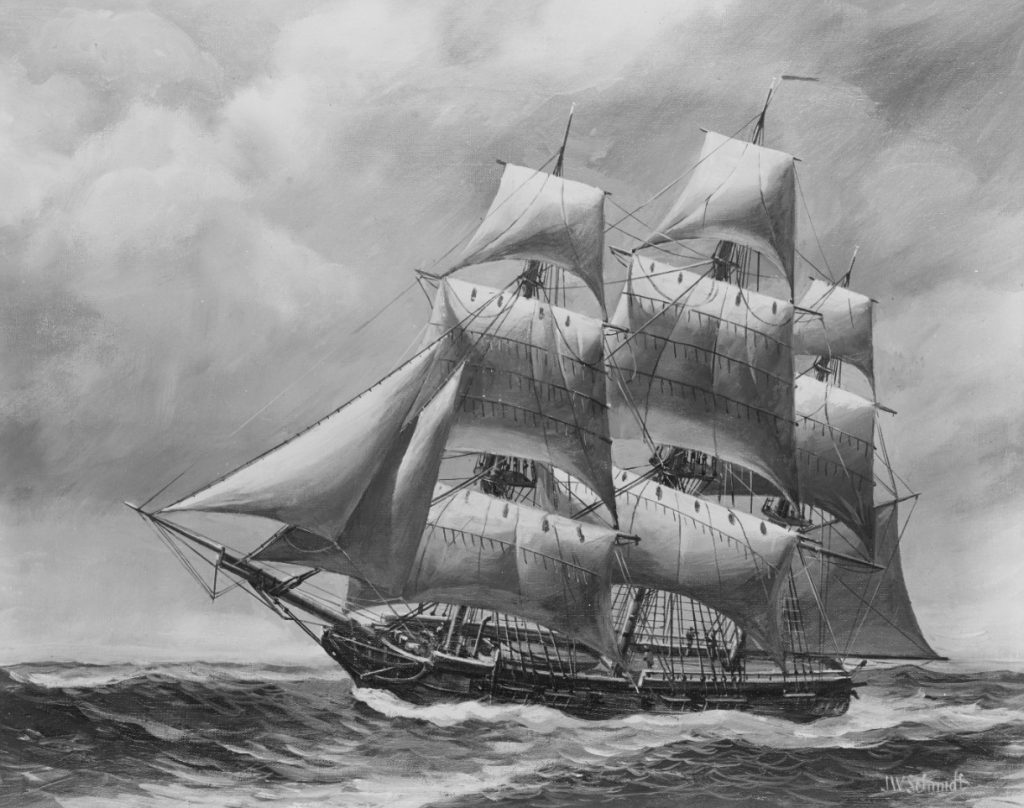
The First ship to bear Saratoga’s name served for only a year but managed to capture 12 ships (Courtesy of US Navy Heritage Command)
1802- Gideon Putnam Builds what becomes Grand Union Hotel- One of the most prominent features of Saratoga County is the mineral springs. World renowned for their health benefits, the springs brought thousands of visitors, including prominent aristocrats and world leaders, to Saratoga County — specifically Saratoga Springs and Ballston Spa. While it’s true that Ballston Spa was the first to take advantage of this, building two hotels in 1792, Saratoga Springs would have more staying power.
The first to take advantage of this was Gideon Putnam who built what would become the Grand Union Hotel in 1802 in the vicinity of the Congress Spring. Putnam would lay out much of what would become Saratoga Springs, tubing and connecting its springs. Putnam was in the process of building Congress Hall when he died in 1812.
While the opening of a hotel may seem like a trivial event in the broad story of the American mosaic, its impact can be seen both in what Saratoga became and the places it inspired. The list of famous figures to visit Saratoga Springs and their significance on American history could go on for pages, and the legacy of Saratoga Springs can be seen in the places named for it in Utah, Nebraska, California and Disney World. And, yes, the paper does regularly get calls from people thinking we are in Utah or California.
1819- Abner Doubleday is Born in Ballston Spa- As legend goes, baseball was created by Abner Doubleday in Cooperstown, New York in 1839. This story is based on the 1907 Mills Commission report which was largely influenced by Abner Graves’ testimony.
While the story has been refuted due to the fact that Doubleday’s diaries make no mention of baseball, he never claimed to invent baseball and would have been in his plebe year at West Point when the story is supposed to have happened, what is true is that Doubleday had a pretty remarkable life, even without inventing baseball.
Doubleday was the second-in-command at Fort Sumpter at the very start of the Civil War and fired the first shots of the Union Army. Doubleday commanded troops throughout the conflict in many notable battles. His most famous moment came in the Battle of Gettysburg when he took command of I Corpe and repelled a numerically superior force. Throughout his career, Doubleday is reported to have ordered baseball bats and balls for his troops because he believed sports were a good way to build unit cohesion.
While Cooperstown may be the birthplace of Doubleday’s myth, the man himself was born in Ballston Spa.
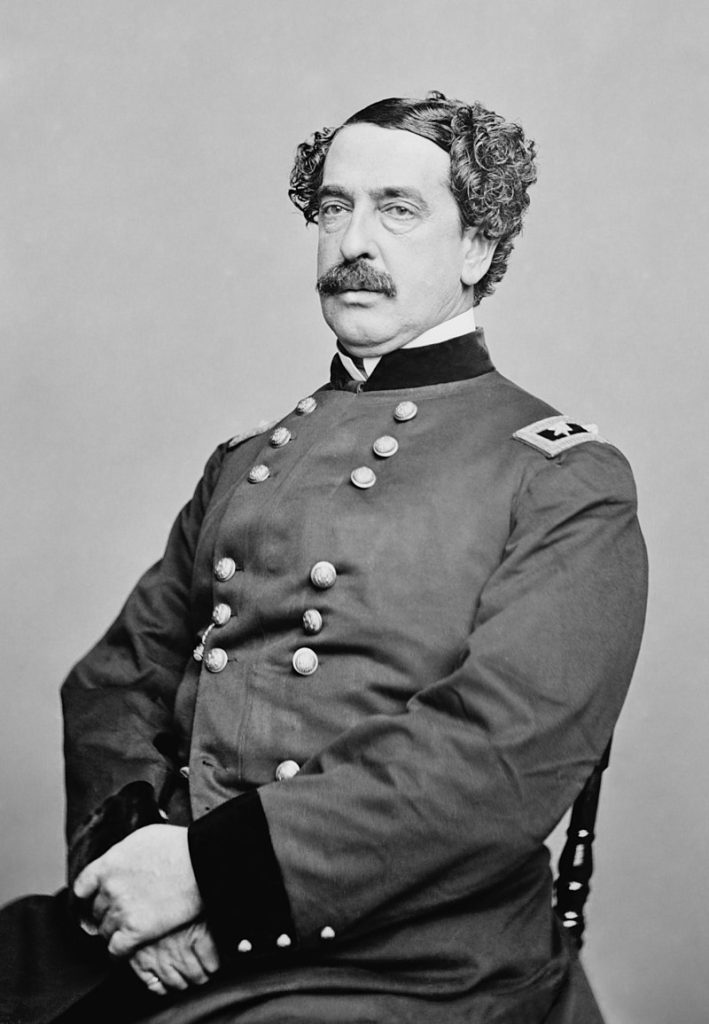
Baseball or no baseball, Abner Doubleday’s story is still worth telling, and that story began in Ballston Spa. (Courtesy of Library of Congress)
1825- Erie Canal Completed- The Second of the two Canals in Saratoga County, the Erie Canal was completed in 1925 with the ceremonial dumping of water from Lake Erie into New York Harbor on November 4, 1825. The canal’s completion would fundamentally shape New York and connect New York City to Midwest markets in Michigan, Indiana, and Ohio. It drastically reduced the cost of transporting goods, meaning that agricultural products made in those Midwest states could be shipped to New York.
The cost of transporting a ton of goods from Lake Erie to New York City went from $100 to $9, and freight traffic surpassed that of the Mississippi River. This prosperity propelled New York to become the largest port in the country within five years and led to the boom in cities such as Syracuse, Utica, and Rochester.
Saratoga’s connection to this route can be seen in the southern part of the county in Halfmoon and Waterford. Originally the Erie Canal bypassed the Cohoes Falls through a series of locks in Cohoes before crossing the Mohawk River at the Lower Mohawk Aqueduct in Halfmoon — today the site of the Crecent Bridge. In 1918, new locks to facilitate barge traffic were completed which bypassed the Cohoes Falls to the north in Waterford.
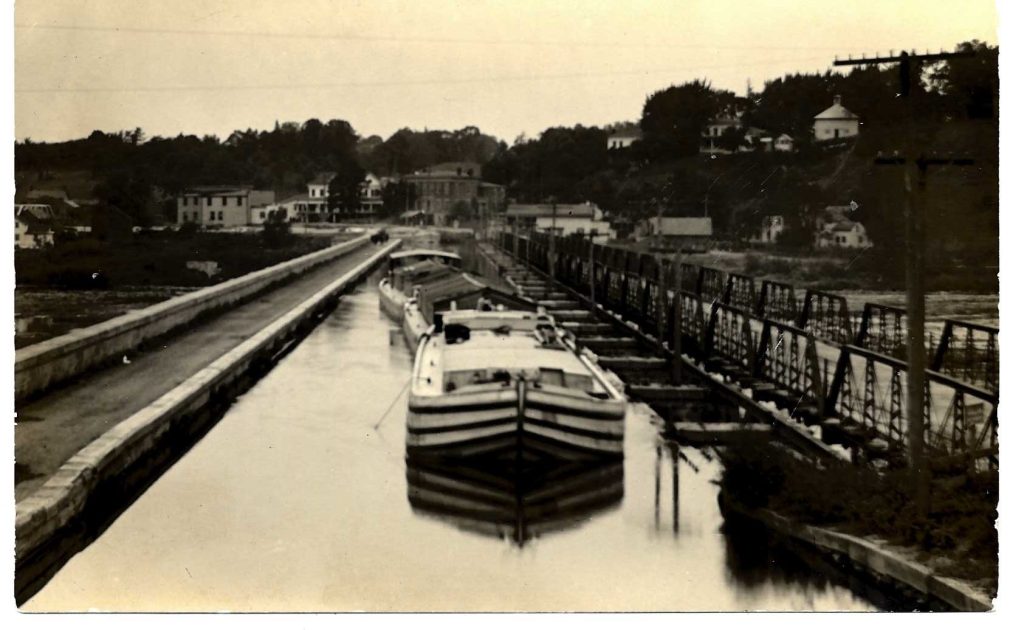
Canal Boats transit the Lower Mohawk Aqueduct in the Town of Halfmoon (Courtesy of CPH Library Local History).

1841- Saratoga Springs Resident Solomon Northup is Kidnapped into Slavery – In April 1841, Solomon Northup, a free Black man living in Saratoga Springs and working various jobs was enticed by two circus men to travel with them to Washington, DC as a traveling musician.
In Washington, Northup was drugged and kidnapped into slavery beginning a 12-year ordeal. Northrup was held in slavery in Louisiana under the name Platt Hamilton. In 1842 Northup was sold to plantation owner Edwin Epps for $1,500, where he would remain in bondage until 1853. Northup’s ordeal ended after Epps hired a Canadian Carpenter by the name of Samuel Bass. Bass in June 1852 managed to get two letters to William Perry and Cephas Parker who were friends of Northup in Saratoga. The two men contacted Northup’s wife and an attorney named Henry Bliss Northup whose relatives had at one point owned his father.
Henry Northup soon gathered documents to show that Solomon Northup was a free man and in bondage in Louisiana and received permission from New York Governor Washington Hunt to travel to Louisiana and rescue Northup in accordance with New York law. Henry Northup first went to DC to receive the backing of the Secretary of War and one of Louisiana’s senators. He contacted Bass in Louisiana who instructed him on where to find Solomon Northup and successfully freed him on January 3, 1853. That year Solomon Northrup and David Wilson would publish a book “Twelve Years a Slave,” which recounted his time in bondage. In 2013, the book was adapted into a movie which was nominated for 315 awards and won 145 of them — including three Academy Awards.

12 years a Slave Solomon Northup, as depicted in Twelve Years a Slave
1861- Malta Man is First Union Officer Killed in Civil War- The first officer to give his life in support of the Union cause was a man from Malta — Elmer Ellsworth. Ellsworth was born in Malta in 1837, grew up in Mechanicville and made his way to Illinois in 1854. Ellsworth, who had a fascination with all things military history, formed a militia company based on the French Zouave Regiment. The Company was known for its discipline and soon grabbed the attention of a Springfield lawyer by the name of Abraham Lincoln. The two became close friends with Ellsworth working in Lincoln’s law office as a clerk and participating in his 1860 presidential campaign.
When war broke out, Ellsworth returned to New York and recruited a 1,100-man unit, the 11th New York Infantry Regiment. Known as the “Fire Zouaves” due to its heavy recruitment of New York City firefighters, this unit was tasked on May 24, 1861, with crossing the Potomac River to seize Alexandria, VA. After the city was secure, Ellsworth went to a hotel to take down a Confederate flag that flew over it. While he was carrying down the captured flag, Ellsworth was shot and killed by the hotel owner, James Jackson. Jackson was then immediately killed by one of Ellsworth’s men who later received the Medal of Honor for this action.
Ellsworth’s death became an early rallying cry for the Union cause. His body lay in State in the White House before being buried in Mechanicville. Spurred by his death, another regiment, the 44th New York, was formed with the nickname “Ellsworth’s Avengers.”
1863- Thoroughbred Racing Begins at Saratoga- The so-called “Mecca of American horse racing” got its start mere weeks after the battle of Gettysburg. At the time, horseracing wasn’t new in Saratoga Springs as harness racing had been going on since 1847 at the Saratoga Trotting Course. In August 1863, the track would see something new to the Spa City and put its place on the map for the next 166 years: thoroughbred racing.
On August 3, 1863 — a month to the day after the Civil War’s turning point — the Irish born bare-knuckle boxer John “Old Smoke” Morrissey held the first thoroughbred race in Saratoga Springs at the Trotting Course. While the number of horses was limited, the crowd wasn’t, with 15,000 people attending. The next year Morrissey along with Leonard Jerome, John Hunter and William Travers would build the Saratoga Race Course as the Trotting Course was deemed to be too small for their operations.
Morrissey’s race paid off for the city. Already a resort town with its spas and springs, Saratoga Springs became a hub of gambling and horse racing for years to come. In 2024 with its normal home down for maintenance, the Belmont Stakes were held in Saratoga Springs, adding a jewel to the Saratoga Race Course’s history of excellence.
1885- Ulysses S. Grant Dies in Moreau – While Ellsworth and Doubleday may have commanded troops when the Civil War began, it was Ulysses S. Grant who commanded its conclusion. And as the two Saratoga County born officers started their stories Upstate, Grant would end his here — both literally and figuratively.
Dying of throat cancer, the former 18th president and General of the Army made his way to a cottage on Mt. McGregor in the Town of Moreau in June 1885. The cottage was owned by a friend of his who offered it as a quiet respite to spend his finals days. It was here where Grant finished his memoirs on July 18, 1885, and died on July 23. His body would be transported to New York City where it lies in a grand tomb in Upper Manhattan.
1925- USS Saratoga (CV-3) Launched- The fifth ship to carry the name Saratoga, the USS Saratoga (CV-3) had arguably the most interesting service run of the six “Saras.” She was originally designed and laid down to be a battle cruiser, but post-World War 1 naval limitations forced Navy planners to find a new role for her. That new role was to become one of the Navy’s first fast aircraft carriers. Launched in 1925 and commissioned in 1927, the Saratoga helped the Navy develop its tactics and train aircrews in the leadup to World War 2. She was in San Diego when Pearl Harbor was attacked and sortied to Pearl Harbor shortly after. In January 1942, she was struck by a torpedo and missed the Battle of Midway due to subsequent repairs.
The ship would take part in the invasion of Guadalcanal and the subsequent Battle of the Eastern Solomons, sinking a light carrier in the process. Throughout 1943 and 44, she would take part in several campaigns throughout the Central and South Pacific, striking targets and providing air cover to invasions. In February 1945, Saratoga was providing air cover for the invasion of Iwo Jima when she was struck by five bombs and three aircraft. After repairs in Washington, she spent the rest of the war as a training ship.
At war’s end, Saratoga was used to ferry troops home from the Pacific theater as part of Operation Magic Carpet. She ended up transporting 29,204 personnel, the most of any ship. When she retired from service, aircraft had completed 98,549 carrier landings on her deck, the most of any ship at the time. Her end would come in 1946 when she was sunk by the second of two atomic bombs during Operation Crossroads.
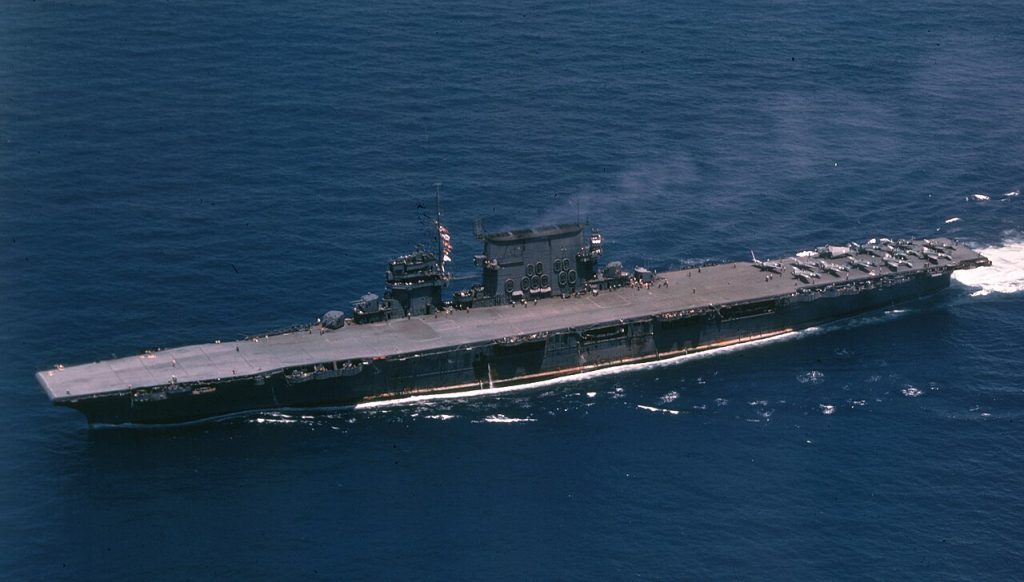
The USS Saratoga served for nearly 20 years and was one of the US Navy’s first modern carriers
1945- Malta Test Site Begins Operations-
In order to test rocket rockets seized from the Germans in World War II and develop our own capabilities, the nation turned to Saratoga. In 1945, General Electric established the Malta Rocket Test Station to test rocket engines, fuels and other weapons for the military. At the site, rockets would be held in the gantries and tested prior to flight tests elsewhere the United States. Rockets tested at the site included the Bumper, Vanguard Vega, Discoverer, Centaur, Polaris and Skybolt rockets. In 1964, GE sold the site to the New York State Energy Research Authority and later the Wright-Malta Company.
The site continued to test ordinance for the US Army when Global Foundries took over the site as part of their technology campus making semi-conductors.
1955- Kesselring Site begins Operations. It’s not just the USS Saratoga that ties Saratoga County to nukes and the navy. While initially built as a test site for nuclear reactors, it was quickly transformed into a training center and research facility to assist sailors and officers training for duty on-board nuclear-powered Navy ships. Over 50,000 sailors have trained at the site, including future President Jimmy Carter. The site is still in operation today, training sailors on the S8G nuclear reactor in use on Ohio Class Submarines.