


Smokey Saratoga Summer: A Look at What’s Causing Air Quality Levels to Drop
For the second week in a row, a haze fell over Saratoga County as wildfire smoke continued to penetrate the landscape.
On Aug 4 and 5 Federal and private monitors in the capitol region showed air quality index levels above 100 — making the air unsafe for sensitive groups — while some monitors in Saratoga County showed air quality levels above 150 — dangerous for all people.
With the continued downturn in air quality, Saratoga TODAY looked at what’s causing this problem and whether it will get worse.
What’s causing drops in air quality?
In the US, air quality drops have been associated with smoke coming from wildfires currently taking place in Canada. Smoke from fires over 1000 away from Saratoga has been travelling southeast, across the Midwest and into New York.
According to the latest situation report from the Canadian Interagency Forrest Fire Centre (CIFF), there are currently 737 active fires impacting the country. Of those, 504 are considered out of control with 199 receiving a full response and 305 receiving a monitored response.
Where are the fires taking place?
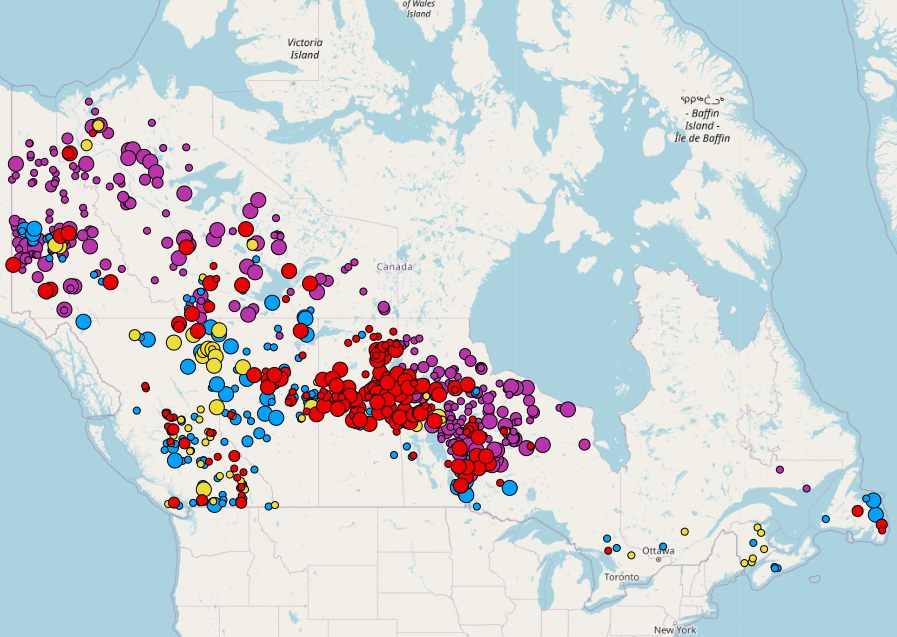
The fires are taking place largely beyond where most of the population of both Canada and the US would be directly impacted by the blazes. According to CIFF, most of the fires are taking place out west in the northern parts of Western Ontario, Manitoba, Saskatchewan, Alberta and British Columbia. There are also clusters of fires in Canada’s Northernmost territories of Yukon and Northwest Territories, as well as out east on the island of Newfoundland.
While Canada is the second largest country in the world by landmass, most of it’s population is clustered in major cities such as Toronto and Montreal in the east and Calgary, Edmonton and Vancouver in the west, according to population maps from statistics Canada.
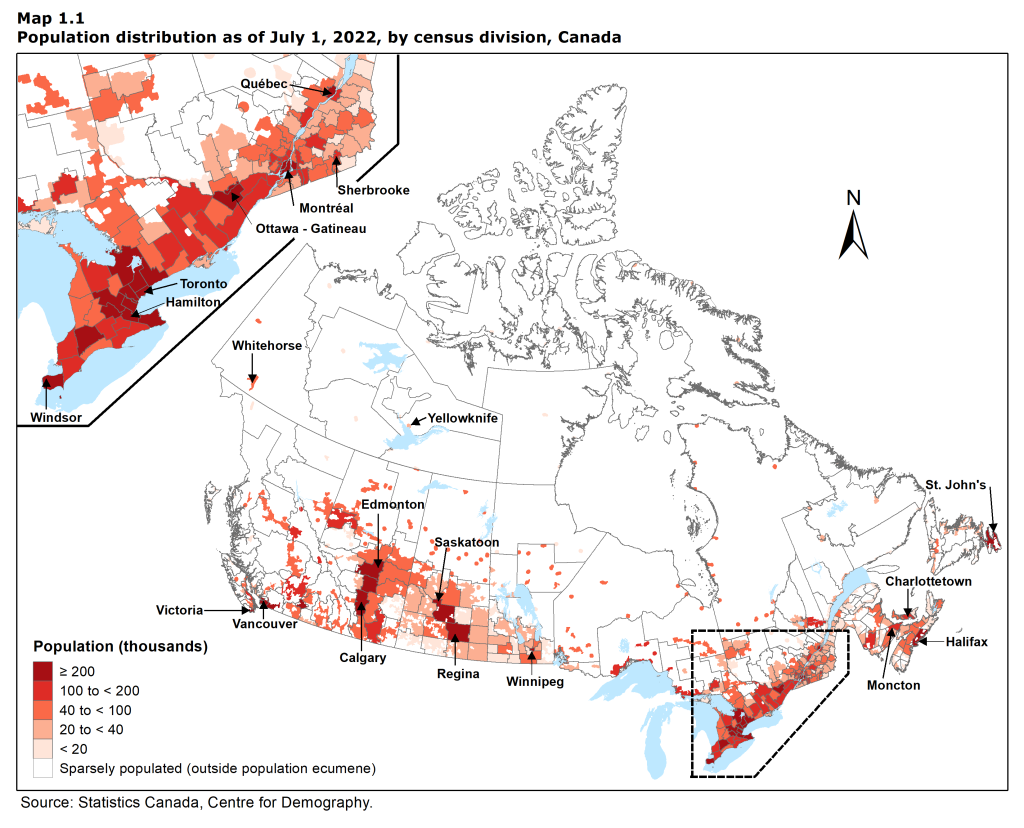
As a result, most of the fires are taking place far away from population centers. While there have been multiple evacuation orders in the provinces impacted by the blazes, many of these are primarily in small rural communities.
Is this normal?
Across North America, wildfires are a natural phenomenon. In Canada specifically, the fires serve to help a forest recycle debris and prevent build up, according to Parks Canada.
Fire is also one of the ways forestry services deal with wildfire conditions. As part of many forest management plans, agencies will start fires in what are prescribed burns, according to the National Park Service. These fires reduce fuel build up and allow an area to go through its natural processes in a more controlled way. Fires are even used locally in Saratoga National Park to help keep the battlefield in similar condition to what it was during the battle 250 years ago.
While fires themselves may be natural, the current conditions aren’t. Since 1983, when data on wildfires was first collected and reported in Canada, there has been only two fire seasons worse than the one currently being experienced — 1994 and 2023.

These worsening fire conditions have been attributed to climate change. According to Natural Resources Canada, because the air is becoming warmer and drier, wildfire seasons have been getting longer and more intense. This can be seen in drought conditions which show much of Canada experiencing abnormally high levels of dryness — particularly in areas currently dealing with the fires.

Canada has also had to deal with “zombie fires” or fires that lay dormant beneath the permafrost and snow for months before sparking back up when conditions are ripe for fires, according to NOAA.
How does this compare to the US?
Despite sharing a long border and working together on many wildfire responses, there are some notable differences between how the US and Canada experience and deal with fires.
The first major difference is human settlement in fire prone areas. In the US, settlement in wildland areas has gone up by nearly 50% in the last 40 years, according to a study funded by the US Forest Service. This number equates to 32% all housing in the US being in the wildland areas as of 2020.
Meanwhile in Canada, according to data from the Canadian Journal of Forest Research, 12.1% of Canadians live in wildland areas with an estimated 17% of those being in wildfire prone areas.
Beyond just having a lower population in wildland areas, Canada also has fewer fires started by humans. In the US, an estimated 85% of fires are started due to human interaction — be it accidental or due to negligence, according to the US Forest Service. Canada meanwhile sees the majority of their fires sparked by lightning strikes. In 2023 — the worst fire season on record — 93% of fires were as a result of lightning strikes with the remaining 7% caused by humans according to a study by Canada’s natural resource department.
What’s the impact on Saratoga?
In light of the of these fires, the New York Department of Health has advised residents to keep an eye on air quality levels and consider moving events inside — especially for those in high-risk groups.
“Poor air quality can pose serious health risks — especially for those with heart conditions, lung diseases, such as asthma, young children, those over 65 years old and pregnant individuals,” New York State Health Commissioner Dr. James McDonald said “To reduce exposure, limit strenuous activity outdoors. We encourage all New Yorkers to visit airnow.gov for the latest air quality forecast and be on the lookout for Air Quality Health Advisories from the Department of Environmental Conservation and the Department of Health.”
