

Triangulation: Tradition, Transition, and Transformation
Starting a tradition of going to the races with his father, Kevin Cox has transitioned from a New York City police officer to a professional handicapper
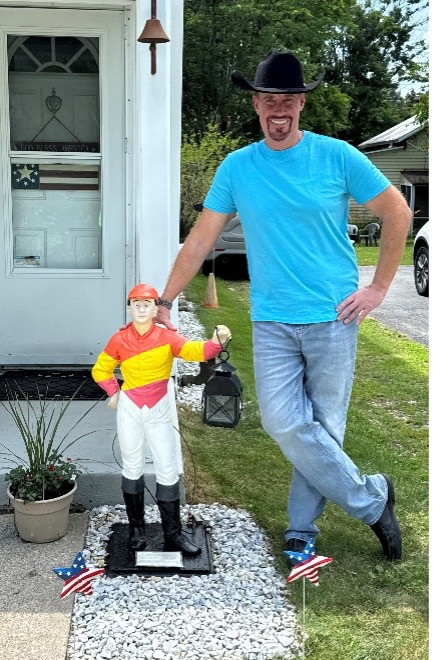
Kevin Cox views his Saratoga Springs experience as triangulated with tradition, transition, and transformation, particularly when it comes to horse racing and handicapping.
The youthful 55-year-old, known as the “Brooklyn Cowboy,” has taken his childhood tradition of coming to Saratoga Racecourse with his parents, who helped him transform that into a second career as a professional handicapper, writer, and racing analysis for his Substack platform and other opportunities.
“My father got me into the sport,” he said. “My mother helped me get the ball rolling. So, it’s clearly the right path, and then I morphed into writing a column.”
The Saratoga tradition started for Cox when he was eight years old as his father Walter “Bijou” Cox and mother Patricia DeAngelo Cox brought him to the area. Over the next several summers, Cox and his father continued that tradition by watching the workouts and races at the track while staying at the Brentwood Hotel, eating at the Weathervane, and playing at Murphy’s Driving Range and Mini Golf.
Cox’s father also taught him about handicapping races. While Cox was growing up, his father often brought that day’s Daily Racing Form to their Prospect Park home in Brooklyn for post-race analysis and refining his handicapping skills.
“That’s how I got my love of handicapping,” Cox said. “He would bring home the ‘Form’ and save them. He tried to come up with the systems. I still have some of his copious notes on different systems. It’s kind of cool to see his handwriting on some of the old forms.”
It has been 21 years since his father’s passing. However, Cox created another tradition that started with his father’s birthday on Aug. 13, 2005: a memorial race in which a horse ironically named The Daddy won the race with domination. There is also plaque in honoring his father beneath the former scratchboard near the eighth pole.
Since then, Cox has continued to celebrate his father’s Aug. 13 birthday with an annual lobster gathering among family and friends that include Sackatoga Stables Operating Manager Jack Knowlton and trainer James Ferarro, as well as his column and Twitter post as a tribute to the father-son relationship and traditions.
“Every year, on his birthday, I put an opening in my column. It’s a tribute to him. Basically, it’s about traditions,” Cox said. “It’s about the same things we used to do: stayed the same hotel, drank the water, played mini golf, went for the twin lobsters. It’s those memories until I started becoming old enough where I was able to rent a place for a couple weeks on my own.”
After purchasing a summer home on Madison Street, Cox has created another tradition: painting salvaged a lawn jockey each year. For the last 18 years, he has painted a theme or something symbolic to reflect the Saratoga racing season that started with the West Point Thoroughbred colors when he won his first race as a jockey agent.
To commemorate America’s 250th anniversary, Cox selected a design inspired by the 13-year-old horse Fourth of July, a winner of 7-of-25 races and competed twice at Saratoga. After thorough research, he found the silks that represented the horse’s career before going through the challenging painting process as he calls it a “labor of love.”
“Every year is a theme, an event, or a horse,” he said. “I always come up with something creative. It takes me five hours to do. It’s a beveled surface. It’s not like painting on a flat surface. I’m on my back going underneath [to paint it].”
Despite Cox’s passion for horse racing and handicapping, his mother wanted a career for him. After his mother submitted the application on his behalf to New York City Police Department, Cox went through the training process, received the same shield number used by his uncle, and was sworn as an officer by 20 years old.
For the next 20 years, Cox was a member of the New York City Police Department. After spending 15 years as a transit and plain clothes officer, he transitioned into a mounted officer as he rode Carnival House, a gelding whose lone win in 28 starts occurred in a $5,000 maiden claiming race at Colonial Downs in 1999.
During his service, particularly after the Sept. 11, 2001 terrorist attacks, Cox also had an epiphany of following a dream: working on the Aqueduct backstretch.
“After Sept. 11th being down there and realizing how many people didn’t get to live out their dreams, I decided to follow mine a little bit,” he said. “I wanted to work for somebody and learn things.”
Following his 9 p.m.-6 a.m. shift with the NYPD, he spent his mornings on the Aqueduct backstretch doing various tasks that included massaging horses for the late Joseph Aquilino, helping other trainers like Ferraro and Gary Contessa, and even learning how to become a jockey agent.
Once Cox retired from the NYPD and experiencing the challenges of being a jockey agent, he transformed his second career into a professional handicapper, especially after winning $40,000 at a Belmont handicapping contest that landed him a spot on the Esquire Network docuseries Horseplayers in which he displayed his signature appearance with the black cowboy hat and boots.
Building from that success, Cox launched a handicapping column and later expanded his work to the Substack platform with help from his cousin Stephen DeAngelo and Laura Arth, founder of the marketing and communications company Triangulate.
Cox, an advisory board member for Old Friends at Cabin Creek and the Thoroughbred Aftercare Alliance, also makes appearances for Capital OTB with his Play of the Day every Friday and Saturday that has produced a flat-bet profit for the last four years. He also provides analysis for other tracks and events, including the Breeders’ Cup.
During his 12½ years of handicapping close to 25,000 races, which includes 5,000 winners, Cox has never taken off a day as he has battled through illness and computer glitches to publish his analysis. While Cox spends about seven hours on a given 10-race card, he wouldn’t have it any other way.
“I’m master of my own domain,” he said. “Seriously, how many people are fortunate enough to do their job in their underwear!”