

A History of the Saratoga Springs History Museum
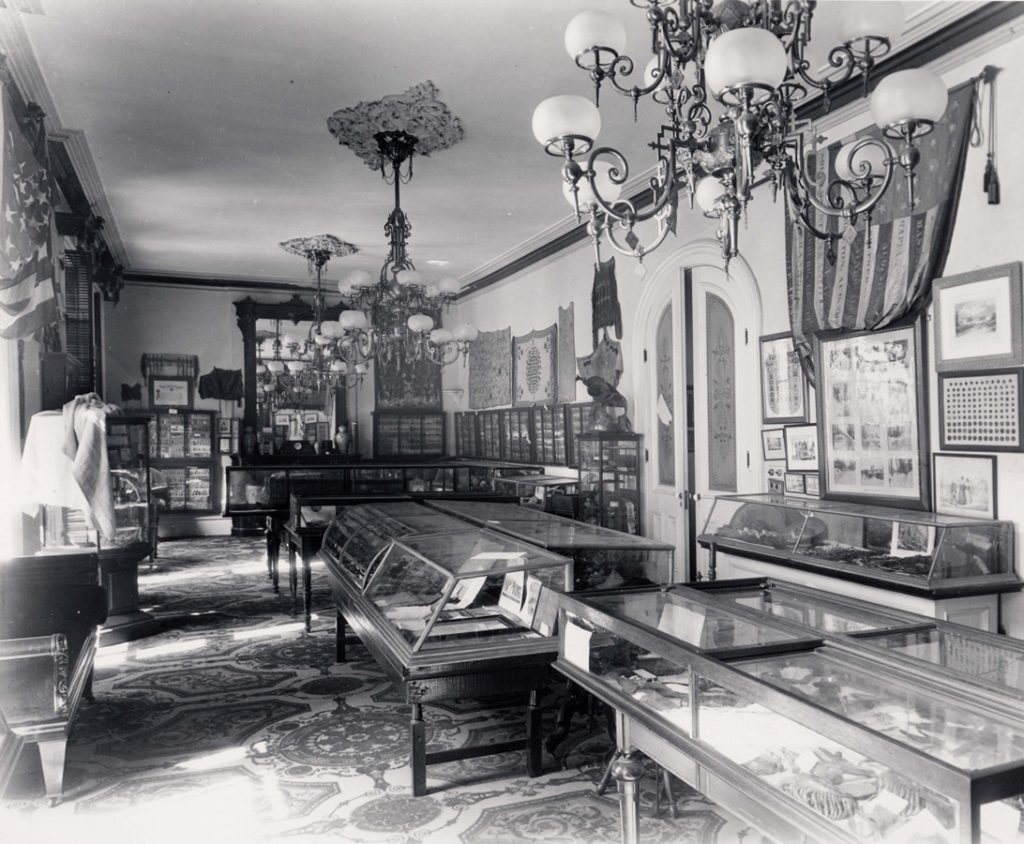
A Saratoga Historical Society exhibit in the Canfield Casino, circa 1920. Photo provided by the Saratoga Springs History Museum.
SARATOGA SPRINGS — The Saratoga Springs History Museum explored its past and present at the 142nd annual meeting of its historical society at the opulent Canfield Casino on Oct. 29.
Before diving into a presentation on the museum’s evolution during more than a century of existence, Executive Director James Parillo addressed its current state, which appears to be quite healthy. According to Parillo, income this year is up 18% compared to 2024, admissions have risen 5%, donations are up 50%, memberships are up 24%, and grant income is up 30%. The only financial element that hasn’t increased this year is gift shop sales.
“Our expenses this year only rose 1.7%, so that’s one thing that helps keep us in such a strong position, with income up, and expenses not rising,” Parillo said. “Our spending is very conservative.”
Careful stewardship of the museum over the years has been a tall order, with some stewards perhaps succeeding more than others.
The historical society that preceded the museum was founded on October 13, 1883 by a group of 16 petitioners that included some big names in Saratoga history, such as Spencer Trask, co-founder of Yaddo; Joseph W. Drexel, the original owner of what is now the Grant Cottage State Historic Site; and John R. Putnam, the grandson of Saratoga Springs founder Gideon Putnam. Their first board of trustees also included Ellen Hardin Walworth, one of the founders of the Daughters of the American Revolution.
This prestigious group didn’t initially create a museum per se, but they were interested in sharing their collections of historic artifacts. Their first home was the House of Pansa building on Broadway, which still stands and is currently the headquarters of Death Wish Coffee.
After a while, the historical society needed a new place to house its collection and by a happy coincidence, the Canfield Casino was for sale. The casino, originally named the Saratoga Clubhouse by its legendary founder John “Old Smoke” Morrissey, was sold by then-owner Richard Canfield after anti-gambling forces shuttered it. The City of Saratoga Springs purchased the famed gambling house in 1912 and allowed the historical society to move into the building’s second floor. This is when the society appointed its first official curator, Captain James Andrews, and the museum as we know it today began to take shape.
In 1927, the museum named a new curator: Evelyn Barrett Britten, who was close friends with the Walworth family. Britten’s Saratoga bona fides were impressive. She was valedictorian of Saratoga Springs High School in 1909, a longtime reporter at The Saratogian, and, for 25 years, the city’s official historian. Britten was responsible for supervising the transfer of belongings from the Walworth mansion to the third floor of the Canfield Casino. Britten also waged a sometimes bitter war to protect the casino from developers. She passed away in 1969, after serving as the historical society’s curator for 42 years.
“She was wonderful,” Parillo said. “We owe her so much for organizing the museum and bringing in artifacts.”
Britten was succeeded (both as leader of the museum and as city historian) by Bea Sweeney, who became the historical society’s first-ever director. Sweeney had a substantial influence on the Spa City by placing more than 70 buildings in the Franklin Square area on the National Register of Historic Places and by establishing the city’s archives.
“Bea Sweeney was a powerhouse,” said Parillo. “She was a woman that organized everything… Bea went through, with a corps of volunteers, and catalogued every artifact we had at the museum. You were looking at 80-plus years of collections. It was a monumental task.”
In more recent years, the museum has modernized with a new logo and mission statement: “to foster public education and chronicle Saratoga Springs history by operating the History Museum, conducting programs, and collecting, preserving, exhibiting, and interpreting materials that document the city’s social, political, economic, geological, and cultural history.”
Today, the museum boasts the highest visitation in its history, preserves more than 16,000 artifacts, and has digitized thousands of photographs for online research.
Those interested in supporting the museum can do so via a membership or donation. To learn more, visit www.saratogahistory.org/membership or www.saratogahistory.org/donate.