

A President’s Day look At Calvin Coolidge
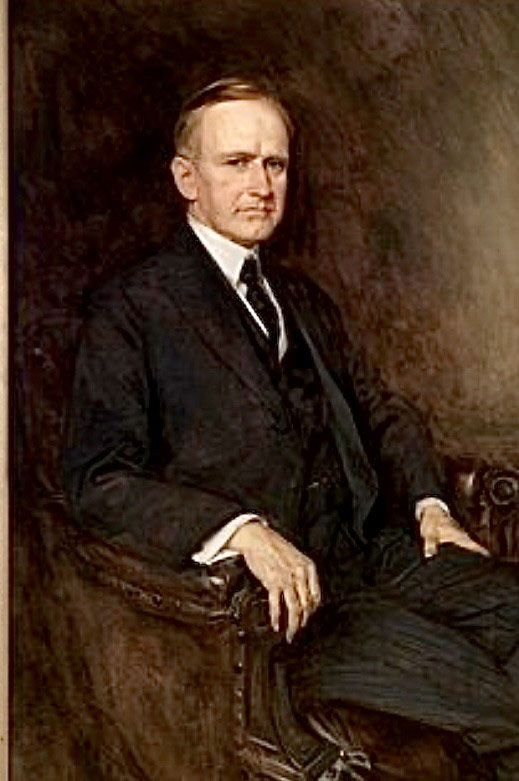
Portrait of Calvin Coolidge
This Monday we celebrate President’s Day. It is a time to reflect on the forty-five men who have risen to the highest office in the land. Today we will take a look at the life of Calvin Coolidge, our thirtieth Chief Executive.
His life’s journey began in a small village in our neighboring state of Vermont. His boyhood home is a National Historic Site. It makes for a nice day trip for the Saratoga area residents who are interested in Presidential history.
Calvin Coolidge was known as “Silent Cal.” During his Presidency a story circulated that he was sitting next to a woman at a dinner party. She stated that she had made a bet with someone also attending that she could get the President to say three words. Coolidge quipped back, “You lose.” It gives some insight as to his demeanor.
He was born in Plymouth, Vermont in 1872 on the Fourth of July. The date was apropos for a future President of the United States. His father Calvin Sr. was a storekeeper and a state legislator who would play a major role years later on the most important day of his son’s life. Calvin spent his entire youth in Plymouth. He attended local schools and then studied at St. Johnsbury Academy. He continued his education at Amherst College where he graduated with honors and then pursued a career in the law. In 1897 he opened a practice in Northampton, Massachusetts. Coolidge became involved with
Republican Party politics and methodically climbed the ladder to the state’s governor’s office in 1919.
After serving only two years in that capacity, he was nominated as Vice President on the Republican ticket headed by Warren Harding. The duo were elected in a landslide. On March 4,1921 Calvin was sworn in as our twenty- ninth Vice President. At that time the office was pretty much a do nothing job. Theodore Roosevelt who held the office before his elevation to the Presidency had this to say about it. “I would much rather be anything, say a professor of history than Vice President.”
Fate was about to dramatically change the life of Calvin Coolidge.
On the second of August,1923 Warren Harding suffered a heart attack and passed into history at the age of fifty-seven. It was a shock to the nation. The affable Harding was a beloved figure at the time. Nine million Americans lined the railroad tracks to see his funeral train make the voyage from San Francisco to Washington DC.
It wasn’t until much later that his time in office was diminished due to the various scandals that tarnished his reputation.
When Coolidge was informed that Harding had passed, he was visiting his family in Vermont. At 2:47 on the morning of August third he was sworn in as President by his father Calvin Sr. The elder Coolidge held the position of Justice of the Peace and used that authority to administer the oath. Calvin Coolidge was now the most powerful man in the country.
Coolidge was in office for a major part of the decade known as the“Roaring Twenties.” America was in a feel good mode. After a short lived depression following the First World War, both the Harding and Coolidge administrations put the country back on it’s feet. Unemployment was cut in half, taxes were reduced and the country was at peace.
The 1924 election rewarded Coolidge with four more years in the White House. Prosperity drove the Republican ticket to an overwhelming victory. The Democrats took a shellacking, receiving only twenty- nine percent of the popular vote. His only full term as president was for the most part unremarkable. He continued with the same policies that had worked since he took office. Coolidge chose not to run for re-election in 1928. He was of the belief that he had served long enough. He thought that being in the office for too long created the air of an Imperial Presidency.
In retrospect it was the perfect timing to retire. Coolidge had dodged a bullet. His successor, Herbert Hoover would find out the hard way. “Wonder Boy” as Coolidge respectfully called him, held the office for only eight months before the stock market crashed. The reverberations were felt around the globe. The “Roaring Twenties” were over, a world wide depression was about to begin.
Coolidge retired to his home in Northampton where he wrote his autobiography, penned articles for various publications and wholeheartedly defended Republican Party policies. The former president suffered a heart attack and died on January 5, 1934. He was just sixty years old. This comment from a New York Herald Tribune article shortly after his death sums up the character of Calvin Coolidge. “In a very real sense the nation has lost the leader whom it completely trusted.”
For those interested In presidential history the Calvin Coolidge Homestead is a must see. His boyhood residence, just a two hour drive from here through scenic Vermont, has been left virtually untouched since the night he was sworn in as president. It also served as the Summer White House during the first full year of his presidency. It was here that he conducted the Nation’s business on the second floor of the home. Noted visitors included Henry Ford and Thomas Edison. The President’s burial site is near by at Plymouth Notch Cemetery.
The Calvin Coolidge Presidential Library can be found in Northampton, Massachusetts. It is housed on the second floor of the Forbes Library. Although on a lesser scale than many of the presidential museums, it has much to offer relating to the life and times of our thirtieth Chief Executive. Happy travels!