Author: Joe Raucci

THE BREEDERS’ CUP CLASSIC..RATING THE FIELD

With Michael Veitch


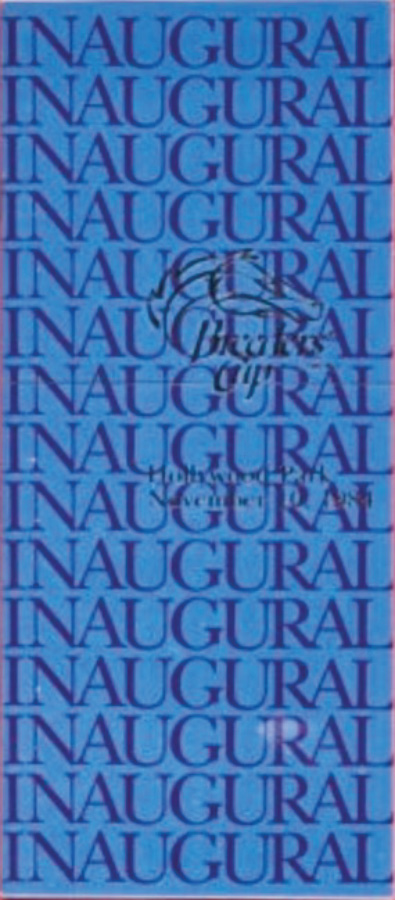
“Program cover 1984 inaugural Breeders’ Cup”

This weekend all roads lead to southern California and beautiful Del Mar Racecourse for the 42nd rendition of the Breeders’ Cup. It is the pinnacle event of the horse racing season. The two-day extravaganza showcases the best thoroughbreds in the world competing in 14 races with a mind-boggling 30 million dollars in purse money.  

The grand finale of the weekend is the Breeders’ Cup Classic. The mile and quarter event brings together the best in the three-year-olds and up category. The rivals will compete for a seven million dollar purse and probable Horse of the Year honors. No less than an astounding 17 of the 41 winners have gone on to claim that title. 

This year’s field has all the earmarks of becoming “One for the ages.” The race is absolutely loaded with talent. The top contenders include: SOVEREIGNTY…2025 Kentucky Derby, Belmont Stakes, Travers Stakes. SIERRA LEONE…2024 Breeders Cup Classic, Whitney Stakes. FIERCENESS..2024 Travers Stakes, Jim Dandy Stakes, 2025 Pacific Classic. FOREVER YOUNG…2024 Japan Dirt Classic, 2025 Saudi Cup. JOURNALISM…2025 Preakness Stakes, Haskell Stakes. BAEZA…Pennsylvania Derby. MINDFRAME…2025 Stephen Foster Stakes. Grade 1 winners NEVADA BEACH  

and ANTIQUARIAN round out the field. 

One may have to look back to the 1973 Marlboro Cup to find a more accomplished field. It showcased the likes of the great Secretariat and his brilliant stablemate Riva Ridge. The supporting cast included fellow Hall of Fame champion Cougar 2nd, 1972 Three-year old champion Key to the Mint and 1973 Canadian Horse of the Year Kennedy Road. 

Comparing previous Classics, the 1998 version has aged like a bottle of 1959 Lafite Rothschild. The Canadian star Awesome Again defeated the great champions Silver Charm and Skip Away, along with a host of Grade 1 winners. It is considered one or the greatest fields ever assembled. 

I have reached out to Saratoga’s own Michael Veitch to analyze the race for our readers. He needs no introduction here. His resume speaks for itself. Mike will guide us through the entries and their chances of winning the race. He will also present a short history of the Breeders’ Cup. 

Without further interruption, the Maestro can take it from here. 

The  Breeders’ Cup was created to increase the exposure of racing on a national scale and to help determine national champions with a year-end program of rich races. Owner and breeder John Gaines is credited as one of the driving forces in its creation, which for several years saw the races held at such tracks as Gulfstream Park, Lone Star in Texas, and Woodbine in Toronto. Hollywood Park hosted the 1984 inaugural, with Aqueduct Race Track hosting the second edition in 1985. Over the decades, the program itself has grown from a single day of six races to a two-day event of 14. 

Its importance is such that many of the old barometers of titles, races such as the Travers, Champagne, Jockey Club Gold Cup, Arlington Million and others, have now become stepping stones to the Breeders’ Cup.This was upsetting to racing traditionalists at the time. The Jockey Club Gold Cup for many years was known as “Racing’s Crowning Event.”  Not anymore. It is the Breeders’ Cup that frequently anoints divisional champions.The Cup races bring together many, if not most, of the divisional leaders. Its timing in late October or early November puts the finishing touch on championship campaigns. 

Now it’s time for Mike’s assessment of the field: 

BAEZA is my pick to win the Classic. I think he has finally attained the composure and professionalism that goes with his considerable talent, much of which remains untapped in my opinion. He is trained by the masterful John Shirreffs, who handled the immortal Zenyatta. He finally earned his Grade 1 victory in the Pennsylvania Derby last out. 

FIERCENESS has done little wrong in his career. Second in this event last year, he won the Pacific Classic this season at Del Mar after nearly bolting through the inner rail at the start. He will be hard to handle in his best.  

This fabulous field also contains SOVEREIGNTY, and all he has done is capture the Kentucky Derby, Belmont, and Travers, which in all likelihood assures him the division Eclipse Award,  regardless of his performance in the Classic. He is training for this event with his Hall of Fame conditioner Bill Mott at Saratoga’s Oklahoma Training Track. 

SIERRA LEONE won this event last year. He is a confirmed closer who loves 10 furlongs and has never been out of the money. He does need help with a strong pace, but none-the- less has a lot going for him as he returns to Del Mar. 

Third in the 2024 Classic was FOREVER YOUNG , who last year was third to Mystik Dan and Sierra Leone in the Kentucky Derby, just a head short of winning. He was bred in Japan, whose runners are increasingly prominent on the world stage. 

MINDFRAME is yet another with a terrific resume and he holds a victory over Sierra Leone in the Grade 1 Stephen Foster this past summer. He had horrible luck in the Jockey Club Gold Cup at Saratoga when he lost jockey Irad Ortiz when bumped at the start. Having said that, please note that he ran the distance and thus, presumably, got something out of it. 

JOURNALISM is a solid member of the sophomore class of 2025. He won the middle jewel of the Triple Crown, the Preakness Stakes, and owns Grade 1 victories on both coasts. Thanks to Mike for his analysis and history of the event, Most of you that read this will surely be watching the Breeders’ Cup. For those who have a passing interest or none at all, this one is worth watching. Tune in and see what makes horse racing such a grand sport. Seldom do we get a chance to see this many accomplished thoroughbreds enter the starting gate with such great expectations. Post time for the race is Saturday at 6:25 pm EDT. It will be televised on NBC and its affiliate, Peacock TV. Article submitted before any late scratches might occur.

RON TURCOTTE: SECRETARIAT, SUCCESS, AND TRAGEDY


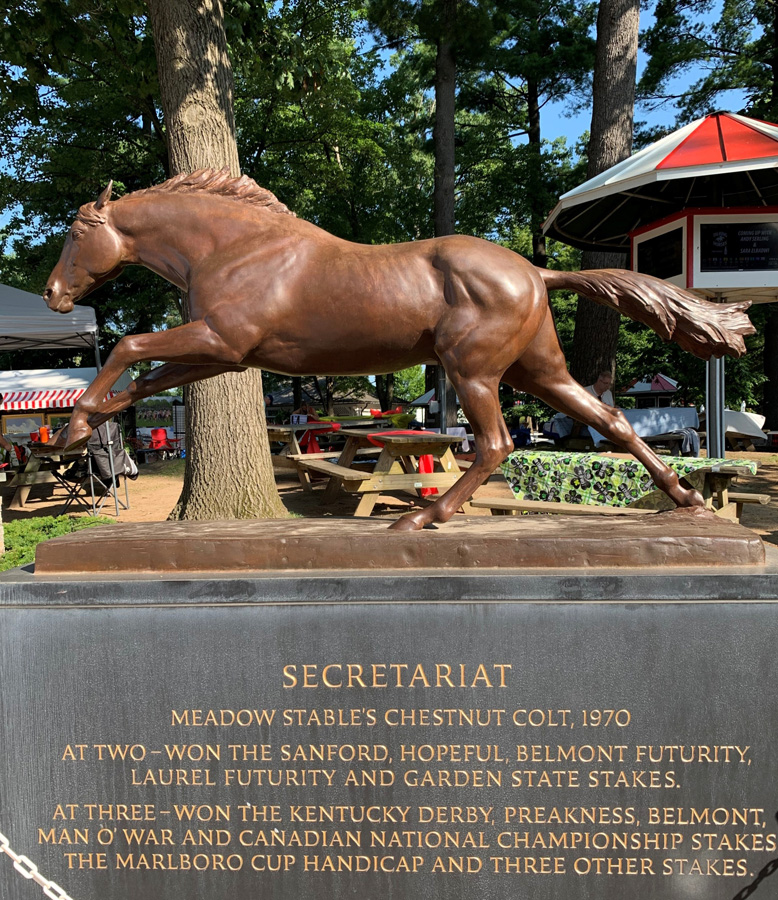
A statue of Secretariat at the Saratoga Race Course. 
Photo by Jonathon Norcross.

Hall of Fame jockey Ron Turcotte passed away last week. He was 84 years old. Born in Canada to an impoverished family, he and four of his brothers sought a better life. With their diminutive size, jockey silks were the perfect fit for the Turcotte crew.

Ron was the first to make the move in 1960. He got his start as a groom at E.P. Taylor’s legendary Winfields Farm. One by one, his four brothers followed him to the racetrack. It wasn’t long before the Turcottes would carve out successful careers north of the border. They were all talented, but Ron was special. He was the leading jockey in Canada for the years 1962 and 63. He had proved that he was the best rider on the Canadian racing scene. Now it was time to make the move south to the states and the big time.

Ron headed for Maryland where he connected with fellow Canadian, trainer Lucien Laurin. Little did these two know that within a decade they would be two of the most famous personalities on the planet. Ron got his first taste of Triple Crown success with Tom Rolfe in 1965. He took the Preakness aboard that year’s three-year-old champion. He also rode the likes of Hall of Fame inductees Northern Dancer, Damascus, Arts and Letters, Fort Marcy, and Shuvee during the decade of the 1960s.

In the early 1970s, lightning would strike for Ron Turcotte with Penny Tweedy and her Meadow Stable’s Riva Ridge. He would give Ron a taste of things to come. The colt won both the Kentucky Derby and Belmont Stakes on the way to a Hall of Fame career. If not for a sloppy track on Preakness day, Riva Ridge could very well have swept the Triple Crown series. 

Waiting in the wings was his stablemate, a chestnut colt who would soon shake the racing world to its core. While Riva Ridge was busy winning Triple Crown races, Secretariat was about to make his debut at Belmont Park on the Fourth of July, 1972. It was at best a lackluster performance. After that, the two-year-old ran the table. He won his next eight races and became the first juvenile runner to be named Horse of the Year since the great Native Dancer in 1953. Ron Turcotte was on cloud numbers one through eight. The best was yet to come. In 1973, he would be sitting alone on cloud number nine. 

Secretariat was already a household name when he prepared for his three-year-old campaign. He started that season with blowout performances in the first two of New York’s Kentucky Derby prep races. He suffered a minor setback finishing third to stablemate Angle Light in the Wood Memorial. Two weeks later, he was on his way to Valhalla when Ron Turcotte guided him to a track record time in “The Run for the Roses.” The Preakness was two weeks later. Another track record was in the cards for the big horse. Next up was the Belmont Stakes. Secretariat annihilated the rest of the field in the mile and a half race. As announcer Chick Anderson called it, “He is moving like a tremendous machine.” At the finish, he was a mind-boggling 31 lengths clear of his nearest competitor. This one too was clocked in record time. Turcotte looking back at Secretariat’s beaten down rivals is an iconic photo in the history of the sport. 

“Bid Red” was hailed as the first Triple Crown Champion in a quarter century. He would go on to thrill fans across the horse racing universe throughout the season of 1973. It would have been fitting for Ron to be aboard the champ when he won his last race, The Canadian International at Woodbine. Unfortunately, he was in the midst of a riding suspension. His fellow Hall of Fame jockey Eddie Maple got the call and was onboard as Secretariat demolished the rest of the field by six and a half lengths. Secretariat’s career was over. He was named Horse of the Year for the second time.

Other Triple Crown champions have come along. The all-time greats Seattle Slew and Affirmed come to mind. Yet, Secretariat stands with Man o’ War and Citation as one of the three greatest horses ever produced on this continent. It is not a stretch to say that when one thinks of Secretariat, the next thought is that of Ron Turcotte. The two will always go hand in hand. 

Unfortunately, the story doesn’t end there. Five years after the celebrated season of Secretariat, Ron was badly injured in a race at Belmont Park. The masterful winner of over three thousand races was relegated to a wheelchair for the rest of his life. 

It is said that one must go into the deepest valleys to climb the highest mountains. This can be stated when looking back at the life of Ron Turcotte. Despite being paralyzed, he never gave up. He spent the rest of his life promoting the Permanently Disabled Jockey Fund as a spokesman for that organization. Rest in Peace to a great gentleman of the turf, Ron Turcotte.

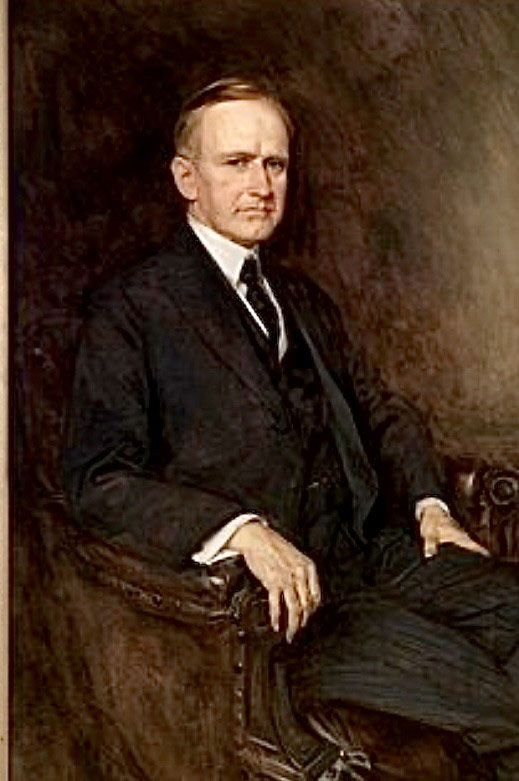
A President’s Day look At Calvin Coolidge


Portrait of Calvin Coolidge

This Monday we celebrate President’s Day. It is a time to reflect on the forty-five men who have risen to the highest office in the land. Today we will take a look at the life of Calvin Coolidge, our thirtieth Chief Executive.

His life’s journey began in a small village in our neighboring state of Vermont. His boyhood home is a National Historic Site. It makes for a nice day trip for the Saratoga area residents who are interested in Presidential history.

Calvin Coolidge was known as “Silent Cal.” During his Presidency a story circulated that he was sitting next to a woman at a dinner party. She stated that she had made a bet with someone also attending that she could get the President to say three words. Coolidge quipped back, “You lose.” It gives some insight as to his demeanor.

He was born in Plymouth, Vermont in 1872 on the Fourth of July. The date was apropos for a future President of the United States. His father Calvin Sr. was a storekeeper and a state legislator who would play a major role years later on the most important day of his son’s life. Calvin spent his entire youth in Plymouth. He attended local schools and then studied at St. Johnsbury Academy. He continued his education at Amherst College where he graduated with honors and then pursued a career in the law. In 1897 he opened a practice in Northampton, Massachusetts. Coolidge became involved with

Republican Party politics and methodically climbed the ladder to the state’s governor’s office in 1919.

After serving only two years in that capacity, he was nominated as Vice President on the Republican ticket headed by Warren Harding. The duo were elected in a landslide. On March 4,1921 Calvin was sworn in as our twenty- ninth Vice President. At that time the office was pretty much a do nothing job. Theodore Roosevelt who held the office before his elevation to the Presidency had this to say about it. “I would much rather be anything, say a professor of history than Vice President.”

Fate was about to dramatically change the life of Calvin Coolidge.

On the second of August,1923 Warren Harding suffered a heart attack and passed into history at the age of fifty-seven. It was a shock to the nation. The affable Harding was a beloved figure at the time. Nine million Americans lined the railroad tracks to see his funeral train make the voyage from San Francisco to Washington DC.

It wasn’t until much later that his time in office was diminished due to the various scandals that tarnished his reputation.

When Coolidge was informed that Harding had passed, he was visiting his family in Vermont. At 2:47 on the morning of August third he was sworn in as President by his father Calvin Sr. The elder Coolidge held the position of Justice of the Peace and used that authority to administer the oath. Calvin Coolidge was now the most powerful man in the country.

Coolidge was in office for a major part of the decade known as the“Roaring Twenties.” America was in a feel good mode. After a short lived depression following the First World War, both the Harding and Coolidge administrations put the country back on it’s feet. Unemployment was cut in half, taxes were reduced and the country was at peace.

The 1924 election rewarded Coolidge with four more years in the White House. Prosperity drove the Republican ticket to an overwhelming victory. The Democrats took a shellacking, receiving only twenty- nine percent of the popular vote. His only full term as president was for the most part unremarkable. He continued with the same policies that had worked since he took office. Coolidge chose not to run for re-election in 1928. He was of the belief that he had served long enough. He thought that being in the office for too long created the air of an Imperial Presidency.

In retrospect it was the perfect timing to retire. Coolidge had dodged a bullet. His successor, Herbert Hoover would find out the hard way. “Wonder Boy” as Coolidge respectfully called him, held the office for only eight months before the stock market crashed. The reverberations were felt around the globe. The “Roaring Twenties” were over, a world wide depression was about to begin.

Coolidge retired to his home in Northampton where he wrote his autobiography, penned articles for various publications and wholeheartedly defended Republican Party policies. The former president suffered a heart attack and died on January 5, 1934. He was just sixty years old. This comment from a New York Herald Tribune article shortly after his death sums up the character of Calvin Coolidge. “In a very real sense the nation has lost the leader whom it completely trusted.”

For those interested In presidential history the Calvin Coolidge Homestead is a must see. His boyhood residence, just a two hour drive from here through scenic Vermont, has been left virtually untouched since the night he was sworn in as president. It also served as the Summer White House during the first full year of his presidency. It was here that he conducted the Nation’s business on the second floor of the home. Noted visitors included Henry Ford and Thomas Edison. The President’s burial site is near by at Plymouth Notch Cemetery.

The Calvin Coolidge Presidential Library can be found in Northampton, Massachusetts. It is housed on the second floor of the Forbes Library. Although on a lesser scale than many of the presidential museums, it has much to offer relating to the life and times of our thirtieth Chief Executive. Happy travels!

And They’re Off At Saratoga

It’s here. the track announcer will speak the familiar words “It is now post time” followed by “And they’re off” and the historic Spa’s racing season will be underway. 

There are few sporting venues that can compare to the beauty and charm of America’s greatest horse racing destination. Augusta, home of the Masters, along with Fenway Park and Wrigley Field, tributes to baseball’s glorious past may compare, but none can surpass it. 

It’s Summer in Saratoga. Adding to the mystique of “The Sport of Kings,” The Performing Arts Center will host some of the finest talent in the music world. Golf courses abound. Up the road from Union Avenue sits Saratoga National. A marvelous layout, it is as challenging as it is beautiful. The eighteen hole course in the Spa State Park is scenic and not as demanding as the afore mentioned. It makes for an enjoyable morning before heading over to the track. 

What can compare with walking down historic Union Avenue and the entrance to the racecourse. If one has the time, a visit to the National Museum of racing is a worthwhile stop on the way. The world of thoroughbred racing is on display. Here the horses, trainers and jockeys who surpassed their rivals in talent and fortitude are enshrined for eternity in Horse Racing’s Hall of Fame. Trophies won by America’s greatest stables abound in rooms befitting their importance. It is a must stop for the serious racing fan. For the novice and the vacationer who come to Saratoga, it can be a wonderful learning experience. Then it’s a short walk into the past. The enticement of the historic track awaits. The ghosts of Man o’ War, Secretariat and so many other great champions can be felt, as one strolls the beautiful grounds. 


{loadmoduleid 268}


The main reason one comes here is to wager on the magnificent thoroughbreds that are bred to display speed and endurance over distances ranging from five furlongs to more than a mile and a half. 

At Saratoga you can expect the best of them to appear. They will strut their stuff in search of a visit to the winner’s circle. The best will compete in a stakes race schedule that is stacked with major events. The Whitney Stakes, The Alabama, and the coveted Travers Stakes lead the way. This years” Mid Summer Derby” may be one for the ages. If all goes well it’s a distinct probability that the Belmont Stakes at Saratoga winner will be entered in the race. How about that to ice the cake for one of America’s greatest horse races. The meet will be full of surprises. You can bet on that. It’s what makes horse racing such an interesting sport. You can also be rest assured that a champion in the making will make an appearance here. That has been a sure thing since racing began here in 1863. 

Get ready, the best is yet to come.