

Author Sheds Light on ‘90s Jam Bands and Saratoga’s Place in Music History
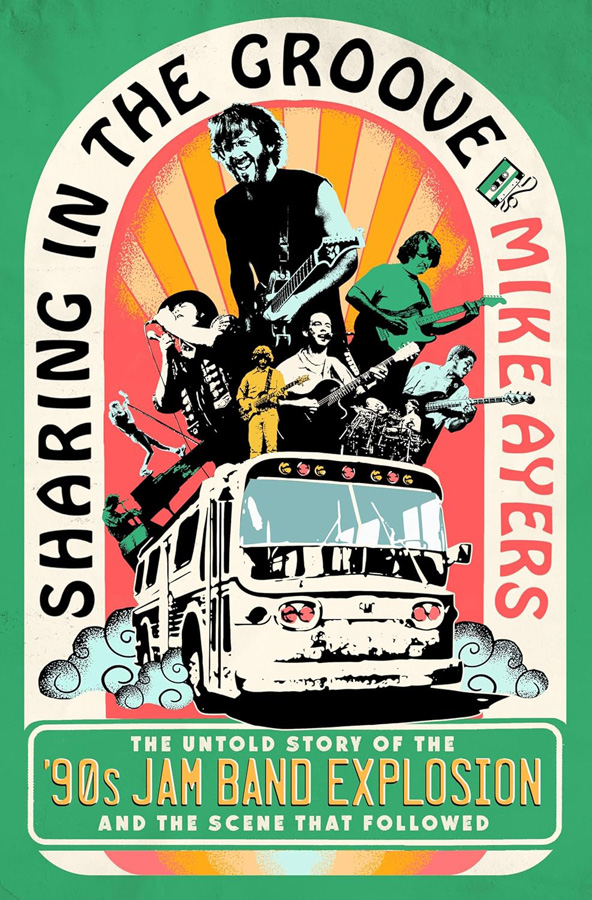

“Sharing in the Groove” cover image and author photo of Mike Ayers provided by the
St. Martin’s Publishing Group.
“I’d seen hundreds of concerts [at SPAC]. And here I am on that stage for the first time, which was my dream when I was 16…I mean, I saw everybody there. And that was my dream to play on stage one day, and here I am playing on that stage with one of my idols. We did ‘That’s It for the Other One,’ which the Dead hadn’t played in years. Had my career gone no further than that day, I would have been fine. My dreams were realized.”
-Vinnie Amico, drummer for the jam band Moe, on performing alongside surviving members of the Grateful Dead at SPAC on July 6, 1997. [This quote appears in the book “Sharing in the Groove” by Mike Ayers].
SARATOGA SPRINGS — It wasn’t necessary to ask Mike Ayers, the author of a new book on ‘90s jam bands, just what exactly he was doing in Saratoga Springs last weekend.
Phish performed its 27th show at the Saratoga Performing Arts Center (SPAC) last Sunday, concluding their three-night stay in a city that continues to hold a special place in jam band history. Last weekend, the Dave Matthews Band played their 50th concert at SPAC. Last summer, rising jam band Goose played two headlining shows at the venue six years after being an opening act at Putnam Place. Also, that summer, Blues Traveler played at Belmont on Broadway, a free concert downtown. At the end of the year, up-and-coming jam group Dogs in a Pile played four straight shows at Putnam Place to celebrate New Year’s Eve. In 1985, the Grateful Dead famously drew the largest-ever SPAC crowd of more than 40,000 Deadheads. It was one of many times that various iterations of the Dead (both before and after Jerry Garcia’s death) took the SPAC stage.
The list of jam bands—ranging from obscure acts to all-time greats—that have played in Saratoga is an almost impossibly long one. But why does the Spa City hold such a prominent place in jam band lore? Saratoga TODAY spoke with Ayers—whose oral history book “Sharing in the Groove” chronicles the explosion of jam bands like Phish, Dave Matthews, and Blues Traveler—to help unravel this mystery.
“There’s definitely lineage around certain areas,” Ayers said. “Up here, near Woodstock, it has this aura that is left over from the 60s that probably just continues to permeate in ways.”
Ayers compared the Upstate jam scene with others that have sprung up around the country, in places like Georgia (where the Allman Brothers and Widespread Panic were based) and Colorado (home of the long-running Telluride Bluegrass Festival).
“It’s probably a case of you have these longstanding scenes and then you have young people coming up in them, taking influence from the past but putting their spin on it, whatever that may be,” Ayers said.
Young people, typically college kids, are a key ingredient in fostering a successful jam band scene. Many of the bands covered in Ayers’ book sprung up around college towns (such as Athens, Charlottesville, and Burlington) that had plenty of bars, fraternities, and other venues that could host and/or subsidize live music. And as the ‘90s progressed, college kids increasingly had access to internet connections, allowing them to network with other jam band fans. This gave rise to a fan base that was enthusiastic about sharing music with like-minded people. Ayers was one of those fans, mailing tapes to strangers across the country “all the time.”
But the jam band scene isn’t always so harmonious. In the ‘90s, following the death of guitarist Jerry Garcia and the official end of the Grateful Dead (though the surviving members would subsequently play together many times), some Deadheads didn’t enjoy the new crop of emerging jam bands—especially Phish—and seemed to resent Phish’s status as the jam scene’s new torchbearers. That dynamic is repeating itself today as some Phish fans resist the rising popularity of Goose. Ayers, however, (like most jam band fans, probably) doesn’t partake in these internal squabbles.
“I’m definitely more of an omnivore; I like a lot of things,” Ayers said. “But in the ‘90s with this jam culture movement, I remember if you were an indie kid or a punk rock kid, you did not want to listen to the jam stuff and vice versa. It was very divided. It was almost like a record store where here’s the punk section, here’s the rock section, here’s the classics.”
The divisiveness, however, is probably more of a vocal minority than an accurate representation of the entire scene. And despite some bad vibes, jam bands have continued to flourish well past the ‘90s glory days.
“It seems pretty healthy now, like it was in the ‘90s,” said Ayers. “You have multiple acts selling out arenas or large theaters. Goose, Billy Strings; those are prime examples. Phish is still doing it. Dave [Matthews] is still doing it. [Widespread] Panic does pretty sizable theaters still…It’s probably a bit of a perfect storm where you have a younger crowd that is super interested and you have an older crowd that can get away a little bit easier. There’s new acts, there’s old acts; there’s lots of stuff to check out.”
To see evidence of how the jam scene is still truckin’, simply stop by a Phish or Dave Matthews show at SPAC, and good luck finding a decent spot on the lawn if you don’t show up early enough.
“It’s not shocking that [these bands] are still going, it’s shocking that they’re still putting 25,000 people in Saratoga Springs for three straight nights,” Ayers said. “It’s great to see. So many people are still into it, especially here.”
“Sharing in the Groove” was released on July 22 and is currently available at booksellers nationwide.