Author: Tony Podlaski

Smooth Like Buttah

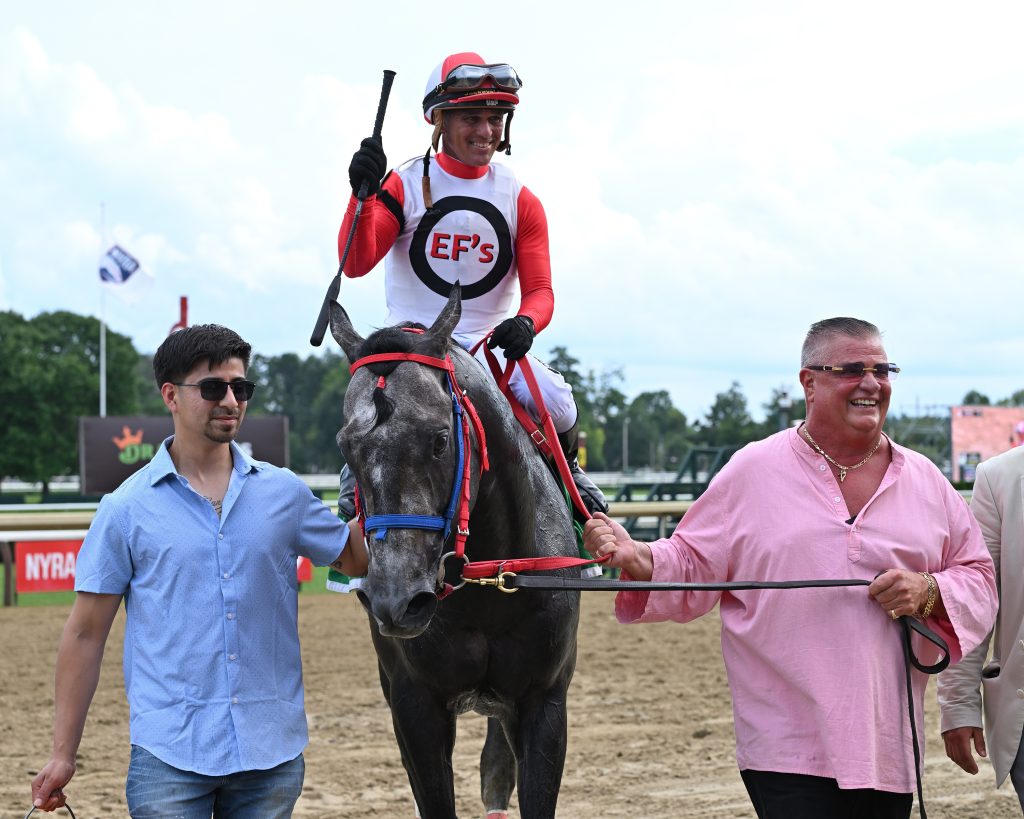
Jorge Pagan (left) is the groom; Javier Castellano is the jockey; Eddie Fazzone (right) is the owner. (Courtesy of Susie Raisher)
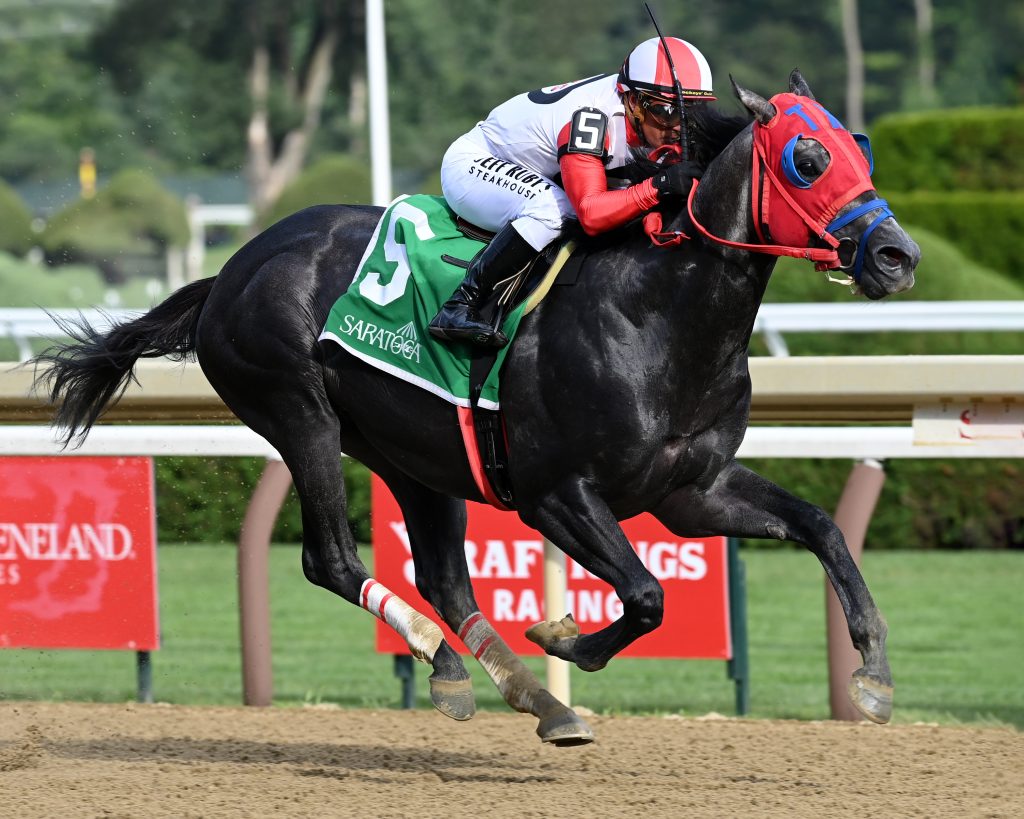
Buttah at Saratoga Race Course (Courtesy of Adam Coglianese)

Capital Region restauranteur Eddie Fazzone’s Buttah spreads another win to his resume after winning the John Morrissey Stakes at Saratoga Race Course

Just like butter goes with a lobster roll, so does Buttah winning a race at Saratoga Race Course.

The 4-year-old gray colt earned his fifth career victory on Thursday by taking the John Morrissey Stakes for Eddie Fazzone, the Schenectady native and owner of Eddie F’s New England Seafood Restaurant.

Well positioned early in the race, Buttah took the lead near the quarter-pole, fought off a challenge from Acoustic Avenue at the eighth pole, then prevailed by 1¾ lengths under strong handling by Hall of Fame jockey Javier Castellano in the seven-furlong event for older New York-breds.

After getting caught in the final strides in the off-the-turf Cab Calloway Division of the New York Stallion Series last year at Saratoga, Buttah finally joined his half-brothers Lobsta and Chowda as stakes winners coming from the mare Salty Little Sis.

The victory also marked Fazzone’s second stakes win at Saratoga after Dream Central took the Suzie O’Cain Stakes in 2022.

“Just when you think it can’t get any better, it gets better,” Fazzone said. “With Dream Central, that was a great stakes win at Saratoga. We knew this horse had it. His brothers won stake races. Last year up here, he got a bad break. He had caught at the wire in the New York Stallion stakes.”

Fazzone, whose racing name is based on his Clinton Street restaurant, thought the sprinting distance and running style were the ideal factors for Buttah.

“He’s got some good tactical speed. I always saw seven furlongs for all of the brothers was the best distance,” he said. “These guys want to be up [near the pace]. If you grab hold of them, drop four or five months behind, that’s a different state. They’re not that kind of closer. They all got hearts and they want to fight you.”

Fazzone also believes Buttah has established himself as a horse for the course, entering the John Morrissey Stakes with two wins and four starts at Saratoga, including his second career race on Sept. 2, 2024.

“We gave him a race, and he still ran a decent fifth,” he said. “That wasn’t bad for the first time out. Then, he won the second time out. Last year, he got beaten a neck. Now, he’s won three times here. Definitely, this is his home.”

Winning a stakes race at Saratoga is also a familiar experience for Buttah’s trainer Ilkay Kantarmaci. Nearly three years ago, he and his brother, Mertkan, won the Grade 2 Ballston Spa Stakes at Saratoga with Evvie Jets, a mare they claimed for $80,000 who also won the Grade 3 Noble Damsel Stakes at Aqueduct.

With Buttah’s win, Kantarmaci won 6-of-38 races this meet after Sunday’s races. Over the last five years, he has won more than 100 races from over 700 starters.

“I have won a lot of races, but it was exciting in the Winner’s Circle,” he said about winning the John Morrissey. “It was so huge. It was a good feeling.”

Buttah came to Kantarmaci’s barn following Gary Sciacca’s retirement from training horses in late February. Sciacca thought Kantarmaci could be a good fit for Buttah.

“When Gary retired, he said, ‘Hey, I got one nice horse. I’m going to talk to Eddie.’ Gary spoke so highly about me to Eddie. He let me train the horse. He trusted me, and I have tried my best.”

After Buttah spent the rest of the winter at a Wappingers Falls farm, he resumed training at Belmont Park in April. Following three weekly half-mile workouts and other gallops around the track, Buttah had a strong second finish in an allowance race on May 14.

During the Belmont Stakes Festival at Saratoga, Buttah came back with a solid allowance win at 29-1. That victory proved to be a productive prep race as Local Knowledge came back to win the Grade 2 Amsterdam on July 31, and Sea Strike took the Curlin Stakes on Aug. 2 by 8¼-lengths.

With that key race, along with the way Buttah has been training, Fazzone felt confident going into the John Morrissey Stakes.

“From the last race, he’s going to be really tough,” he said. “We’ve been here every day for eight weeks and watching him train at 5:30 in the morning. The exercise rider came off the track; he couldn’t hold him back.”

Even though Kantarmaci thinks Buttah is the same horse as when Sciacca trained him, he has considered other variables that have helped the horse run perhaps two career-best races.

“There is nothing really different about him,” he said. “Maybe like a little time off might help him. It might be the training schedule. It might be the different groom and different rider. Everything is different when you switch to the barn. Don’t get me wrong. Gary was a very successful trainer. He won a lot of races, and I have a lot of respect for him.”

Buttah is not the only horse running solid races for Fazzone. Mo for the King has finished no worse than third over the last 8-of-10 starts, including Sunday’s allowance race for state-breeds at Saratoga. Following an almost four-month rest, Mischievous Trick has won back-to-back races at Finger Lakes.

While Fazzone’s horses are running well, he is waiting for the last progeny from Salty Little Sis, who is now retired as a broodmare at John Jayko’s Fedwell Farm, just over three miles west of Saratoga Race Course and about 1½ miles from the Eddie F.’s restaurant.

Tartah has been training on both the dirt and turf since arriving at Robert Falcone, Jr.’s barn in mid-June. Fazzone knows the hopeful 2-year-old may have some expectations to follow the half-brothers as he looks to start him near the end of the meet.

“No pressure on him; he’s got some big shoes to fill,” Fazzone said. “But he’s doing good and Falcone said he’s getting better with every week and catching on to what his job is. He looks like a horse who wants to do it, so hopefully everything goes good with him.”

Fazzone is going to savor Buttah’s victory while thinking about the horse’s fall campaign, which could include graded stakes competition, as he hopes the horse continues to run smooth like butter.

From the Dairy Farm to the Racetrack … and to the Breeding Farm


After working as an assistant trainer around outstanding horses, including a two-time Horse of the Year, Seth Gregory continues to build on his Innisfree Farm in Galway


“Seth Gregory with his unnamed yearlings at Innisfree Farm in Galway”

Seth Gregory has worked with many elite Thoroughbred horses through horse racing’s respectable trainers. Now, for more than a decade, he has taken that experience to breeding successful horses.

Since starting as an assistant to Hall of Fame trainer Bill Mott, Gregory has evolved into a breeder with his Innisfree Farm in Galway. In 2013, he bought the 65-acre farm that crosses over Galway Road and named it after his favorite poem “The Lake Isle of Innisfree” by William Butler Yeats.

“I always wanted to be around the Saratoga area,” he said. “I think it was a six-year search to find something that fit my needs and my wallet.”

Growing up in Garrattsville, about 20 miles west of Cooperstown, the 53-year-old Gregory never wanted to follow the family’s dairy farm business. However, after graduating from high school, he still wanted to work with animals, especially horses.

With a Clark Foundation Scholarship given to seniors in the Leatherstocking Region, Gregory attended college for a year. Yet, he wanted an outside-the-classroom education at the racetrack and the breeding farm.

“I wanted nothing to do with dairy farming,” Gregory said. “I always had horses. My original plan for life was to probably go to Kentucky to manage a farm, but I wanted to see the racetrack before I did that.”

After graduating from Cornell with a bachelor’s degree in animal science in 1995, Gregory joined Mott’s barn after meeting him at Allen Paulson’s Brookside Farm in Versailles, Ky.

During his time with Mott, he worked with many multiple Grade 1 winners that included Lassigny, Northern Emerald, and King’s Theater. Though, one of Gregory’s more memorable moments came with two-time Horse of the Year, Cigar, whom he groomed during their time at the Dubai World Cup.

“I got bit by the racetrack bug. It was absolutely amazing,” Gregory said. “He’s a super, nice horse and great to be around. You couldn’t ask for more. I was blessed to be there at the time of Cigar and lucky enough to end up going with him to Dubai.”

Gregory then spent a decade working for Mark Hennig by handling another accomplished group of runners such as Grade 1 King’s Bishop winner Gygistar, three-time Grade 1 winner Raging Fever, and multiple graded stakes winners Gold Mover, With Ability, and Biding Time. Gregory also worked for Tom Albertrani, who trained several horses for the Godolphin and Darley group.

Still working at the racetrack, Gregory became involved in breeding horses with a mare who was also his first winner as an assistant trainer under Hennig: Won Perfect Rose. Shortly after getting transferred to John Campo’s barn, Won Perfect Rose suffered a career-ending injury as Gregory found an opportunity.

“The injury was bad,” Gregory said. “Basically, our owner’s bloodstock advisor said to find her a home somewhere in New York.”

That home was his family’s dairy farm.

“I talked to my parents (Henry and Connie Elizabeth) and they let me send her home,” he said. “She was my start in the breeding business.”

With graded stakes winner Spinal Tap as the sire, Won Perfect Rose produced Won Dozen Roses, Gregory’s first horse that initially ran under his father’s name as she won 7-of-25 races.

Won Perfect Rose’s more successful progeny was Gold and Roses, who won 10-of-45 races, including the New York Stallion Stakes in 2005 and back-to-back editions of the John Morrissey Stakes at Saratoga Race Course, while earning $877,966 for Henry Gregory.

Seth Gregory reinvested some earnings from Gold and Roses into another mare: Road to Mandalay. He purchased Road to Mandalay, who was in foal to two-time Grade 1 winner Aptitude, for $25,000 at the Keeneland Association Breeding Sales in November 2005.

Shortly after that sale, Road to Mandalay delivered La Concerto, who was later purchased for $110,000 in February 2008 before winning 8-of-18 races. After producing nine other winners, she stands retired at Innisfree Farm.

“She has been a wonderful asset,” Gregory said. “She just had beautiful babies that always sold very, very well. She’s still at the farm. She’s retired and enjoying her life.”

One of Road to Mandalay’s progeny may be following a similar breeding trend around Gergory’s farm: the 14-year-old mare Sonora, who won six races – all sprints – in 46 career starts. Michael Anthony Ferraro sold the mare back to Gregory shortly after her last race in March 2019.

After Sonora lost her first goal, her next one has shown some promise: Unlock the Value, an impressive 9½-length winner in her first start at Saratoga Race Course on July 30.

Once Unlock the Value left Gregory’s farm, bloodstock agent Mike Ryan purchased her for $50,000 for Klaravich Stables at the Fasig-Tipton Kentucky Fall Yearling Sales in Keeneland in October 2024. A few months later, the unraced filly was sent to Chad Brown’s stable at Monmouth Park where she posted consistent workouts until August 2025, then was turned out for the rest of the year.

She started training again in February at Fair Hill before coming to Saratoga in May for a couple of months, then was sent to Monmouth Park until her debut.

“I’m very glad that Chad was so patient with her,” Gregory said. “She had a layoff and then they gave her plenty of time and got her back in very, very good order. She’s just a pretty filly and has done everything right.”

Along with producing Unlock the Value, Sonora has bred an unnamed 2-year-old filly by Vekoma who sold for $400,000 at the Ocala Breeders’ Sales in June, a yearling colt by New York-bred Horse of the Year Americanrevolution, and a foal colt by Messier who was born on May 5.

Sonora and Road to Mandalay are just two of the 20 horses at the Innisfree Farm. Gregory also has 2021 New York Oaks winner A Bit o’ Irish Sass, Hey Mama, and some playful yearlings.

Beyond his breeding farm, Gregory, who was once a wine distributor throughout the Hudson Valley region, also assists his wife Kiley’s wine and spirit store since 2018.

From grooming a two-time Horse of the Year on the international stage to breeding potential runners at his own farm, Gregory has built a career that he imagined after deciding that dairy farming was not for him.

A Natural Gift for Horses – From New York, Florida, and Kentucky to the rodeo arena, Saratoga Springs native Jesse Costa has built a career and hobby around understanding horses.

Jesse Costa at Saratoga Race Course (Courtesy of Tony Podlaski)

Jesse Costa has made a career out of his natural ability with horses, a gift that continues to shape his work at the racetrack and his hobby.

As an assistant starter for the New York Racing Association, Costa spends his mornings and afternoons helping horses into the starting gate. Outside the track, he participates in rodeo competitions and works with horses for riding.

“I got a good gift with horses,” the 29-year-old Saratoga Springs native said. “They talk back, but they don’t speak to you. They show you. You can read a horse. You will know exactly what they’re going to do.”

Although he never received any formal training, Costa learned about Thoroughbreds as a child at Belmont Park where family’s horses were trained by Dominic Schettino.

“Every weekend, I was at Belmont Park. That was my backyard. That was my playground,” Costa said. “I learned a lot underneath him about the racetrack life from the bottom up. Also, I sat around for long hours watching older guys. I picked up little things. It was just natural.”

At 18, Costa became a NYRA outrider. After about 18 months at Saratoga Race Course, Belmont Park, and Aqueduct, he was head outrider at Gulfstream Park for four years before returning to New York in January 2024.

About eight years ago, Costa faced a life-changing experience: trigeminal neuralgia, a chronic pain disorder. After three brain surgeries, he had an epiphany and decided it was time for a change.

“It felt like jumper cables were on my face,” he said. “There would be times when I got a flare up. Now, I’m pretty good, knock on wood. It took me a while to realize it … life is too short. I took a step back and realized the worked that I done at Gulfstream for four years. I missed a lot. Family and everybody was up here. I’m grateful for being down there. It was a great steppingstone.”

That steppingstone lead into his next career: an assistant starter.

During the Keeneland spring meet in 2020, Scott Jordan, NYRA’s current head starter, recruited Costa to serve as an assistant starter for the Kentucky Oaks and Kentucky Derby when his team was short-handed. Despite having no starting gate experience, Costa was successful; he was invited back to Churchill Downs for the following year.

This spring, Jordan offered Costa a position as an assistant starter. Costa believed this was part of his future.

“I like the gate. When I was a kid, I always hung around the gate,” he said. “Eventually, it was going to happen. I just didn’t know when. It was a pretty easy transition. These guys took me underneath their wings. It’s better on my body right now. It also gives me more time to do some other stuff.”

Outside the racetrack, Costa enjoyed team roping since he was 14 after learning the sport from rodeo legend Roger Stockton at his Ballston Spa ranch.

“When we were up here for the summers, he would always bring me up to his house where he had a roping arena and a bunch of horses,” Costa said. “I would help him, and he would teach me how to rope. That’s how I got a liking to it.”

Costa spends his time at Riding High in Warrensburg on Mondays, as well as the Painted Pony Championship Rodeo in Lake Luzerne on Wednesdays and the Lucky E Rodeo in Broadalbin on Thursdays – both part of the International Pro Rodeo Association and the Interstate Rodeo Association organization.

As a rookie in the IPRA and IRA circuit, he also participated in the team roping competition at the Saratoga County Fair on July 22. One of his riding partners is Robbie Erck of Fort Edward, the son of the former NYRA lead outrider Steve Erck. Like many aspiring rodeo riders, Costa dreams of advancing to that next level.

“I just like the adrenaline,” Costa said. “It’s the closest thing I kind of get right now to catch a loose horse. It’s you and your horse. It’s also you and your partner. If I can stick with it and keep on doing what I’m doing, I would like to eventually [compete at the next level].”

While a riding partner is important to team roping, Costa knows a dependable horse is just as essential. For the last five years, McCall has been that horse, a former Kentucky ranch horse he purchased while working as an outrider at Gulfstream Park and later transitioned into rodeo competition.

“During the meet, I didn’t want to put too much pressure on him,” Costa said. “I never took him to the rodeo … because I needed them here. Now that I’m not [outriding], it’s time for him to shine.”

Costa also has Smokey, a big white Quarter Horse that caught his attention after Hall of Fame trainer Bill Mott purchased him at Payson Park more than two years ago. After keeping Smokey for a year, he offered the former show horse to Costa shortly after Sovereignty won last year’s Kentucky Derby.

“I got over to his barn, sat down in his office, and he said, ‘Son, you got $10?’ There’s a horse in the next barn, he belongs to you,” Costa said. “He was a little-too-much horse for Bill. He was most of a catch horse rather than a stable pony.”

Because no one rode Smokey in two years, Costa needed patience with him.

“When I got on him, he almost bucked me off,” Costa said. “That night, I roped about 4-5 cows when I was on him. He’s a finished horse. It’s very hard to find horses that can do it all. I am blessed to have two of them.”

Besides McCall and Smokey, Costa recently rescued Elton, a palomino yearling in Texas for $850. He is hoping to develop Elton after the Saratoga meet.

“When I bought him, he was a runt,” Costa said. “That’s my new hobby now. He might be a stable pony. He might be a rope horse. He might be a barrel horse. He might just be an ornament. Who knows? I’ll see what he wants to do.”

Costa also assists other trainers with difficult horses, including two sent to him by Finger Lakes trainer Paul Barrow this spring that showed remarkable improvement in their temperament after about two months of work.

“They were a little too much for them at the moment,” Costa said. “One of them was bucking people off. He wasn’t bad. He had a personality. Once he figured you out, the bond was good. I sent them back and they couldn’t believe how good they were.”

Over the past 11 years, Costa has evolved from outrider to an assistant starter, pursued rodeo riding, and overcome a rare medical condition. These changes have shaped him.

“It’s a big change, but it was a good change,” he said. “I like it so far. Everything’s going smooth.”

Leaving an Impactful TRF Career


After 20 years of starting as a volunteer for the Thoroughbred Retirement Foundation, Pat Campagna retires as Chief Financial Officer in August


(Pat Campagna with Fortunate Storm)

What began as a desire to give back to retired Thoroughbreds evolved into a two-decade career in helping the oldest and largest aftercare organization in the United States.

Now, Pat Campagna is preparing to close that chapter.

Campagna is retiring from the Thoroughbred Retirement Foundation after serving as a volunteer, executive director and chief financial officer, helping guide the organization through a period of financial growth, a strengthened Board of Directors and expanded oversight of retired racehorses at several farms, including Wallkill Correctional Facility as part of the Second Chances program and sanctuary farms such as 18 Karat Farm in Schuylerville.

“I will definitely leave with mixed emotions,” she said. “I’m obviously passionate about the mission. I’ve always liked what I’ve done. At some point, I have to retire. The TRF is in a good place. They have a really strong [Board of Directors]. I think the herd is in great shape. Our Second Chances program is strong.”

Many people involved in Thoroughbred racing and aftercare typically started when they were as young as a child. However, Campagna’s career path has been different.

Before entering the horse racing industry, Campagna built a career in the nonprofit and publishing sectors. After the Saco, Maine native earned a master’s degree in nonprofit accounting from the University at Denver, she worked in mental health administration, then became an independent contractor for smaller business mergers and acquisitions in Massachusetts, as well as an interim CFO for Globe Pequot Press.

After moving to the Saratoga Springs area for personal reasons, Campagna became involved in racing partnerships that included West Point Thoroughbreds and Parting Glass Racing.

Among the horses that she co-owned were two-time Saratoga Race Course winner and stakes runner Yolanda B. Too and Fortunate Storm, who won three races for West Point Thoroughbreds before being claimed.

“When one of them won, it was just one of the most exciting things I had done in my life. It was just such a great experience,” she said.

Although she enjoyed the racing partnerships, Campagna wanted to give back to the horses once their careers were over. Her search for aftercare organizations led her to the TRF.

“I kept thinking that I have to figure out a way to give back to the horses,” she said. “I came upon the TRF because it was, at that time, one of the very few organizations that helped Thoroughbreds when their racing days were over. I was committed to doing a donation anytime one of my horses won.”

Within months of attending an adoption clinic, Campagna began volunteering for the TRF for about a day each week. That led to a part-time accounting role, then a full-time CFO position until 2019 when she added the executive director title.

During her tenure, especially over the last two years, Campagna helped strengthen the organization’s finances and led the strategic plan process built around “greatness.”

“Everybody had a different opinion about what that was,” Campagna said. “I think that’s our mantra: What does great look like? As long as we keep working toward that goal, I think the TRF will continue to improve. I think the financial stability is huge. Everything the TRF accomplished, we’ve done as a team.”

The TRF’s annual events around the Saratoga racing season have become an important source of support for the aftercare program that includes the Second Chances program and sanctuary farms. That commitment has helped the organization earn accreditation from the Thoroughbred Aftercare Alliance and the Global Federation of Animal Sanctuaries. This year’s events include:

Gumbo with Kendrick Carmouche: While advanced tickets for this event on July 27 from 5-10 p.m. at the Principessa Elena Society on 13 Oak Street in Saratoga Springs have been sold out, there will be a limited number of tickets available at the door.

Cocktails For Aftercare: The Adelphi Hotel on 365 Broadway in Saratoga Springs is hosting this TRF fundraising event on Aug. 5 from 6-8 p.m.

TRF Polo Classic: The TRF has reimagined its annual summer fundraiser with this inaugural event on Aug. 25 from 4:30-7:30 p.m. at Bloomfield Farm on 18 Bloomfield Rd. in Saratoga Springs.

More details on these events, as well as other TRF information, are available at trfinc.org.

While there are many retired Thoroughbreds that have played an integral part in the Second Chances program, one of them is still recognized today: Quick Call. A winner of 16-of-86 races that included the 1988 and 1989 Forego Stakes, he was one of the eldest herds until his passing in 2019 at the extraordinary age of 35.

His remains rest at Clare Court on the Saratoga Race Course backstretch. Presented by the TRF, a stakes race is also named in his honor for his career as an aftercare ambassador.

“I made a lot of visits to Wallkill during the years when Quick Call was there,” she said. “I certainly knew the horse and I could see the impact that horse, along with many others at Wallkill, had on the incarcerated individuals there.”

Even one of Campagna’s owned horses became part of the Second Chances program. After winning his final race in a $4,500 claiming event at Charles Town in West Virginia, Fortunate Storm found himself in a “bad situation.”

Campagna helped rescue him and brought him to Wallkill. Now, he is at the Saratoga Springs sanctuary farm, while her other co-owned horse Yoland B. Too, resides at a California farm.

“I think the Second Chance program is something I’ve always felt really proud to be a part of,” she said. “Rescuing horses or taking horses that are being responsibly retired is great. That’s the mission that I signed up for.”

Even though she is retiring from her career at the TRF, she plans to continue supporting the organization.

“I’ll probably remain involved in some capacity as a volunteer,” she said. “I feel like I just need some downtime, then rethink what I want to do and how much I want to stay involved in industry and in aftercare. I’ll always be involved at some level.”

As she prepares for retirement, Campagna hopes she has left a legacy at the TRF.

“I hoped that I’ve inspired other people to get involved,” she said. “I hope that I am leaving the organization in as good or better shape than it was in when I got there.”

From the Racetrack to the Running Track


Photo of Carson Gambaro by Tony Podlaski.


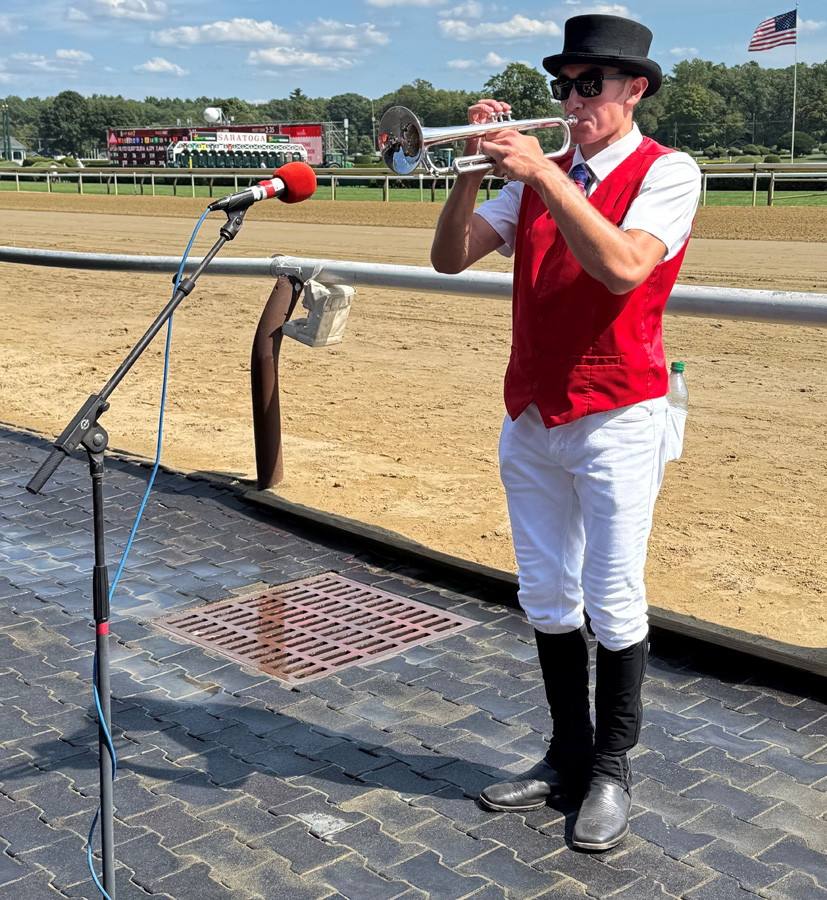
Carson Gambaro, known for being the Saratoga Race Course bugler with his father Tony, continues to build upon his track goals – both running and announcing – once the meet is over after Labor Day.

The Labor Day weekend at Saratoga Race Course is not only the end of the 40-day meet, it is also that moment of transition with the leaves turning colors before falling to the ground as the summer season makes its exit in a couple of weeks.

The three-day weekend is also the last vestige of summer with vacations coming to an end, some young adults are going back to college, and families are returning to a routine around the school-year schedule, especially around high school sports.

After again co-leading the call to the post with his father Tony Gambaro this season, Carson Gambaro plans to continue his passion around running by covering and announcing high school track and field meets, as well as cross country races, while staying in shape as a sprinter for next year.

Since graduating from Syracuse University in 2022, along with being a Saratoga bugler and playing for his father’s band Ten Most Wanted, Gambaro became a freelance correspondent for MileSplit New York, a popular website and social media platform for high school runners and fans to find results, information, and interviews on various meets throughout the state.

That opportunity has led him to announce at track meets at Stillwater High School, where he graduated in 2018, and other local meets and invitationals where he has been polishing his skills.

“I joined MileSplit because I knew that they broadcasted the New York State Championships and other New York state invitationals,” Gambaro said. “That’s when I realized after getting reps as a public address announcer at my high school and other small local track meets, I wanted to get more serious about announcing the sport.”

Gambaro’s interest in announcing and running was something that developed going into the COVID-19 pandemic. As an undeclared freshman at Syracuse, Gambaro strived for a 4.0 grade point average that would allow him to transfer into the Newhouse School with the emphasis on the broadcasting digital journalism program. He wanted to follow the path of alumni Bob Costas and Mike Tirico.

“I have always been fond of sports and sports announcers,” Gambaro said. “I would always try to know who was announcing a primetime football game, the crew, the play-by-play and color [commentators], and some of the big names. Once I got into Newhouse and started getting some extracurricular experience, that’s where I developed the journalistic side to myself.”

Once the pandemic occurred during his sophomore year, Gambaro, like many college students at the time, initially struggled in finding activities and that extracurricular experience. That’s when he went back to his passion for running.

After marching band rehearsals, Gambaro went to Syracuse’s practice track for his own workouts with stretches and interval runs. He also became more interested in following the elite runners who competed at the World Championships and Diamond League.

“I didn’t have a whole ton of hands-on stuff to do with everything being remote,” Gambaro said. “That gave me some time to reconnect to a lost love of mine, and that was competitive track and field. I was also starting to watch professional track and field. That really made me a bigger fan of the sport.”

Growing up, Gambaro always had an interest in running, whether it was connected to going up the stairs, playing outdoor games with his friends, or even chasing after his Doberman Pinschers in the yard.

“I always just loved the idea of being fast when I was young,” he said “I always run up the stairs. I would always try to beat my friends and races. I didn’t think I’d always win because I didn’t really know how to run.”

By the time Gambaro got to Stillwater High School, he learned how to run, which led him to be a successful sprinter, especially during his senior year of the outdoor track season with a personal-best time of 56.22 seconds for 400 meters.

Along with being part of the winning 4×100-meter and 4×400-meter relay teams at the Wasaren League Championships, Gambaro anchored the 4×400-meter relay team that captured the Section II title.

The sectional title may have been more impressive for Gambaro after he overcame a disappointing 11th-place finish in the 400 meters. He also believes that his unofficial final split was within the 54-second range for the sectional title.

“I had a terrible race earlier that day when a gust of wind blew my hip number into my hand. I looked at it, and the next thing I knew I was out of the race. I was not happy,” he said. “But my coach told me, ‘You got to focus on your race.’ I knew that I had to go all or nothing.”

With self-recorded workouts, weight training and proper nutrition, with the exception of an occasional Oreo Double Stuffed cookie or slice of pizza from Jimmy’s in Malta, Gambaro still aims for the 54-second personal best performance at many meets throughout the Capital Region that include the Colonie Mile and Summer Track Series through the Hudson-Mohawk Road Runners Club.

Flirting around 56 to 57 seconds at the meets, Garmbaro got closer to his benchmark at the Empire State Sports Council Patriot Invitational at Watervliet in June. After announcing at the AAU event, executive director Anthony Mills allowed Garmbaro to compete in the masters division of the 400 meters. The electronic timer had Gambaro finishing in 55.66 seconds for his first race of the season.

“I completely blew myself away,” Gambaro said. “I had no indicators with the workouts that I was going to run anywhere near the time that I did.  I’m so grateful for [Anthony Mills] in making that opportunity happen.”

He has also entertained the local running scene. At one of the Colonie meets, long-time high school coaching notable Frank Myers and track official Mark Mindel convinced Gambaro, who scratched from the 400-meter event that day due to a hamstring pull, to dress in his bugler uniform and give a call to post for the 1-mile event.

Gambaro has also taken on other challenges such as running 400 meters in jeans, something similar to elite runner Johnny Gregorek Jr.’s blue jean mile, 400 meters in an Easter Bunny costume, and 1¼ miles in the bugler uniform.

Off the track, Gambaro continues to work on his announcing and digital broadcasting ventures through the In Full Stride podcast that is on his YouTube channel in which he interviews high school sprinters on their experiences and strategies in becoming a successful runner. One of Gambaro’s goals is getting the opportunity to announce at the World Championships and the Olympics.

In the meantime, Gambaro continues enjoying his two passions once the Saratoga racing season is over: track and announcing.

Giving Back through the Backstretch and a Quarter Pole


The quarter pole is an important marker for all horses who compete at Saratoga Race Course. Not only does the quarter pole set up the last stage of the race, it is also a reminder for the horse and jockey that there is 440 yards to the finish, especially if it is that horse’s last race before retirement.

Mary Lou Doyle knows the importance of that as she shares her experiences of being an owner, breeder, and even a co-creator of her latest venture in making miniature quarter poles through her personalized backstretch tours.

Most mornings, Doyle gives people – both in and outside of Saratoga Springs – an opportunity to learn about the backstretch by introducing them to an experience most have never had.

“I started doing tours more because I met too many owners who didn’t know where the test barn was or had never seen the walking path to the paddock,” she said. “Then I met people who had never seen a horse up close, but they were huge racing fans. That was a disconnect to me, and I wanted to close that gap.”

For about an hour, the Saratoga Springs native gives her guests aspects of the track that many people do not see during the day, whether it is the pathway that each horse takes from the stable to the paddock for a race, watching the race around the three-eighths pole where people can hear the jockeys encouraging their horses and the thunderous sounds of the hooves on the track, or driving past barns to view horses such as Kentucky Derby and Belmont Stakes winner Sovereignty, who is the strong favorite in Saturday’s Travers Stakes.

Doyle also introduces any jockey who has ridden for her, if they are available: Javier Castellano, Kendrick Carmouche, and Irad Ortiz, to name a few. Her guests see how the jockeys are part of the backstretch, too.

“They ride their own golf carts or with their agents and they understand the PR value of their brand,” she said. “Most are super friendly anyway and always stop for a quick hello and photo.”

Doyle’s guests also get to meet many trainers who know her or have trained her horses, including those through partnerships. The first trainer who welcomed one of her first tours years ago was H. James Bond and his wife Tina.

“A new CEO was in town for almost a year and hadn’t been to the track yet and hadn’t even thought about the backstretch,” she said. “They were so impressed when the Bonds invited them to see their barns, they whispered, ‘If I ever buy a horse, those are the kind of people I want to train it!”

Doyle emphasizes the need for trainers who are ambassadors for new or potential owners and first-time “backstretchers.” Other trainers who are part of Doyle’s tour include Carlos Martin, Michelle Nevin, Tom Morley, and fellow Saratoga native Jen Paragallo.

As part of the tour, many guests are surprised by all that goes on behind the scenes. They offer to pay Doyle, but she does not accept any payment. Though, she does ask them if they would make a donation to Thoroughbred aftercare or the Double H Ranch.

“We donate a lot,” Doyle said. “We give a percentage to aftercare. It has been important to us since we first started buying horses. You have to be thinking about it when you buy a horse.”

Along with aftercare, Doyle believes in the importance of a trainer managing a smaller stable for her horses. She appreciates Nevinis giving individualized attention and care to her horses. In return, Doyle gives back to many backstretch workers, including security, by making breakfast treats such as blueberry and banana muffins, as well as a French toast bake.

“I’m really supportive of small stables,” Doyle said. “I really stand up for them because they’ve great horses, and we need those opportunities in races. They’ve got the time for them and they’re hands on, literally.

“We try to bake about 100 mini-muffins every week and hand them out to grooms I see on the tour,” she added. “Some I know, some I don’t. But anyone who waves with a smile to my guests, they get muffins as a thank you.”

The backstretch tours evolved from Doyle’s car tours at the MacMahon of Saratoga Thoroughbreds Farm, where she has stabled and bred her horses over the past eight years, including one of her mares being mated to her favorite horse Bucchero, the sire of Book’em Danno, who is competing in Saturday’s Grade 1 Forego; her other mare bred to Grade 1 winner Americanrevolution.

With the guidance and support from founders Joe and Anne McMahon, as well as general manager John McMahon, and marketing, sales, and office manager Jane McMahon, Doyle gave well-informed tours at the farm.

“They have been so open to me going there, and I had a lot of questions,” Doyle said. “The relationship with them has been fantastic, and they’re great for learning about horses. I learned about aftercare from the McMahons. They take back any horse sold and give it a forever pasture. They’re the gold standard.”

Since her home was not far from the Saratoga Race Course, Doyle entertained the idea of bringing small groups to the backstretch, especially since she felt the responsibility as an owner to share that experience.

“It was just very important to me that people see the backstretch,” she said. “Because when I was a kid, you could ride your bike through here. It was all open to the public. So when it started closing, I felt a responsibility as a horse owner to be sharing this with people who could see what’s back here.”

As a second-generation Saratogian with a link to Major League Baseball (her grandfather, Judd Bruce “Slow Joe” Doyle, pitched from 1906 to 1910 for the New York Highlanders and Cincinnati Reds), Mary Lou Doyle and her family had an indirect connection to horse racing.

Along with selling hot dogs before becoming a supervisor for Harry M. Stevens, Inc. at Saratoga Race Course, she was also a babysitter for several jockeys and trainers during the late 1970s, which helped pay for her Western riding lessons. At 14, she got to meet Marylou Whitney and enjoyed sharing a conversation with her.

Doyle and family also had two Hollywood stars rent their house for the week during the Fasig-Tipton sales in 1980: Jack Klugman and John Forsythe.

While Doyle and her family spent the week at a camp in Lake George, Klugman and Forsythe attended the four-day event. When Doyle and her family came home, they found steaks in the freezer that Klugman and Forsythe left, and the ability to have central air conditioning in the house.

“We were so happy to have steaks. We were just so excited and they were so nice,” Doyle said. “When our house was built in 1970, there was no central air conditioning. Basically, Klugman and Forsythe paid for our central air conditioning.”

As Doyle got older, she wanted to leave the Saratoga Springs area. After graduating from Hudson Valley Community College in 1983, she went to Philadelphia and worked full-time while going to Temple University during the evening for a bachelor’s degree in journalism.

For decades, she worked in communications, marketing, and government relations. She also worked as a lobbyist, and worked for two governors and two presidents, demonstrating a unique ability to connect people at a high level on issues. 

Traveling back and forth for years from Chester County, Pennsylvania to Saratoga Springs, she got the call to come back home. She bought her parent’s retirement home after her father’s passing and developed a five-year plan to come back to Saratoga – for good.

“All the old timers told me I had to come back,” she said. “I didn’t get it, but now that I’m here, I get it.”

Doyle’s husband James, who recently retired as vice president of Penske Corporation, is the detailed woodworker behind the quarter poles.

“He’s meticulous,” Doyle said. “You know the quality immediately, from the craftsmanship to the anodized gold ball on top. Saratoga Quarter Poles is our business name.”

The quarter poles come in two sizes: 16 inches and 5 feet. When they started in September, the first orders were shipped throughout the country within 30 days. Since then, the quarter poles have gained interest – including at the international level from Japan and Australia – especially during the holiday season.

“I had a line out my door on Christmas Eve with people wanting it for Christmas presents. Then I was shipping it,” she said. “It just exploded. It’s great. It’s been really fun. It’s absolutely gorgeous. Nobody’s ever done it before.”

Nobody has done the quarter poles before in America, especially since they are made in Saratoga Springs.

Rising Stars on the Track and a Racing Hero in the Classroom


Photo courtesy of the National Museum of Racing

As the Travers showcased rising champions, Saratoga enters the transitional phrase of ending the racing season with some people heading back to the classroom

This year’s 155th running of the Travers Stakes at Saratoga Race Course provided another exciting finish with 2-year-old champion Fierceness holding off a determined run from 3-year-old filly divisional leader Thorpedo Anna.

The Travers is somewhat of the transitional point for the Saratoga meet, especially going into the last week and Labor Day weekend, for horses, those involved in the industry, and even seasonal and retired employees around the track.

While Fierceness and Thorpedo Anna, as well as Sierra Leone, Dornoch, and perhaps a couple of the other finishers coming out of the race, transition into the fall by preparing the Breeders’ Cup in November at Del Mar, many people in the Saratoga Springs region are also getting ready for the upcoming school year, whether it is being a student or a teacher.

One of those people is legendary track announcer, broadcaster, and speaker Tom Durkin, who is teaching public speaking at Saratoga Catholic High School starting in September.

This is not the first time that Durkin has taught a public speaking course. Shortly after retiring with a 24-year career as the track announcer for the New York Racing Association in 2014, he taught a public speaking class for the Saratoga Springs High School Continuing Education program.

“This is something that I always that I always wanted to do,” he said. “I did one for adults in the continuing education, and I liked that. I really wanted to teach high school-aged kids about public speaking.”

Durkin approached Saratoga Catholic principal and alumni Chris Signor about teaching the class. While Durkin’s approach and idea came as a surprise for Signor, he is excited about this learning opportunity for the students, which is a joint project in both the English and Business Departments.

“This came out of the blue. I never planned this in my wildest dreams,” Signor said. “He has some great ideas about teaching a course that he wanted to expand upon when he taught it as an adult continuing education class. This is going to be a popular course with the kids. This has been very well received.”

Durkin’s interest in public speaking started in a class at a catholic high school in Chicago where he grew up. Not only did Durkin only enjoy the small-sized class, he also found it beneficial as those skills became the foundation to his race calling for NYRA and the Breeders’ Cup, his sportscasting for NBC and ESPN, and speaking engagements that include the National Museum of Racing and Hall of Fame Inductions.

While race calling, broadcasting, and being an emcee for the Hall of Fame inductions reflect an aspect of entertainment in public speaking, Durkin believes that rhetoric and discourse are important to both persuasion and analysis.

“There are all different kinds of discourse,” he said. “Rhetoric is the art or science on convincing someone to your point of view by the means of speech. If you want to ask your parents to borrow the car, you can use a lot of rhetorical skills to try to persuade them.”

By taking a student-centered approach to his teaching, one of Durkin’s objectives is providing students the skills and experience they need, which includes writing speeches, appearance, and body language, so they can deliver an effective speech.

“I will give them many of the tools,” he said. “The primary objective will be having the students get in front of other people and speak at least once every class. It’s just getting that experience of getting in front of people and communicate to them. It’s important for them to sound good. If you don’t sound good, it’s much harder to keep the audience’s attention.”

Durkin’s lesson plans also include teaching students about when to memorize speeches, how to use adrenaline to their benefit, and how to overcome perhaps the common challenge many public speakers – fear.

“It’s the No. 1 phobia in America,” Durkin said about fear. “People are more afraid of public speaking than they are afraid of dying. If there is any of that, we are going to deal with that off the bat. If you make a mistake, so what? The ceiling didn’t fall. You didn’t get struck by lightning.”

As part of the lesson, Durkin plans to emphasize that one of the ways for students to overcome the paralysis of fear and being confident is preparation.

“If you are over-the-top totally prepared, you are going to have a good experience because you will be confident,” he said. “If you are not prepared, all you will be thinking about is the mistakes that you are going to make.”

Durkin plans to share plenty of personal examples for being prepared, as well as other concepts covered in this class. Some of these include his retirement speech in the Saratoga Winner’s Circle, his speech for receiving the Eclipse Award for Merit, and his mother’s eulogy – all of which required a thorough revision process.

 “The key to writing a good speech is rewrite and brevity,” he said. “Part of rewriting is editing out extraneous stuff, but adding stuff by using various rhetorical tropes to make it a good speech.”

While Durkin plans to cover the objectives for the course, he would also like to work with students on cultivating their creativity over the academic year.

“I really like to take somebody who was intrepid on public speaking. I want to foster creativity.” he said. “This course is going to teach creativity and conviction. I will point them in certain directions on how they can do that and how to convince people. There are several ways to do it: pathos, ethos, and logos.”

With a student-centered classroom, teaching can be a two-way street as the students gain knowledge and skills from the teacher, and the teacher learns from them as well. Durkin indicated that he wants to learn something from the students.

“I would like to have an ability to connect to younger people,” he said. “There is a lot of stuff that they do, which I don’t understand. I’m sure there is a lot of stuff that I do that they don’t understand. It’s just being around young people and open up my understanding about the real person behind the teenager.”

If the class goes well and he learns something from the students, Durkin said he would “absolutely” come back to do it again next year.

From Selling Newspapers at Saratoga to Being in the Winner’s Circle

Saratoga Spring native Jennifer Paragallo wins her first race at Saratoga Race Course as trainer following a horse racing path that started with selling the Daily Racing Form and newspapers.

Photo by Tony Podlaski

Jennifer Paragallo’s career path in horse racing may be an atypical one, but the path has recently become a winning one.

Paragallo won her first race as a trainer at Saratoga Race Course on Friday when Dunedin Causeway took the lead inside the sixteenth pole before inching away to a three-quarter length margin in the maiden claiming race.

“A win anywhere, regardless of the track, is special,” she said with a hoarse and raspy voice from shouting with excitement. “Though, a win at Saratoga is special. This one is my biggest deal because it’s home. Being from Saratoga and growing up here, this means the world to me.”

Paragallo’s world in horse racing started as a child when she was selling the Daily Racing Form and other newspapers with her mother outside the track. During that time, she became familiar with jockeys and their agents, as well as trainers and other horsemen.

Entering her teenage years, Paragallo evolved into a dedicated fan of the sport, which part of it was reflected constantly watching the first Breeders’ Cup on her recorded VHS tape before it broke from overuse.

By the time Paragallo entered Saratoga Springs High School in the late 1980s, she had aspirations of going to the “big leagues” at Belmont Park and Aqueduct where she could gallop horses. However, she never realized that Saratoga was always the place to be.

“When I was a kid, I knew that Saratoga was big, but I couldn’t wait to leave,” she said. “I never knew this was the big leagues, and I’ve been to a lot of tracks all over the country –California, Florida, Arkansas, Texas, Indiana, New Jersey and Delaware. There is no place like Saratoga.”

Once Paragallo left Saratoga Springs in 1991, she started galloping horses for trainers that included Mike Daggett, Mike Sedlacek, and Terri Pompey. After galloping horses for a few years, Paragallo wanted to follow her dream of becoming a jockey.

During the Oaklawn Park meet in 1994 while riding under her maiden name Jennifer Robinson, Paragallo had just five mounts during that meet with none of them finishing in the money.

Once the Oaklawn Park meet ended, Paragrallo migrated to Finger Lakes where she was getting closer to her first victory with three second-place finishes. With no Winner Circle appearance, she ended that year with a second-place and third-place finish at Aqueduct.

With more riding opportunities in 1995 at Atlantic City, Paragallo finally won her first race aboard Prize Writer in a claiming race. Just over a week later, she guided Delightful Marine to his first victory after 41 attempts as a maiden.

That was the last winner for Paragallo as she finished her jockey career at Hoosier Park on Oct. 15, 1995 due to limited opportunities and other challenges.

“I was bound and determined to be some great jockey,” she said. “I didn’t plan to quit. I was making a decent living, but I was fighting my weight. It was probably not in my cards to be a jockey because I wasn’t naturally light.”

Paragallo came back to New York as an exercise rider for a plethora of trainers that include Hall of Famers Bill Mott and Nick Zito for the next two decades. 

Paragallo eventually transitioned into an assistant trainer with her early opportunity coming from Bruce Brown in 2009. During her 4½ years with Brown, she took care of the 30 horses that he stabled at Saratoga once the Oklahoma Training Track opened in the spring.

During her time with Brown, Paragallo traveled to Santa Anita for the Breeders’ Cup Turf Spring with Spring to the Sky and Churchill Downs for Breeders’ Cup Mile with Compliance Officer. She also went to Woodbine for the graded stakes races with New York-bred Strong Impact and Night Officer.

“This was an important part of me,” Paragallo said. “Bruce is the easiest-going and simple kind of guy. He was one of the best bosses that I had. There is so much [public relations] at Saratoga. He liked how I handled that.”

Paragallo made the decision to become a trainer in late 2022. About three months since her first starter at Tampa Bay Downs, she won her first race with Redzilla on Mar. 4, and that followed with a victory from Mylastredcent and another win from Redzilla.

Now, she has just five horses at Barn 42 at Saratoga. Four of those horses are still looking for their first wins: Althena, Devil of Ramadi, Fire Baron, and Theregoesmymiracle.

Though, Paragallo wasn’t the only trainer who earned her first Saratoga win based at Barn 42. In fact, she gave up one of her stalls for Kathleen O’Connell, who also picked up her first Saratoga victory – and her 2,500th career win – with Thirty Thou Kelvin in Wednesday’s allowance race.

Paragallo likes the manageable stable size that is supported by just her exercise rider and roommate Makaia Carpenter, as well as and her assistant and groom Richie Suttle, who once had his lone stakes win with Dontletthebigonego in the Grade 3 Lafayette Stakes and his only Saratoga victory with Momsmercedes in a maiden race – both in 1998.

“We have a small team. We’re best friends,” Paragallo said. “My friends are my team. We’re working with horses every day – inside and out. We get up 4:30 in the morning and stay until noon. It doesn’t matter if it is hot out, cold out, or raining. We enjoy this small stable.”

 Even with the support of her team, Paragallo knows that being a trainer is still a lifelong learning experience, especially since that has been reinforced by the late Hall of Fame trainer H. Allen Jerkens and his former assistant Chuck Simon, also a Saratoga Springs native.

“I’m still on a learning curve,” Paragallo said. “Jerkens trained horses for more than 50 years. He said you never stop learning. Even Chuck said that you never stop learning.”

“I am a little thick-headed,” she added. “Sometimes, you don’t always see stuff when you are in the moment,” she added. “I might be overtraining. I might be overreading. I might be trying too hard sometimes. When you are trying to force something, you cannot make it happen. I understanding these things. No one teaches you these things.”

While Paragallo never had intention of training horses, she has embraced this part of her career path, but she had never forgotten about being a fan of horse racing, especially at Saratoga.

“They say, ‘Do what you love and you will never work a day in your life.’ I’m living my dream. I don’t want to miss a moment with my horses. Coming to Saratoga, I am still a fan. This is where I fell in love with the sport.”

A “Goose” That Has Caught Horse Racing Attention

For more than a decade, attorneys Wesley Lawrence and Elizabeth Kruska have entertained horse racing fans and others in the industry with a parody Twitter account based on the late Saratoga infield goose, which has also gotten them involved as owners and aftercare.

Photo by Tony Podlaski

There are many social media parody accounts that personalize dogs, cats, and even horses.

However, there is one Twitter account that has been migrating around the horse racing community for more than a decade: the Spa Infield Goose.

The parody account, which now has over 7,000 followers, was created by Vermont attorneys Wesley Lawrence and Elizabeth Kruska 12 years ago when they were at Saratoga Race Course.

While watching the Olympics in between races from their clubhouse seats, both of them were captivated by an unusual goose, named “Lippy” for having part of a missing beak, meandering around the infield and the pond that is the host for the Travers canoe.

That’s when they had some ideas flying through their mind.

“We thought this goose has seen a lot of things,” Lawrence said. “It would be funny if [we had something] from the perspective of the goose with the ongoings of the track.”

It was an opportunity since also animal-related accounts emerged during that time: The Bronx Zoo Cobra, Rafalca Romney (the dressage horse for U.S. Senator Mitt Romney), Gator Kitten, and Juba (the Gray) who raced at Saratoga.

“It was the peak of animal parody accounts at the time,” Kruska said. “At first, we didn’t know what to expect. We sometimes do joke that many people talk to a goose. At the same time, we work at it. It’s fun, and it’s a lot of observational stuff. You have to keep it up.”

Not only does the Spa Infield Goose account continue to attract followers, it has also brought Lawrence and Kruska further into the sport as fans, owners, and even aftercare.

“It is surprising on the connections that we have made and people who we have met by virtue of it,” Lawrence said. “It has helped us professionally and being observant and analytical to the details by walking around here.”

Prior to handling the parody Twitter account, Lawrence and Kruska had some interest and background as horse racing fans.

Growing up in New Jersey and central Long Island, Lawrence came from a family who enjoyed horse racing that included his father, who often attended the Kentucky Derby while attending the University of Louisville, as well as his grandparents who started bringing Lawrence to Monmouth Park when he was seven years old.

By 18, Lawrence occasionally went to the Meadowlands while attending the University of Delaware before going to Vermont Law School where he later met Kruska.

Both of them started going to the racetrack together in 2008 for races that included Big Brown’s Triple Crown campaign, then that followed with Rachel Alexandra’s 3-year-old season with the Preakness and Woodward Stakes.

During the first couple of years as the Spa Infield Goose on Twitter, Lawrence and Kruska interacted with many horse racing fans, as well as those in the industry. By 2015, that interaction guided them into becoming an owner of the Thoroughbred horses through Zilla Racing Stables based in Guilderland.

Their first horse, Benevolence, graduated from the maiden ranks at Saratoga in July 2016, then the New York-bred gelding was claimed nearly two years later. From there, Lawrence and Kruska bought into more horses that included their favorite horse English Soul.

Starting her career with a second-place finish at Saratoga near the end of August 2017, then following that a victory in the East View Stakes, English Soul came back to Saratoga a year later to beat Take Charge Aubrey by a nose in the Fleet Indian Stakes.

At the Keeneland Breeding Stock Sales in November 2019, Calumet Farm bought English Soul for $170,000 and raced just four more times before starting a career as a broodmare.

However, after unsuccessful attempts at breeding and little interest in racing, English Soul’s future was a little uncertain. That was until Lawrence and Kruska visited Calumet Farm during the Kentucky Derby weekend in 2021.

“They raced her and they were going to breed her,” Lawrence said. “She couldn’t be bred and didn’t want to race anymore. When we visited her, they knew the connection and asked if we wanted her. So, then decided to take back the mare.”

The thought of Thoroughbred aftercare was not a new concept for both Lawrence and Kruska. Along with their interactions through Twitter, they became familiar in aftercare after visiting an information table while attending the Mass Cap at Suffolk Downs in 2008 – the last edition of the race which was won by Commentator, who has been long retired at Old Friends at Cabin Creek in Greenfield Center.

Lawrence and Kruska still had a challenge: finding a home where English Soul could have a new life as a possible riding horse. Though, they learned the New York-bred mare had physical limitations after her examination at Tufts University.

“It became apparent that there was something physically wrong with her,” Kruska said. “It was pretty clear that it wasn’t going to work in retraining her. So, we moved her to another farm.”

Today, English Soul is living on a family farm in Hartford, Vt. with another retired Thoroughbred: At the Bell, who once raced against Funny Cide as a two-year-old maiden. Kruska said both horses have the life as “beautiful lawnmowers.”

However, English Soul is not the only horse who they have admired. Out of Trouble, one of the early daughters of Into Mischief, was also part of their partnership with Zilla Racing.

After winning six races, including two here at Saratoga, the mare was retired and sent to Wynnstay Farm in Winchester, Ky. where she was bred to Volatile, winner of the 2020 Alfred G. Vanderbilt Handicap. That combination produced Haleakala, who finished third in her debut at Ellis Park on Saturday.

While those horses continue to have a post-racing life, Lawrence and Kruska continue to be part of the Zilla Racing partnership with their recent winner at Saratoga: Tongue Twister.

Unlike many geese who will start migrating to the south after the Saratoga meet comes to an end, Lawrence and Kruska plan to stay in the region with their primary home in Woodstock, Vt.

However, after purchasing a Saratoga Springs “nest” in earlier this year, they plan to make a longer stay in the area, especially on the weekends.

“This is a very nice town,” Kruska said. “Obviously, we are here for the racing. However, I expect to be here quite a lot over the rest of the year. There is a lot going around here.”

Off To A Good Start

Photo by Tony Podlaski

With the support of trainers and his father, Saratoga Springs native Dylan Davis looks to exceed his personal best at Saratoga Race Course this year.

Like most jockeys, Dylan Davis has to work hard, get the right support to be competitive, and remain confident in his riding, especially at Saratoga Race Course.

Right now, that seems to be working for him.

Within the first 14 days of the Saratoga Race Course meet, Davis has a good start as a sixth-leading jockey with 11 winners and 13 others finishing either second or third.

That’s a sharp contrast to when Davis had just two winners in 2020 within that same time fame. However, those numbers improved with five wins in 2021, six wins in 2022, and nine winners last year – all within the same time span.

“It has been great,” Davis said. “I try to go in with a lot of confidence. The outcome, getting the winners early, has exceeded my expectations.”

Davis is also close to exceeding his expectations of total winners for the Saratoga meet after finishing with 17 in 2002, 18 in 2021, 15 in 2023, and 19 last year, which has been his personal best.

“I set a personal goal. I was trying to get to 19 [winners],” the 2011 Saratoga Springs High School graduate said. “I try to beat my personal best. I haven’t been focusing on what the other riders are doing. I am focusing on me. We aren’t halfway through the meet. Everything is going well. I’ve got guys behind me and support me.”

It didn’t take Davis that long to get his first winner of the meet. For his second mount on Opening Day, he guided first-time starter Punch the Clock to a front-running victory for trainer Raymond Handal. That followed with riding longshot The Queens M G to victory in the Schuylerville Stakes.

“It is incredible,” he said. “Saratoga-native and any win is special here, but to win the feature of the day is great.”

Just over a week later, Davis had a four-win day that included another Handal-trainee Union Dolly and two for trainer Mark Casse with Full Screen in an allowance and Pounce in the Grade 3 Lake George Stakes.

Even during the dark days of the Saratoga’s first week, Davis picked up another win by going to Finger Lakes where he helped Pandagate, trained by Clement, outfinish Doc Sullivan in the New York Derby.

“I try to stay available,” Davis said. “Going to Finger Lakes for guys who are [trying to get] a good shot are the guys who ride me since I am based in New York. They give me opportunities.”

Over his 13-year career, which included his first winner at Suffolk Downs in September 2012, Davis has slowly moved up the standings as one of the top 10 jockeys on the New York circuit while riding his fair share of stakes winners. He eventually took the New York riding title in 2022 with 186 winners.

Though, a lot of that success could not happen without support of numerous trainers, which includes Clement.

In Fall 2020, Clement had Davis ride Mutamakina in the Long Island Handicap in which they won. For the following year, Davis guided Mutamakina to victory in the E. P. Taylor Stakes and the Dance Smartly Stakes at Woodbine.

Last year, Clement gave Davis another opportunity with Carson’s Run, who won his career debut that followed with a close second-place finish in the With Anticipation Stakes at Saratoga. A month later, Davis and Carson’s Run won the bet365 Summer Stakes at Woodbine that earned both a trip to the Breeders’ Cup Juvenile Turf.

Davis and Carson’s Run reunite again for the Saratoga Derby Invitational as part of Saturday’s Whitney undercard.

Because of Carson’s Run, Mutamakina and several other horses, Clement had confidence in putting Davis on Pandagate for the UAE Derby at Meydan Racecourse in Dubai as they finished third to Japan’s talented 3-year-old Forever Young.

“Clement has had a big impact on my career as of late,” Davis said. “If he wants me to go somewhere, I am available. He knows that. It’s not like I am going to say ‘no’ to him.”

Another person who has helped him is his father and retired jockey Robbie Davis. As a teenager, Dylan Davis wanted to be an aspiring motocross racer, not a jockey. With his father’s encouragement, Davis got on horse and enjoyed riding it around the paddock.

“With my father on my side, coach, mentor, everything, I knew he was someone who was going to give me true advice,” he said. “I knew he has been 100 percent on my side. That has been great to have as a top rider in New York. He has helped me to be professional – both on and off the track – and always think that the camera is on you all of the time. Then, you will never do anything wrong.”

Just like with the other riders, Davis knows it’s difficult to compete at Saratoga – both on and off the track. Along with the challenge of getting horses to ride, there is also the difficult task of making the right decisions on the track.

“It’s tough,” he said. “The other day, there were 34 riders in the room. Many of them had just 1 or 2 mounts. I was riding seven. It’s a matter of staying focused out there. I’ve been riding for almost 12 years. It’s trial and error through the years.”

“When I have been riding up here, every decision that I have been making has been working out,” he added. “Obviously, you need the horse to get the job done. Whether it is waiting, moving early, staying inside longer, or moving out early and getting the jump, all of those decisions has been all on cue.”