

Gangsters Galore: Area’s Criminal Past Recalled in Saratoga and Greenfield
SARATOGA SPRINGS — Perhaps it’s not something to boast of, but the Spa City’s gangster-ridden past connects it to the 1919 World Series “Black Sox” scandal, the creation of Las Vegas, “The Godfather Part II,” and the formation of the Mafia itself.
In two recent lectures—“More Gangsters of Saratoga” by former Police Chief Greg Veitch and “Fixing Things: Arnold Rothstein in Saratoga” by former Daily Gazette reporter Stephen Williams—Saratoga’s supporting role in the story of organized crime was explored.
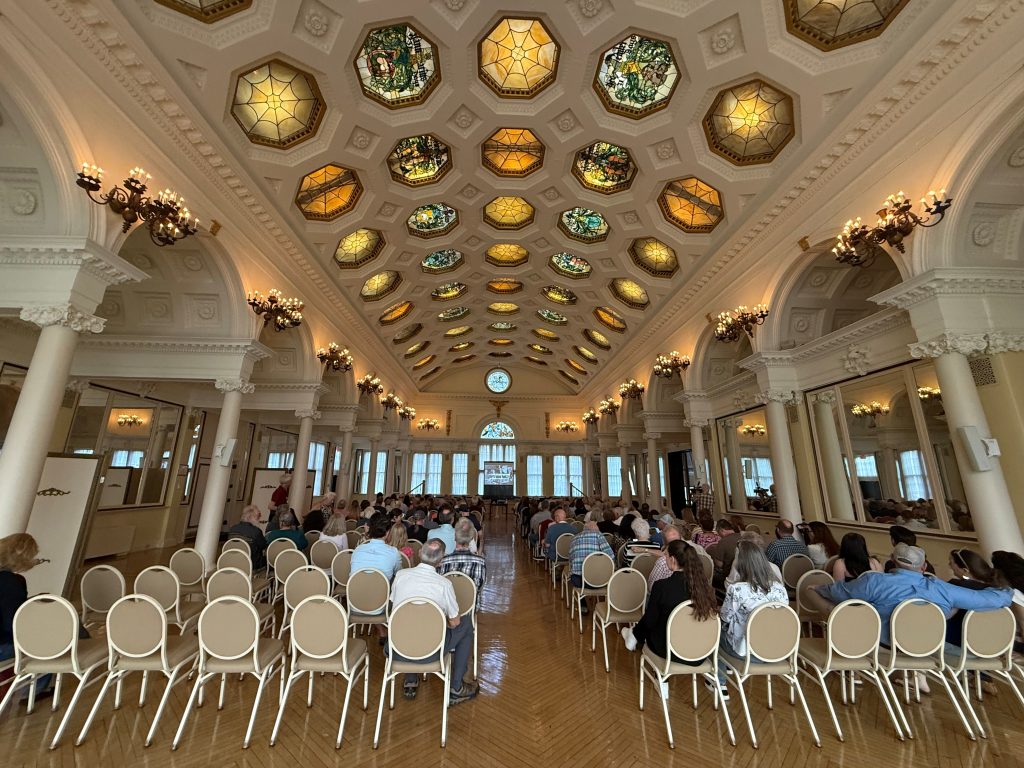
Veitch packed the opulent Canfield Casino with spectators while Williams delivered his talk to an attentive crowd at the Greenfield Community Center.
Both lecturers detailed the history of The Brook Club, an illegal gambling den and nightclub opened by Arnold Rothstein in 1919. The Brook was located on Church Street on the west side of Saratoga Springs, near the intersection of Church, Brook Road, and Locust Grove Road.
“Arnold Rothstein was the grandfather of organized crime,” Veitch said. “He taught all the other gangsters how to operate casinos, including Charles “Lucky” Luciano, Meyer Lansky, Dutch Schultz, Joe Adonis, and Frank Costello, who all as young men worked for Rothstein at the Brook resort.” (For those interested in seeing a fictional depiction of this crew, Rothstein, Luciano, and Lansky are prominently featured in the HBO series “Boardwalk Empire.”)
According to Williams, Rothstein began visiting Saratoga during the summer months in the early 1900s, providing financial backing to local casino operators. By 1917, he was interested in opening his own establishment. Not long after, construction of The Brook began.
“This was a very grand and palatial kind of place, the kind of place where there were no prices on the menu,” Williams said. “[An] ‘if you have to ask, you can’t afford it’ kind of restaurant. They would have very well-known entertainers coming in. The food, by all accounts, was excellent. It was where rich people went and you could flaunt your wealth.”
Rothstein tasked Lansky, then his young protegee, with working at The Brook. Lansky likely spun roulette wheels and operated other table games at the Spa City gambling den. (The Hyman Roth character in ‘The Godfather Part II’ is based on Lansky, and the name Roth was a nod to Rothstein, a detail revealed in one of the film’s deleted scenes.)
Veitch said he believes that it was Lansky who introduced the idea of a casino-resort to Bugsy Siegel, who then brought the concept to Las Vegas (though, other sources believe that Siegel was more inspired by gambling operations in Galveston, Texas).
“The Las Vegas casino-resort model was born on Church Street in Saratoga Springs,” Veitch said.
The Brook on Church Street also played a role in the infamous 1919 World Series, which was fixed (allegedly) by Rothstein. During the sordid affair, eight members of the Chicago White Sox were accused of intentionally losing the series in exchange for payments offered by organized crime figures.
Mont (or Monte) Tennes—a gambler from Chicago who operated a sports news wire service—was at the Brook in August of 1919. It’s here that Tennes claimed he started hearing rumors that the upcoming World Series would be fixed.
“[Tennes] says he heard it from Rothstein,” said Williams. “I am skeptical that Rothstein was that careless. But there were other gamblers there who may well have talked to this guy because he was always snooping around for inside information.”
Tennes was among a handful of witnesses targeted for questioning by sportswriter Hugh Fullerton, who helped uncover the Black Sox scandal.
Although Rothstein has long been suspected of orchestrating the fixed World Series, his precise involvement has been difficult to definitively prove.
“He knew something,” Williams said. “At the very least, he knows there’s a fix.”
Rothstein was also accused of manipulating or fixing horse races, including the 1921 Travers Stakes in Saratoga, which was won by Sporting Blood, a horse owned by Rothstein.
Four years later, Rothstein sold The Brook to his associate Nat Evans, who was also allegedly involved in the 1919 World Series fix. In November of 1934, Evans took out an insurance policy on the Brook, Williams said. In December of 1934, the Brook burned down.
Decades later, in 1953, Lansky’s one and only prison stint was at the Saratoga County jail, where he was sentenced to serve three months. According to the Mob Museum in Las Vegas, Lansky’s time in prison “was an anomaly, even beyond the fact it was the only time served during his criminal career. The incarceration, and subsequent release, received little if any publicity, thus leaving that short period behind bars with a dose of mystery. A notation tucked within Lansky’s FBI file states…that during incarceration, in July 1953, ‘he was also treated for a kidney infection in the Saratoga hospital.’”
More Spa City mob stories can be found in Veitch’s books “A Gangster’s Paradise” and “All the Law in the World Won’t Stop Them.” Williams also includes a story involving Lansky in his book “Off the Northway.”