


Housing Shortage Dominant Theme of “Inside Malta” Event
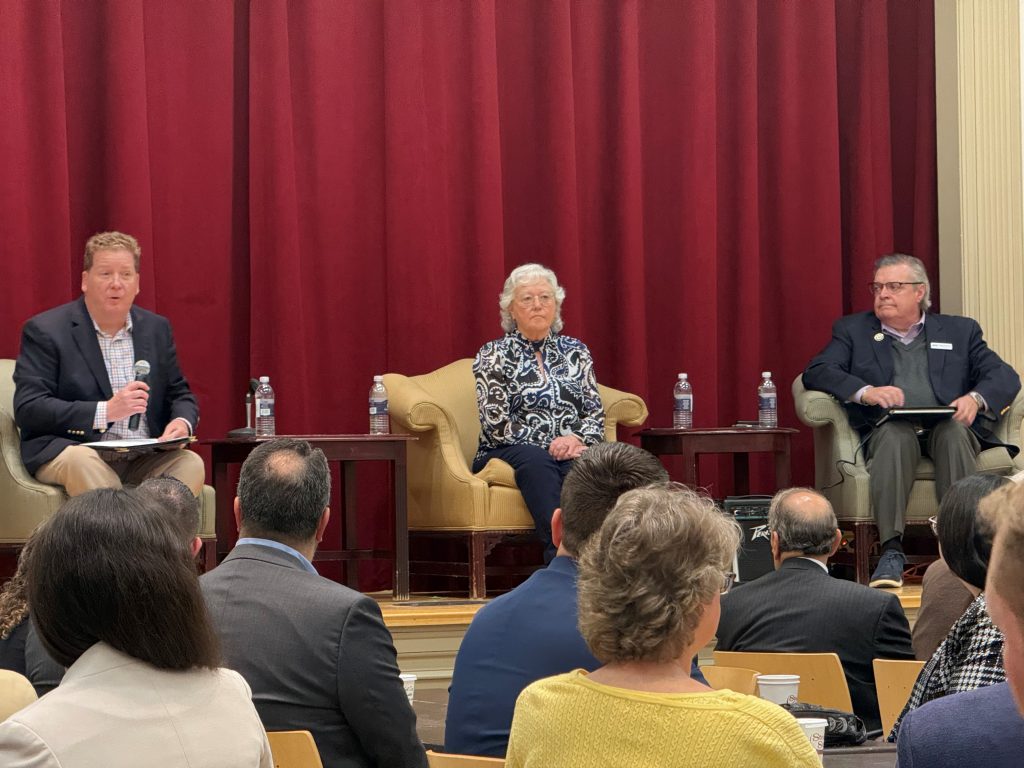
From left to right: Capital Region Chamber President and CEO Mark Eagan, Malta Town Supervisor Cynthia Young, and Saratoga Economic Development Corporation President and CEO Greg Connors at the Malta Community Center on April 29. Photo by Jonathon Norcross.
MALTA — “Housing, I think, is the single biggest problem we have here in Malta; affordable housing and housing stock,” said Malta Town Supervisor Cynthia Young at the “Inside Malta” event on Wednesday.
“Housing availability and affordability is really our biggest challenge here, not only in [Saratoga] County but in the Capital Region,” said Saratoga Economic Development Corporation President and CEO Greg Connors.
Though many issues concerning Malta and Saratoga County were touched upon at the “Inside Malta” event organized by the Capital Region Chamber of Commerce, housing was a recurring theme.
According to statistics provided by Young, Malta currently has 5,300 single-family and two-family homes, which comprise 61% of its overall housing. It also has 2,600 apartment units and 735 manufactured homes.
Yet, the stock is insufficient, as anyone looking to buy a residence in Malta (or Saratoga County at large) can attest.
“Our children can’t come back and buy a house in Malta,” Young said. “My son has been looking to buy a house someplace in Saratoga County, and they probably bid on 10 houses, and they offer above the asking price, and for every single one of them, they’ve been outbid.”
Malta has approved an additional 11 housing projects with 750 total units, but only three of those projects are currently under construction, Young said.
Part of the housing issues stem from an aging population (many downstate retirees are moving north). Simultaneously, the school district enrollments are declining, indicating that Malta lacks younger families.
“I don’t think that’s a healthy environment for any municipality,” Young said. “We might think of ourselves as a family town, but it’s tough for families to afford our homes.”
One event attendee said that an ongoing problem is that exorbitant fees are incurred before a new house even breaks ground. Another cited tiny homes as a possible solution. A third wondered if short-term rentals might be having an outsized impact on housing stock.
Connors said that there are around 2,000 short-term rentals in Saratoga County.
“One of the things about short-term rentals is we don’t really want to necessarily discourage them because it’s an active part of our tourism, and tourism is a big part of the entire county,” Young said. “But one of the things that we also don’t want is a bunch of LLCs just owning our housing stock for short-term rentals because that takes the housing stock away from people who want to live here.”
Young said that she wants to encourage the type of short-term rentals that allow homeowners to rent out their property for a month or so and then utilize that additional income to help afford their home.
Both Young and Connors expressed concern that short-term rental properties are not properly inspected, with Connors citing a recent example of a mother and her child dying in a fire inside a short-term rental property on Long Island that lacked smoke detectors and emergency exits.
One event attendee asked Young and Connors if there was a way to get locals to be less resistant to the creation of new housing stock, especially apartment complexes. Young and Connors didn’t have an easy answer, but Connors said that communication was key.
“The scale is important,” Connors said. “When a developer comes into the town and mentions a number like 900 units, that stuns those of us who live here. It’s not that we don’t want to welcome new people, but… They’ve got to be a little bit more sensitive with the scale of projects that they bring in because the public perception is key.”