

How a Rockefeller and a Local Newspaper Created SPAC
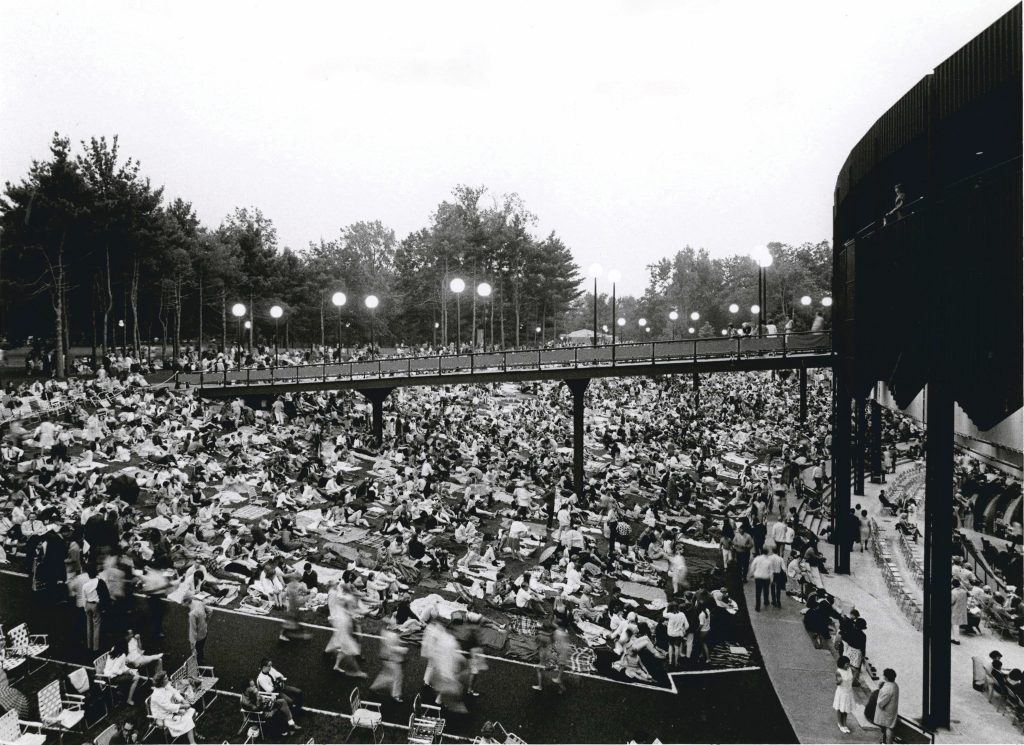
In the 1960s, a crowd of SPAC attendees pack the venue’s lawn. Photo provided by the Saratoga Performing Arts Center (SPAC).
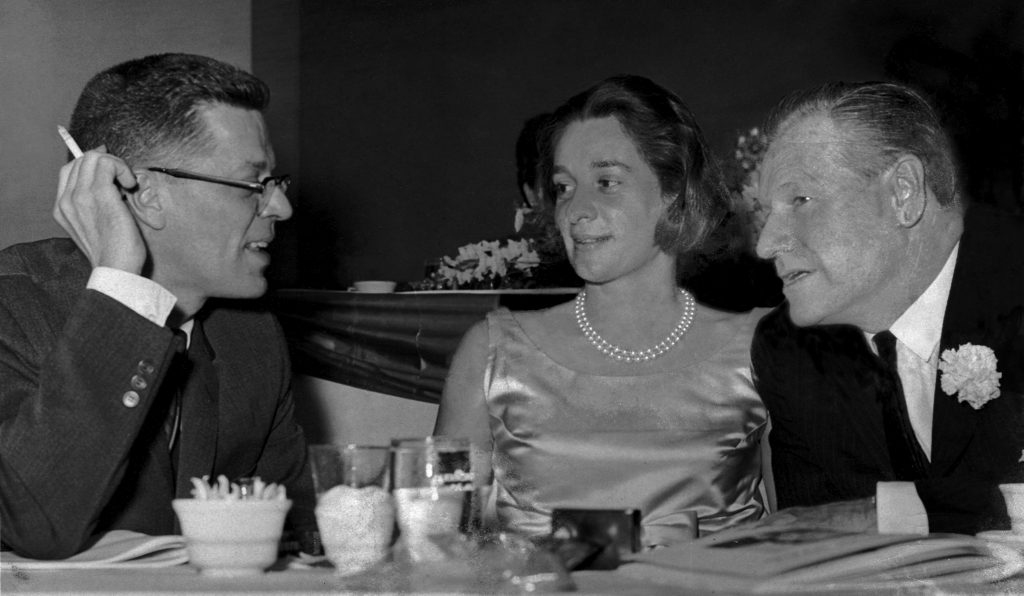
Fred Eaton, publisher of The Saratogian, with Gov. Rockefeller and the governor’s wife, Happy Rockefeller. Eaton and the Rockefellers were instrumental in creating SPAC. Photo provided by the Saratoga Performing Arts Center (SPAC).
THE SPIRIT BEHIND SPAC
Nelson Rockefeller had every advantage in life, descended as he was from the nation’s first billionaire. Opulent estates, an Ivy League education, and colossal sums of money were at his disposal.
But he was also dyslexic, and for much of his life, he didn’t realize he had a learning disability. He believed that his IQ was simply not as high as those around him. This resulted in some intellectual humility. Rockefeller—as governor of New York from 1959 to 1973 and then vice president of the United States from 1974 to 1977—surrounded himself with the best experts his vast fortune could buy.
But Rockefeller’s dyslexia also meant that he struggled with pre-written speeches, a burden for someone so often in the spotlight. Though not typically known for his oratory skills, there were off-the-cuff moments when his passion rendered him eloquent.
One such moment arrived during a heated budget debate with a fellow Republican, who argued that because state spending needed to be reduced, the state council on the arts would have to take a hit. Rockefeller rejected the idea and then uttered these memorable words:
“Let me ask you a question. What is government all about? What is life in this nation all about if it’s not centered around our culture? You indicate that these issues of dance and the arts have nothing to say to us, but they are absolutely the essence that holds our culture together… This isn’t silliness. This is what we’re all about.”
Rockefeller’s sentiment, spoken decades ago, is in many respects embodied by the existence of the Saratoga Performing Arts Center (SPAC), which is celebrating its 60th season this summer.
“If you think about Rockefeller and his view of society, he really looked at the arts as the foundation of a democratic society,” said SPAC’s CEO Elizabeth Sobol. “I’d love to think that spirit permeates what we do.”
“People forget now what a radical departure it was 60-plus years ago for a state government, or for that matter, the federal government, to invest tax dollars in culture,” said Rockefeller’s biographer Richard Norton Smith. “Saratoga was, in a lot of ways, an experiment. And I think [Rockefeller] would be very, very pleased with the way it’s evolved.”
THE LOCAL NEWSPAPER THAT STARTED IT ALL
Before Nelson Rockefeller became entwined in the creation of SPAC, there was an editorial that sparked the idea of a performing arts venue in Saratoga Springs.
Duane LaFleche of the Knickerbocker News, a now-defunct newspaper based in Albany, caught wind of the idea of hosting a summer festival for the New York Philharmonic and the New York City Ballet in Vermont. LaFleche had a different idea.
“It seems strange, somehow, that a New York Orchestra and Ballet should have to look out of the state for a summer home,” LaFleche wrote in his 1961 editorial. “Wouldn’t the State Reservation at Saratoga make a nice location?”
With the idea now out in the ether, prominent Saratogians converged to manifest it. One of those manifesters was another newspaperman, Fred Eaton, publisher of The Saratogian. According to him, “the idea for a performing arts center started with an editorial in The Albany Knickerbocker News, a speech by then State Sen. Eustis Paine, and telephone calls to two people from Saratoga Springs resident Robert N. McKelvey, then with the state commerce department in Albany.”
The idea spread from one interested party to another—McKelvey, the Adirondack Trust Company, The Saratogian, Yaddo, Leonard Bernstein (then musical director of the New York Philharmonic), and Charlie Dake of Stewart’s Shops all played their parts. A veritable who’s who of Saratoga power players had coalesced around the idea. Then, Gov. Rockefeller entered the stage.
ROCKEFELLER’S INFLUENCE
“At a January dinner at the Governor’s Mansion, I got Gov. Rockefeller’s ear and explained our problem – we needed an angel,” Eaton wrote. “His $1.2 million from the Martha Baird Rockefeller [Fund] was a huge stimulus.”
The precise total donated to SPAC’s creation by the Rockefeller family varies from source to source, but all agree that it was substantially more than $1 million (which is equivalent to $11 million today).
“The governor’s support was wholehearted,” states SAPC’s 50th anniversary commemorative book, published a decade ago.
“A lot of things had to come together for the Saratoga Art Center to exist, and it never would have happened, in my opinion, if Nelson Rockefeller had not been governor of New York at that point,” said Smith.
Saratogians also turned out their pockets, committing to fund the entire $1.8 million construction estimate. Again, the Spa City elite (such as the Dake family and Marylou Whitney) stepped up to the plate. By the time they were done, millions had been accrued.
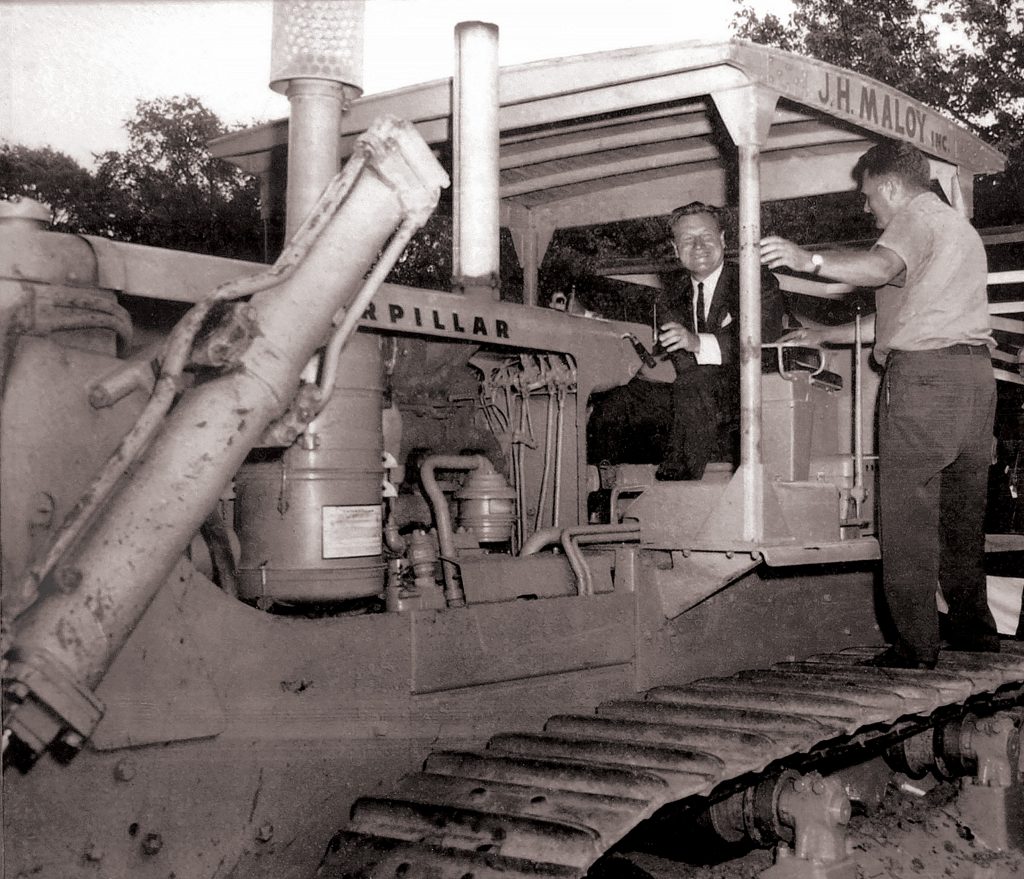
As money fell into place and plans advanced, SPAC was hit with a curveball: the New York Philharmonic decided to present its summer concerts in Central Park, leaving the future SPAC without an orchestra. But Richard “Dick” Leach, then the executive director of SPAC, came to the rescue, securing a commitment from the Philadelphia Orchestra instead. After the New York City Ballet also formally committed to the project, the time had come for a suited Nelson Rockefeller to hop aboard a bulldozer for the groundbreaking ceremony.
THE IMPACT ON SARATOGA SPRINGS
Initially, it made sense that an arts center housing two New York institutions (the Philharmonic and Ballet) should be located in New York. But there were other reasons to build a center in Saratoga.
In 1966, when SPAC first opened, a New York Times article labeled Saratoga Springs “a city in decline.”
“The 1950s were a bleak time for Saratoga Springs,” agrees SAPC’s 50th anniversary book.
According to the Saratoga Springs History Museum’s executive director, James Parillo, the Spa City back then was “struggling to redefine itself.”
Saratoga’s collapse stemmed from a confluence of factors. Tourism declined, in part because it changed. The Victorian era, in which visitors spent weeks or months in summer destinations like Saratoga, had ended. So too had the era of gambling. By 1953, all illegal casinos in town were kaput, which sent many service workers packing. Use of the Spa hydrotherapy facility had been declining for at least a decade. Major hotels along Broadway had become vacant behemoths. The city needed a shock to its system. And then SPAC arrived.
“When SPAC came in 1966…they would start attracting a new audience into Saratoga,” Parillo said. “That’s the real kick that we needed to get going.”
It was, as Nelson Rockefeller declared at SPAC’s groundbreaking, a “new era for Saratoga.” His brother Laurance Rockefeller called it a “rebirth.”
THE LAUNCH
On June 30, 1964, SPAC broke ground. Around 1,000 people attended the ceremony.
“When the Performing Arts Center is completed two years from now, we will have here a unique combination of spa, park, and cultural center whose contribution to the recreational, aesthetic, and economic life of this state will be of major significance for generations,” Rockefeller predicted in his remarks.
The governor also reiterated his firm belief that government should “encourage the arts.”
“[Government’s role] is not to dominate the arts, but to lend encouragement and support,” Rockefeller said.
In 1967, after SPAC had concluded its first year of operation, Rockefeller saluted the Saratogians who joined forces to make the venue a reality.
“As impressive as its appeal has been in the international worlds of music, the dance, and the other arts, even more exciting has been the complete acceptance given the Performing Arts Center by the citizens of Saratoga Springs,” Rockefeller wrote in a statement published by The Saratogian. “They have contributed heavily of their time and money to make the Center an overwhelming success. But they also have supported the Center by attending the performances with warm and enthusiastic applause.”
60 years later, the applause hasn’t died out.
At “This Place Loves You Back,” a photography exhibit unveiled earlier this month at The Pines at SPAC, one testimonial from a veteran SPAC-goer read: “I am 93 years old, my husband and I attended the opening night of ‘A Midsummer Night’s Dream.’ I have only missed two opening nights since that time, bringing my children, grandchildren, great grandchildren, and many friends. It has been a great pleasure.”
Mary Ann Fitzgerald, who watched Rockefeller break ground in 1964, shared similar sentiments with the Times Union a decade ago when SPAC celebrated its 50th season.
“SPAC is the crown jewel in Saratoga,” she said. “I can sit out on the lawn, gaze up at the stars, listen to the rush of Geyser Creek and hear some of the greatest musicians in the world. You can’t beat that.”