

Local Construction Industry Leaders Bemoan Labor Issues
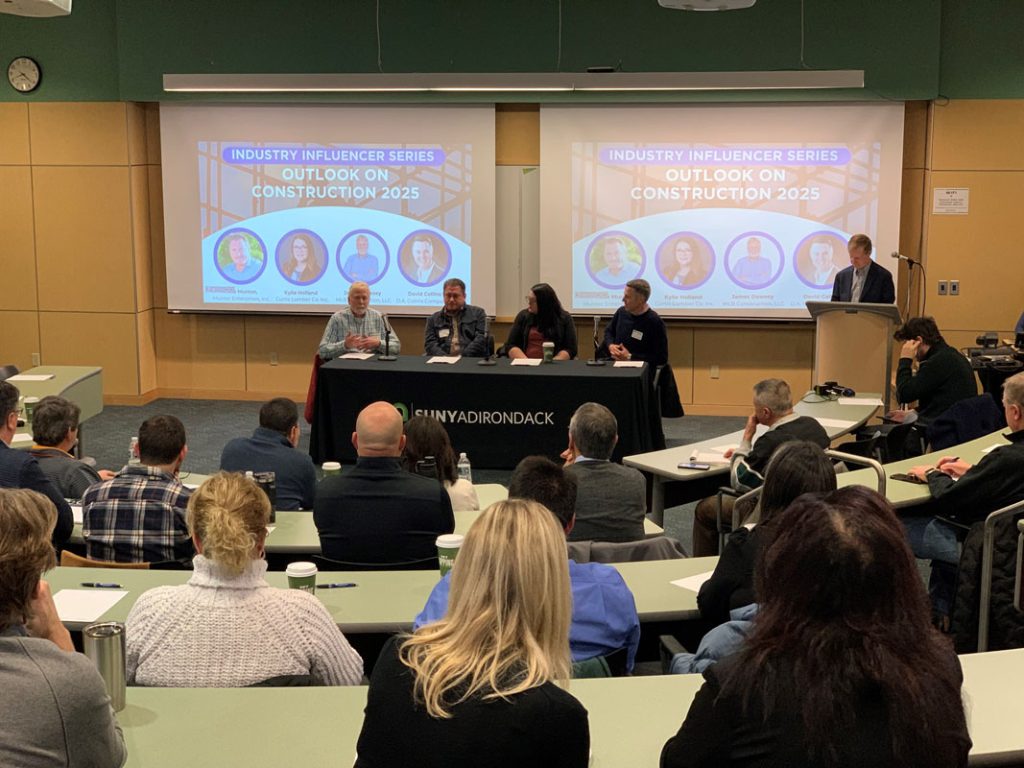
A sold-out audience listens to the Outlook for Construction 2025 panel discussion hosted by the Saratoga County Chamber of Commerce at the SUNY Adirondack campus in Wilton. Panelists, from left to right: James Dawsey of MLB Construction Services; Michael Munter of Munter Enterprises; Kylie Holland from Curtis Lumber; and David Collins of D.A. Collins Companies. Photo by Jonathon Norcross.
WILTON — Local construction industry leaders assembled on Tuesday morning at SUNY Adirondack’s Wilton campus for a panel discussion about the future of the business in Saratoga County. Among other topics, the panelists described issues they’re facing with recruiting and training new hires, many of whom lack skills applicable to the construction trade.
“Historically, in our industry, we recruited farm kids,” said David Collins, owner of D.A. Collins Companies. “They know how to fix equipment, they know how to operate equipment, they know how to work long, hard hours. Now those farms aren’t around anymore.”
Collins said the lack of skilled recruits was resulting in more training for new hires.
“The younger people coming in don’t have the same work ethic or insight into what a day’s work is compared to a farm kid,” added Michael Munter, vice president of Munter Enterprises. “I don’t want to use the word ‘soft,’ but I think we’re a little softer than it was when we were out there in the trenches getting screamed at.”
Munter said that veteran construction workers had begun mentoring younger workers to help show them the ropes.
Audience member Stacey Fantauzzi, vice president of operations for North East Fire Protection Systems, said business owners themselves had also become “soft” by “accommodating a lot of the shenanigans” of new hires. Fantauzzi said parents are “atrophying our children by allowing a lot of this softness.”
One 2022 survey conducted by the Associated General Contractors of America found that 91% of construction firms reported having difficulty filling open positions due to a lack of qualified candidates. This shortage of skilled laborers could result in longer and costlier projects, declines in productivity and quality control, and more injuries on the job.
The labor issues could also impact housing shortages. A fall 2024 labor market report from the Home Builders Institute stated that “additional skilled construction workers will be needed to reduce the nation’s housing deficit during the second part of the current decade, a shortfall [the National Association of Homebuilders] estimates to total 1.5 million homes.”
Despite the need for more workers, labor shortages in home building remain widespread, even with an uptick in immigration over the last two years. A NAHB/Well Fargo Housing Market Index survey found that builders reported shortages in 16 different trades, ranging from landscape to carpentry.
James Dawsey, president of MLB Construction Services, suggested that a stronger presence in schools was necessary to introduce kids to skills applicable to the construction trade.
“I think if we reach down and at least give the kids a basis for wanting to get into this business, I think that’s a big plus on our side,” Dawsey said. “Hopefully it’ll pay dividends in the future to try to attract people into our business.”