

Local Professor Hopes to Use Cutting-Edge Tech to Improve Horse Industry
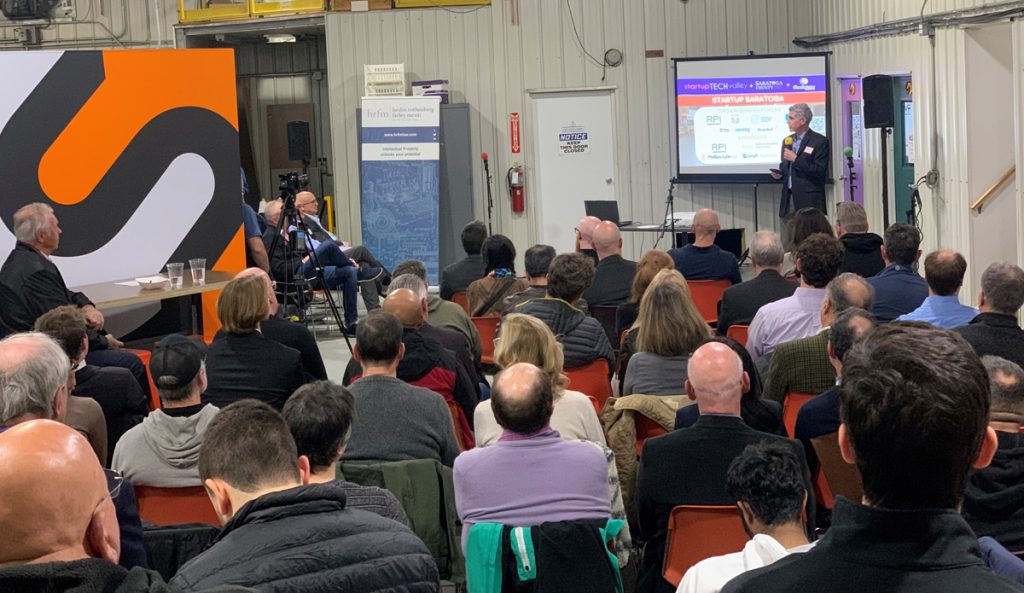
Spectators prepare to hear business pitches at Startup Saratoga, an annual event that occurred this year at Innovation Center Saratoga in Ballston Spa. Photo by Jonathon Norcross.
BALLSTON SPA — Startup Saratoga—an annual event similar to “Shark Tank” that allows local innovators to pitch their business ideas—took place, appropriately enough, at Innovation Center Saratoga last Thursday.
Five entrepreneurs presented their ideas to a packed house of business leaders, investors, mentors, and students. Of those five pitches, one was especially applicable to Saratoga Springs and its equine industry.
Riley Studebaker, a professor at Rensselaer Polytechnic Institute (RPI) who focuses on advanced digital fabrication, is perhaps best known as the founder of MetaOrnate, a company that installed the first, permanent 3D-printed ceramic façade in the western hemisphere in 2024.
But Studebaker also grew up on a horse farm, and his latest ambition is to use a new method of 3D scanning and printing to better the equestrian world.
Saddles, Studebaker said, can be uncomfortable for horses, even when those saddles are designed for a specific horse. And since horses typically only wear their saddles for a relatively small amount of time, there’s not enough opportunity for the animals to break in their saddles in the way that a human might break in a new boot. That’s where 3D scanning and printing technology comes in.
Studebaker wants to fabricate “exact replicas of unique horses’ backs to passively break in saddles when not in use,” he said during his Startup Saratoga pitch.
The RPI prof acknowledged that some existing companies already provide a similar service, but he said these services were one-size-fits-all, lacked customization, and don’t respond to the curvature or asymmetries of horses’ backs. “It’s not that good because it’s not that accurate,” Studebaker said.
Studebaker’s solution is to use a combination of 3D scanning and what he called a “novel” method of 3D printing to create an uber-precise replica of horses’ backs that would allow saddles to be broken in without the horses having to do much of anything. This process of scanning and creating a horse’s back would only take about five days, Studebaker said.
And because horses are athletes with bodies that can change shape, the 3D scanning and printing service could be repeated a number of times to create up-to-date replicas of horses’ backs. Studebaker’s initial strategy would be to market these products to horse trainers while also partnering with saddle manufacturers and horse show venues. Some lucky horse owners might even be able to get one of these 3D-printed products for free.
“We want to make some and give them away as first-place prizes for high-profile horse shows in the Saratoga region to get some customer feedback,” Studebaker said. “From there, an active subscription is $800 per scan; four scans per year.”
Although any small boost to a horse’s comfort could positively impact its performance and thus result in more prize money, Studebaker emphasized that the horse owners he’s spoken with prioritize the well-being of their animals most of all.
“Honestly, horse people just love their horses,” he said. “One of them articulated it to me in this capacity: ‘Owning a nice show horse is like owning a race car that’s also your best friend.’”