

New Book Spotlights the Revolutionary Schuyler Sisters
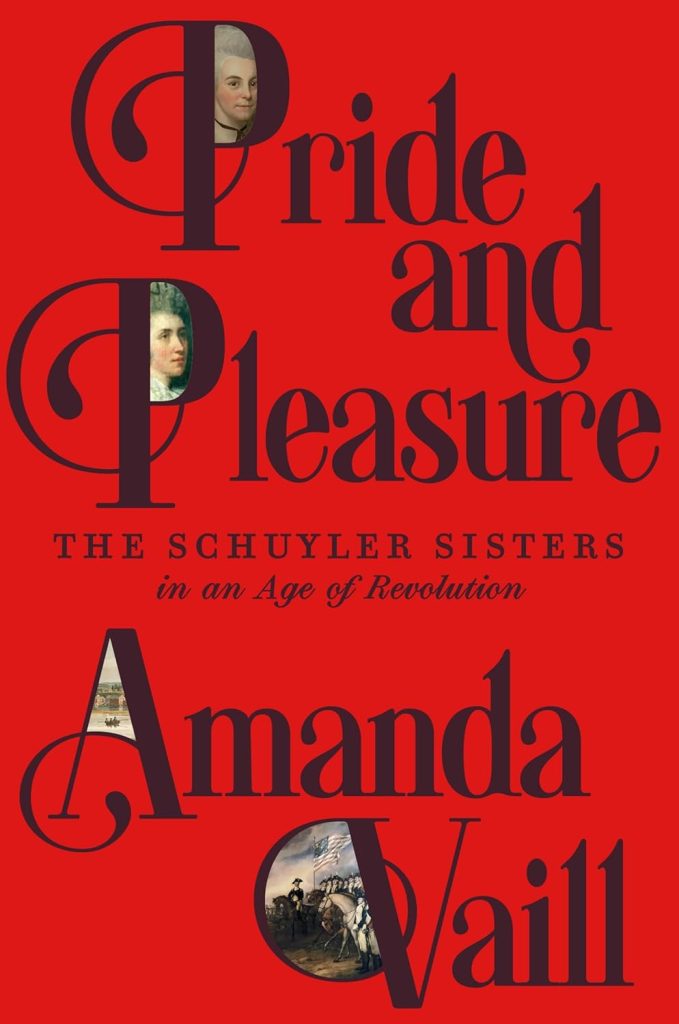
Book cover of “Pride and Pleasure: The Schuyler Sisters in an Age of Revolution” via the publisher, Farrar, Straus and Giroux.
SARATOGA SPRINGS — Angelica and Elizabeth Schuyler had just reached their early 20s when their country home in present-day Schuylerville was incinerated.
“On October 11, surrounded and desperate, his army depleted by casualties, [General] Burgoyne petulantly put the torch to Schuyler’s house, barns, and mills, reducing everything to ashes and charred timber,” writes Amanda Vaill in her new book, “Pride and Pleasure: The Schuyler Sisters in an Age of Revolution.” “On the thirteenth he began negotiations for capitulation, and on the seventeenth his entire army of nearly six thousand men, seven thousand muskets, and forty-two cannon—in addition to tents, blankets, and other military provisions—was surrendered to Horatio Gates at a meeting place ‘150 rods south’ of the still smoking ruins of Schuyler’s estate.”
The Schuyler sisters not only bore witness, but also participated in a turbulent time of war, death, and the pursuit of a republic. The odds seemed to be always stacked against them, just as the ragtag colonists were thought to have little chance of success against the British Empire—that is, until Burgoyne’s surrender at Saratoga changed everyone’s fortunes.
The remarkable story of the Schuylers, especially the glamorous Angelica and the steadfast Elizabeth (wife to Alexander Hamilton), have been recounted time and again, most famously in the “Hamilton” musical and in Ron Chernow’s brilliant biography, “Alexander Hamilton.” But there’s often been a tendency to cast these characters in supporting roles, relegating them to shiny accessories.
The historical record reveals Angelica and Elizabeth to be fascinating figures in their own right; well-read, insightful, and influential women living in a time when women’s ambitions were restricted. Vaill, a bestselling author and Emmy-nominated screenwriter, explores their stories in her new book.
In advance of her Dec. 3 appearance at the Northshire Bookstore in Saratoga Springs, Vaill spoke with Saratoga TODAY about her new tome. Below is our interview, which has been edited for length and clarity.
Saratoga TODAY: Of all the things you could have written about, why the Schuyler sisters?
Amanda Vaill: If you look at my past publications, you’ll notice maybe that what I seem to be attracted to are these kind of turning point moments in history when things are changing. The ground is shifting under everyone’s feet… I’m attracted to this like bees to honey and I like thinking about the way people interact with those moments; how they’re caught up in them, how much they can influence them or not, how much they are affected by them. And in this case, I had these two women who did something so different from what they would have been expected to do. They didn’t just marry the right guy, they married the wrong guy [laughs]. They married really wrong guys, and one of them actually so much so that she had to elope, and her parents threatened to disown her. Of course, they didn’t. But Alexander Hamilton, even though Philip Schuyler became enamored of him…he was a real outsider. And the fact that these women decided, ‘Oh, I think I’ll cast my lot in with this guy,’…I thought that was awfully intriguing.
ST: I’d love to talk a little about Eliza. On paper, Angelica’s life seems so exciting and romantic, but Eliza always seems like someone who gets cast as a dull background character.

AV: Oh, you have put your finger right on it.
ST: What makes Eliza more interesting than perhaps we’ve been led to believe?
AV: If I may say so, I think a lot of historians who’ve looked at [Angelica and Elizabeth Schuyler] are as enthralled by Angelica’s flirtatious charm as men in her own time were, and I think they all kind of want to date her… But the fact is, [when] these very same people think about Eliza, ‘Well, she was a good housekeeper. She could do the household finances. She could bear a bazillion children. She could do all of these things. They’re not very glamorous. Don’t I wish I had that person at home to do all my stuff for me.’ I feel as if people have willfully not paid attention to the evidence in front of their eyes. She is a beautiful woman. She was as beautiful as her sister. In some respects, maybe more so… They’re ignoring the things that she did to help Hamilton’s career, and it’s not just by being a hostess, although she was one. When people maintain that she wanted Hamilton to leave the government, they’re only relying on one witness for this… She also, of course, helped Hamilton with drafting his political papers and memoranda. She was there when he wrote the memoranda that justified the Bank of the USA. And in fact, [she’s] probably the person who read all of the horrific, thick tomes about economic history because it’s her name in those books, not his… She has an incredible ability to run things. Once Hamilton is dead, she’s able to collect all of his papers, which is an extraordinary undertaking. This little woman is traveling all up and down the eastern seaboard copying letters… She ran an orphanage for 20 years, an entirely woman-run nonprofit, and got it a state charter. She got money from the state. She got bills passed that would enable it to receive funding. She did all of that. This woman is really pretty formidable.
ST: Near us, we have the Schuyler family’s country estate. Could you talk about why you think these types of sites are important? If you go to the estate, what can you learn about the family and about the people who lived there?
AV: The thing that’s really stunning about going to the historical residence is the scale that life was lived on in this country. If you go to England or any of those stately houses, they’re Downton Abbey. They’re giant, huge things. Even the grandest places here are not that imposing. It’s a big house that you could kind of manage by yourself. I mean, you couldn’t manage it by yourself if you had to do all the cleaning and everything yourself and keep things up to the standards that people wanted, and also take care of all the agricultural work that went along with them because these were working farms and they needed a lot of attention. But they’re not immodest. There’s a scale that’s human about them, and it makes you suddenly realize that these are people that lived at a scale that’s a little less grandiose than you might imagine, given the fact that Philip Schuyler owned thousands and thousands of acres of New York State… The other thing is the relationship that the houses have to the land around them. When you go to see them, you can see how the people lived in them and related to their surroundings in a way that you wouldn’t if you had never seen it. And of course, in the case of the Schuyler Mansion—where so much of the furniture has been reassembled or they’ve made real efforts to replicate some of the objects that they had to make the house appear, at least in part, the way it might have when [the Schuylers] were there—you get a sense of: What was the material texture of life for these people? What kind of beds did they sleep in? How many people slept in a bedroom? All that kind of stuff is fascinating.
ST: Based on your research, what do you think the Saratoga estate meant to the family?
AV: Oh, a lot. The first house, the one that was burned by Burgoyne, Catherine Schuyler was really fond of that house. She loved it. I think it must have caused her terrible pain when it was burned. But [Philip] rebuilt it pretty much as fast as he could. Right after it was destroyed, he used Army carpenters and construction people and he really got that house put up pretty quickly. It’s grander now than it was because originally, when it was first built, the floors of the second story were the ceiling of the first story. They weren’t putting insulation and layers of stuff in between. It was just, ‘Get something put up here quickly.’ Because they wanted to have a place there. He had all of that real estate and all of the farms and the mills and the fisheries along the river there, and I think it was important to him to be able to be close to them to supervise them. But the family also appears to have had a real fondness for the house and the country because Albany was not New York City, but it was a pretty bustling small city. And Saratoga was just the country, and I think they loved it the same way people do now.
Amanda Vaill will appear in person at the Northshire Bookstore in Saratoga Springs on Dec. 3 at 6 p.m. Her book about the Schuyler sisters, “Pride and Pleasure,” was released on Oct. 25 and is available everywhere books are sold.