


Pulitzer Prize Winner Discusses Battles of Saratoga and the Art of History
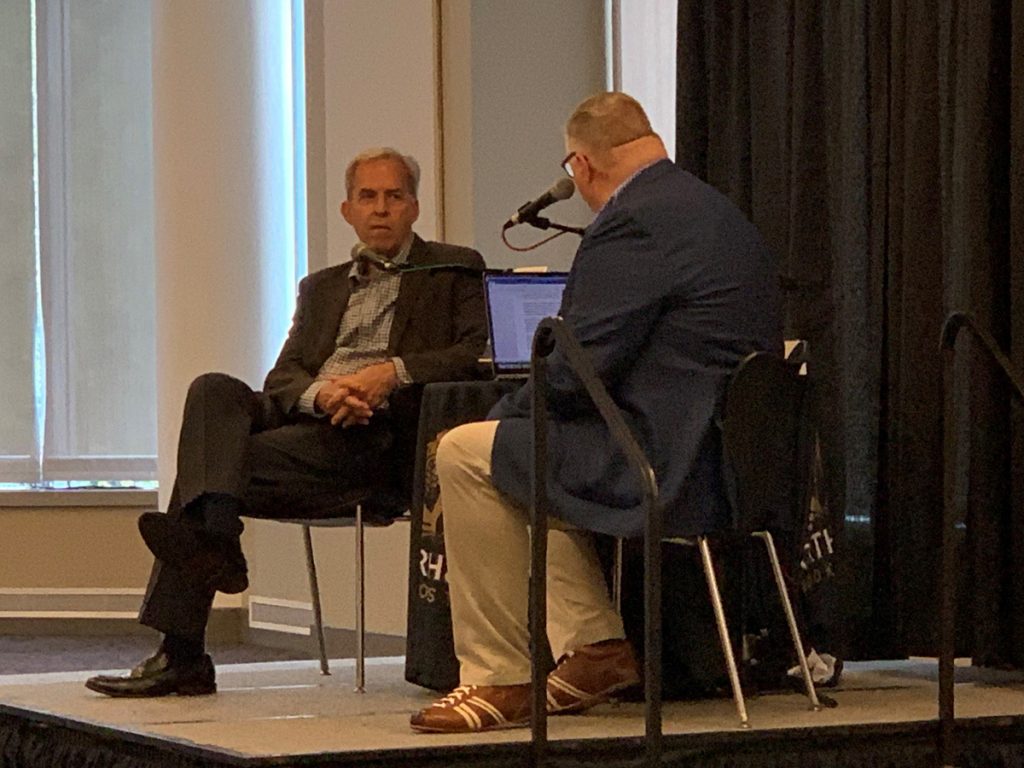
Pulitzer Prize-winning author and historian Rick Atkinson discusses his latest book with WAMC/Northeast Public Radio’s Joe Donahue at the Saratoga Springs City Center on May 30. Photo by Jonathon Norcross.
SARATOGA SPRINGS — About ten miles from the site of the Battles of Saratoga, Pulitzer Prize-winning historian Rick Atkinson assessed the historic importance of the events, calling them a “manifest catastrophe for the British.”
Atkinson’s discussion of the famed skirmishes jived with what would probably be considered common knowledge among locals: Benjamin Franklin used the victory to entice the French into the war, a critical turning point that ultimately led to American independence. But he also described why the battlefields were a valuable resource for the second installment of his American Revolution trilogy, titled “The Fate of the Day: The War for America, Fort Ticonderoga to Charleston, 1777-1780.”
“If you go to Saratoga, you’ve got some sense of the sacrifice that was made there,” Atkinson told a large audience at the Saratoga Springs City Center last Friday. “You get some feel for it. Even though it’s 250 years ago, there are ghosts there and you can feel them. It’s also important for me as an amateur to see the ground and to understand tactically why they did this and why they did that.
“I spend a lot of time understanding the flora and fauna of places. When I go to Saratoga or Valley Forge or whatever, I’ve got apps that show me what’s growing there, and I use that to be able to bring the reader in touch with the natural world the way that they were then…I think that’s one of my ambitions as a writer, to recreate that.”
Atkinson elaborated on his artistic aspirations as a chronicler of history, saying he hoped to bring long-dead people back to life, make the reader feel like they don’t know what’s going to happen (even when they do), and empower the reader’s imagination by allowing them to hear, smell, and feel historic events as if they were unfolding in the present.

“That is when I think you begin to transform history into art, when the reader’s imagination is playing on the words on the page in a way that they have become engrossed in the story,” Atkinson said.
One perhaps surprising detail Atkinson uncovered in his research was that he found George III to not quite be the “royal brute” described by Thomas Paine, nor the “tyrant” that Thomas Jefferson called him in the Declaration of Independence. Atkinson was granted access to thousands of previously unpublished letters written by George III, which helped him better understand the king’s perspective.
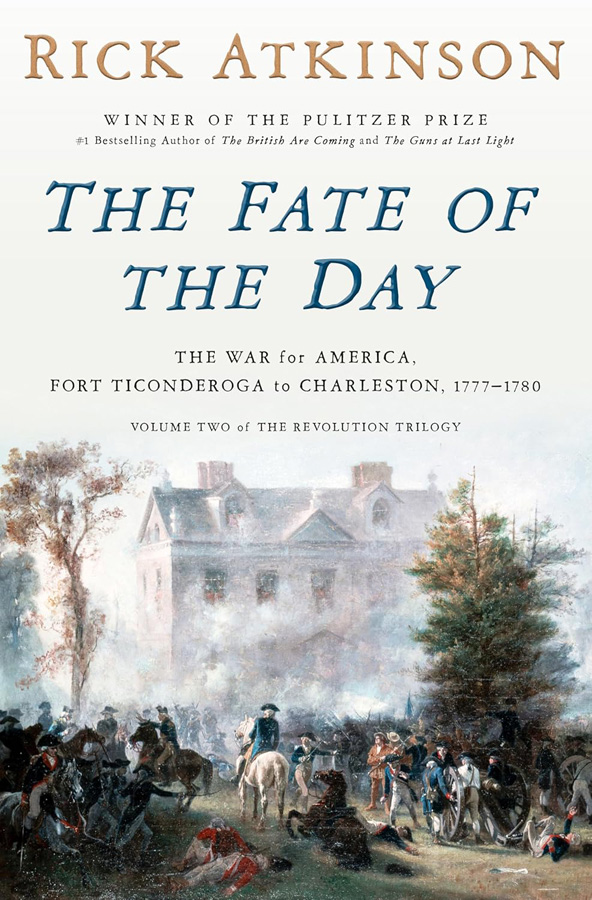
Cover of Atkinson’s “The Fate of the Day: The War for America, Fort Ticonderoga to Charleston, 1777-1780” provided.
“He’s a constitutional monarch,” Atkinson said. “He’s a patriot king. He’s a child of the Enlightenment who’s a great patron of the arts and the sciences. He’s got a lot going for him.”
The scholar’s latest tome covers, among many other things, the Battles of Saratoga and the role of Fort Ticonderoga in the American Revolution. His previous work includes the Liberation Trilogy (“An Army at Dawn,” “The Day of Battle,” and “The Guns at Last Light”), as well as “The British Are Coming,” the first volume of his Revolution Trilogy.
His appearance at the Saratoga Springs City Center was presented by the Northshire Bookstore and the Saratoga 250 Commission, which had “soldiers” in revolutionary garb posted outside the event.