

Acclaimed Author Stops in Saratoga to Talk Meryl Streep, The New Yorker, and the State of Media
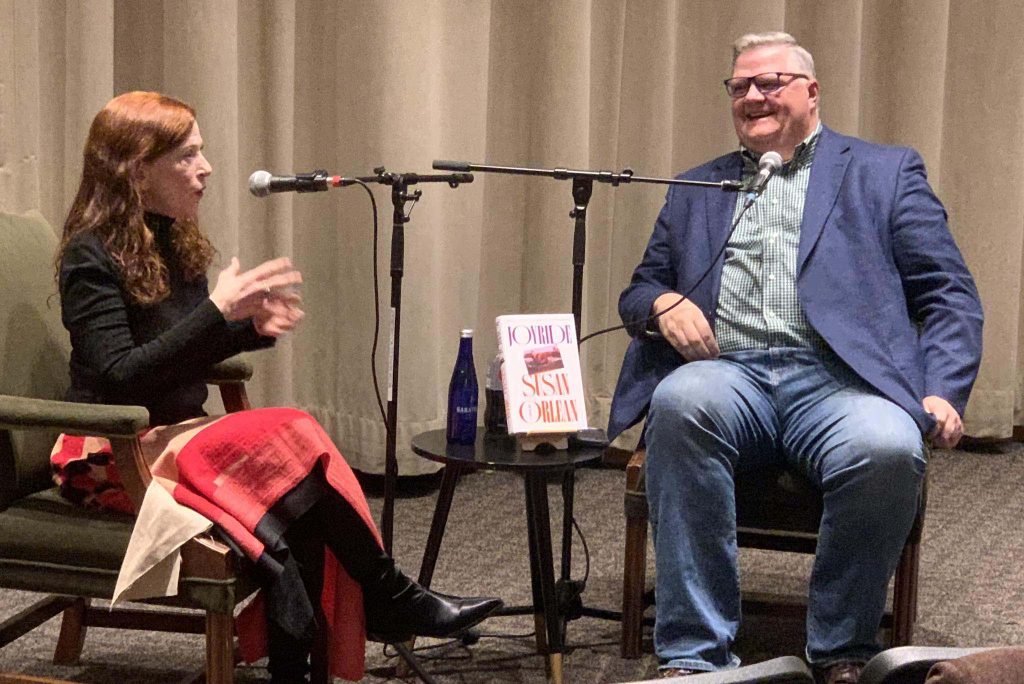
SARATOGA SPRINGS — Susan Orlean, a staff writer at The New Yorker since 1992, has lived a life worth documenting.
She was portrayed by Meryl Streep (albeit in a highly fictionalized fashion) in the brilliant 2002 film “Adaptation.” As a journalist, she’s spent time on cult compounds, soaked up waves and wisdom with Maui surfers, and maintained decades-long employment at one of the world’s most esteemed magazines.
Her latest book, “Joyride,” is a memoir that offers both a deeper understanding of the author herself and the many fascinating figures she’s profiled. What does it feel like to be welcomed into a cult commune? How did a horticulturist come to be arrested for poaching rare flowers? What is the life of an ordinary 10-year-old suburban boy really like? What exactly goes on at the World Taxidermy Championships?
To promote the release of “Joyride,” Orlean embarked on a coast-to-coast book tour that included a stop in Saratoga Springs. On Nov. 17 at Skidmore College’s Palamountain Hall, Orlean fielded questions from the audience and was interviewed by WAMC radio’s Joe Donahue. The event was presented by the Northshire Bookstore (the shop’s Director of Events Rachel Person called Orlean a “longtime Northshire staff and customer favorite.”)
Below are highlights from Orlean’s chat in the Spa City, edited for length and clarity.
Joe Donahue: At what point did you think to yourself, “Oh, that may be a good idea [to write a memoir]?”
Susan Orlean: I never thought it was a good idea [audience laughs]. What happened was, I had begun thinking about writing a book about writing, and the more I thought about it, the more it sounded like the process of writing a book about writing wouldn’t be very interesting. It sounded really pedantic and dry. At that same time, I was reflecting on this astonishing realization that I had written “The Orchid Thief” 25 years earlier. I was so struck by that, it seemed so monumental. So, it put me in the mind of reflecting on that period of time. “The Orchid Thief” wasn’t even my first book, but I just thought, “Boy, I’ve been doing this a long time and I’ve collected so many stories, not only what’s on the page, but the stories of how I did those stories.” It occurred to me that I could write a book about writing that, at the same time, sort of traced the path that I’ve taken and be a conversation with readers that was more personal than what I’m usually doing.
JD: You write in the book: “Being a writer is so much fun.” And this is a line I love: “It’s Make-A-Wish for the curious.”
SO: It really is. I sometimes am humbled by realizing how crazy it is that I can conjure a thought, like “I really want to learn about taxidermy,” and the next thing I know, I’m learning about taxidermy. Maybe that doesn’t appeal to everybody here, but to me, it was extremely exciting. It’s almost—if I can think of it, I can write a story about it.
JD: How did you write “The Orchid Thief”? You have the book in your hand. Someone from Hollywood takes the book. They go off, and the next thing you know, Meryl Streep is playing you.
SO: Yeah, it was a different experience [audience laughs] than a lot of people have… I thought the whole thing was a joke that it got optioned. Because when this book got optioned, I thought, “This is so not a movie. I cannot imagine why you’re optioning it.” But of course, you’re not going to say “No.” I just thought, “Good luck. I have no idea how you’re going to make this into a movie.” The book was a very interior kind of meditation on orchids, on passion, on Florida. The crime at the center of it is relatively small. No one gets killed. There are no car crashes. I remember at the time that it got optioned, saying to my husband, “They’re probably going to make the crime a murder, they’re probably going to jazz it up and make it a Hollywood movie,” which they kind of did, but not at all the way I pictured that it would be made into a Hollywood movie. The thing is that I never thought it would really get made. Most things that get optioned don’t get made. The percentage is maybe 1% of the things that get optioned. That’s just the way Hollywood works. So, when I got a call and they said, “Well, we’ve got the script.” I thought, “What? Seriously?” And then when they showed me the script, I said, “Seriously? No. Absolutely not.” I said, “You’re going to ruin my career, and I don’t want to be a character in a movie.” I got a lot of puppy-dog eyes. “Really, are you sure? Everybody else said ‘Okay.’” And I kept saying, “No, no, no, no, no, this is nuts.” And then my curiosity got the better of me. That feeling that I have, which is, I’d rather not not do something. I don’t always want to do things, but I don’t want to not do them. So, given this kind of knife edge that I was on, I finally, in the last minute, said, “All right, fine.” And then it was this crazy ride and obviously the film is a very complex meditation on the nature of the book. I’m far more glad that that is the movie that got made than what I pictured, which was basically taking my book, kind of amping up the drama a bit, and making a typical Hollywood movie.
JD: Who were the writers that you were reading in The New Yorker and thinking, “Man, they got it?”
SO: Oh gosh, it’s a long list. Calvin Trillin, Ian Frazier, Marc Singer, Alec Wilkinson, and then the older writers, Joseph Mitchell, A.J. Liebling, E.J. Kahn. I mean, it’s a long list and I’m probably leaving out lots of people. It was an awe-inspiring and, of course, somewhat humbling, rogue’s gallery to be joining. These were the people when I think about John McPhee, and in fact, my first office at The New Yorker was right across from his, and I really felt like, how do I get to sit in an office across from John McPhee? I’m not worthy. That’s why when I wrote the introduction of “Joyride,” I really did feel that I was in the land of giants, that these were the giants of nonfiction writing, and to be in their presence was truly inspiring. They’re in the office regularly, people like Roger Angell and Marc Singer, they were all in the office all the time. So just being around them and also seeing that when they turned stories in, they got nervous. That was actually somewhat comforting to see that even when you reach those pinnacles that they had reached, they still went through all of the same emotions of figuring a story out, not being sure whether it worked or not, waiting to hear from their editor. I remember one day seeing Roger Angell kind of pacing in the office, looking very unhappy. I said something to my editor, and I said, “What’s going on?” He said, “Well, he’s waiting to hear about a Talk of the Town piece he wrote.” The Talk of the Town pieces are these short little pieces. Roger Angell, at that point, had done millions of features, millions of books. He was one of the great writers of The New Yorker and he was still pacing the hall nervously waiting to hear if a Talk piece had worked.
JD: To this day, when you see your work in The New Yorker…still a thrill.
SO: Oh, an absolute thrill. Absolute thrill. I think it’s as exciting, seriously, as exciting as the very first time. I still, after having been there now for a long time, I still see my writing in The New Yorker typeface, and I kind of can’t believe it. I still feel like I can’t believe this. This is so, so exciting.
Audience member: Before, when you were talking about all the different writers that you worked with and that influenced you, it seemed most of them were men. When you started at The New Yorker, were there many women? And would you consider yourself a trailblazer in that way?
SO: No, The New Yorker has always had a very healthy number of women writing for it. In fact, the first, I believe, deputy editor back when the magazine was founded, was a woman. In collaboration with a man, but she was definitely at the forefront. Early on, you had writers like Janet Flanner. When I arrived, there were a lot of women writers. It happens that the list that I gave you, I mean, I could add to that Lillian Ross, Joan Didion. There were a lot of women writers who I really admired. Lillian Ross was a really important figure at the magazine. But also at that time, they had Andy Logan covering City Hall, Pauline Kael. There were a lot of women and there always have been, even at a time when maybe that wasn’t as true at other publications.
Audience member: How does one get a job as a writer in today’s market?
SO: This has been the question that has dogged me on my book tour because, without realizing it, in writing my book, I kind of trace an arc that no longer really exists. I started at alternative news weeklies, which by and large are gone. I wrote a lot for Sunday magazines, which are almost entirely gone. It’s a different world. I don’t have a quick answer to that. I should try to devise one because I’m asked a lot, and I think there are ways that being published has become somewhat easier. Not getting paid but getting published. Anyone can start a Substack. Anyone can post online. There are all sorts of easy ways to get published, but that’s not the same as supporting yourself as a writer or getting editing. One thing that has changed that I recommend to young writers is every magazine has a website that has infinitely more room for writing than the print publication. It’s just a matter of dollars and cents. You can have a gigantic website and it doesn’t cost you the way printing pages costs. So, younger writers have a bit of an easier time getting in through the website. But I don’t have an easy answer. I feel lucky that the things existed when I was coming up because those seem so much more accessible than what is going on today. I remain optimistic about people’s desire to read good writing. I will continue believing that until I’m absolutely proven wrong. But is it easy to make your career that way, or is it harder than it used to be? I think it has become harder.
THOUGHTS ON EDITORS
During her conversation, Orlean also shared her thoughts on some of the well-known editors she’s worked with at The New Yorker.
On Tina Brown: “When Tina came in, she had a completely different attitude. She wanted the writers to be stars. She commissioned fancy headshots of everybody with the idea originally that they were going to run in the front of the magazine. It never ended up happening. But she just didn’t understand why you wouldn’t want to promote your writers as stars.”
On David Remnick: “He knows me well and he knows that if I get really excited about something, that I could probably figure it out. He doesn’t always immediately get what I’m trying to do with the story, but he’s willing to let me take a shot at it. I remember when I had, through an accident, coming across a taxidermy catalog, and I got really excited, and I thought, “Oh my God, taxidermy. Who thinks about taxidermy and who knew that it was such a thriving business that it would have an industry catalog this thick?” I was super excited about it. I Googled taxidermy, and lo and behold, the World Taxidermy Championships were coming up. So, the next day, I burst into the office, and I said to Remnick, “Can I cover the World Taxidermy Championships?” And he said, “Let me think if I already assigned it to someone.”
On Robert Gottlieb: “He was wonderful. He’s a brilliant man and also very playful and very open to eccentricity because he was eccentric himself. He didn’t edit my pieces. He read everything. He wasn’t my hands-on editor, but he absolutely was open to the ideas that I was bringing early on that were pretty out there. He let me go at them. My first full-length feature, which I did under his reign, was I had heard about a cab driver in New York who was the king of his African tribe. I just thought, this is a fantastic story and I really want to do it as a feature. He just said, ‘Absolutely. Go ahead, that sounds great.’ So he was very open to ideas that push the boundaries of what maybe was a typical magazine piece and I loved working with him.”