Friday, August 22
Weekly Pond Exploration
Wilton Wildlife Preserve and Park, 80 Scout Rd., Wilton | 10 a.m. to Noon. Discover the aquatic wildlife found at Delegan Pond! Using dipnets, you will get to search for a variety of aquatic animals while learning about their life cycles and adaptations. This is a drop-in program. Come each Friday through August 29 at any time during the hours listed above.
2025 Ghost Tours
Canfield Casino, Congress Park, Saratoga Springs 11 a.m. – 12:30 p.m. The Canfield Casino, one of America’s Most Terrifying Places, as featured on the Travel Channel and Ghost Hunters. This season’s tours promise to immerse guests in Saratoga’s spectral history with new stories, local legends, and chilling accounts of real paranormal encounters. Hear true tales of hauntings, mysterious events, and the spirits believed to still roam the corridors. From whispered voices to sudden chills, every tour is a chance to connect with the supernatural side of Saratoga’s rich history. Suitable for ages 10 and up. Every Monday, Wednesday and Friday through August 29. Tickets: Visit https://www.saratogahistory.org/ghost-tours-summer-2025 to reserve your spot.
Writing the Land: Song Poetry Writing
223 West Ave., Saratoga Springs | 5 p.m. Discover poetry’s musical roots and create lyrical, rhythmic pieces inspired by the land. This summer and fall, let the land speak through you. Pitney Meadows Community Farm, in collaboration with the Ndakinna Education Center, invites community members 12 years old and up to “Writing the Land,” a transformative six-part poetry workshop series led by renowned Abenaki poet, storyteller, musician, and Saratoga Springs’ Poet Laureate, Joseph Bruchac. All workshops are free. Space is limited, reserve your spot. www.pitneymeadowcommunityfarm.org/calendar/events.
Saturday, August 23
Saratoga Community and Cross Country 5K Challenge – Run and Walk
Pitney Meadows Farm, 223 West Avenue, Saratoga Springs | 9 a.m. To support a new adaptive and inclusive playground in Saratoga Springs. Event/Cost: $30 registration fee to run or walk the course; $35 if registering on Saturday; children 5 and under free. Music, Awards and Food Truck. Hosted by: The Unitarian Universalists of Saratoga Springs. Packet Pick Up is Friday August 22 between 4 – 7 p.m. at UUSaratoga, 624 North Broadway, Saratoga Springs. Packet Pick Up on Race Day 8 to 8:45 a.m. at Pitney Meadow Farms at 223 West Avenue, Saratoga Springs. Extreme Weather Rain Date: August 30 at 9 a.m. For questions call Bev at 518-587-0403. Registration:
Brookside Explorers Club: School Days
Brookside Museum, 6 Charlton St., Drop in – 10 a.m. – Noon. Join us for our next meeting of the Brookside Explorers Club, a new history and learning club for kids! History Scouts will travel back in time and learn what school was like long ago. Through a pop-up exhibit, story time, learning activities, crafts, and play, kids will explore classroom life from the past in this fun, hands-on history experience. Kids of all ages are welcome. $5 per child to help cover the cost of supplies. Parental supervision is required.
Chicken BBQ Fundraiser
Knickerbocker Mansion, 132 Knickerbocker Rd., Schaghticoke | 4:30 – 6 p.m. Your friends at Knickerbocker Mansion and the Emma Foundation invite you to join us for A Day in the Country Part 3 Chicken BBQ. We are serving a barbecued Half Chicken with Corn-on-the Cob, Pasta Salad, Dessert & More under the Pavilion or as take-out. Proceeds will benefit the Emma Foundation’s scholarships for students attending the Waldorf School of Saratoga Springs. Call 518 588-7130 or 518 248-6676 to reserve. Mansion tours will be available! The Knickerbocker Historical Society and the Emma Foundation are each 501-C3 non-profit organizations, and all proceeds will fund scholarships to the Waldorf School of Saratoga.
Sunday, August 24
Summer Sunday Stroll: Horsin’ Around North Broadway
Meet northwest corner of North Broadway and Van Dam Street, in front of Witt Construction | 10:30 a.m. – Noon. Join the Foundation’s Executive Director, Samantha Bosshart for this engaging stroll that explores the deep ties between Saratoga Springs famed North Broadway, and the city’s rich horse racing heritage. Discover the connection between prominent racing families—like the Jeffords, Chenery, and Phipps—and the grand summer cottages of this historic neighborhood. The cost is $15 for SSPF members and $20 for non-members. For additional information or to purchase tickets to any of the upcoming strolls and events, visit www.saratogapreservation.org, call 518-587-5030, or email Sydney Hedge, Preservation & Programs Coordinator, at shedge@saratogapreservation.org.
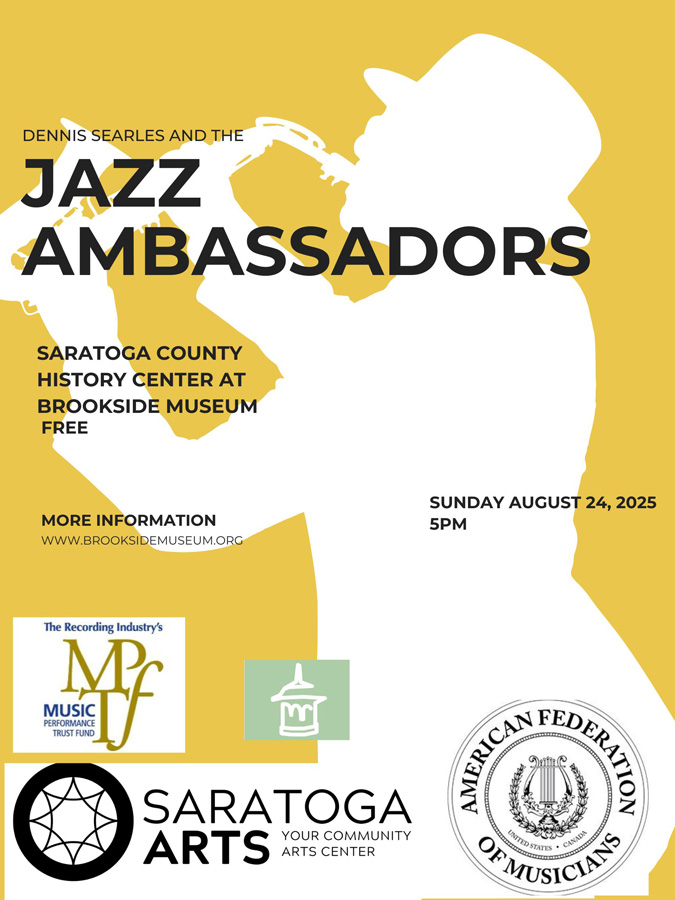
Sounds of Summer Concert II: Dennis Searles and the Jazz Ambassadors
Brookside Museum 21 Fairground Ave., Ballston Spa | 5 p.m. Join Dennis Searles and the Jazz Ambassadors for an evening of music and fun on the front lawn of Brookside Museum. This event is free and all are welcome. Attendees are encouraged to bring chairs and a picnic dinner to enjoy. This event is sponsored by Brookside Museum, Saratoga Arts, the Music Performance Trust Fund of the American Federation of Musicians and the Village of Ballston Spa Committee on the Arts. Rain date is scheduled for August 31.
Monday, August 25
Pickle for Ponies
Saratoga Springs Rec Center, 15 Vanderbilt Ave., Saratoga Springs | 4 – 7 p.m. Saratoga’s favorite summertime showdown is back. The fast-paced celebrity pickleball tournament, returns, bringing racing professionals and the local community together for a fun-filled evening benefiting Therapeutic Horses of Saratoga (THS) and the Permanently Disabled Jockeys Fund (PDJF). Racing fans and community members will have a rare opportunity to rally alongside some of the sport’s most accomplished figures as they trade their silks for sneakers in support of two meaningful causes. Tickets are $25 per person. To purchase player or spectator tickets, or to inquire about sponsorship opportunities, visit: thsaratoga.org/picklefortheponies.
Tuesday, August 26
2025 Grand, Gilded, and Glorious: A Saratoga Stroll Walking Tour Season
Saratoga Springs Heritage Area Visitor Center, 297 Broadway, Saratoga Springs | 10:30 – Noon. Participants will begin at the Saratoga Springs Visitor Center and stroll through historic Congress Park, concluding with a full tour of the elegant Canfield Casino, including admission to the Saratoga Springs History Museum (a $15 value). The tour takes place every Tuesday – Saturday, until October 18, rain or shine. Tickets are $25 Adults, $10 Youth (12–17) and Children under 12 free. Tickets can be reserved online at www.SaratogaSpringsVisitorCenter.com. For more information, call 518-587-3241.
The SHEratoga Trolly Tour
Saratoga Springs Visitor Center, 297 Broadway, Saratoga Springs | 11 – 11:45 a.m. A 45-minute trolley experience that brings Saratoga’s trailblazing women to life. Far beyond the city’s famed Revolutionary War legacy, Saratoga played a pivotal role in the “Bloodless Revolution” that ultimately granted American women the right to vote. Seats are limited. Experience the stories of the women who changed the nation, right here in Saratoga. Following the trolley experience, guests are invited to visit the Saratoga History Museum in Congress Park, featuring a special exhibit on Miriam Leslie and a rich collection of artifacts highlighting Saratoga’s role in the fight for women’s equality. For tickets and more information, visit https://www.saratogahistory.org/events/the- sheratoga-trolley-tour
Saratoga Summer Concert Series
Congress Park War Memorial, Saratoga Springs | 7 p.m. Rain location is the back covered patio at the Heritage Area Visitor Center, located at 297 Broadway, Saratoga Springs. A free, family-friendly concert series. Bring your blankets and chairs, find a spot on the lawn, and enjoy some of the area’s favorite performers. This week’s concert features Tops of Trees. With a sound built upon a strong foundation of drum and bass, classic organ, blistering vocals, and an unshakeable horn section, the band continues to thrill audiences with high energy performances and a modern interpretation of soulful music steeped in early R&B, funk and soul. For more information, contact the Saratoga Springs Heritage Area Visitor Center at 518-587-3241 or visit www.saratogaspringsvisitorcenter.com.
Wednesday, August 27
New Book Launch Rescheduled
Saratoga Farmers Market, Excelsior Ave., Saratoga Springs | 3 – 6 p.m. Native Saratogian and local author Elizabeth Macy is excited to announce the release of her fourth children’s book, Lucky’s Adventure: The Saratoga Rescue – the first chapter book in the beloved Lucky’s Adventures series, perfect for readers ages 7 – 11. Based on a true story that inspired the original picture book. Join us for the official book launch, part of the Kids Club series. A portion of book sales will benefit Lucky Puppy Rescue.
Meatloaf Dinner
Saratoga Wilton Elks Lodge, 1 Elks Lane, Saratoga Springs | 4:30 – 6 p.m. Take out only. Call Monday or Tuesday between 10 a.m. – Noon to place an order at 518-584-2585. Menu: meatloaf, mashed potatoes, vegetables, salad, roll, gravy. Dinner: $15 (cash only).
Photography Club
Galway Public Library Community Room, 2112 East Street, Galway | 6 p.m. This month Sandra Peters will present “Interpreting the Camera’s View: What Makes it Art?” Everyone is welcome to attend these relaxed and friendly gatherings. For more information, please contact Dave Waite at davewaitefinearts@gmail.com
Music in the Park
Gavin Park, 10 Lewis Dr., Saratoga Springs | 7 – 9 p.m. The Town of Wilton presents the 2025 Music in the Park. This week’s featured band is Nostalgia. Bring your lawn chairs or blankets, kick back, and enjoy some free, live music with friends, family, and neighbors. Whether you’re dancing or just soaking in the tunes, it’s the perfect way to enjoy a summer evening in Wilton!
Der Kleiner Klezmer Orchestra
Congregation Beth Shalom, 688 Clifton Park Center, Clifton Park | 7 p.m. The ensemble plays traditional klezmer music from the Jewish diaspora, early 20th century Yiddish theater music, and Israeli dance music. They draw on old recordings, out of print music collections, Yiddish theater compositions, and modern Israeli music to create a unique repertoire. Pre-registration is required and a $10 donation per person is requested at the door. To register, go to https://lp.constantcontactpages.com/sl/W41mqAQ/Klezmer and complete the requested information. For any questions, email us at sjca.sjcf@gmail.com.
Thursday, August 28
Concert in the Park
Old Iron Spring Park, 198 Front Street, Ballston Spa | 6 – 8 p.m. This week’s concert features Protones. This free, family-friendly event brings live music every Thursday evening from June 26 through August 28, offering a perfect way to enjoy the warm summer nights with friends and neighbors. Attendees are encouraged to bring blankets or lawn chairs for seating. Food concessions will be on-site, offering a variety of refreshments.