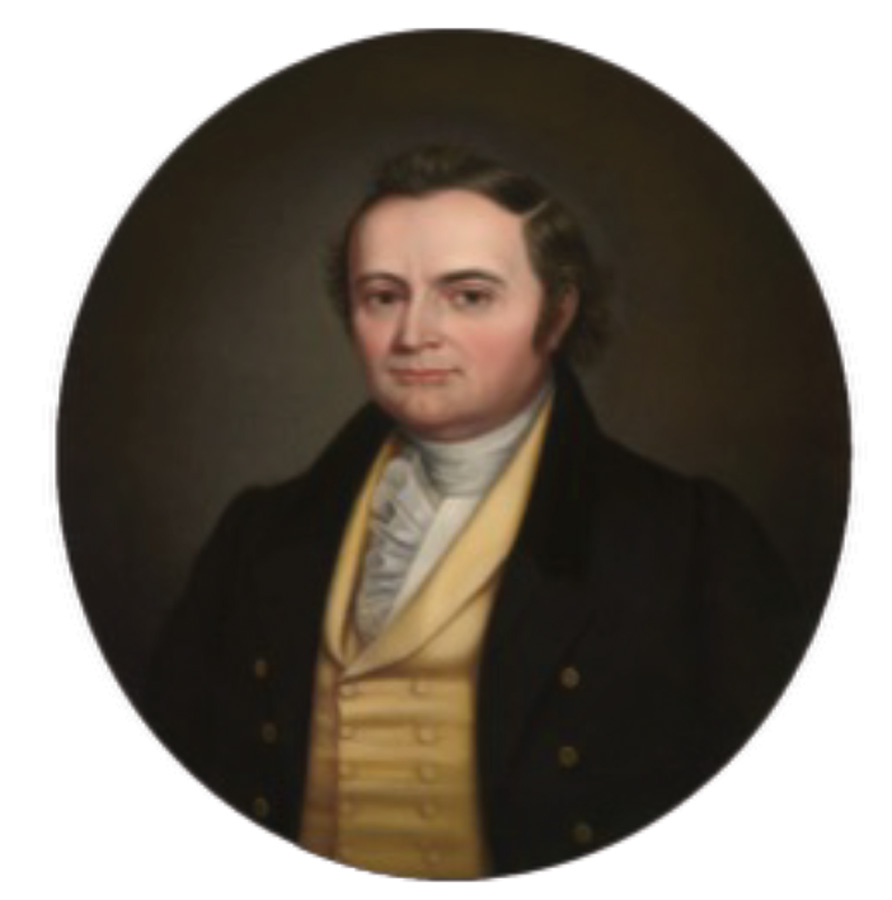
More Than a Guiding Force: The Life and Legacy of Lucretia Foot Booth

Lucretia Foot Booth was born in 1804 in Troy, NY, the only child of Ebenezer Foot and Betsey Colt Foot. She grew up in a household deeply committed to education. Betsey and Ebenezer wanted their daughter to have the best academic foundation possible. Lucretia inherited a dedication to learning and supporting educational equality for girls, ensuring they received a parallel education from those of their male counterparts. 

Her efforts mirrored her mother’s actions, whose vision for academic accessibility led to the charter created for the Union School for Girls in Albany, NY, which became The Albany Academy for Girls, when it opened in 1814—a pioneering seminary dedicated to offering young women the same academic opportunities as young men. Betsey recognized the significant disparities in academic opportunity and urged Ebenezer, a prominent lawyer, to create the school’s charter. Their shared belief was that “girls and women are not only deserving of higher education but fully capable of leading intellectually and socially engaged lives.” 

In the 19th century, the word seminary denotes institutions dedicated to higher learning for women, and is not based on religious education. Female seminaries focused on teaching young women subjects such as philosophy, science, arithmetic, and literature. Both the Foots and Colts were prominent in society, with the resources to pass on knowledge and prestige to their descendants. The Albany Institute of History & Art has a painting of Lucretia Foot as a child by an unknown artist, a testament to the social status of the family. 

The men in the families were educators, lawyers, and judges. Both families emigrated from England during the colonial period. The wealth and prestige of the Foots provided them with the ability to send their male children to study law or higher education. The generations of women before Betsey and Lucretia stood with their husbands, who also knew the importance of what their wife brought to their relationship, an uncommon relationship at the time. In 1821, Lucretia Foot married Lebbeus Booth, who would establish the Ballston Spa Female Seminary in 1824. Inspired by her mother’s unwavering commitment to education, Lucretia urged Lebbeus to open the seminary, ensuring that young women had access to the same academic instruction that she had. Though severely overlooked by history, Lucretia’s steadfast advocacy left a lasting mark, shaping opportunities for generations of young women. 

Despite her pivotal role, an article detailing the school’s founding credited only Lebbeus, noting that forty women were initially enrolled. However, both Lucretia and Lebbeus were actively involved in shaping the seminary, overseeing its operations, and developing its curriculum to provide students with a comprehensive education. 

Lebbeus Booth dedicated his career to education and public service in Saratoga County, contributing to both civic and religious institutions. A committed member of Christ Episcopal Church, he served as loan commissioner and later became County Superintendent of the Poor in 1844, working to support those in need. His leadership extended into financial and community organizations, holding the position of Vice President of the Ballston Spa National Bank and president of the Saratoga County Bible Society.

Lucretia and Lebbeus had twelve children, seven of whom died before entering adulthood. Elizabeth, their first child, and daughter, lived fifteen years. 

Their first-born son, Moss Kent, was a Commencement Orator. He moved back to Ballston Spa, where he lived for 30 years until his death. 

John Chester II established a private school in Cranesville, about two miles north of the village. He became a successful attorney and also had an interest in history, compiling a detailed account of Saratoga County—a work he completed two years before his death. John’s research was published posthumously when Edward F. Grose incorporated his history into Centennial History of the Village of Ballston Spa in 1907. John died at 28, leaving behind his wife, Margaret, and their two daughters, Ella and Mattie (Martha). Tragically, Mattie soon succumbed to diphtheria at age seven. 

Tragedy struck Lucretia’s family repeatedly. Infant son, Josiah Quincy, lived just over 8 months. Infant daughter Martha died at 3 months, but her namesake Martha II grew up and married Lindsley Seelye in 1852. Seelye’s family was one of the first citizens of Ballston Spa. Lindsley is credited to be a man of honor, prestige, and faith. Having suffered from consumption, the family spent the winters in New Orleans, and the rest of the year in Ballston Spa. Lindsley died young at 39, Martha lived on to 82. 

Infant daughters, Mary Lucretia, and Mary Lucretia II, both died before their second birthday. Young adult, Isabella “Belle” died at 17 from a contagious fever, while attending Troy Seminary. She was to be part of the graduating class of 1856. She never graduated. 

Daughter Lucretia married the Reverend George Washington Dean S.T.D. He was the chaplain and instructor of Latin and metaphysics in St. Agnes’ School, and alumni professor of the evidence of revealed religion in the General Theological Seminary in New York City. He founded the St. Stephen’s college at Annandale. For six years he was rector of Christ Church, Ballston Spa and later was rector of St. Stephen’s Church, at Schuylerville, until his death in 1880. Lucretia II died from pneumonia at 86.

Lucretia by following her mother’s influence, inspired her own dedication to educational equality. Both Betsey and Lucretia married men who believed their wives should be by their side, not one step behind them. Lebbeus died at 70 in 1859, with marasmus (malnutrition) cited as the cause of death. Lucretia lived another 13 years and died in Ballston Spa at the age of 67, in 1872. Lucretia and her family are buried in the Ballston Spa Village Cemetery, in the Booth family plot. 

Sources: Genealogical Memoirs of the Family of Colt and Coults

The Foote Family or the Descendants of Nathaniel Foote

The Railroad’s Impact on Corinth

Wood Pulp being transported to the Corinth Paper Mill

Travel through Corinth was difficult at best in the mid-nineteenth century. The Hudson River was navigable only a few months of the year. At a time when roads were rutted, muddy, or ice and snow covered, the railroad offered the best form of reliable transportation for passengers and goods. The Adirondack Railroad from Saratoga to Hadley was completed at the end of the Civil War in 1865. The rail system helped spur industrial development in the area with the advent of dependable transportation.

Trains transported heavy equipment of the newly established Hudson River Pulp and Paper Company to Corinth in 1869, and rolls of paper were sent to market. By 1874 over two tons of fine quality printing paper were produced annually. Unfortunately, the railroad was located a few miles away and freight had to be hauled by horse-drawn wagons to the Corinth station. By 1888, the company had constructed a branch line through the village to the upper part of the mill. This coincided with the expansion of the facility when five more paper machines were added. Pulpwood was also delivered by rail.

The railroad offered an efficient method of delivering mail to the area. The post office had begun using the Adirondack Rail system in 1869. Charles E. Cudney made the delivery to Corinth and Palmer Falls twice a day from the railroad station over 35 years by horse and later using his auto bus which also transported passengers to and from the station.

A variety of people and animals were transported into town by the rail system. In July 1904, the Sig Sautelle Circus came to Corinth, bringing along over 200 men and women. The attractions included clowns, cowboys, cowgirls, Indians, golden chariots, wild beasts, hundreds of horses, camels, a steam calliope, and an assortment of elephants. Clarence Flora had 1,000 baby chicks delivered by parcel post from a hatchery in New Jersey in the spring of 1927. 

Materials of all kinds arrived at the Corinth station. In 1930 an entire Aladdin House kit was delivered by rail into the village along Palmer Avenue. The partially prefabricated house was erected next to the Baptist Church to become the new parsonage. In 1905 a coal elevator was constructed near the IP spur line. Dennis O’Brien operated a coal business on Third Street and would have his coal deliveries come in by rail.

Passengers of all kinds rode the rails over the years for both business and pleasure. In the early 1890s a philosophical group called Theosophists came to Corinth to build a retreat on a 165-acre farm. They presented lectures about Karma and reincarnation that drew hundreds by rail to witness the outdoor programs. Organized by Christoph Maschmedt, who also purchased a store stocked with imported items, he travelled to New York City by rail to purchase his inventory. Mr. Maschmedt was eventually charged with fraud and made a final rail trip to New York City where he was arrested. All his property and stock were sold off to pay his creditors.

In September 1901 Vice President Theodore Roosevelt was enjoying hiking in the Adirondacks after taking the train up to North Creek. He knew that President McKinley was recovering from an assassination attempt five days earlier. An urgent message was telegraphed to North Creek telling Roosevelt to return to Washington, D.C, the president was dying. By the time Roosevelt reached the rail station the president was dead. Each station master along the way was instructed to offer any assistance necessary. 

Mike Burke was the station master at Corinth. When he heard the whistle from up the line he rushed to the platform, but the train passed the station and stopped about a mile down the line at Hadfield’s Switch to take on water for the steam engine. Mike ran down the line and as he approached the final Pullman car he heard someone yell “Halt”. It was Roosevelt’s guards with submachine guns in hand. Mike told the men he was the station master and had been instructed to help in any way necessary. The men replied, “We don’t need anything, just turn around and go back.” Mike did as he was told.

In 1910 a strike occurred at the paper mill after an employee was fired without explanation. Tensions had been strained since the company did not recognize the union that had been formed by the workers and refused to yield to its demands. Violence broke out and rail cars carrying strikebreakers were attacked and a trestle set fire. The New York State militia was sent in by rail to quell the uprising and escort the strikebreakers into the mill. After ten weeks the strikers agreed to return to work. 

The trains also brought summer visitors. In July and August 1905, carloads of 145 Fresh Air Children from New York City arrived at Corinth. The children then spent two weeks in the area enjoying the outdoors and country life.

The train also brought problems to the area. The engines emitted embers that created a fire hazard along the tracks, especially in the dry spring months. Ambrose C. Hickok, local fire warden, kept an account book. His entries of April 1905 show how frequently these fires occurred: April 8 – five acres burned, April 14 – 11 total acres, April 17 – 8 acres, April 18 – 5 1/2 acres, April 20 – 4 acres, and April 24 – 75 acres of pastures and meadows burned along the tracks.

Slowly the rail service in Corinth declined. A depot was built in South Corinth in 1880, but by the summer of 1924 the station agent position was eliminated and 1933 marked the last time the train stopped at that location. The Corinth station located on upper Hamilton Avenue (originally called Railroad Avenue) was constructed in 1865. A new passenger station was built in 1911 after local officials complained about the dilapidated conditions of the old depot. The station ceased operations in 1977. Passenger use on the railroad had diminished over the years. Competition from autobuses as well as individual automobiles cut back severely the number of passengers using the trains to the north country. Regular passenger service ceased on the line by 1956. International Paper continued to send and receive freight into the mill. But even that ended in 2002 when the paper mill that had been in operation for over 130 years shut down.

However, portions of the railroad still operate as a tourist attraction.  In 2006 the town of Corinth purchased the section of the railway from Saratoga Springs to the northern town line. The Upper Hudson River RR leased the line for a few years and later the Saratoga and North Creek Railway began scenic rides as well as special events until 2018. Three years ago, the Saratoga, Corinth, and Hudson Railway commenced 90-minute excursion runs from Corinth to Greenfield Center and back. Many special events are scheduled on the train, bringing thousands of people into the community. The SC&H has also restored locomotives and cars to put them back into operation – a true labor of love by their crew. The railroad still lives here, 160 years young.

This Week in History 


A photo of the train derailed during a railroad Strike in Ballston Lake (Courtesy of North East Rails)

Walking the streets of Saratoga Springs, it’s almost impossible not to notice the history all around you. 

From having one of the oldest sporting venues in the country to being next store to one of the most important battles in American history, the spa city is no stranger to influence and importance. 

It’s this history that inspired Saratoga TODAY to look back at some of the events and notable happenings that took place this week in history. 

Grant visits Saratoga Springs 

July 27, 1865, saw famed general and future president Ulysses S. Grant and his family visit Saratoga Springs briefly before traveling to Nova Scotia via Boston. According to media reports at the time, Grant — who was only three months removed from winning the Civil War — was met with cheering but mostly well-behaved crowds. While in the city, Grant attended parties at Congress Hall, Union Hall and Lake Saratoga. He reportedly left in the early hours of July 29 to avoid crowds of onlookers. Later that day, General Joeseph Hooker and Rueben Fenton would arrive in the city for vacations.

Child Abducted in Saratoga Found in New York City 

July 28, 1874 saw a child who was abducted from his father in Saratoga was found 12 years after he was kidnapped. The finding came after his abductor made a deathbed confession admitting to the kidnapping. Upon hearing the news, the father went to New York City to retrieve the now young man. 

Train Derailed as Part of Strike 

The night of July 31, 1910, saw eight rail workers purposefully derail a passenger train carrying 400 people in Ballston Lake. The derailment lead to the Sherriff to intervene in the strike and prevent further violence. Local reports indicate that the strikers were look for a 25 cent — about $8.50 today — increase in pay. The eight men were later caught and tried for the derailment. 

Flights between Saratoga and New York City Begin 

On July 27, 1929, it was announced that there would be regular flights between Saratoga Springs and New York City during track season to start July 29. The flights took place during track season and transported passengers via seaplane from Queens to Saratoga Springs with an additional stop in Lake George. Media reports said the schedule meant that someone could work in the morning, go to the track and be back in time for dinner. 

In addition, on July 31, a short-wave radio station between Roosevelt Field in New York City and Saratoga Springs was implemented to give pilots up-to-date weather information. 

Anti-Gambling advocates Home Bombed

On July 28, 1934, the home of Emma St. John was bombed by two men who reportedly broke the front windows of her home and tossed in the bombs. St. John was treated by a local doctor for shock. The bombing came after she had submitted a petition to then New York Governor Herbert Lehman to remove three county and city officials in Saratoga for failing to curb gambling in the city ahead of the race season. Lehman refused. 

John Brotherson was Late

A lot of things could be said about John Brotherson, but those who knew him well were unlikely to include “he would be late to his own funeral.” Yet in the middle of the day on October 17, 1887, a group of people waited patiently on a little knoll in Ballston Spa’s Village Cemetery, and he was nowhere to be found. 

John had passed away two days earlier at the home of Dr. Charles Inslee Pardee, a relative with whom he spent the winter months in his later years. His death was an unfortunate accident by asphyxiation, caused by John inadvertently leaving a gas valve on when he retired for the night.

At his passing at eighty-seven, John Brotherson was the senior member of the Saratoga County Bar and a practicing attorney for over fifty years. Brotherson’s career in law began in the city of Schenectady in 1821, and he practiced there until he ended his partnership with John Cochran in 1841 and relocated to Ballston Spa. During his years in Schenectady, he participated in that city’s debating club and served as the secretary of the Schenectady County Temperance Society. It was during his time in Schenectady that he published a book of interest to other attorneys, the Executors’ and Administrators’ Instructor, which contained the law and necessary forms related to the topics noted in its title. 

When he found time, John enjoyed the sport of fox and raccoon hunting. Considered an expert at the pursuit of fox, after old age prevented him from following the sport, the residents of Ballston Center noted a dramatic increase in intrusions into their hen houses by these predators. His knowledge of the sport even carried into his law cases, as in one where he represented a party whose hunting dog had been shot by a farmer when it entered a sheep yard while following a fox trail. Brotherson won the case with a judgment of fifty dollars for damages plus court costs against the defendant. 

Known to be tenacious when pressing his cause in the courthouse, his summations could sometimes be so abusive as to elicit an attack from his opponents. In one instance during a Schenectady court case in 1841, Lewis Peck, said to have been “goaded into madness,” threw off his overcoat and landed two or three blows on Brotherson. 

This willingness to win at all costs resulted in his pursuing cases that stretched over decades, the most notable being a lawsuit against Emmanuel Consalus to recover costs from several litigations. This suit, continued even after the death of Consalus in 1872, was noted in some obituaries as having been the sole focus of Brotherson’s legal work for the last fifteen years of his life. 

John Brotherson was born in Charlton in 1806. A lifelong bachelor, beyond his law career and fox hunting, one of his main interests was spiritualism. During his lifetime, spiritualism had found a considerable following in the village, with John as the leader in the local society. Other prominent members of the village who were involved in the society included mill owner Benjamin J. Barber and Samuel Hides of the Hides-Franklin Spring. 

Only this humorous story about John Brotherson’s personal involvement in spiritualism was ever recorded, published by the Weekly Saratogian on June 23, 1881:

Mr. B. is a firm believer in the Spiritualistic faith. While boarding with Mr. Brown on the hill, he was sitting one night at a basement window, which was even with the ground. Suddenly, he heard three or four thumps on the glass. John told the other inmates of the room to keep quiet, as he wished to converse with the spirits outside. He went into a trance and remained so for twenty minutes, and said he had a talk with a most beautiful creature. Upon going outside, Mr. Brown found two large sized toads flopping against the window in their efforts to catch flies that had been attracted there by the light inside. 

The most well-known account of spiritualism connected to Ballston Spa is that of Samuel Hides and the discovery of his famous spring. It was during a séance that the spirit of Benjamin Franklin was said to have told Hides that he would find an abundant mineral spring if he would only dig down 715 feet at a certain spot on his property. When the hole reached the predicted depth, a huge geyser shot high into the air and continued to provide a source of mineral water for years afterward as the Hides-Franklin Spring. 

The spiritualist society in Ballston Spa, which boasted at one time as many as eighty members, gained a prominent presence in the village in 1876 when society member Benjamin J. Barber erected a 200-seat meeting place on Bath Street that was named “Centennial Hall.” By Brotherson’s death in 1887, the building had fallen into disuse and became a storehouse for the American Hide and Leather Company.                                                                                                                                        

The remains of John Brotherson finally arrived in Ballston Spa on the six p.m. train and were met by his relatives and a large group of friends. His interment was held the same evening in the Ballston Spa Village Cemetery by the aid of lamps and lanterns, which presented a “weird and impressive scene,” according to the October 18th Albany Argus. Members of the Saratoga County Bar at Ballston were the pallbearers at the funeral. The services were conducted by Rev. Brooke Gwathmey White, a Protestant Episcopal minister from Jacksonville, Florida, who was in the area visiting friends.  

Two weeks later, on the evening of October 30, 1887, Christian Science founder Mary Baker Eddy held a “conversation” with John Brotherson open to the public at the Saratoga Springs town hall. The results of this conversation with John’s spirit were never revealed.                                                                                                   

In 1903, John Brotherson’s stepsister, Mrs. Anna Attocha, erected a 25-foot-tall monument on the Ballston Spa Village Cemetery Brotherson Plot in memory of her brother. Also buried in the 

Brotherson Plot is John’s sister Eliza, his stepmother Alice Odell Brotherson, and his stepsisters Aleta & Sarah. Anna would be laid to rest in this plot the year after the monument was erected.

Finders, Keepers

A genuine “Gold Rush” occurred in Saratoga Springs in the summer of 1932, outside of the seasonal dash to the race track and roadhouses. During the construction of Saratoga Spa State Park gold and silver were discovered, however not in the form of bulk bullion, but in minted coins.

Architectural work for the development of the Saratoga Spa at the geysers was spread among three different architects in an effort to complete the entire project within two years. Dwight Baum of New York City was awarded the work on the recreation group of golf clubhouse and Victoria swimming pool along with the bottling plant, with Marcus T. Reynolds of Albany designing the Gideon Putnam Hotel. Joseph H. Freedlander of New York planned the administration building, bath houses, laboratory and the Hall of Springs. 

These construction jobs provided much needed work during the Great Depression, which held the nation in economic grips, and would also return the flow to the mineral springs which had been depleted by commercial exploitation.

The site selected for the Hall of Springs had earlier belonged to Lyman F. Pettee, who was the president of the Geysers Natural Carbonic Acid Gas Company, one of the operations utilizing the springs for profitmaking marketability. Lyman and his wife Mary had a large 12-room summer home in this vicinity and their son, Harry E. Pettee, would become the Mayor of Saratoga Springs (1918-1919), and president of the successor corporation, General Carbonic Gas Company. Mary Pettee was remembered as someone who engendered old world notions and sensibilities and did not trust financial institutions, preferring to hide her savings in various vessels in the basement of their geyser area home. New York State acquired the Pettee Cottage, from General Carbonic Gas in April 1912 for reservation purposes.

During July 1932 major events had taken place nationally and globally. In Germany, discontent and hardship, fostered by the punishing conditions of the Treaty of Versailles, led to the Nazi Party gaining a voting majority in the Reichstag. In Chicago, New York Governor Franklin D. Roosevelt was nominated by his party as their candidate for President. Governor Roosevelt, who had been instrumental in constructing Spa State Park, promised a “New Deal” for citizens, and abolition of the laws prohibiting the sale of alcohol. The nominating convention had concluded to the strains of the song, “Happy Days Are Here Again,” a spirited and hopeful tune.

Locally during high-July, a five dollar gold piece was found at the construction site, and the windfall created a sensation. A few days later three workmen employed by the Lowe Construction company of Schenectady, which had the contract for the excavation and foundation work for the Hall of Springs, ran across a number of $20 gold pieces. This ignited a passionate excitement, with the prospect of striking rapid wealth, and word spread quickly and contagiously.

The July 26, 1932 Saratogian reported,

“A genuine gold rush of truly amazing proportions overwhelmed Saratoga Springs last night and today. Early this morning hundreds of amateur, but none the less earnest, prospectors, armed with pickaxes, shovels and improvised sieves, had taken upwards of a thousand dollars in gold and silver coin from a mound of loosely piled earth a few feet south of the foundation site of the new Hall of Springs in Geyser Park. The rush of the modern Forty-Niners started late yesterday afternoon.” The article continued, “Richard O’Brien, state engineer in charge of the construction work at The Geysers, said today that the earth which bore the pay lode had already been turned over four times when the rush started. It was originally removed from the site of the Hall of Springs in excavating, dumped in a mound a few feet south of the location, brought back to the original site for filling and finally returned to the spot where prospectors were still feverishly digging and sifting this afternoon.”

It was mentioned that the money was found in milk bottles, canning jars, and tin cans in the soil, and that prospectors worked through the night, aided by lanterns and flashlights, many humming the newly popular tune “Happy Days Are Here Again.” 

The gold and silver coins were in varied denominations ranging up to twenty dollar pieces, and most of the durable legal tender was minted in the early 1880’s, the newest coin bearing the date of 1890. The Saratogian reporter continued,

“The sweat poured from their fevered brows in the heat of the merciless sun. But at noon today it appeared that the lode was almost exhausted although workers continued to pick up dimes, quarters and an occasional half or silver dollar. Many, however, kept on grimly, hopeful that another large strike might be unearthed. Some even expressed the opinion that the pay lode had hardly been touched as yet, and that much larger amounts would be found eventually. The “gold fever” was strong upon every man, woman and child who sought the money. “There is no fooling about this Klondike fever,” one of the searchers said, “when you are pawing over that dirt, and something shines, you start to tremble all over. It’s worse than buck fever ever was.” It was well-nigh impossible to secure the names of the lucky finders or to get them to divulge the amounts they had taken out of the earth. For it became immediately apparent that the question of legal ownership of the buried sums might prove disastrous to the interests of the prospectors.”

Indeed that proved to be the case as Attorney General John J. Bennett, when the matter was brought to his attention in Albany, directed that the state police put a stop to the mining operations on the grounds, as treasure found on state property belongs either to the state, or to the owner of the property prior to its acquisition, thus suspending succeeding searches seeking sovereigns.

Legacy in the Ashes: Victory Mill History Lives On

On June 2, 2025, excavators rolled onto a quiet stretch of Fish Creek to begin dismantling the remains of Victory Mill, the five-story concrete giant that has towered over the Village of Victory since 1918. The demolition comes just days after a devastating fire on May 31, which gutted the long-dormant factory and ended the physical presence of a structure that once defined the rhythm of life here.

But as brick crumbles and beams fall, the story of the mill—and the people who built their lives around it—remains firmly intact.

Victory owes its name to the American triumph in the Battles of Saratoga, culminating in the complete surrender of British General John Burgoyne’s army on October 17, 1777. It was a moment that shifted the trajectory of the Revolutionary War and gave the young nation a new hope. The land along Fish Creek, where Victory Mill would later rise, had already been partly industrialized by General Philip Schuyler, who built an upper sawmill and dam on Lot No. 5 as early as 1768.

After the war, Schuyler’s descendants developed and sold parcels along the creek. By 1828, his grandson, Philip Schuyler II, opened the Horicon Mill—a water-powered cotton factory that began Victory’s industrial identity. The Panic of 1837 eventually forced the sale of the property, opening the door for corporate investment.

In 1846, work began on the first Victory Mill: a three-story brick textile plant designed to take full advantage of Fish Creek’s nearly 100-foot drop. That same year, company housing began to rise, and the village’s population surged. Victory was incorporated in 1849.

By 1850, the Victory Manufacturing Company employed 369 workers—160 men and 209 women—and operated 309 looms. By the 1870s, the workforce had expanded to 550, producing over two million yards of fabric annually. The factory consumed more than 2,000 bales of cotton each year, and Victory’s fate became bound to the rhythms of the industry: whistle blows, shift changes, and rail deliveries tied it to national markets.

Yet the mill was more than a workplace. It was the heart of a company town. A four-room schoolhouse opened in 1872 and served local children for over 80 years. The company supported churches, built a community house, and created a tight-knit village shaped by labor and mutual reliance. Workers, many of them Irish immigrants, built families and traditions rooted in shared work and faith.

The late 19th century brought upheaval. Labor unrest—including strikes in 1876 and 1879—coincided with national downturns like the Panic of 1873. By the 1880s, poor management and leadership instability led to inconsistent operations. A brief resurgence came in 1910 when the American Manufacturing Company of Brooklyn acquired the site and redirected it toward rope and cordage production. With that shift came a monumental physical transformation: the five-story concrete mill and hydroelectric plant construction completed in 1918. A new community house and casino followed, offering recreation and support to workers.

Still, global forces intervened. In 1921, bag-making operations moved to India. By 1928, facing pressure from rising costs and Southern competition, the company began relocating machinery to Alabama. That fall, 328 carloads of equipment left Victory. Local production halved, and by September 1929, all spinning, carding, and weaving had ceased.

A new chapter began in 1937 when United Board and Carton repurposed the site for cardboard manufacturing. Through changing ownerships—Wheelabrator-Frye, Clevepak, and finally Victory Specialty Packaging—the mill operated into the 1980s. It closed in 2000, ending over 150 years of continuous industry on Fish Creek.

The concrete shell stood for the next two decades—weathered but resolute. In 2008, the site was nominated to the National Register of Historic Places, recognizing its architectural presence and economic impact. Redevelopment plans emerged but never secured funding. And then, on May 31, the fire.

Smoke rolled across the creek as more than 100 firefighters from Schuylerville, Greenwich, Easton, Quaker Springs, Middle Falls, and beyond battled the flames. Residents brought food. Some watched silently, others in tears. The mill was a ruin, but for many, it was also a relative—a place where grandparents worked, where birthdays were celebrated in the community house, where lives were stitched together over generations.

As demolition crews began their work, the sounds of machinery were less jarring than expected. They seemed almost like an echo—one last call from the mill whistle that once shaped daily life in the village—a final signal, not of labor beginning or ending, but of an era passing.

Yes, Victory Mill was just a building. But it raised families. It gave people their first paychecks, homes, and a sense of pride. And that doesn’t burn away.

The Village of Victory may now face an open space where a factory once stood. However, it still holds something more critical: memory, continuity, and a legacy woven into the soul of Saratoga County.

History doesn’t disappear with demolition. It endures in archives, family stories, the deep curve of Fish Creek, and the firehouses and homes that still carry the name Victory.

The Greenfield Town Hall’s Remarkable Heritage

During the First World War, banker, broker and sportsman E. Clarence Jones, who resided in Manhattan (in a brownstone which occupied the site of the present One57 Tower, Central Park South), purchased property on high ground just north of the Saratoga Springs corporate line, in Greenfield.  Mr. Jones constructed an estate which included multiple buildings, marvelously linked through a series of gardens. The main building was known as Broadview Lodge, and construction took place during 1917-18.

The planning of the Jones Estate occurred while the country was at war with the Central Powers of Europe. Perhaps this type of extravagance which naturally entailed a very large workforce, taking place during wartime with soldiers in the field, or the relatively small size of the community with limited media resources, explains the dearth of primary source material regarding construction details of Mr. Jones’ structures.

E. Clarence Jones hired the prominent New York Architect, Aymar Embury, to design his summer place to be, which continues into our time as the Surrey-Williamson Inn operated by Skidmore. Aymar Embury would become one of the country’s most noted architects, and he left a few notable landmarks in Saratoga County.  The planning process introduced Mr. Jones to many residents and he developed an appreciation for his neighbors and officials in the Town of Greenfield, and presented them with a new Town Hall Building, which he had his architect, Aymar Embury design.

Aymar Embury served as a captain with the 40th Engineers of the United States Army during the conflict. Architect Embury, with his developed appreciation of aesthetics, was called upon to design the Distinguished Service Cross, which was established by the US Army in 1918 to honor heroism of the highest degree, which remains our Nation’s second highest military award. Mr. Embury needed to step away from his normal duties when he went to Europe to join the Allies with the American Expeditionary Forces, and left completion of his Saratoga projects to his capable associate Lewis E. Welsh, and his future wife, Landscape Architect Ruth Dean.

I find it fascinating that the benevolence of E. Clarence Jones, a visitor and summer resident of Saratoga, would provide the Town of Greenfield with a new Town Hall Building, for which he covered the total expense for construction and design by world famous architects. A remarkable example of good citizenship, which residents of Greenfield today might call upon.

An Overview of Early Saratoga Religious Communities

Throughout Saratoga County’s long history, many religious and spiritual communities have called our home their home, with the land even being sacred to some. This article will highlight the founding of several of Saratoga County’s religious communities through the 19th century, with a focus on Saratoga Springs.

Today, diverse people of faith have joined those long established denominations to call Saratoga home, including Jewish communities, several Indigenous Cultural Revival Movements, and a Mosque, Masjid Al-Arqam in Halfmoon. All of them play important roles in the Saratoga Community. 

We must begin with the first religions in what is now Saratoga County. The Mohawk branch of the Haudenosaunee (Iroquois) Confederacy maintains a long-lasting presence here, and they primarily follow The Great Law of Peace (Gayanashagowa). The Great Law functions as a sort of constitution. According to legend, it stems from the Great Peacemaker Tekanawí:ta, who traveled among six warring nations and preached a message of cooperation. This eventually led to their coalescing into one Confederacy, with a unique system of government which mirrors representative democracy. This has led some scholars to point to it as a possible influence on the U.S. Constitution, which was later acknowledged by Congress in 1988. There are some supernatural elements in Tekanawí:ta’s story: he was born to a virgin mother, and sailed from the far north on a canoe made of white stone. It is important to remember that religion comes in many forms. This one served as the foundation for an enduring political system.

The earliest Europeans in the region were French Catholic missionaries and traders on their way to and from Quebec, marking the beginning of a Christian presence here. Their attempts to convert the native Mohawks were unsuccessful and often violent. An exception would be St. Kateri Tekakwitha, a Mohawk woman who secretly studied and converted to Catholicism. She is the first indigenous woman of North America to be canonized by the Catholic Church and has become a symbol for both regional Catholics and Indigenous ones across the continent. Despite limited success in converting the natives, a few French missionaries settled on the foothills of the Adirondacks, becoming the region’s first permanent Catholic residents.

Before the American Revolution, Dutch families settled along the Hudson River, bringing the Dutch Reformed Church with them. Today several of these congregations still exist along the eastern and southern borders of the county from Bacon Hill to Vischer Ferry.

As more settlers migrated from New England to Saratoga County (which was considered part of Albany County at the time) they brought their religion with them. In 1769, Eliphalet Ball, a Presbyterian preacher from Bedford, New York on the Connecticut border arrived with members of his congregation. He was an advocate of the New Light movement inspired by the First Great Awakening, which emphasized personal relationships with God and rejected established church power structures. Its less centralized spiritual message heavily resonated with frontier communities. Ball founded the first Presbyterian church in the southwest corner of his farm in 1775, and the town of Ballston came to be named after him.

With the onset of the Second Great Awakening in the early 19th century, upstate New York became known as “the Burned-over District” because of the sheer emotion and energy of Protestant religious activity. This religious fervor along with population growth inspired by the construction of the Erie Canal and railroads lead to a steady rise in Church membership. In 1805, Saratoga County saw its first Anglican Church in Ballston. In 1816, a new Presbyterian Church was founded in Saratoga Springs. Abijah Blanchard was its first ordained deacon, and Darius Oliver Griswold became Reverend in 1822. Although Presbyterians were not newcomers, they gained many converts and formed new congregations. Other Christian denominations which put down local roots during the Second Great Awakening included Baptists, using land gifted by Gideon Putnam, and the Quakers, who would invite Frederick Douglass to speak in 1849.

Starting in 1815, the fledgling Catholic community was bolstered by a wave of French and Irish immigrants. Most were seeking jobs during the summer season, as Saratoga Springs became a popular tourist destination for wealthy Americans and Europeans. At first, they met in town under the leadership of traveling priests, but not long after the Saratoga and Schenectady railroad opened, the Church of St. Peter was founded in 1839, a permanent Parish for a growing congregation. With the arrival of more Catholics, primarily Italian and Irish immigrants, another parish became necessary. St. Clement’s opened in 1917 after the Albany Diocese approved its establishment.

The Saratoga Racetrack opened in 1863, drawing additional ethnic groups into the city. As the African American community grew in mid-century seeking employment in the large hotels, the Dyer-Phelps Memorial AME Zion congregation was founded in 1862. Since then, it has been joined by the Mt. Olivet Baptist church and the Soul Saving Station Church of Saratoga Springs.

Sadly, these new arrivals were not always welcomed in the community. In 1853, a woman who local newspapers dubbed “Miss Lamb” was attempting to convert to Catholicism. In an effort to prevent this, three Episcopal priests kidnapped her. Eventually she escaped and fled to Albany, where she finished her conversion.

Jewish newcomers began arriving in the early 20th century, as Jews from Eastern Europe immigrated to the U.S. en masse. A particularly egregious example of discrimination was the Seligman Affair. In 1877, Jewish banker and founder of J. & W. Seligman & Co. Joseph Seliman was denied a stay in Saratoga Springs’ Grand Union Hotel because he was Jewish. This social antisemitism may have faded by the 1960s, but at that time it was very real.

Saratoga County is home to many faiths, and there will no doubt be more religious choices available as time goes on. While tensions will sometimes arise, if we respect our differences and work together to build a better community, we will be stronger for it.

Mechanicville’s 1919 School Fire


Mechanicville School No. 1
Photo provided by The Saratoga County History Roundtable.

It was a very calm night.  No wind was blowing and the ground was free of ice and snow and the moon was shining brightly.  It was a beautiful winter’s night, with no hint of tragedy.  Communicants of the First Methodist Church and the Presbyterian Church were meeting for special entertainment.

At the Music Hall on Park Avenue, a dance was in progress.  In the basement of St. Luke’s Episcopal Church, a few yards north of School One, members of the Mechanicville Retail Grocers’ Association were just sitting down to their banquet.  The calendar said February 17, 1919, and the clock in the basement said 7:45 p.m.   Forty-five minutes before, the School One clock had sounded seven.

In the new high school, adjacent to St. Luke’s church, the Mechanicville basketball team known as the Halfmoons were handing the Troy Arsenal a drubbing by the score of 24-16 when someone rushed into the gym balcony and shouted “School One is burning!”

Hal Sheehan, Mechanicville’s well-known newspaper columnist who for years recorded and recounted some of the most fascinating happenings in the history of our communities, gave us a vivid picture of what happened on that February night one hundred and two years ago. He recounted this tragic event in several of his columns, Down Our Way, in the Saratogian, in 1969 and again in his column Over Mechanicville Way in the Gazette in 1984, as well as brief mentions in others.

The school building was Mechanicville’s first high school and was built in 1888. Its first class graduated in 1892, a class consisting of six young ladies. It had twelve large classrooms on three stories, as well as a library and a board of education meeting room in the basement.  Atop what Hal calls the “ugly” mansard roof was the pride of the community . . . a tower with a large clock and a 1457-pound bell that rang the hour of the day and night faithfully for 31 years.

As the community of Mechanicville grew, a new, larger high school building was built on the other side of St. Luke’s church and rectory in 1915, and the original building became an elementary school dubbed School One.

On that February night, Sheehan tells us, the Reverend James A. Tappe, rector of St. Luke’s, looked out his window, only a few yards from the school building, at about 7:45 and saw flames shooting up from the basement. He sounded the alarm from a fire box in front of the church, and the Mechanicville Fire Department raced to the scene. 

Firemen had to deal with no pressure in the hydrants,  but soon got their pumpers into action. Seeing the magnanimity of the blaze, they brought in their ancient steamer and put it in action to reach the top floors. One of their big concerns was of the roaring flames spreading to the rectory of the church as well as the Mead home on the south side of the school. The school had wooden ceilings, wooden staircases and oiled birchwood floors and quickly became a roaring furnace. 

At 8:57, the mansard roof collapsed into the basement. Three minutes later, at exactly nine o’clock, the bell chimed nine times and then the clock and bell plummeted 60 feet from the tower into the basement.  The fire would not be controlled until 11 p.m., but continued to smolder all night and the next day as 50 tons of coal stored in the basement burned. By morning light, nothing remained of the school but windowless walls and three chimneys towering above the rubble.

Lost in the conflagration were a thousand library books as well as the textbooks of the school’s 550 students. The flag, which had not been taken down that night, also burned.

City residents wept as they watched the blaze consume the school of which they were so proud. The loss of the clock and the bell were particularly lamented, especially since it had rung just a few months earlier on November 11, 1918 to proclaim the end of the Great War. Many demanded that the bell be retrieved from the wreckage and used again on a new school building. Sadly, the damaged bell was eventually auctioned off, and the high bidder was the Meneely Bell Company of Troy which ironically had crafted the bell some 32 years earlier.

While the students were relocated to many locations throughout the city until a new School One could be built, in a later column, Hal noted an interesting side note to the fire.  It seems that an annual occurrence was the migration of chimney swallows who flew into Mechanicville every year on May 15. They always made their home in the ventilating chimney at the rear of the school.  Observers had noted that there were about 200 of those swallows living at the school in the previous September when they had left town and headed south on the 15th of that month. 

Said Hal, “When the fire destroyed the school building and left only skeleton chimneys standing, the swallows must have gotten the message, for they never returned.”

Rowland’s Hollow: A Lost Crossroads


Rowland’s Hollow – Yesterday and Today. Photo provided by The Saratoga County History Roundtable.

Saratoga County has seen 9 generations come and go in the almost 235 years since it was carved out from Albany County in 1791. Settlers moved in, established farms, mills, and small communities. Several of these communities have become villages, cities and suburban towns. Others have remained hamlets and become known as Forgotten Crossroads – still vibrant communities with a rich history of memories. Still others have disappeared altogether, no longer visible or remembered.  They have become Lost Crossroads.

Rowland’s Hollow, also known as Rowland’s Mills, was one of those crossroads, a center of economic activity in its heyday. Now gone but should not be forgotten. In 1878, Nathaniel Sylvester in his History of Saratoga County describes it as follows.

This hamlet is on the eastern line of Milton, and not far from the village of Saratoga Springs. The place is named for H.R. Rowland, the proprietor of the saw-and grist-mills that are situated upon one of the branches of the Kayadrossera. Southeast of the mills there are also stone-works. Prince Wing resides at Rowland’s Mills, and is very extensively engaged in milling, burning lime, and farming. In these occupations he employs a large number of persons. Prince Wing is a native of the town of Greenfield, his father having settled there at an early date.

Sylvester gives credit to two of the most well-known entrepreneurs responsible for the development of Rowland’s Hollow. But where did they come from? And how was it that they were able to obtain the resources to develop these mills? Sylvester hints at an important aspect of the development of Rowland’s Hollow and that is, it did not begin with these men. They were following in the footsteps of their parents and grandparents who first settled in this area years before the first dam was built to contain the first mill pond.

Isaac Rowland migrated from Pittstown, Rensselaer County with his father Oliver and brother Robert in 1802 soon after the birth of his son Hiram. Isaac began accumulating several pieces of land, beginning with the purchase at auction of property of his father, seized for non-payment of debt in 1805. Oliver died in 1810, but son Isaac continued to add to his landholdings. Two purchases were in the 9th lot of the 16th allotment of the Kayderosseras Patent. It was in this area that Rowland’s Mills began to take shape, midway along Rowland Street between today’s Geyser Road and Rt 29.  By 1824 the mills were already in place along the creek, as Isaac parlayed his land acquisitions into successful business enterprises.

By this time Isaac had considerable influence in the community in addition to his business interests. In 1823 he became a subscriber to the newly formed Saratoga County Bank,[i] and his involvement in banking continued – Isaac was one of the original stockholders when Ballston Spa National Bank was formed in 1839, and served as a bank director from 1840-1845. Both his sons, Isaac and Hiram, followed their father in industrial pursuits.  Isaac, Jr partnered with Chauncey Kilmer to erect a paper mill in Rock City Falls in 1840. Hiram worked alongside his father in Rowland’s Hollow, eventually taking over the family’s mills.

Three miles north of Rowland’s Mills another family had settled into the adjoining Town of Greenfield. Prince Wing – grandfather of the quarryman and mill owner- moved to Greenfield in 1786, becoming one of the first settlers in the town. He purchased property and built his home and farm on what is now Wing Road. Grandson Prince, who was to play an important role in the development of Rowland’s Hollow, was born in 1806, and following in the footsteps of his father and grandfather, continued the family’s agricultural tradition. His involvement in Rowland’s Hollow was to come later, after the mills had been operating for many years.

The death of Isaac, Sr in 1857 had a significant impact on the  inhabitants of Rowland’s Hollow.  He was their patriarch. The Beer’s map of 1866 gives us a good snapshot of Rowland’s Hollow as the next generation took over. Hiram Rowland is prominently listed along with his sawmill and gristmill at the junction of the road and the creek. By this time Hiram was 70 years old, and he apparently sold this mill to Prince Wing, who one year later owned the gristmill, expanding his business interests in the Hollow where he also operated the stone quarry and lime kiln.

Wing may have been the owner, but the day-to-day operations were left to others. Joe Parmatier ran the gristmill throughout this period. He lived in the old stone house across the street from the gristmill.  Patrick Leonard was the foreman for Wing’s quarry.

With all the focus on the sawmill and gristmill, it was the limestone rock itself that became the lifeblood of the Hollow in the period after the Civil War. The demand for limestone was high.  It was processed in Wing’s lime kiln and used within the Hollow itself at Isaac Wager’s plaster mill where it was ground for use by the many farms in the area. The products of the Rowland Hollow quarry were also used to construct homes, churches and commercial buildings throughout the Saratoga and Ballston area.  This vibrant community included stonecutters, millworkers, blacksmiths and lime burners whose children attended a small one room schoolhouse on the corner of Rowland Street and Grand Avenue.

The few photos we have today from the last quarter of the 19th century show a small bustling complex of mills, homes and bridges, many constructed using the Hollow’s limestone.  These images represent the second generation of Rowland’s Hollow, the first having given way as wood gives away to stone.

But this heyday was not destined to last. Soon after the turn of the century, the demand for limestone declined, as the plaster mill closed and paper manufacturers turned from straw to wood in their operations. The families that had been supported by the stonecutters and mill workers moved away, and Rowland’s Hollow was abandoned.

The limestone buildings could have, should have, lived on. But they did not.  We are fortunate to have views of the Hollow as it existed in the 1930’s, long after the mills had been abandoned. Even then the buildings were in ruins. Over the years since, the buildings have disappeared, the limestone repurposed for other uses in the local area.

Today it is even harder to uncover the vestiges of the Hollow. Cars and quarry trucks race along Rowland Street. If you look quick you might catch a glimpse of the northeast corner of the stone grist mill, standing 30 feet tall. One wonders why even this remains. How many of us drive along roads in Saratoga County, passing by similar spots, unaware of the life that used to be in these Lost Crossroads?