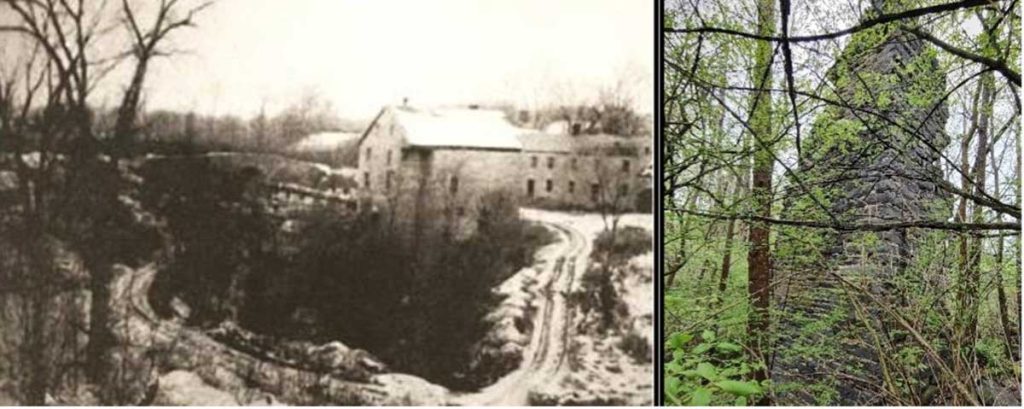
Dawson’s Mill – Charlton’s Last Gristmill 

Local historian W. Bronson Taylor once observed that the three essentials of the early pioneers of Western Saratoga County were “a grist mill, a sawmill, and whiskey still.” While there is little mention of stills, Taylor’s point about the mills is borne out in historical records time and time again. In the town of Charlton, one of these early mills was built by William Dawson on the Crabb Kill, not far above where it enters the Alplaus Kill Creek. Brought into operation as early as 1785, mills would run on this property for the next 120 years. 

William Dawson was born in England in 1762. It was in the English village of Lanchester that he married Jennet Monteith and where in 1780 they had their first son, John. During the next four years, they emigrated to America and purchased property along the Alplaus Kill Creek. Soon after arriving, they had another son, William, followed by James in 1787, and a daughter named Jane two years later. 

The home that William built for his family was a 22 by 34-foot structure built in the saltbox design. While over the years this building was moved and repurposed, as late as 1959 part of it was still standing and being used as a barn. Along with their home, William also built a sawmill and the other necessary outbuildings for the farm. 

When William died in 1822, control of the mill was passed on to his oldest son, 42-year-old John Sr., and after his passing in 1853, John Dawson, Jr. took over management of the mill. In 1858, he began making plans to enlarge his milling business, leaving the original mill site on the Crabbe Kill, and rebuilding further downstream on the Alplaus Kill. 

In the Autumn of 1859, Barrett’s Mill, located just South of the Dawson Mill, burned to the ground. Evidence at the scene pointed clearly to arson as the cause. Without local authorities investigating, the neighboring farmers began collecting clues. One of the most visible was a set of footprints coming from the Dawson homestead. Even more incriminating were the prints themselves, as ones showing an out-turned foot were quickly identified as being that of John Dawson, Jr.’s twenty-three-year-old son Simon. On October 20th, the Lansingburgh Democrat gave this report of the incident:

John, Jr. and Simon Dawson, father, and son, mill owners in Schenectady, are held there on a charge of firing a grist mill run by another party. The evidence is very flimsy and consists only of known business rivalry, and the footprints found around the building where the fire was kindled corresponded with those made by their boots. 

John was released within a couple of weeks, with Simon being held for trial. Though ultimately found innocent, Simon was not let off as easily by some members of the community. Tired of harassment from his neighbors, in the 1860’s he moved West with his wife and children, finally settling in Kansas where he passed away in 1908. With Simon gone, John Jr.’s son George Harmon Dawson stepped in to work beside his father in the family business.

This was not the end of the story, as in that close-knit community many knew that someone was patiently waiting for an opportunity for revenge. That chance came in the fall of 1869, nine years after the Barrett Mill fire, when on the very weekend that the Dawson Mill insurance policy expired a fire was discovered in the grist mill’s stairwell. With the smell of kerosene filling the air, the Dawsons tried in vain to extinguish the flames. Years later, a man on his deathbed confessed to torching the Barrett Mill after being refused credit for a bushel of corn. 

John Jr. and his son George soon began the work of rebuilding their milling business. To expedite the process an existing mill was brought in from a farm in Schenectady that is now part of the General Electric complex and set up below where the Crabb Kill and Alplaus Kill merged. One account of the move noted that it took only three weeks to get the building moved and the mill again in operation. 

In the spring of 1875, while working in this sawmill, John Jr. slipped in front of the blade and had his foot cut off. His severed appendage then flew free of the saw, landed in the millrace, and was washed down into the stream. Those nearby helped stop the bleeding and he was quickly taken to a doctor. It is part of local lore that some morbid individuals spent time searching for John’s foot, with someone finally succeeding in locating the severed limb. 

After losing his foot, John no longer worked in the mill and instead set up a cobbler’s shop on the mill’s second floor. Here he continued in that trade until he died in 1889. The mill was converted to a gristmill after the accident with George taking over management. After operating the mill for the next thirty-two years, George Harmon Dawson passed away in October of 1907. At that time his 29-year-old son, Burton, who went by the name of Bert, who was then working as a brakeman on the railroad, took over management of the mill.

Bert continued to work away from the mill, leaving the day-to-day operation to others. In December of 1911, William Barnett, who had been running the grist mill for Bert, broke his leg in two places when it was caught in machinery in the mill. A year after this accident, W. Bronson Taylor acquired the mill property from Bert Dawson, with the Dawson family moving to Scotia and Bert taking employment as a machinist at General Electric.

Bronson Taylor, in later years known as the “Miller of the Alplaus,” was the last person to operate a mill on the Alplaus Kill Creek and ended its operation in 1941. At that time, Taylor removed the iron from the mill for scrap to support the WWI war effort, and finally in the 1960s sold most of the grist-mill machinery to the Cromie brothers of Charlton.  

Not Mr. Smith… but Burnt Hills-Ballston Lake School Seniors go to Washington


Sponsored byThe Saratoga County History Roundtable
Contact The Saratoga County History Roundtable at: saratogacohistoryroundtable@gmail.com

It must have been quite an experience. The anticipation in Senior Year must have been quite exhilarating. Yes, a group of rural American kids going to the big cities for a vacation, a trip, an experience, an adventure. Yes, Burnt Hills-Ballston Lake Central School District’s Senior class was going to Washington DC, 400 miles south.

This all doesn’t sound like such a big deal in our America in this time but, for up to 100 years ago, it WAS a big deal. And all experienced by young people from the Burnt Hills and Ballston Lake communities, all seniors at Burnt Hills-Ballston Lake Central School.

It all started in 1927.  The inaugural trip. It was actually in March 1926 that the junior class started making plans to take a trip to Washington DC as a class.  There were approximately 40 people in the senior class that year but, in the end, according to one of the local newspapers, only 7 students participated in the trip. But, it started a tradition in the school district and, for the next 14 years, every spring, the Senior class took a train trip to our capital city with numerous stops at other cities along the way and on the way home.  The tradition ended with the lead up to the United States entrance into World War II, in 1940. 

Was this unusual? Was it uncommon for rural young people to make trips such as this as part of their school’s program?  How widespread was this activity is a question with an answer that is uncertain but the Ballston Spa School District had started a trip such as this, also during Spring break, way back in 1912.  Whether it continued every year after that is also uncertain but that trip was going strong from the mid-1920s to the start of war, very similarly to the years BHBL was doing it. And, for Ballston Spa, it seems to have come back after the war, from the early 1950s into the 1960s. Other school districts in the greater Capital Region area were doing trips like this as well, including South New Berlin in the Catskills.

It seems that the itineraries were not always exactly the same year after year but the local newspaper, The Saratogian, printed a detailed itinerary of the 1928 trip, the second in the series of many BHBL trips. The 19 students and their chaperon, teacher Miss Margaret Ray, left the Burnt Hills-Ballston Lake area in the afternoon of April 6 and arrived in Washington DC at 6:30 AM April 7 where they immediately went to the Arlington Hotel. I wonder how many of the students had even been in a hotel before?

Saturday’s tours were many and highlighted by Mount Vernon, many Masonic sites, Arlington Cemetery, the Tomb of the Unknown, and the National Cathedral.  

Monday’s itinerary included a visit to the White House and maybe even a reception with the President; the Red Cross building; the DAR; and the Congressional Library.  Tuesday: the Botanical Gardens, the Navy Yard and the Capitol and the Supreme Court as well as the Lincoln Memorial, the Smithsonian, and various other monuments.  And Wednesday, the last day in Washington, visits were made to the Treasury Building and included a bus tour of the city. A very ambitious agenda for anyone, much less restless teenagers!

Then came Baltimore with a sightseeing tour through the residential sections of the city and visits to a number of the colleges there.  On to Philadelphia and the Walton Hotel which featured a ladies’ restaurant, a gentlemen’s café, several parlors, a banquet hall, and 400 guest rooms, 200 of which had separate baths. That evening, the group attended a dancing party at the hotel! Overall, quite an experience for high schoolers!

In Philadelphia over the next day, there were trips to Fairmount Park where the country’s sesquicentennial (150 years) of 1926, just two years before, had been held as well as Independence Hall, Betsy Ross’ house, and Benjamin Franklin’s grave.  

Finally, after a two hour train ride from Philadelphia, the group arrived in New York where they experienced an elevated train ride, Battery Park, the Aquarium, old Trinity Church, and a tour of an old steamship. Columbia University and Central Park rounded out the visit to New York the next day.

The April 5, 1928 Saratogian newspaper says about the planned end of the trip: “After dinner at 7 o’clock the evening will be free until 11:45 o’clock; one hour before the party is to leave the Grand Central terminal in Pullmans [rail cars].  The entire cost of the trip is $59.”

In other years, other sites were visited as well. The Naval Academy at Annapolis, boat rides on the Chesapeake Bay, various churches in Washington, the Washington Zoo, and Colonial Williamsburg, among others.  In 1940, the last trip before the war, 25 of 29 seniors participated in what must have been very worthwhile trips.  

How did they afford ALL that money?  And, in all seriousness, it did cost a large sum of money for most people in the BHBL community at the time.  There were numerous fundraisers for different classes throughout the years.  The class of 1930 filled the gym at the school while people watched their “circus” animal acts, a Clown Band which included students from the local Charlton School, boxers from Father Hogan’s local boxing school, and a Hall of Horrors Freak Show.  Attendees feasted on Eskimo Pies, candy, and popcorn.  The class realized a profit of $150 from the event, all to be used to offset expenses for the Washington trip.

To think that about 100 years ago all of this was happening in the Burnt Hills and Ballston Lake communities. The seniors were getting a taste of the world beyond their usual one. And it certainly accentuates the fact that the Burnt Hills-Ballston Lake Central School District has been and continues to be a leader in educational activities in this area.  

A West Side Story

This is a story about growing up on the West Side of Saratoga Springs as a member of the post-World War II “Baby Boom” generation. Which side was the East Side or the West Side of Saratoga Springs was determined by the railroad tracks until the late 1950s, but today Broadway is considered the dividing line.

Our neighborhood was centered on the intersection of Waterbury and Lawrence Streets and was very similar to other neighborhoods in Saratoga Springs. Kids were everywhere. The west end of Waterbury Street was the site of The G.F. Harvey Company, maker of Saratoga Ointment.  Every household in town had a jar of the ointment. The 15 households around the intersection were home to 45 children born between 1946 and 1962.

During our growing up years Lawrence Street was a dead-end street, terminating at what we called the “Oval” or the Woodlawn Oval, a reference to the  trotting track on the Hilton Estate. Our Oval was an “in the woods” type of playground for all the children living on or near that section of town, This section of town was referred to as “the rocks” due to granite bedrock’s proximity to the surface, in some areas mere inches below ground.  Primary features of “The Oval” were a “Big Pond” and a “Little Pond” each pond 18 inches, or so, deep, and two “Ash Roads” (The First and Second). The First Ash Road connected Clinton Street with Waterbury, the Second Ash Road connected Clinton with Greenfield Avenue.

A large field, of five or more acres, was also part of the Oval, and miraculously the hay and straw were mowed a couple of times each summer! The Oval was the edge of town in those days and contained wildlife and was a wonderful area to explore, build “forts”, play hide and seek and just have adventures. The Oval is now home to the Embury Complex.

As we got older (7 or 8) we dared to wander a bit farther. We didn’t have restrictions placed on our movements, just be home for supper! The vast Woodlawn (Hilton) Estate and what remained of the Woodlawn Mansion were close by. Following the old Adirondack Railroad tracks north parallel to Seward Street there was a freshwater spring bubbling out of the rock. “Hobo Springs” was a resting spot where a drink of fresh, cold water was available.

Ash Grove Farms was next to the Crusher property (The Crusher may in fact have been part of Ash Grove Farms) and the farm had plenty of cows and horses for us to annoy. The grounds of The Saratoga Golf and Polo Club were and still are near the Ash Grove fields. Many of us received our initial taste of golf at “The Little Club” either via caddying or “jumping on” and playing without permission or paying.

The grounds of “The Little Club” were also a mecca for sleds and toboggans in the winter months. Many winter weekends were spent flying down the various hills of the golf course, then, taking turns, hauling the toboggan back up to do it again. Adjacent to “The Little Club” was the estate of Warren Wright owner of the Calumet Stable and Kentucky horse farm. Between the Wright property and the railroad tracks were the grounds of The Iceland Hotel, which always seemed vacant. The “Hotel” was large, empty, and could be very scary. The hotel burned to the ground sometime in the 1970s and is now Birch Run development.

Around the time we reached the fourth grade, we became fascinated with the Soapbox Derby. The Clinton Street Hill was a perfect spot to “test” our creations for the derby. The parts for our “racer” were either scavenged from neighborhood backyards or “purchased” from “Pop” Ballou. “Pop Blu” was a junk dealer who circulated the streets with his horse and wagon picking up discarded items.We refined our “racers” designs to the point they didn’t fall apart but failed to advance to actually enter The Soap Box Derby.

Beyond the bottom of the Clinton Street hill, on the Woodlawn Estate, was the “Vly”. The Vly was a lake surrounded by woods and was full of fish. A wonderful spot for skinny dipping, fishing, catching frogs, enjoying wilderness. The Vly contained mostly bullheads and the area in and around the Vly had a large population of snakes of many sizes  and varieties. It was drained and excavated for the railroad when the tracks were relocated out of downtown Saratoga Springs in the late 1950s.

We continued to expand the horizons of our world, roving on Daniels Road. In our day the roads beginning with Clinton Street hill and beyond, were dirt roads. Daniels Road paralleled the Adirondack Railroad tracks past Locust Grove Road to route 9N. There was a large brick farmhouse at the intersection of Braim Road and Daniels. Still there. This farm grew some amazing “disappearing “sweet corn”. The farmer would get quite upset (I am sure he did not aim at us, but he did discharge his shotgun) over his vanishing sweet corn, brandishing his shotgun to scare us off.

Near this juncture was a bridge over what we called “The Third Brook”. We thought of this as the third of what we believed were three separate brooks. “First Brook” crossed Denton Road, and “Second Brook” was lost in the woods of Ash Grove farm fields. From Braim’s farm, Mr. Braim paid us for our “irregular help” in his greenhouse and fields with tomato or pepper plants. Many sunfish were caught and released, since none of us wanted to eat the sunfish we caught in Braim’s Pond.

Our bicycles opened new vistas for our exploration, but that’s another story.

Saratoga County: 234 years of Hard Work, Civic Engagement, and Resilience


Map of the County of Saratoga by David H. Burr 1840. Published by the Surveyor General pursuant to an act of the legislature. Stone & Clark, Ithaca NY 1840. From the Saratoga County Clerk’s Office  

The Birth of Saratoga County: February 7, 1791 On a cold February day in 1791, Saratoga County officially separated from Albany County, marking its beginning as an independent community. Known as “Saratoga” by Indigenous peoples and later formalized by colonial settlers, the county has long been defined by its strategic location, historical significance, and hardworking residents.

For over 230 years, Saratoga’s foundation has been shaped by values of resilience, civic engagement, and industriousness, creating a vibrant community that honors its past while embracing progress.

Before 1791: Evolving Boundaries and Communities. Before becoming a county, Saratoga’s boundaries were part of Albany County, with its governance structure evolving over time. A major milestone came in 1684 with the Saratoga Patent, which granted settlers six miles of land along both sides of the Hudson River from Mechanicville to the mouth of the Battenkill.

By 1772, the area was divided into two districts, Half Moon and Saraghtoga, marking the start of local governance. In 1788, New York State formally established towns within Saratoga, including Halfmoon, Saratoga, Ballston, and Stillwater. Three years later, these towns separated from Albany County to form Saratoga County, ushering in a new era of self-governance.

Saratoga: The “Mother of Towns.” As communities expanded, Saratoga became known as the “mother of towns.” In 1775, Ballstown branched off as a new district, and in 1789, East Town (now part of Washington County) separated. These changes reflected Saratoga’s growing role in shaping local governance. The county’s contributions to the nations founding solidified its historical importance. The Battles of Saratoga, the turning point of the Revolutionary War, demonstrated the region’s resilience and strategic importance.

Geography: A Key to Saratoga’s Growth. Saratoga’s geography has always been central to its development. Nestled between the Hudson and Mohawk rivers and crossed by waterways like the Kayaderosseras Creek and Sacandaga River, the county’s location served as a crossroads of early trade and travel. Fertile farmland and abundant natural resources attracted settlers who built the agricultural and economic foundations for Saratoga’s prosperity.

Civic Engagement: A Lasting Tradition. From its earliest days, Saratoga County residents valued self-governance and community involvement. County, City and Town government leaders partner with private businesses and non-profit societies to create a culture of collective responsibility. Today, this spirit continues. Residents engage in preserving historical sites, supporting sustainable development, and promoting civic pride—ensuring these values remain central to the county’s identity.

Resilience and Modern Growth Saratoga County’s history is filled with stories of perseverance. From the Revolutionary War to the Industrial Revolution and beyond, the community has adapted to challenges while building a thriving economy.

Modern Saratoga County is home to a diverse range of economic activities, including tourism, healthcare, technology, farming and manufacturing. Landmarks such as the Saratoga Performing Arts Center (SPAC), Skidmore College, and the Saratoga Racetrack enrich the county’s intellectual and cultural life. Visitors are drawn by its historical sites, scenic landscapes, and recreational opportunities, further boosting the local economy.

A Legacy of Independence and Progress Since 1791, Saratoga County has grown from four towns to include nineteen towns, several villages and two cities. The values of resilience, self-reliance, and industriousness that defined its early settlers remain at the heart of its modern identity. From town meetings to thriving businesses, residents continue to honor its history while looking ahead to new opportunities for growth. Saratoga County’s journey—rooted in its rich history, strategic geography, and enduring values—is a story of progress that connects the achievements of the past to the promise of tomorrow.

A President’s Day look At Calvin Coolidge


Portrait of Calvin Coolidge

This Monday we celebrate President’s Day. It is a time to reflect on the forty-five men who have risen to the highest office in the land. Today we will take a look at the life of Calvin Coolidge, our thirtieth Chief Executive.

His life’s journey began in a small village in our neighboring state of Vermont. His boyhood home is a National Historic Site. It makes for a nice day trip for the Saratoga area residents who are interested in Presidential history.

Calvin Coolidge was known as “Silent Cal.” During his Presidency a story circulated that he was sitting next to a woman at a dinner party. She stated that she had made a bet with someone also attending that she could get the President to say three words. Coolidge quipped back, “You lose.” It gives some insight as to his demeanor.

He was born in Plymouth, Vermont in 1872 on the Fourth of July. The date was apropos for a future President of the United States. His father Calvin Sr. was a storekeeper and a state legislator who would play a major role years later on the most important day of his son’s life. Calvin spent his entire youth in Plymouth. He attended local schools and then studied at St. Johnsbury Academy. He continued his education at Amherst College where he graduated with honors and then pursued a career in the law. In 1897 he opened a practice in Northampton, Massachusetts. Coolidge became involved with

Republican Party politics and methodically climbed the ladder to the state’s governor’s office in 1919.

After serving only two years in that capacity, he was nominated as Vice President on the Republican ticket headed by Warren Harding. The duo were elected in a landslide. On March 4,1921 Calvin was sworn in as our twenty- ninth Vice President. At that time the office was pretty much a do nothing job. Theodore Roosevelt who held the office before his elevation to the Presidency had this to say about it. “I would much rather be anything, say a professor of history than Vice President.”

Fate was about to dramatically change the life of Calvin Coolidge.

On the second of August,1923 Warren Harding suffered a heart attack and passed into history at the age of fifty-seven. It was a shock to the nation. The affable Harding was a beloved figure at the time. Nine million Americans lined the railroad tracks to see his funeral train make the voyage from San Francisco to Washington DC.

It wasn’t until much later that his time in office was diminished due to the various scandals that tarnished his reputation.

When Coolidge was informed that Harding had passed, he was visiting his family in Vermont. At 2:47 on the morning of August third he was sworn in as President by his father Calvin Sr. The elder Coolidge held the position of Justice of the Peace and used that authority to administer the oath. Calvin Coolidge was now the most powerful man in the country.

Coolidge was in office for a major part of the decade known as the“Roaring Twenties.” America was in a feel good mode. After a short lived depression following the First World War, both the Harding and Coolidge administrations put the country back on it’s feet. Unemployment was cut in half, taxes were reduced and the country was at peace.

The 1924 election rewarded Coolidge with four more years in the White House. Prosperity drove the Republican ticket to an overwhelming victory. The Democrats took a shellacking, receiving only twenty- nine percent of the popular vote. His only full term as president was for the most part unremarkable. He continued with the same policies that had worked since he took office. Coolidge chose not to run for re-election in 1928. He was of the belief that he had served long enough. He thought that being in the office for too long created the air of an Imperial Presidency.

In retrospect it was the perfect timing to retire. Coolidge had dodged a bullet. His successor, Herbert Hoover would find out the hard way. “Wonder Boy” as Coolidge respectfully called him, held the office for only eight months before the stock market crashed. The reverberations were felt around the globe. The “Roaring Twenties” were over, a world wide depression was about to begin.

Coolidge retired to his home in Northampton where he wrote his autobiography, penned articles for various publications and wholeheartedly defended Republican Party policies. The former president suffered a heart attack and died on January 5, 1934. He was just sixty years old. This comment from a New York Herald Tribune article shortly after his death sums up the character of Calvin Coolidge. “In a very real sense the nation has lost the leader whom it completely trusted.”

For those interested In presidential history the Calvin Coolidge Homestead is a must see. His boyhood residence, just a two hour drive from here through scenic Vermont, has been left virtually untouched since the night he was sworn in as president. It also served as the Summer White House during the first full year of his presidency. It was here that he conducted the Nation’s business on the second floor of the home. Noted visitors included Henry Ford and Thomas Edison. The President’s burial site is near by at Plymouth Notch Cemetery.

The Calvin Coolidge Presidential Library can be found in Northampton, Massachusetts. It is housed on the second floor of the Forbes Library. Although on a lesser scale than many of the presidential museums, it has much to offer relating to the life and times of our thirtieth Chief Executive. Happy travels!

Isaac Mann, Stillwater Loyalist

George Palmer Historic Marker, Stillwater, New York Photo provided by The Saratoga County History Roundtable.

Winston Churchill may or may not have said “History is written by the winners” a quote often ascribed to the British Prime Minister, one of the architects of the allied victory over Germany in the Second World War. However, the phase is a truism nonetheless.. American history is replete with examples throughout our history.

As we approach the 250th anniversary of our nation’s beginning there is a concerted effort to broaden the story of our founding by seeking out the stories of those who either labored in the background on both sides – women, the enslaved and Native Americans for example – or men who outright opposed the Revolution as did maybe 20% of the population. Variously labeled Tories, Loyalists or Royalists, some of these men are famous, or infamous depending on your view. Benedict Arnold comes to mind, as does Joe Bettys, the Ballston patriot soldier who switched sides, spied for the British and paid the price – death by hanging.

More commonly, those men and women who remained loyal to the King endured unrecognized hardship in standing up for their beliefs. Many loyalists were captured by militia units, some imprisoned, others escaped and were banished to Canada, their families scattered, their property confiscated. Their stories often remain untold, lost even in modern day reenactments where red coated British regulars face off again blue and buckskin clothed rebels.

Isaac Mann was one of those loyalists you never heard of.  Born in New York City into a merchant family in 1723, he became prosperous enough to purchase extensive property along the west side of the Hudson River midway between Waterford and the estate of Philip Schuyler on Fish Creek.   There he erected grist and sawmills, bringing in nearly 200 families who settled in the area of the present village of Stillwater.

Interestingly, in 1762 George Palmer arrived in the area as a member of the Congregational church of Caanan, Connecticut which elected to move their church en-mass to Stillwater. This group of New Englanders formed the foundation story of Stillwater. Sylvester’s 1878 History of Saratoga County devotes pages to the arrival of the church and the history of the Palmer family. Isaac Mann’s settlement, which was well established by 1762, is only mentioned in passing.  Sylvester states “Isaac Mann, of whom the Palmer tract was bought, must have been a still earlier pioneer, but of him we have no account.”

In fact, before the Revolutionary War Isaac Mann was a prominent and well-known community leader, serving as a Justice in the Albany County court, and Colonel of the 2nd Regiment of the Albany County Milita during British rule.

The relationship between Palmer and Mann was established early on. In 1764 George Palmer purchased 200 acres from Isaac Mann. There appeared to be some dispute over this transaction. Palmer thought Mann’s mills were included but apparently they were not and almost ten years later he purchased an additional 305 acres and access to the mills at a public sale. It seems on the eve of the Revolution Mann suffered some financial setbacks.

As conflict approached the two took opposite sides in the struggle.  Palmer was an ardent patriot, serving on the Albany Committee of Correspondence and as an ensign in the New York 1st Regiment of the Continental Line, while Mann became a vociferous advocate of the King and continued British rule. Mann and his family would pay the price for their stance.

The Albany Committee of Correspondence was formed in January 1775, one of numerous local committees throughout the colonies whose purpose was to implement the Resolves of the First Continental Congress held in Philadelphia the previous September. All residents were encouraged to sign an Association, pledging their loyalty to the Patriot cause. It became the litmus test for distinguishing friends from foes and was used to identify dissenters (aka Loyalists) throughout the Revolution.

Isaac Mann, loyal British subject, refused to sign as did his sons John, Thomas and Isaac, all young men in their 20s. In a narrative written after the war, Isaac did not mince words about his opinion of those who opposed the King, saying they were “subverters of good government, consisting mostly of persons whose zeal was blind or fortunes desperate who insensibly lead [others}  in open rebellion, under the preposterous pretense of relieving  from tyranny and oppression the freest and happiest people existing…and becoming their own tyrants!”

The Albany Committee was not amused. Issac’s sons John and Thomas were committed to the Albany goal before being disarmed and released in February 1776. Isaac himself was not afraid to follow through on his beliefs. He admitted to having “concealed and provisioned numbers of distressed Loyalists who fled to me for succor, several of which I found means to convey to New York [City] and some to Canada.”

For that he was arrested in March and held in the Albany goal and began a tortuous life of imprisonment. Taken first to Fishkill, he was marched along with 130 other loyalists to Exeter and then Amherst New Hampshire where he was held in close confinement from November 1776 until January 1778.

During his confinement, his sons joined the Loyalist regiment accompanying Burgoyne’s invasion force and Thomas was captured and taken to the Albany goal where he was exchanged two days before his trial for high treason. As Burgoyne’s army approached, Isaac’s wife Ann and their 13-year-old son William were forced from their Stillwater home to relocate to Albany as refugees. They fled in an ox cart loaded with furniture which was plundered during the trip. Their home was stripped and their papers destroyed by militiamen.

 His wife, however, was a resilient soul, pestering the Albany Committee to release her husband. In January 1778 they relented, and Issac was returned to Albany for trial. After several months, Isaac and his family, having lost their land, house and property to confiscation, was allowed to “repair forthwith by flag [of truce] to Canada” where they arrived on September 1, 1778.

After the war Isaac submitted a claim for his wartime losses totaling £4,672 and was awarded £280 which he called a ‘trifling sum.” In 1787 he received a grant of 2,000 acres at Cross Pointe on the north side of Restigouche River on the Gaspe Peninsula. Disputes over this land grant continued after Isaac’s death in 1803, but he and his sons became prominent members of their new community, even if forgotten by those in his former home.

Jim Richmond is an independent historian and volunteer at the Saratoga County History Center at Brookside Museum. He is the author of two books on local history – War on the Middleline and Milton, New York: A New Town in a New Nation. Jim also edits and publishes This Week in Saratoga County History for the History Center.

Sources: History of Saratoga County, Nathaniel B. Sylvester,1878; Minutes of the Albany Committee of Correspondence, 1775-1778; American Loyalist Claims, Peter Wilson Coldham, 1980; Narrative of the Sufferings of Isaac Mann, Esq, 1784, in Ancestry.com; UK American Loyalist Claims, 1776–1835. AO 12–13, in Ancestry.com.

Pulitzer Prize Winner Lived in Malta

by Tom Williams  | Sponsored byThe Saratoga County History Roundtable                    

Contact The Saratoga County History Roundtable at: saratogacohistoryroundtable@gmail.com


Malta home of Katherine Anne Porter 1941-1946 Photo provided by The Saratoga County History Roundtable.

Saratoga County has attracted more than its share of literary lights, whether they have spent time at the Yaddo retreat or taken in “health, history and horses.” One of these writing notables is a point of pride for residents of the town of Malta. Katherine Anne Porter, a recipient of the Pulitzer Prize for fiction, lived in Malta and owned a home there.

Porter is perhaps best known for having written “Ship of Fools,” the 1962 novel that was the basis for the 1965 movie of the same name. Porter received the Pulitzer for the publishing in 1965 of “The Collected Stories of Katherine Anne Porter,” a volume of her short stories she had published up to that point. Three of those stories were also published together in a separate volume in 1939 called “Pale Horse, Pale Rider.”.

The real life of Katherine Anne Porter could have easily described some colorful characters in her well-crafted stories. She was born Callie Russell Porter on May 15, 1890, the fourth of five children of a struggling farmer, in the dusty small town of Indian Creek, Texas. Her mother died when Callie was 2, so her father, Harrison, moved the family to Kyle, Texas, a more substantial community (the “pie capital of Texas”) just outside Austin. Callie’s grandmother, Catharine Ann Porter (note the spelling), helped raise the children. In tribute to her grandmother, Callie later changed her own name to Katherine Anne Porter.

After the family moved to several other cities, in Texas and Louisiana, Porter attended a private girls’ school in San Antonio. A bright youngster, she read widely and studied music, but was never educated beyond grammar school. In 1906 at the age of 16, she married John Henry Koontz. Lasting nine years, it was the longest of her five marriages. Later in life, she half-jokingly said that she remembered only three of those unions.

In a review of a biography commissioned by Porter in her later years (“Katherine Anne Porter, A Life,” by Joan Givner), literary critic Elizabeth Hardwick wrote of Porter: “She was beautiful, a spendthrift, an alert coquette and, since she lived long, a good many of her friends, lovers and three of her husbands were younger than she was.”

In 1915 Porter traveled to Chicago to try acting for a silent film company but soon becamw interested in journalism. Through the late ‘teens and 1920s she took writing jobs and did freelance work for magazines and newspapers. In an era when women were becoming increasingly independent, she also began writing her own short stories and poems. One of her better short stories, “Flowering Judas,” was published in 1930.

Her writing yielded a $2,000 Guggenheim Fellowship, which she used in 1931 to travel by steamship from Mexico to study in Germany. On that voyage, aboard the S.S. Vera, she took notes about the wide variety of passengers she met. Porter’s notes laid the groundwork for the much later publication of “Ship of Fools.”

By 1939 she had gained a reputation as “one of the country’s best writers,” according to one sympathetic biographical sketch. This led to a stay during 1940 at Yaddo, the artists’ retreat in Saratoga Springs. Enter the town of Malta.

While at Yaddo, Porter and a companion took an auto ride one day in January 1941 through the rural area south of Saratoga Lake. On the ride, she spotted and fell in love with a two-story, seven-room country house on Malta’s Cramer Road. She soon bought it — what she called her “dream house” — for $2,000 (including a $200 down payment) and called it South Hill.

In a letter to her fifth husband, according to another biographer, Porter expressed “soulful feelings about how this special place [South Hill] would heal her hurts, inspire her creativity and ground her.” She got to work making needed repairs there. However, the task of home rehabilitation, cold upstate winters and the social isolation of World War II (despite parties she hosted there for Truman Capote, Eudora Welty and others) eventually became too much for Porter.

In 1946 she sold South Hill to George F. Willison, a writer and editor known for producing several nonfiction volumes on American history. Willison later became a speechwriter for U.S. Sen. Estes Kefauver and New York Gov. Averill Harriman. Over the years, the South Hill house on Cramer Road has been maintained in excellent condition by subsequent owners, and there is now a roadside historical marker near the house.

Throughout the 1940s, ‘50s and ‘60s, Porter remained active writing stories, teaching, lecturing, and making public appearances. A Ford Foundation grant in 1959 spurred her to complete her long-delayed novel, “Ship of Fools.”

The novel had remained dormant until 1940, when she started writing the book using her notes from the Vera voyage. But it wasn’t published until 1962, when she was 72. When asked to explain why the publisher (Little, Brown & Co.) kept announcing, then delaying the book’s release, Porter replied, in character, “Look here, this is my life and my work and you keep out of it. When I have a book I will be glad to have it published.”

When it finally appeared, the novel received good reviews and was the best-selling fiction title of 1962. Years later in The New Yorker, the critic Hilton Als wrote that “Ship of Fools” is “a thick book remarkable for its concision—the many plot points move along at a good clip — [it] is less a masterwork than a piece of cinema, a detailed script about the lost and the damned and the tragedy of history that no man can escape.”

And it did become cinema. Hollywood paid Porter $400,000 for the movie rights (equivalent to about $4 million today), and Stanley Kramer produced and directed. Notable stars included Vivian Leigh (in her last film role), Simone Signoret, Oskar Werner, George Segal and Lee Marvin. Released in 1965, the movie won two Oscars (art direction and cinematography). Notably, the movie was banned in Spain by that country’s dictator, Gen. Francisco Franco, due to its anti-fascism.

Porter achieved the pinnacle of the literary world in 1965, when her “The Collected Stories of Katherine Anne Porter” received the Pulitzer Prize and the National Book Award. These works of the 1960s yielded for Porter several honorary degrees, long-sought financial security and even invitations to events at the White House.

The last 10 years of Porter’s long life were marked by declining health but also by a couple of unusual projects. In one, she sought to write an essay for Playboy magazine on the Apollo 17 moon landing, but that was never finished. In 1977, she published “The Never-Ending Wrong,” a book about the Sacco-Vanzetti affair. After suffering several disabling strokes in 1977, Porter died on Sept. 18, 1980, in her 90th year.

Tom Williams is town historian for the town of Malta. A graduate of the University of Rochester, he is a retired journalist, having worked as a reporter and editor for daily and weekly newspapers, and for national trade magazines.

Beth Alvarez of the Katherine Anne Porter Society at the University of Maryland assisted with research for this article.

The Gonzalez Tragedy Revisited

by Dave Waite  | Sponsored byThe Saratoga County History Roundtable

Contact The Saratoga County History Roundtable at: saratogacohistoryroundtable@gmail.com

On Western Avenue, two miles from the hamlet of West Charlton, stands a blue and gold historic marker recalling a tragedy from nearly 250 years ago:

GONZALEZ HOME

HERE, IN 1782, JOSEPH

GONZALEZ AND SON EMANUEL WERE KILLED AND SCALPED BY ST REGIS INDIANS, HIS SON JOHN WAS TAKEN CAPTIVE

Fleeing persecution for their Protestant beliefs, Don Manuel Gonzalez brought his family to America in 1690 and settled along the Hudson River. A grandson of this early settler, Joseph Gonzalez left Dutchess County for the wilderness west of Schenectady in the early 1770s. Here he settled with his family in the southwest corner of what is now the Town of Charlton, Saratoga County. on a 1500-acre tract in the Kayaderosseras Patent. This area, at that time still a part of Albany County, was known to early settlers as the “Woestyne,” or what today would be called “wilderness.”

For the next ten years, Joseph Gonzalez and his family carved a farm out of this wilderness, and until the time of the Revolution had maintained a peaceful relationship with the Native Americans in the area. Joseph’s oldest son Emanuel, a strong, well-built young man, was often seen as a threat to the natives who encountered him. One story of his prowess tells of him being attacked by twelve Indians, and though his head was severely twisted during hand-to-hand combat, he was still able to grab a fence rail and drive off his attackers.

Living in an area where many settlers were loyal to the British, Joseph Gonzalez was well known for siding with the Patriots. In early 1782, a group of soldiers were sent from Schenectady to arrest a Tory who lived in the vicinity of the Gonzalez homestead. After convincing the soldiers of his innocence, the Tory invited them to stay in his home for the night. In an amazing act of treachery, the man left his sleeping guests and proceeded to the Gonzalez home where he told Joseph and his sons that the men were Tories and asked for assistance in murdering them while they slept. Gonzalez refused and the next morning the man was arrested. The prisoner was taken to Schenectady, where he was tried and sentenced to be hung, with Joseph Gonzalez interceding for the man, convincing the court to grant him a pardon.

Only a few months after this incident, a band of St. Regis Indians who had spent the winter hunting in Northern New York, returned south to attack the Gonzalez family. On an April morning in 1782, Joseph and his sons Emanuel, John, and a younger son, also named Joseph, along with a hired servant, were burning a field when the band of Indians approached. The elder Joseph, assuming that the group was friendly, extended his hand in greeting, only to be immediately cut down by a tomahawk.

John and Emanuel were quickly seized, with Emanuel fighting off his attacker and fleeing. Making it to a fence surrounding the field, he was again grabbed and shot in the hand when he finally broke free. Still attempting to escape, he was fatally shot while climbing the last fence separating him from the woods. While all of this was happening, one of the Indians, who remembered a kindness from the past, released young Joseph to escape to the house where his mother, sister Dorcas, and eighteen-year-old brother David were hiding.

Before the attackers had time to regroup, David hitched up a wagon and drove the family seven miles to Cranesville on the Mohawk River. From there the family continued their flight to safety and headed east another eight miles along the Mohawk River to Tinker Hill in Glenville, the fortified home of Militia Captain Teunis Swart.

Swart immediately called the militia together to pursue the attackers. Concerned for the safety of their families, the men refused to leave that day but agreed to move out in the morning. Unwilling to wait, Captain Swart and David Gonzalez immediately returned to the scene of the attack. Here they located the lifeless bodies of Joseph Gonzalez and his son Emanuel in the field where they had fallen and brought them to the family’s log home where they kept vigil for the night.

The next morning the militia arrived, bringing with them Mrs. Gonzalez. Joseph and Dorcas. Together they buried father and son on the family farm. The pursuit of the Indians was immediately taken up in hopes of releasing John Gonzalez and the family servant who had also been taken captive in the raid. Unfortunately, after two days the trail was lost somewhere in the vicinity of Fish House on the Sacandaga River when heavy rain erased all evidence of the path the band of Indians had followed as they headed northward.

Fearful of pursuit, the band of Indians moved quickly toward Canada. For days, the group went without food, with the threat of death forcing the two captives to keep up the fearful pace. Once in Canada, John was separated from his father’s hired man, who was never seen or heard from again. On reaching a garrison of the British Army, John was forced into service of the Crown, though he was never made to actively participate in any campaign for fear he might escape. At that time, his surname was recorded in the military record as Consalus, a name that he continued to use for the rest of his life. As a captive of the British, he was required to make cartridges, though often substituting charcoal for much of the gunpowder to render them ineffective. In the spring of 1785, two years after the war was over, he was finally released and headed back to the Mohawk Valley.

When he finally made his way back home, John searched for his remaining family, only to find that his mother had passed away from a broken heart only months after his capture. The first family member he located was his older sister, Rebecka, who had married Emanuel DeGraff and was then living in Schenectady. His brother David had also settled in Schenectady, with his sister Dorcas having married and moved with her husband to Saratoga. As there had been no way to pay on the contract for the Gonzalez homestead, the property had been taken from the family. In the years after his return, John began buying back pieces of the property on the eastern edge of the tract his family had first settled. In 1792 John married Dorcas Hogan of Albany, and together they raised 12 children. His descendants continued on the property until 1926. Today Consaul Road off of Rte. 67 in Charlton marks the location of this early farm.

Dave Waite has written many articles on upstate New York history, and has recently published two anthologies, Thrilling Attractions and Weird Wonders, and A Place called Pauley. Dave is also the videographer for the several films produced by the Saratoga County History Center, including the Forgotten Crossroads series. He can be reached at davewaitefinearts@gmail.com

Brookside Museum Presents: 18th Century Outerwear, String Theory, History of the Adirondack Vacation


Brookside Museum. File photo.

BALLSTON SPA — The Brookside Museum, located at 21 Fairground Ave. in Ballston Spa will offer the following events this month: 

Cloaks and Greatcoats – 18th Century Outerwear. Friday, Jan. 3, 7 p.m. Join well known historical clothing expert, Henry Cooke to learn how people kept warm in the 18th century and view original and replica garments. Learn about capes, cloaks and greatcoats in the late 1700s. By looking at original and replica garments, as well as artwork from the era, participants will discover the materials, construction techniques and fashionable styles of outerwear for men and women. The event is free and open to the public, though donations are always welcome.

Sounds in Winter Concert: String Theory Trio – Saturday, Jan. 18, 3-5 p.m. The String Theory Trio is a newly formed ensemble comprised of three friends, Brian Mooney,Dana Probeyahn-Smith and Kathryn Tomlin, who recently began exploring the repertoire that exists for two violins and a cello. For many years, they have performed with local orchestras, choral groups, and chamber groups, and have taught their instruments to students of all ages and levels of experience. The concert is open to the public and free, donations are always appreciated.

E.N.D. #26 – Greetings from the Great Camps: The History of the Adirondack Vacation. Thursday, Jan.  23, 7-8:30 p.m. Online event. A Zoom link will be sent out within 24 hours of the start. Join Connor Williams, scholar, teacher and the historian at Great Camp Sagamore (where he directs their history programming) as he answers questions, and discusses how environmentalism, opulence, industry, inequality, architecture and nature all intersected to produce the Adirondack Park (and the Adirondack vacations) we still connect to today. This event is free for members. There is a suggested donation of $5 for non-members, but any donations are always welcome.

For more information check www.brooksidemuseum.org

461 Broadway: A Saratoga Christmas Tradition


Glickman’s Men & Boys Shop 1929-1989                                                      George S Bolster Collection-Saratoga Springs History Museum

by Carol Godette  | Sponsored byThe Saratoga County History Roundtable

Contact The Saratoga County History Roundtable at: saratogacohistoryroundtable@gmail.com

G. Willikers: On This Spot

For generations, stepping inside 461 Broadway has been a sensory delight for Saratogians. Currently home to G. Willikers Toy Store, the address remains a hub of enchantment and community connection. For over 40 years, Linda Ambrosino and her husband have infused downtown Saratoga with holiday magic, captivating locals and visitors alike with their NYC-quality Christmas window displays.

This year’s display is no exception. The first window invites onlookers into a warm, nostalgic scene: a family gathered around a classic movie projector. The following windows come alive with intricate depictions of the films they are watching, drawing delighted murmurs from passersby. People pause to marvel, trying to identify each movie, their faces lighting up with childlike wonder. Inside the store, the enchantment continues. The upper shelves are adorned with snowy landscapes and whimsical woodland creatures, creating a magical atmosphere that makes every visitor feel like a kid again.

For Linda, these festive displays are a labor of love. She smiles when asked about her favorite Christmas window from the past four decades but admits that it’s an impossible choice. “They’re like children,” she says. “You love them all in different ways.”

But the magic of G. Willikers extends beyond its decor. The store’s charm is steeped in the history of its location. Before Linda brought toys and holiday cheer to 461 Broadway, the building housed another beloved family business that defined downtown Saratoga for 60 years: Glickman’s Men’s and Boys’ Shop.

A Look Back: Glickman’s Legacy

Founded in 1929 during the Great Depression by Henry and Pauline Glickman, Glickman’s Men’s and Boys’ Shop quickly became a downtown Saratoga institution. Specializing in men’s workwear, the store served local firemen, policemen, and tradespeople, offering durable clothing at fair prices with top-notch customer service. Over the decades, Glickman’s expanded its offerings under the guidance of Charlotte Glickman Albert, the founder’s daughter, who introduced women’s apparel to the store.

For local teenagers in the 1970s, Glickman’s was the go-to destination for fashion staples. “It was where we got our uniform of the day,” recalls one loyal customer. That uniform often included jeans or corduroys, a Northern Isle patterned sweater, a navy CPO jacket, and Converse sneakers. Kathy Wilson Cleary fondly remembers the rainbow stacks of cotton turtlenecks lining the store’s old wooden counters, while Weezie Foye describes weekly visits after cashing her paycheck at Adirondack Trust.

The sensory experience of shopping at Glickman’s remains vivid in the memories of many Saratogians. Entering through one of the two wooden and glass doors, customers were greeted by the hum of fluorescent lights and the distinct smell of mothballs from wool sweaters. The creak of wooden floors alerted the Glickman and Albert families to greet their next customer warmly.

A Family-Run Business with Heart

Glickman’s wasn’t just a store—it was a family operation that reflected the dedication and values of its owners. Henry Glickman worked well into his 80s, while his son-in-law, Jerry Albert, joined the business in 1958. The Alberts’ three daughters—Robyn, Sharon, and Alicia—helped out during summers and holidays. Alicia, the youngest, recalls being relegated to the basement to inventory Levi’s jeans, underwear, and other items, attaching handwritten price tags.

Upstairs, her grandmother managed the cash register with unmatched efficiency. Always dressed in a circle pin with an attached pen for writing receipts, she epitomized the professionalism and warmth that customers loved.

The family’s commitment to their business often meant long hours and few days off. Glickman’s was open six days a week, expanding to seven during the holiday season. Alicia remembers her father attending her high school graduation but leaving early to man the store, a moment captured in family graduation photos taken in front of the shop.

The personal touch extended to the customer experience. Bill Petit, a longtime Saratogian, recalls seeking advice from Mr. Albert for a wardrobe update. He left the store with a new outfit that boosted his confidence and even helped him impress the girl of his dreams that very night.

An Era Ends, A Legacy Continues

When Glickman’s closed its doors in January 1989, it marked the end of an era. A heartfelt editorial in The Saratogian lamented the loss of “homespun, meat-and-potato retail stores” that had long defined downtown Saratoga Springs.

Yet, the spirit of 461 Broadway lives on through G. Willikers Toy Store. While the creaky wooden floors and mothball-scented sweaters have given way to snow-dusted shelves and whimsical toys, the building continues to create cherished memories for generations of Saratogians.

At Christmastime, this legacy shines brightest of all. Whether it’s the nostalgic glow of the holiday windows or the timeless warmth of a family-run business, 461 Broadway remains a beacon of Saratoga’s enduring magic.