Travels with Darley. Saratoga County Historian Lauren Roberts (left), and Darley Newman, host of Travels with Darley PBS and streaming TV series (right).
SARATOGA SPRINGS — The Saratoga Springs Preservation Foundation presents “Saratoga’s Role in the American Revolution,” at 7 p.m. on Thursday, Jan. 25 via Zoom.
Saratoga County Historian Lauren Roberts will share an overview about Saratoga County’s pivotal role in the American Revolution, the creation of the Saratoga250 Commission, and upcoming plans for the 250th Anniversary of the Battles of Saratoga.
Roberts will additionally discuss her involvement in the PBS television series “Travels with Darley – Revolutionary Road Trips” – which will feature a segment filmed in Saratoga County last fall – as well as her recent participation on a panel at the Smithsonian Institute highlighting Saratoga County’s rich history.
The program will take place on Zoom for a suggested donation of $10 or more. For additional information or to register for the virtual program, visit www.saratogapreservation.org or call 518-587-5030. Everyone who pre-registers for this program will be emailed a Zoom link in advance and will receive a link to the recording.
SARATOGA COUNTY — The Saratoga County History Center (SCHC) at Brookside Museum has issued a call for nominations for its third annual Saratoga County Public History Award.
Each year the SCHC confers the award on two individuals who have made a significant contribution in preserving, interpreting, researching, publishing, promoting or otherwise extending knowledge and understanding of the history of Saratoga County. Previous winners Carol Godette, Charlie Kuenzel, Paul Perreault and Jim Richmond have advanced the awareness of Saratoga County history over many years.
Submissions should include a short bio, a description of the nominees’ accomplishments as well as references. The guidelines for the submission and the nomination form are on the History Center website: brooksidemuseum.org/2023/12/history-center-issues-call-for-2024-award-nominations/
The 2024 Award Selection Committee will review and select winners by March 1, 2024. An award ceremony will be held in April at Brookside Museum in Ballston Spa to honor the award recipients.
Please direct any questions to the attention of the Award Selection Committee by email to info@brooksidemuseum.org.
BALLSTON SPA — The Saratoga County History Center (SCHC) at Brookside Museum will host a virtual presentation by Dr. Kieran O’Keefe on “Loyalists in the Hudson Valley during the Revolutionary War,” at 7 p.m. on Wednesday, Jan. 31 through Zoom.
The talk will explore lives of colonists in the Hudson Valley during the Revolutionary War. It will examine why some colonists remained loyal to the British, what the war was like for Loyalists in the region, and what happened to the Loyalists after the conflict.
O’Keefe was a postdoctoral fellow in Revolutionary Era Studies at the McCormick Center for the Study of the American Revolution at Siena College, and is now Assistant Professor in History at Lyon University in Arkansas.
The event is open to the public. It is free for SCHC members, and $5 for non-members. Pre-registration is required through brooksidemuseum.networkforgood.com/events/65346-end-23 .
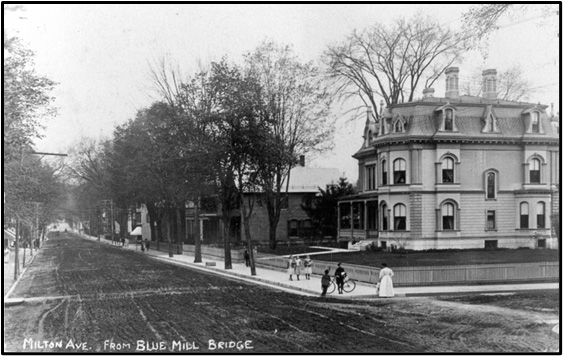
Hovey Mansion – Ballston Spa. Brookside Museum Photo provided by The Saratoga County History Roundtable.
Jonas Hovey had only about a decade to make his mark as a manufacturing powerhouse in Ballston Spa before he died, but he was instrumental in laying the groundwork for the Paper Bag King, George West.
Hovey was born September 16, 1809, in Sutton, MA. Early in life he became one of the wealthiest cotton manufacturers in the city. Seeking an area for greater expansion possibilities, he relocated to Ballston Spa with his wife in 1858.
For several years, Hovey was busy acquiring property around the Blue Mill Dam that once existed across Kayaderosseras Creek. In 1861 he purchased all of the mill properties on the northeast side of town between Milton Avenue and Mechanic Street, which included three cotton mills.
He also purchased land from an investment group headed by Jonathan Beach and Harvey Chapman, which included the future Bag Factory and the Union Mill buildings. This purchase included land and water power west of Milton Avenue, north of Gordon Creek, and west of the Kayaderosseras.
By 1864 Hovey’s enterprises were in full swing. He was erecting a new tower on one of the cotton mills which would contain a clock and bell, and the factory was being enlarged with the addition of another story.
He was also in the process of building his 6,500 square foot mansion on the corner of Milton Avenue and Prospect Street at a reported cost of $70,000 (about $1.6 million in today’s money). The Troy Times wrote in 1865 that the new residence “is nearing completion and will be unsurpassed by any similar structure in the county of Saratoga. It will be a model of architectural taste and elegance.” This stately residence would later be the home of George West and Frederick Bischoff, owner of the Bischoff Chocolate Factory, before being demolished in 1955.
In 1868 the newly-formed J. A. Hovey Hook and Ladder No. 1 fire department on Bath Street was named after him. Years later the name was changed to the Matt Lee Hook and Ladder Company, which still serves Ballston Spa today. Hovey erected some 40 tenement houses for his workers to live in at reduced rates from what they were paying at the local hotels and boarding houses.
By the time he completed his expansion projects around the village, Hovey owned three cotton factories, two woolen factories, the tenement houses, the mansion, and one of the largest tracts of land in Ballston. In fact, he owned every factory in the village with the exception of the oil-cloth factory on Bath Street. Because cotton factories were labor-intensive, Hovey employed more people than any other business owner in Ballston’s history until the Haight tannery and George West surpassed his workforce size in the late 1880s.
Hovey’s manufacturing empire was to be short lived. His business affairs forced him to travel a great deal, especially to New York City. His health began to suffer as the stress from traveling and mounting legal troubles took their toll. He entered an infirmary in Canandaigua and died there in 1875. His obituary stated, “poor health and an overworked mind and body combined to dethrone his reason.” His wife Fidelia inherited the home and his several mills. With no children, she moved back to Massachusetts where she is buried alongside her husband.
For over a year the Hovey Mills sat idle. No one was willing to take the risk of assuming control of several cotton factories when similar mills were closing around the country. However, the availability of this property came at an opportune time for George West. West owned several factories in villages surrounding Ballston Spa and his paper products were in high demand. At the nominal price of $75,000 he purchased the entire Hovey estate, one-third of the stated value of his property just five years earlier. West acquired four mills, the Hovey residence and 30 tenement houses in the transaction.
Although Jonas Hovey does not receive as much credit as other businessmen in Ballston’s history, he left his mark during his short time in Ballston Spa by gathering a substantial number of mills under his ownership, paving the way for George West to purchase the entire property and expand into the largest industry in Saratoga County.
Timothy Starr has published 20 books on local history in Saratoga County and the Capital District and is a former board member of the Saratoga County Historical Society.
Photo provided by The Saratoga County History Roundtable.
The move into World War II by the United States brought about many changes for this country’s citizens. The most important was in the lives of the sixteen million men and women who served during those years and of course the over four hundred thousand who gave their lives, making the ultimate sacrifice for their country.
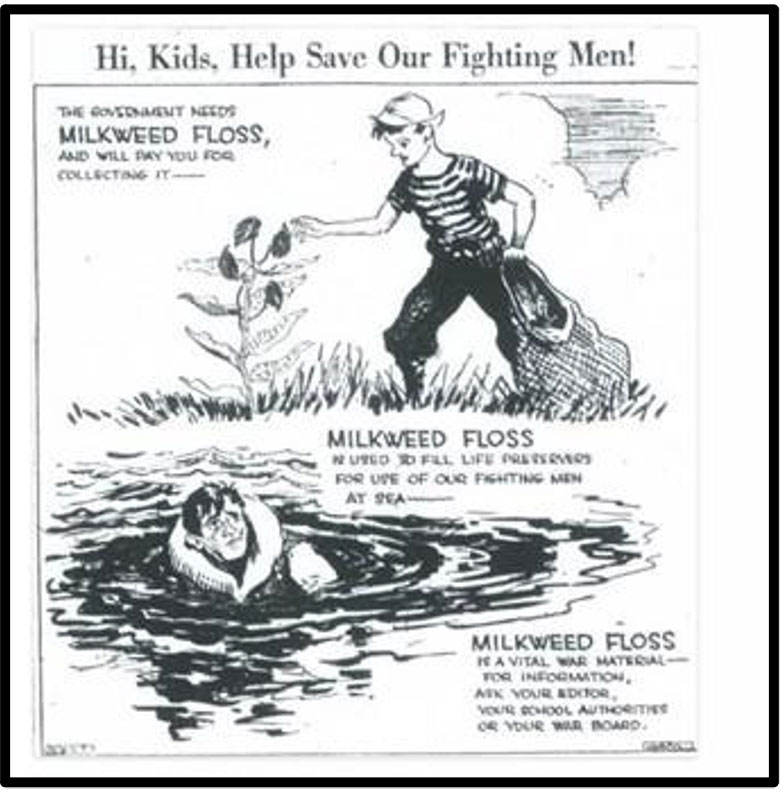
Back at home communities coped with rationing of gasoline, sugar, tires, and other products to support the war effort. Other steps that both young and old in this country were asked to take were buying war bonds and collecting scrap metal and rubber. Likely the most unusual item was the collection of milkweed pods, something desperately needed by the navy for life preservers. As we will see, in Saratoga County, both adults and young people stepped up and did their part to harvest milkweed and help protect the lives of our servicemen and women.
Only hours after Pearl Harbor, Japan attacked the Philippines and the American forces stationed there then. This successful invasion gave Japan control of the Dutch East Indies’ oil reserves and access to abundant raw materials in the region. One of these resources was kapok, a fiber obtained from the kapok tree that grows in the rainforests of Asia. The fiber, light and very buoyant, was used in life preservers by both the military and civilians.
As a replacement for this critical component of life vests was needed, the American industry began searching for likely alternatives. The most effective substitute was milkweed floss, with tests showing that a pound of this fiber would keep an adult afloat for over 40 hours.
Milkweed was quickly given the status of a wartime strategic material and the government allocated funds for its collection and processing. Soon the call went out to pick milkweed pods, with open mesh bags being distributed to schools in regions where milkweed was prevalent.
In Waterford, a drive to pick the pods was organized by the local Lions Club, with members of area Scout Troops, 4-H Clubs, and students from the Waterford Schools pitching in. As an incentive to participate the Waterford Lions Club offered prizes of three dollars, two dollars, and one dollar to boys and girls who collected the greatest number of filled bags.
With one-half million pounds needed to make life vests for the military in 1944, every bag picked was vitally important. In the spring of 1945, the milkweed pods that had been collected locally were brought to the Saratoga County Fair Grounds in Ballston Spa for shipment to the processing plant in Michigan. The eight thousand bags that had been collected from Saratoga, Warren, and Washington Counties would provide enough floss to fill four thousand life vests for the military. Overall, New York State collected enough pods to exceed its goal of gathering enough milkweed to fill over a quarter million life jackets.
The milkweed needed to be picked before they broke open and scattered the floss, leaving only a small window of opportunity to collect the pods. Once filled, the mesh collection bags were hung outside to dry, with two bags needed to fill one life vest.
In many counties, it was the 4-H Club agents who oversaw the work of distributing the collection bags. One example was Samuel B Dorrance the agent for Rensselaer County who passed out two thousand of these open mesh bags. In a newspaper account of his efforts, published in the September 15, 1944, Troy Record, he gave these instructions for collecting the pods: When the seeds are brown, the pods are ready for picking but definitely not before, as they will mold, he said. “Those in the northern part of the county are not yet ready. It isn’t necessary to examine each pod if a test shows that the majority of the seeds are ripe.
He continued with the necessity of leaving the bags out to dry for at least two weeks, preferably hanging them from a fence at least a foot off the ground, after which they could be brought indoors.
Dedicated to the slogan of “Don’t Let Our Sailor’s Sink” 4-H boys and girls roamed the countryside collecting milkweed from fencerows and open fields. Lifelong Saratoga County resident Marion Crandall shared this memory of that time while growing up in Bacon Hill, a farming community near Schuylerville: In the orchard there were a lot of milkweeds… they needed kapok for the war…for life preservers…it was a 4-H project, so we went to the orchard, picked milkweed pods, and put them in big onion bags, mesh bags.
The efforts of the young people in Bacon Hill were a success, as by September of 1944 they had collected eleven bags of milkweed pods.
With the close of the war in September of 1945, collection of milkweed floss was no longer necessary, and the program was ended. While it is impossible to count the number of lives that were saved through this work by the children of Saratoga County, what they accomplished was vitally important to the war effort and even now we can look back with pride at what they achieved.
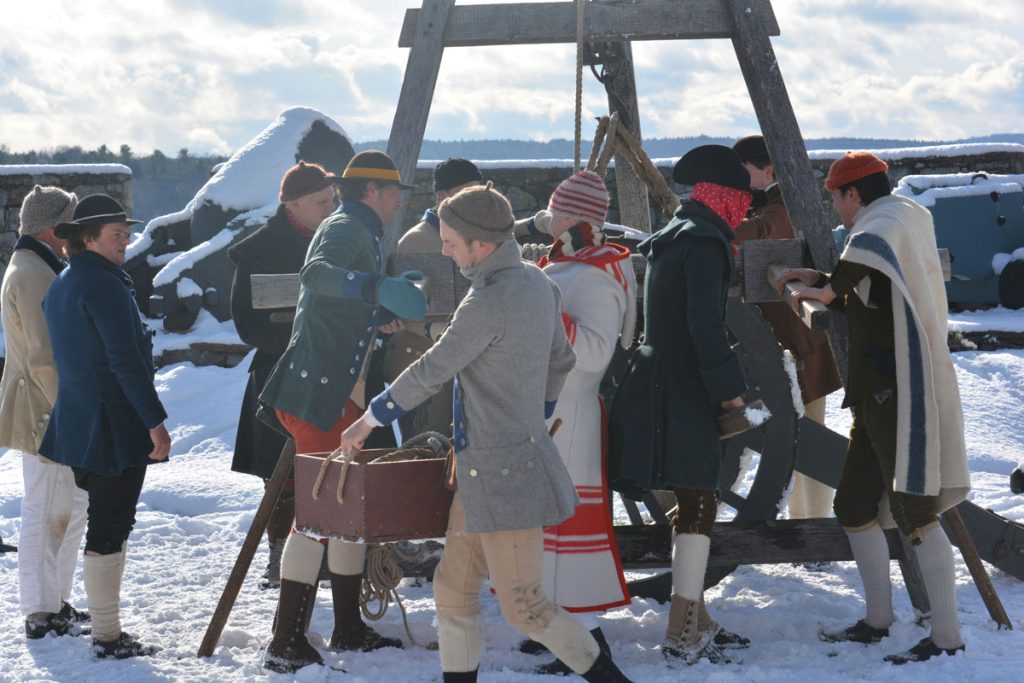
Fort Ticonderoga will present a one-day living history event on Saturday, Dec. 16. Photo provided.
TICONDEROGA — Fort Ticonderoga will present a one-day living history event on Saturday, Dec. 16, which will bring to life Henry Knox’s epic feat as he prepared to move massive cannon from Ticonderoga to Boston to force the British evacuation of 1776.
Attendees may stand inside Fort Ticonderoga on the very spot where Henry Knox began his Noble Train of Artillery.
Highlighted programming throughout the day will immerse visitors in the daily life of December 1775 at Ticonderoga. Join in with soldiers who work as carpenters to build new bunks. See horsepower, ox-power, and manpower in action as they move, test, and load cannon. Discover how testing the cannon was vital for weapons destined for the siege of Boston. Learn about the science of gunnery, preserved in Fort Ticonderoga’s massive cannon collection and archives. Explore the simple luxuries enjoyed by American Continental Officers and learn more about what they ate, where they slept, and other details of daily life.
The event is free to Ticonderoga Ambassador Pass holders and Fort Ticonderoga Members, with no reservations required. Tickets for the general public can be purchased online in advance at www.fortticonderoga.org or upon arrival.
STILLWATER — Saratoga NHP’s Fall Lecture Series in partnership with the Friends of Saratoga Battlefield. will host “Retracing Our Steps: The French-American Joint Reconnaissance Tour in the Winter of 1780-1781” on Thursday, Dec. 7 at 6:30 p.m. The event will take place at the Saratoga National Historical Park Visitor Center Theater.
Studying the terrain to analyze how the action unfolded on Revolutionary War battlefields isn’t just a modern pursuit. It was the first order of business when the French Army arrived on American soil, seeking to understand the war they had just joined. Contrary to popular belief, French and American officers did not sit idle over the winter of 1780–81. Rather, the French organized a joint reconnaissance mission to previous battlefields of the American Revolution under the initiative of François-Jean de Chastellux, an overlooked figure who played a crucial role as a liaison officer between the French and Americans, and in the logistical and strategic planning of the allied army. Dr. de Rode’s discovery of his unpublished private papers, in the ancestral château of the Chastellux family in Burgundy, reveals numerous details about his role, especially on this forgotten reconnaissance mission, including an in depth study of the battlefield of Saratoga.
Dr. de Rode, who is originally from the Netherlands, received her doctorate from the Université de Paris in November 2019. Her dissertation was based on her discovery of the private papers of François-Jean de Chastellux, one of the French generals who served at Yorktown. She published a biography on Chastellux in 2022 for which she won the 2023 Prix Guizot of the Académie Française for “best history book of the year.”
Reservations are required by visiting go.nps.gov/saraevents or emailing SARA_info@nps.gov.
The Saratoga National Historical Park Visitor Center is located at 648 NY-32, Stillwater.
Image provided by The Saratoga County History Roundtable.
Rebecca Jones was born in Schoharie County in the 1820s. Her family moved to Ballston Spa, where Becky attended a girl’s school. By 1850, she was in New York City, working as a domestic for the family of Andrew Gordon Hammersley, a lawyer and banker. She was with them for several decades. A newspaper later noted that she was treated well by the family and was one of those servants who “stand more on the footing of companions and friends than ordinary domestics.”
One day, after Hamersley had become ill, he explained to her that following his death there would likely be contention over his estate and requested that she never share her knowledge of family matters with anyone. “You will suffer if you do not [speak], Becky,” he warned her. Her answer was: “What of that, sir? I will keep my promise.”
After his death in 1883 – followed shortly by that of his son, Louis – a court case was commenced, challenging the will. This dragged on for quite some time. Becky had moved back to Ballston Spa, but her testimony was sought in the court proceedings. She resisted testifying, per Hammersley’s wishes. One time she even jumped from a train to avoid going to New York City to appear at the trial.
Finally, she was forced to go, but in court, she steadfastly refused to answer questions about the Hammersleys. Rather than testify, she said she’d go to jail and stay till “the resurrection day.” The judge found her in contempt of court and sent her to the Ludlow Street jail to induce her testimony.
At the jail, her walls were adorned with photos of members of the family she’d faithfully served. Visitors and newspaper reporters frequently came to see her. When she first arrived, she was unimpressed with her “lodgings,” but the warden had some furniture moved in which made it homier. She told a reporter she was happier in jail than if she were out, because all her people were dead (which was not really true, as she had a sister and brother-in-law back in Ballston Spa).
Her daily routine included an early morning walk in the prison yard, going to meals, and working on a narrative of her experiences. Also, “I read and sew and go to meeting and now and then have a good talk with the people upstairs… and everybody treats me well and I am perfectly happy.” She invited one reporter to call again, on soup day, because she found the soup to be “delicious.”
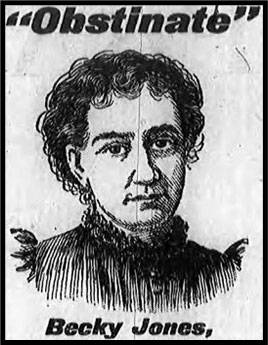
With national interest in her situation, stories appeared in newspapers all over the country. Intrigued reporters nicknamed her “Silent Becky” and “Obstinate Becky.” They were so impressed with her fidelity to her former employer that they even had portraits of her painted.
On hearing she’d be released from jail, she seemed hesitant to leave: “If I’ve got my discharge and it’s legal…I may go out.” Becky was afraid she’d have to run through the streets because people would point her out as having been in jail. She was worried about returning to Ballston Spa, as “people for miles around would come into town to look at me.” She anticipated getting a job with another family, and “if my employers die, you may be sure I’ll never breathe their family affairs.”
When released in the spring of 1885, after about a year of incarceration, she did come back to Ballston Spa. The 1900 Census shows her living there with her brother-in-law, Return J. Burnham (who sometimes went by R. Jay). A newspaper observed that she lived a quiet life, but “she is one of the objects of interest in the village and takes great pride in her course when she spent some weeks in jail…for refusing to answer questions.” She had a collection of news clippings and photographs from the time of the trial.
As noted, Mr. Hammersley’s son Louis died not long after his father. His widow, the former Lilly Warren Price, was originally from Troy, and she became the Duchess of Marlborough when she remarried to the Duke, George Churchill (whose nephew, Winston, would become famous). The Duchess inherited the Hammersley fortune once everything was settled by the courts. In the 1890s, the Duke and Duchess visited Becky in Ballston Spa, and offered her a job, which she declined. She was in comfortable circumstances because Mr. Hamersley had granted her an annual stipend of $1,500.
In the village, she had repairs made to the West High Street house that had been her father’s, arranged for cemetery monuments for family members, and made provisions for her own burial. Her name was still well remembered by the public, though, as her portrait appeared in ads promoting Dr. Miles’ Restorative Nervine. Her testimonial for that product stated that when released from jail, she was a nervous wreck. “For ten years, life was a burden.” But after using the tonic, she was “entirely well.”
Jones died in 1905 at her home. She had given instructions that her funeral would be open only to family, and that her remains were to be placed in a “plain oak casket…with white lining… with a plate engraved ‘Obstinate Becky Jones.’” She is buried in the Ballston Spa Village Cemetery.
Ironically, following her death, there was a court case involving her estate. But Becky said nothing about it!
Note: This week’s article was submitted to us during the summer by David Fiske who passed away on October 28 after a battle with cancer. We publish this story posthumously in his memory.
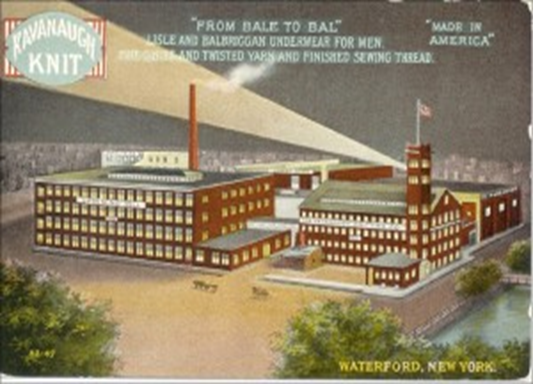
The Town of Waterford’s population in 1910 was said to be 6,128. Of that number, approximately 1,700 worked in the twelve knitting mills making underwear! There were four other knitting mill operations that did not produce underwear; they employed 220. One-third of the overall population worked in the industry. Ruling out minors, the percentage would be even higher. By 1912 and continuing until the 1950s, underwear was Waterford’s largest export item.
Two of the Waterford manufacturers had pressing questions for the underwear-buying public.
Have you been bothered recently by dangerous underwear fads?
Do You need to purchase underwear in a larger size because it shrinks?
The Kavanaugh Knitting Mill, owned by the Kavanaugh family, was the largest factory, with 600 employees. Their business was built on the following belief.
Men who demand cool, comfortable garments and who appreciate good health avoid dangerous underwear fads usually wear the famous Kavanaugh Balbriggan. The comfortable underwear. Just loose enough to avoid the pinch, just light and soft enough for cool comfort, just weight enough to protect against sudden cool breezes.
This advertisement also featured caricature images of the Rough Riders. Charles Kavanaugh was a personal friend of Teddy Roosevelt. Kavanaugh provided all the underwear for the Rough Riders during the Spanish-American War
John Wheeler Ford, in 1891, the same year as the Kavanaugh mill, opened Ford’s Mill, or Ford’s Manufacturing. It was later purchased by the Robert Reis Company. Their main products were tee shirts and men’s and ladies’ undergarments. Their claim was as follows.
Reis’ Union Suits, we’ll put you wise; you needn’t buy them oversize. The size mark on Reis’ Lavender Label means precisely what it says. All athletic underwear shrinks when first laundered. Instead of pretending that it doesn’t. Reis, frankly, allows for shrinkage. So you needn’t buy a 42 when your size is 38 or a 38 when your size is 34. It’s sized right in the first place. Reis, you see, doesn’t skimp on material. Yet, for all the roominess of a Reis, they are tailored to fit. It doesn’t flop around you like a sail or wrap you up like a bug. They fit, and of course, they don’t chafe. They are made for a man, not a wax figure.
Reis’ Mill lasted the longest – in business until 1979. Their main office was in the Empire State Building. The bulk of their manufacturing was conducted at Ford’s Mill in Waterford. During World Wars I and II, they held contracts to supply underwear to the United States Army. The employment there was listed as 300.
During the first half of the 20th century, the Harmony Mills in Cohoes and the Ford and Kavanaugh Mills in Waterford all had military contracts that impacted their ability to produce, distribute, and sell civilian supplies. The others were quick to fill the void. In the second half of the 20th century, with the wars over, the Ford Mill, now Reis, but still known as Ford’s Mill, returned to normal operations. By the mid-1950s, they were the only one left. All the others had gone out of business. Of the twelve mills that were listed that produced underwear, several had majestic brick buildings. They are now all gone, with the exception of the Laughlin Textile Mill, which is vacant. It was the headquarters for Ursula of Switzerland. Ursula passed away recently. That marked the closing of the textile industry in Waterford.
How was Waterford able to become one of the Mohawk Valley’s major producers of underwear?
Waterpower was the top priority in the development and location of textile mills which was abundant in the Waterford and Cohoes area. The Mohawk River, and in Waterford the King’s Canal, provided plenty of rushing water, the humidity was sufficient for spinning, access to seaports was convenient with the Erie and Champlain Canals, and there was an abundant labor supply. For these reasons, the textile industry took root across the northeast, along the Mohawk River valley, and especially at the terminal point of the canals in Waterford and Cohoes.
In 1855, Clark Tompkins, from Troy, NY, patented the first fully mechanized knitting machine. The upright rotary knitting machine relied on mechanical advances not available until the 1840s. In many ways, this invention foretold the industrial future for the Hudson and Mohawk River Valleys. By 1890, Mohawk Valley had become the number one knit-goods manufacturing center in the country.
New York knit-goods manufacturers primarily produced underwear.Two-thirds of all underwear produced in the United States in the late 19th century was made in New York, and of that, a large percentage came from the Mohawk Valley. In 1909, The Knit Underwear Industry reported that New York State produced 33.5% of all knit goods in the United States. With the opening of the King’s Canal in 1830, Waterford successfully harnessed the power available from the Mohawk River. The King’s Canal area became heavily industrialized, with more than half of the underwear manufacturing concerns listed located.
Kavanaugh made mention of Dangerous Underwear Fads. The Utica Brand underwear company asked, tired of underwear fads? Many hours were spent searching newspapers for those fads. Following are some of the underwear fads that appeared between 1890 and 1940.
I found evidence of the underwear that doesn’t have to be ironed. Material fads of fine rayon mesh, nalmook, and crepe. A no underwear fad. A black underwear fad during the Depression to cut down on washing. A pretty underwear fad. Silk underwear. Colored underwear. Dr. Diemel underwear fad. Velvet underwear fad. In 1929, a lightweight underwear fad was to blame for hospital admissions. None seemed particularly dangerous unless you were in Illinois, where in 1929 lightweight underwear apparently caused hospitalizations, and the wearing of silk underwear was successful grounds for divorce.
Russ VanDervoort is the Waterford Town Historian, leader of the Waterford Canal and Towpath Society and a Trustee of the Saratoga County History Center. He can be reached at russvandervoort@gmail.com
On Nov. 23, 1861, hundreds of men dressed in the blue uniforms of the Union Army mustered in Saratoga Springs. Hailing from villages and towns across Saratoga County as well as from Fulton and Essex counties, the soldiers of the newly formed 77th New York State Volunteer Infantry Regiment were heading off to war.
Nearly seven months earlier, on April 12, secessionist forces had opened fire on the federal government’s Fort Sumter in South Carolina’s Charleston Harbor. The decades-long debate between the Northern and Southern states over extending slavery into western territories and new states had degenerated into a shooting war.
In Saratoga County, as elsewhere in communities across the North, men were answering President Abraham Lincoln’s call for tens of thousands of volunteers to quell the rebellion in the South. James B. McKean, a local lawyer elected to Congress in 1858, led the effort to raise a regiment from a three-county area in northeastern New York.
“Traitors in arms seek to overthrow our constitution and to seize our capital,” McKean wrote in an appeal to his constituents published in August 1861. “Let us go and help to defend them. … Let farmers, mechanics, merchants, and all classes, for the liberties of all are at stake, aid in organising (sic) companies. I will cheerfully assist in procuring the necessary papers.”
Dozens of infantry regiments already had been organized across New York State and mustered into the Union Army. Numeric regimental designations in each Northern state were assigned in chronological order. The new Saratoga outfit was supposed to become New York’s 45th Volunteer Infantry Regiment but was instead granted permission to be designated the 77th Regiment, a symbolic tribute to the Revolutionary War’s Battles of Saratoga fought on Bemis Heights in September and October 1777.
Just days after mustering in Saratoga Springs on Thanksgiving Day in 1861, the 77th – known as the Bemis Heights Regiment — boarded trains and headed to New York City. There the 700-plus soldiers were honored by former Saratogians who presented a regimental flag featuring a depiction of British General John Burgoyne surrendering after the Saratoga battles.
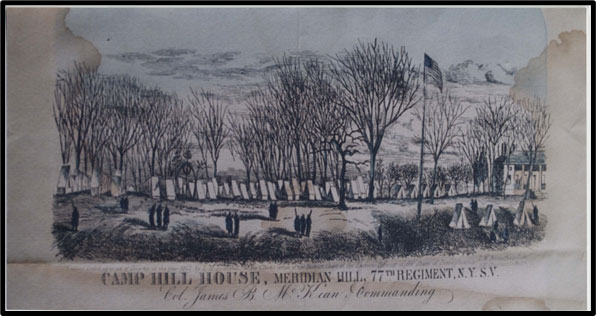
By New Year’s Day 1862, the regiment was encamped at Meridian Hill in Washington, D.C., joining thousands of other Union volunteers encamped in and around the city ahead of the upcoming spring campaign against the Confederate army in neighboring Virginia. That spring, the regiment saw its first action at the siege of Yorktown, the first of many it would fight on the Old Dominion’s soil.
The 77th Regiment fought in the Battle of Antietam at Sharpsburg, Maryland, on Sept. 17, 1862, when Confederate General Robert E. Lee’s Army of Northern Virginia and Union troops clashed in what would turn out to be the single bloodiest day in American history. Total casualties for both sides topped 22,000 killed, wounded and missing. The 77th suffered 11 killed and 21 wounded.
In early May 1863, the 77th Regiment was among the leading Union units that assaulted the rebel positions on the high ground overlooking Fredericksburg, Virginia. Mowed down by defenders firing from behind a stone wall atop Marye’s Heights, the Northerners suffered nearly 1,100 casualties. Among them was Capt. Luther M. Wheeler, one of the regiment’s most admired officers. Advancing out ahead of his troops, Wheeler was shot in the torso. Carried to a temporary hospital by two of his soldiers, Wheeler died of his wounds early the next morning.
Two months later, the 77th was among the Union forces confronting Lee’s army at Gettysburg, Pennsylvania. The regiment was held in reserve, sparring it from the three-day bloodletting that resulted in more than 50,000 casualties between Confederate and Union forces, including more than 7,000 killed.
As fierce as the fighting was in 1862 and ’63, it would get even worse in 1864. Lincoln had appointed General Ulysses S. Grant as overall commander of the Union Army that March, and the Yankee hero of the war’s Western Theater brought a relentless approach with him when he came east. Unlike his predecessors, Grant wouldn’t retreat after every battle, whether it was won or lost. Instead, starting in May, the West Point graduate kept his army on the offensive following every engagement, resulting in a series of battles across eastern Virginia that left tens of thousands of dead, wounded and missing soldiers in their wake.
The 77th participated in most of those clashes, from The Wilderness and Spotsylvania Court House in May to Cold Harbor the next month. Spotsylvania, fought over multiple days, would turn out to be the 77th Regiment’s bloodiest battle, with 30 soldiers killed, 56 wounded and another 21 listed as missing in action. The regiment would lose dozens of other soldiers before the war’s deadliest year was over.
As the war entered its fourth year, there was hope on the Union side that the Confederate army was on its last legs. Grant had besieged Petersburg, Virginia, the key supply center for the Confederate capital in nearby Richmond, while General William Tecumseh Sherman’s army had marched its way through Georgia to the sea, gutting the Confederate war machine’s infrastructure and materiel support systems for the remainder of the war.
In early April 1865, the 77th was there when the siege of Petersburg ended, then participated in one of the final battles of the war, fought at Sailor’s Creek in Virginia on April 6. Three days later, Lee surrendered to Grant at Appomattox Court House. The 77th Regiment was among the Union outfits bivouacked nearby when word arrived that the Army of Northern Virigina would lay down its arms.
On June 27, 1865, the Bemis Heights Regiment – now reduced to a battalion of fewer than 300 – was mustered out of service in Washington, D.C. During the war, the regiment suffered more than 600 casualties, including 286 soldiers who died in combat or from disease or illness.