Glidden Auto Tour: Testing the Reliability of Early Automobiles

For the car enthusiast today, the term cross country rally recalls dust-covered cars testing skill and endurance by racing across endless landscapes of sand dunes and giant cacti. In the early days of automobiles, these contests were also held where the roads were poor, and the skills of drivers were pushed to the limit. Fortunately, the contestants did not have to travel the world to compete, as these early rallies were run on the bone-rattling roads of rural America.

One of the most well-known of these early contests was the Glidden Auto Tour, a public auto rally organized by the American Automobile Association to promote the reliability and practical use of this new form of transportation. The tour offered the public a chance to see automobiles as they passed through their communities driven in a safe and controlled manner. The maximum speed for the drivers in the Glidden Tour was twenty miles an hour on the open road and reduced to fifteen when they passed through residential areas. These speeds were verified at timed checkpoints and penalties were assessed against those who arrived ahead of the scheduled times.

Named for Charles Jasper Glidden, a telephone pioneer and automobile enthusiast, the first tour was held in 1904 to finish at the World’s Fair in St. Louis, Missouri. The rally that year had three starting points: Philadelphia, New York City, and Baltimore, which converged during the 1000-mile route to end in St. Louis. Of the 77 automobiles that left the starting line, only 66 passed the checkered flag eighteen days later.

The 1905 Glidden Tour again started in New York City, with all the contestants following the same route that headed north into New Hampshire. Before each race, representatives of the Glidden Tour would drive the roads along the course of the rally and create a route book for the contestants to use during the tour.

As this rally was organized as a reliability test, the route included steep inclines, culminating with a visit to New Hampshire’s White Mountains. The Buffalo Courier newspaper of July 30, 1905, gave this report on the climbing ability of these early automobiles:

Hills, which for years have been climbed only with a team of horses, including the Crawford Notch Hill with a 22 percent grade, the Hard Scrabble Hill near Bethlehem (NH) with a 25 percent grade, and the Saw Dust Hill near Chester with a grade of 28 percent at one point, were surmounted by car after car.

For 1906, the tour returned to the northeast, starting the sixteen-day race on July 12th in Buffalo, and heading east to Utica, into the Mohawk Valley, north to Saratoga, and then into the Eastern Adirondacks. In the days preceding the event, the organizers posted signs along the route to help the participants follow the course. In Fonda, a community along the Mohawk River ten miles west of Amsterdam, officials refused to allow the signs, and no details of food or facilities in Fonda that could assist the motorists were included in that year’s tour packet.

The roads between Utica and Saratoga were described by the contestants as “vile,” with the rough roads and thick dust churned up by the motor cars causing accidents that eliminated several entrants. Beyond Amsterdam the tour turned north, encountering a steep grade taking them away from the Mohawk River. When Crane’s Hollow Road, the designated route for the tour was found to be so narrow that it would be impossible to pass disabled vehicles, the tour was rerouted to nearby Swart Hill Road. This thirty percent three-quarter mile grade was a challenge for some of these early autos, with the stronger autos assisting others to bring all the contestants to the summit. By mid-afternoon, the tour cars came down Ballston Avenue in Saratoga Springs and ended their day in front of the Grand Union Hotel. As the tour arrived in Saratoga on Saturday and Sunday was a rest day, the contestants had time to relax and enjoy the sights of Saratoga Springs.

From Saratoga the tour headed north to Glens Falls, then into the Adirondacks, first following a plank road to Caldwell on Lake George and then passing through Warrensburg to Chestertown. Continuing north, the tour skirted the western shore of Schroon Lake, finally rolling into Elizabethtown to end the day. The only excitement during their time in Elizabethtown occurred when two of the participants could not find a room for the night. The problem was solved when the local sheriff offered to house them in the jail. After their cell was opened the next morning, the men said that they slept well, even though they were locked up with a murderer and a wife-beater.

Fifty of the contestants made it to their final stop in Quebec. Thirteen of these were given a perfect score based on delays from breakdowns and the cost and time for repairs. To break this tie, the group voted and chose the first-place finisher from the previous year, Percy P. Pierce, as the winner. Percy was the son of Pierce-Arrow Motor Car owner George Norman Pierce, and of course, for the tour that year he drove one of his father’s automobiles.

The White Mountains were again tackled during the 1906 tour, though this time with what could have been fatal results. Guy Vaughn, a champion of 24-hour auto races, lost control when he encountered a section of road in Crawford Notch that had been damaged by rain the night before and rolled his Sterns automobile. Though his machine was demolished, Vaughn escaped unharmed.

In 1907 the Glidden Tour again went through Glens Falls with a White Steamer auto acting as the pathfinder and pilot. The tour that year had started in New Hampshire with their final destination being Saratoga Springs. The 1908 Glidden Tour started in Buffalo and again ended in Saratoga. The last tour to go through New York State was held in 1911, going between Washington, D. C., and Ottawa, Canada. On their way north the tour passed through both Saratoga Springs and Glens Falls.

The final Glidden Tour was held in 1913, with the organizers acknowledging that the automobile had proven its value and reliability over the years of the competition. In recent years, the Vintage Motor Car Club has revived the Glidden Tours, with the 78th Revival Glidden Tour being held in September of 2024.

Edinburg’s WWII Soldiers and Gold Star Mothers


Rhoba Ferguson Robinson

The year 2024 marks the 85th anniversary of the beginning of World War II. On September 1, 1939, Germany invaded Poland, with Great Britain and France declaring war on Germany on September 3rd. Italy declared war on Great Britain and France on June 10, 1940. Germany invaded the Soviet Union on June 22, 1941 and Japan had occupied all of French Indochina by July 26, 1941. On December 7, 1941, Japan launched an attack on our US fleet at Pearl Harbor, Hawaii – “a day that will live in infamy”. President Franklin Delano Roosevelt declared war on Japan on December 8, 1941.

The next four years would change peoples’ lives forever. In that time 300,000 Americans gave their lives for our country. Men were called to duty by the draft board which had been established by the Selective Service System.

The town of Edinburg had 40 young men and 1 woman signed up to go to war. The Batchellerville and Fox Hill communities gave far more than their fair share of men to serve.

A partial list included Donald Barney, Albert Bills, Andrew Colson, Erwin Conklin, Jack Deming and brothers, Donald and Kenneth Edwards; Foster Edwards, Claude Farrington and brothers, Clifford, George and Herbert Jensen; LaPort brothers, Bert, Fred, Joseph and Oscar, as well as George Mason and John Olmstead – 18 in all from just Fox Hill and Batchellerville.

The rest of the 23 enlistees were from other parts of town. These men were Scott Downing, George Ferguson, Harry Frasier and brothers, Elwin and Erwin Geelan; Edward Green, Warren Hill and brothers, George and Lewis Jenkins; in addition, Floyd Knowlton, Keith Mudge, Robert Nourse, Ralph Olmstead and the Robinson brothers, Leland, Marshall and Ralph; also Channing Rockwell, Leslie Sauve, Howard Simpson and brothers, Luther and Joe Stockwell, and last but not least, Leonard Tryon. The only woman to enlist from Edinburg was Slava Malec, daughter of Marie and Alois Malec. Slava’s family had come to this country in 1911 from the old country. Her sister and brother – Lessie and Jaro – were born in Germany but Slava and her sister Grace were born in the US. Did her family’s feelings about Germany and Hitler have any bearing on Slava’s decision to support the USA?

Of Edinburg’s 42 service people, 2 lost their lives – George Ferguson and Leonard Tryon were killed in action.

After World War I, it became a custom in this country for families of servicemen to hang a banner called a “service flag” in a window of their homes. These flags held a star for each family member in the United States Armed Forces. A blue star represented living service members and a gold star represented those who had lost their lives.

I well remember as a child seeing one of these Gold Star banners in the window of our neighbor, Rhoba Stockwell Ferguson Robinson. Rhobie was the mother of George Ferguson, who had joined the army in 1943 at the age of 21 and was killed in action January 1945. Rhobie was a hard worker – widowed twice – spending hours each day sewing on gloves to add to the income from her small farm.

Rhoba Ferguson Robinson was Edinburg’s Gold Star mother often riding in the Decoration Day – now called Memorial Day – and the July 4th parades in Northville.

The war ended September 2, 1945 in Tokyo Bay on board the battleship, US Missouri, when the Japanese signed the formal surrender document.

It became a custom in many towns across America to display an Honor Roll board – usually in the center of town – listing all the service people from that given community. Edinburg was no exception.

In the mid-1940’s the shop class teacher at Northville Central School was Mr. Mendenhall, who lived on the lower end of Sinclaire Road. He constructed of wood Edinburg’s Honor Roll Board. It stood for many years at the 4-Corners. At some point it was taken down and stored in the old highway barn, now our Rural Museum. In 1991, when the barn was being cleaned out in preparation for the museum, the Honor Roll was re-discovered. The late Fred Trudy gave it a face lift and it was hung in our Nellie Tyrrell Museum. A few years ago, two more names that needed to be added were discovered. The Historical Society commissioned sign maker George Bailey of Edinburg to make a new sign. George donated all of his time and materials to creating the new Honor Roll, which is beautiful. Thank You, George! It is on display at the Nellie Tyrrell Museum.

Thank you and God Bless to all servicemen and women – past and present – for all that they have given for the United States of America!

Moving Day 1974:The Welches Begin Again in Vietnam

Early on July 6, 1974, my family and I boarded a China Airlines flight destined for the capital of the Republic of South Vietnam. I was just shy of my eighth birthday and delighted at the prospect of living in the same country as my father again. We’d been separated since July 1972 when he’d been transferred to the world’s hotspot of Saigon, and we’d been given “safe-haven” on the island of Taiwan.

Prior to that we’d lived all together in Seoul, Korea. My father had had a two-year PSYOP assignment there. Working as he did for the CIA and in psychological warfare, I was not privy to the nature of his work but certain clues indicate that he may have had something to do with Kissinger’s behind-the-scenes work to normalize relations with China. Today, we see in the news that our relationship with the “Middle Kingdom” is strained; back then even conversing with the communist country had been deemed impossible.

In March 1972 my mother wrote home to her parents:

“More than you could ever know, I wish I could tell you of our plans for this coming summer… Jim wrote a really fantastic paper… which was pouched to Washington and I hope that it gets to Mr. K and therefore to the president.

It was so good that our chief suggested that he would like Jim to go to DC to participate in the discussions regarding the future of this line of work in the role of the USA. (Well, Jim laughed to himself as he said someone at his level just would not be invited to “sit-in.”) 

I personally feel that Nixon, etc., will be so short-sighted that they will terminate this line of work which will mean that we will be coming home during the summer”

As it was, we would not return to the States in ‘72. Nixon went to China in February, and—after we finally got our marching orders—my mother wrote home in July:

            “A quickie! Suddenly all H has broken loose! Jim is due back here 15  July after a stopover in Taiwan. Taiwan cable today granted us safe haven there.  I’m delighted.”

And so from mid-1972-July 1974 the Welch family would live apart, my father coming  home to visit us every 5-6 weeks for a long weekend on the misty Grass Mountain just north of Taipei. Then, in early 1974, Saigon was deemed safe for families and thus it was 50 years ago that we set off for our final Southeast Asia post.

In recent years I’ve thought a lot about what a third move in four years must have meant to children between the ages of 4 and 15. The changes in schools, friends, and stability are hard enough at that age. Factor in the “vibe” of war and it’s hard to imagine just how we coped with it. Today’s awareness of social-emotional health was not prevalent at that time. I don’t recall any sort of support or understanding–or even discussion–about what was to come.

I recently read Craig McNamara’s memoir, “Because our Fathers Lied” in which I learned that his father, Robert S. McNamara, died fifteen years ago on July 6, 2009.  The elder McNamara was the eighth secretary of defense (1961-1968) and the man who, more than any other, was the leading architect of America’s involvement in the Vietnam War.

A single sentence in biography.com: captures the enigma of Robert McNamara:

“He is best known for helping lead the United States into the Vietnam War during the Kennedy Administration, an act for which he spent the remainder of his life wrestling with the moral consequences.”

In his book, Craig describes his struggle to come to terms with his father’s role in that “fumbled war” and moreover his father’s consistent silence on matters related to the conflict. I found myself filled with empathy for the author who both loved his father and hated his father’s actions in the war.

I felt a kinship with his struggle though our experiences are vastly different. We both had fathers involved with the war and eager to win it. I found myself feeling grateful that my father was not directly responsible for anyone’s death—at least not that I know of.

How will I ever know? In that, I have not progressed much farther than a child of seven who boarded a plane for her third home in a foreign land. In both instances there is so much unknown, so much that cannot be pinned down. Seeking answers, one often simply finds more questions.

Toward the end of Because Our Fathers Lied, I came across a sentence which made me stop what I was doing, paddling my kayak on the Hudson on a hot afternoon.

“I don’t think I could have put it into words back then, but in retrospect, I was clearly involved in a personal project of reshaping my family’s legacy. “

I was struck by what an effort that is on anyone’s part, and especially for someone with an earnest heart like Craig McNamara’s. On reflection, I’ve decided that I have not been trying to reshape a legacy with my writings but have been striving to pin down the exact nature of my father’s legacy.   He saved 1000 South Vietnamese people at the end of the war, but he had a family, too.

Fifty years ago, we embarked on a new adventure. This time, all nine of us, together. I don’t remember holding my father’s hand as we boarded the plane, but I like to think that maybe I did. Maybe I felt safe in that moment of crossing the tarmac, climbing the metal stairway, and settling into the seat beside him. Maybe I was happy. Maybe it seemed as if, together, our lives were now going to be better than ever.

Originally published on Substack on July 6, 2023

Brotherly Love

Maria Chapin Preston, born in 1842, was the sixth child of Dr. Calvin and Margaret Preston of East Street, Galway, New York.  Like her brothers, she exhibited musical talent early in life, playing the organ at the Presbyterian Church at the age of 14, keyboard instruments at social events, and teaching music.

She also shared their adventurous spirit exemplified by William and Platt, Gold Rush participants and eventual wealthy mill owners in Waitsburg, Washington; and Calvin, Union Soldier in the Civil War and survivor of the 1900 Galveston Hurricane.  Leaving a comfortable existence in Galway, she boarded the Transcontinental Railroad for San Francisco in the mid-1870s, traveling to Waitsburg by coastal steamer and finally stagecoach, joining her brothers and living with Platt while pursuing her interests in music.  In 1885 she married Alexander Stewart, a wealthy Waitsburg businessman.

Unfortunately, while their wealth supported a very comfortable life, Maria’s mental health gradually declined; in 1904 Mr. Stewart became seriously concerned about his wife’s deteriorating mental condition.  He “took her east and consulted eminent specialists on mental diseases in her behalf and…when he returned ….he stated nothing could be done for her”.

The combination of his wife’s illness, their advancing years, and the probability that Alex had chronic health issues of his own motivated him to pursue an arrangement with members of the Stewart family to provide for their care when they were both incapacitated.  His plan was to contract with them to provide care in exchange for transference of property owned by him and his wife.  A problem with the plan: some of the property he intended to transfer was owned separately by Maria, and as she was not mentally competent could not legally enter into a contract to transfer it.  Nevertheless, he had a deed transferring the properties to him drawn up and on April 20, 1906 it was executed by their signatures.

In 1911, Maria and Alex travelled to Idaho to stay with family members. During October of that year, Alex signed a contract with his relatives stipulating that, in return for property transferred to them in Florida and Washington the relatives would support and maintain him and his wife as long as they should live.   In September of 1912 they went to Miami, Florida, where Alex died in November.  At that time all his property and investments including that fraudulently transferred from Maria had already passed into control of the relatives, some of whom lived in that state. 

At about the same point in time William Preston became concerned that Maria’s well-being was in jeopardy. Elderly himself and not in condition for a long trip, strenuous activity, and dealing with legal issues, in February, 1913 he employed an attorney and the attorney’s wife, the latter to provide health care and personal supervision, to travel to Florida and return with Maria.  There they found her in “neglected, in pitiable and filthy condition; …….in feeble health and unable to care for herself…..almost without clothing and in the most abject want…kept in this abject condition by the relatives of her husband”.  One could reasonably conclude that she had been left on her own, to die.

Before permission could be obtained to return Maria to Washington State, the lawyer was required to sign a written contract with the relatives on behalf of William, which described the purpose of Maria’s journey as one of “paying a visit to her brother.” That visit could be terminated by the relatives at any time and  the terms of the original contract signed by Alex and his relatives would not be affected.

“After the contract was executed, suitable clothing was purchased for [Maria], and by easy stages and with the assistance of nurses and hospital attendants secured at various points along the road of travel brought [her] to [Waitsburg] where her health and physical condition …. rapidly improved although her mind [seemed] to be utterly gone.

The next step was to block any attempt by the Stewart family to return her to Florida, and recover her property in Washington.  William was in an awkward position to take the lead in these actions, having authorized signature of the contract prohibiting such, but friends in Waitsburg came to the rescue, applying to the superior court of Walla Walla county to appoint a guardian. The guardian then commenced legal action to recover Maria’s property against the Stewarts to whom the lots had been fraudulently conveyed.  After this action had begun, the Stewarts filed suit to have the guardian’s appointment vacated, and title to the properties restored to them.

The trial judge, upon reviewing the evidence found that the Stewarts were aware of Maria’s insanity when her property was transferred to her husband, issuing a decree setting aside the deeds in question and quieting the title on November 11, 1913.  He also dismissed the action to have the guardian’s appointment vacated.  The Stewarts appealed the actions to the Supreme Court of Washington State.

The Supreme Court decisions on both cases are dated April 20, 1915.  They concurred with the trial judge in both instances. Saving the most critical assessment of the appellant’s contentions for last, the justice opined in part:

 It was not until they [the Stewarts] were about to lose property interests they hoped to control in this state they concluded that their contract had been violated by Mr. Preston … It was then that they concluded that the courts of this state had no jurisdiction to appoint a guardian for Mrs. Stewart, or protect her interests and insisted that she be returned to the state of Florida.  Such contentions, under the facts here known, do not commend themselves to a court of justice.  The judgement is affirmed.”

And that ended the matter.  Maria Preston remained in Waitsburg in the care of William until her death on October 18, 1916.  Had it not been for William’s devotion and decisive actions, she would have died alone, in unspeakable conditions.  She is buried in Waitsburg Cemetery, along with brothers William, Platt and Calvin.

Elder abuse is unfortunately prevalent today. The most likely abuser is a family member and the abuse is frequently financial.

Rhoda Meets Lillian: It Didn’t Go Well

Lillian Russell (left) & Rhoda Thompson (right). Photo provided by The Saratoga County History Roundtable.

On the morning of August 14, 1909, Miss Rhoda Thompson of Rose Hill Farm in Milton instructed her driver, Sylvester, to harness the horses so that she might bring her house guest, a Mr. Wilder, to the Saratoga train station in order to catch the 4 pm train to New York. 

Miss Thompson was a well-known society woman from a very prominent Saratoga County family. She was the daughter of Judge James Thompson, a Regent of the University of the State of New York, and Mary Stansbury Thompson and the granddaughter of John Thompson, the first judge of the county and a member of the State Assembly in 1788. Her brother John was surrogate of the county and one of the founders of the Ballston Spa National Bank. He was its president when he died in 1892

Rhoda was prominent in Saratoga County society and took an active interest in the affairs of her community. She was a  charter member of the Saratoga County Daughters of the American Revolution and the Saratoga County Historical Society. She contributed to many charities and each year helped direct and finance the West Milton District School, repairing and modernizing the schoolhouse and giving funds each year to balance the budget. When she died in 1923, she directed that the remainder of her estate, over $100,000 ( equal to over $1,800,000 in today’s dollars ) go to the New York and the Albany County Association of the Blind in the name of her mother who was blind for many years prior to her death.

As Miss Thompson and her party were heading toward their destination, they encountered a “huge car crossing the Mourningkill flats at great speed.”  The road was very narrow at this point; not wide enough for two vehicles to pass without great care and Rhoda anticipated that the car would exercise such. Instead “it put on more power and shot up the hill like lightning, there was no escape from being crushed, except to take to the ditch”.  Her carriage was smashed  and on its side, while the horses were scattered. Rhoda found herself “lying in a dusty road, a stunned, dazed, tattered, battered dust heap” who could not rise  due to a painful ankle.  As bad as the physical injuries were, worse was about to come.

As Rhoda recounts “Over the brow of the hill appeared a bold, coarse, painted woman, who filled my soul with disgust. She offered to take me anywhere, to send a doctor, etc. …. I refrained from saying I prefer to lie here in the dust, until some decent person comes along if only to take me in a wheelbarrow.”

Rhoda soon learned that her “undoer” was none other than Lillian Russell, the “Kardashian” of fin-de-siecle society. Although a talented vocalist and actress, by 1909 she was better known as the “friend” of Diamond Jim Brady, the market manipulator who was famous for making money, wearing flashy jewelry and eating enormous amounts of food. Jim owned over 20,000 diamonds and a typical meal could consist of two whole ducks, six or seven lobsters, a sirloin steak, two servings of terrapin and assorted vegetables.  Because he did not drink alcohol, the meal would be washed down with gallons of orange juice.

Lillian adopted all three of Jim’s habits and by this time her “girlish figure” was being described as “full-bodied”. The couple were a fixture in Saratoga each August at the races and the casinos. Lillian’s, the popular downtown restaurant which closed in 2015, was named for her.  

While recovering, Rhoda wrote to a friend that when she discovered who the driver was “I understood my instinctive feelings of repulsion and disgust, the desire to first clear the air of her presence”. While Miss Russell offered to assist and even provide a ride to a doctor, Rhoda saw her offer as being made “in a perfunctory way with the air of doing a noble gracious act, although entirely irresponsible” and chose to accept a ride from a passerby.

Rhoda’s distaste for Lillian was apparently not only based on this encounter but a deeper-seated feeling about “the sporty class who scatter money and diffuse evil through this region during the summer.”  Sounds like “old money” looking down on “new money.”

Paul Perreault served as the Malta Town Historian from 2009-2023. He was a principal in the Ballston Spa School District and a history teacher at Shenendehowa High School.  He is a member of the Association of Public Historians of New York State, the Ballston Spa Rotary Club, and volunteers at the Saratoga County History Center.

Johnny Mancini: Hero of Ballston Lake

Have you seen the Grotto of the Redemption in West Bend, Iowa? It is a series of nine grottos depicting scenes in the life of Jesus and is believed to be the largest grotto in the world. The value of the rocks and minerals contained in this grotto is estimated to top $4 million.

A grotto is a shrine, usually Catholic, that is built into and/or made from rocks. Grottos can be natural or man-made.

But, do you know that there’s a grotto in Ballston Lake in upstate New York?  Man-made; totally made from rocks; but certainly not at such a grand scale as the Iowa grotto.  The story of this man-made masterpiece is a complicated one, it is the story of a boy’s sickly childhood, a compassionate priest, a grateful man, and a tragic death.  Johnny Mancini was born on April 23,1919 in Ballston Lake NY, one of 3 children. He suffered from tuberculosis at an early age and the residual effects of that illness left him far weaker than a normal boy growing up.  His parents must have realized that he needed help and, when he was 11 years old, decided to have him move into the home of the neighborhood parish priest, Father Daniel Hogan.

Father Hogan was a unique man who had founded the Our Lady of Grace Catholic parish, offering masses for the first couple of years at a nearby amusement park and in a local Ballston Lake home. By 1923, he had worked to build a church building in which to create a permanent Catholic community in Ballston Lake.

Before being ordained and while in school, Father Hogan starred in numerous sports and probably would have been offered a slot in major league baseball had he not decided to become a priest.  But, his greatest love in sports was boxing and, in the basement of his new church, he started a boxing school to help wayward and sickly boys as they tried to find their way in a tough world. Johnny Mancini was one of those boys.

Father Hogan worked his boys hard.  He trained them. He followed their academic progress. He taught them proper behaviors.  He took them on trips to see the great boxers of the day.  He had them perform their boxing skills in shows for the public.  He also taught them to sing, something the boys did as part of their travelling boxing performances.  It must have been an incredible experience, not only for Johnny, but for all the boys.

Johnny excelled at boxing.  And he excelled in school.  He was President of his class in both Junior and Senior years at the Burnt Hills-Ballston Lake School. Upon graduation, he entered Siena and there spent two years.

While living with Father Hogan, he began a project that, unwittingly, has become a lasting legacy to himself. At age 14, he started collecting cobblestones which he planned to fashion into a grotto on the church property.  He worked on the project for three months, all under a tent, refusing to let anyone see it until it was complete. When finished and uncovered, there was a grotto on the grounds of the church, a grotto dedicated to Father Hogan, the man who had helped him recover.  When asked about it years later, Father Hogan merely regretted having had the grotto built in a distant location from the church.  If he had known that it would be such a work of art, he would have chosen a more prominent location on the grounds!

After building the grotto and while at Siena, Johnny developed an intense interest in flying.  In 1939, the Siena Aviation Club created a Civil Aeronautics Training School and the boys in it began to learn all about flying. In the course of two years in which 5000 boys across the country took part in programs to learn to fly, 77 boys were trained at Siena.  These boys, including Mancini, got their first learn-to-fly experiences at Albany Airport. (By the way, everyone participating in the program had to wear a parachute—just in case.) They all awaited the day when they were told to “take it up alone.”

Also, while at school, he inherited a sporty convertible, a 1927 Model T, from an elderly couple and he would drive it 45 minutes to and from school each day. People knew him because of the car he drove. When asked what’s the difference between his car and an airplane, his answer: “Very little.  They both get me where I want to go.”  A car and a plane, equal in his eyes.

On October 31, 1941, he, like so many others who were watching the world consumed by a major war, joined the Army Air Forces.  Almost immediately, he started training to become a pilot and, by the next year, he was a pilot.

His task was to do photographic and visual searches in the Pacific region during the war and, by all accounts, he did them well.  His flying abilities were exemplified by the fact that he was entrusted to fly Elliott Roosevelt, father of Eleanor and brother of Teddy, at times.

On April 22, 1943, one day before his 24th birthday, he took off from Guadalcanal in the Pacific Ocean during a time of thunderheads and squall lines in the area. He was piloting a Lockheed F5 Lightning plane, typically used for reconnaissance missions at the time.  Unfortunately, he was never heard from again, listed as “missing in action,” and declared officially dead December 17, 1945.

Posthumously, he was awarded the Air Medal, bestowed on an individual for single acts of heroism, and the Purple Heart, presented in the name of the President for heroic acts during wartime.

His legacy:  grit, determination, willingness to work for what he wanted.  And desire to give back to those who helped him.  Johnny advocated on behalf of Father Hogan and, in time,  the Army named Hogan an “Honorary Member, Aviation Cadet Detachment” at the Army Flying School in Moore, Texas.  Johnny thus honored his mentor. And, of course, Johnny also left us with the grotto which still stands proudly on the property adjacent to the current Ballston Lake Baptist Church, Ballston Lake, New York.  The grotto is truly a tribute to Father Hogan and to Johnny Mancini himself.

Joseph Henry: A Summer Respite in Galway

Some people may recognize the name Joseph Henry as that of an imminent scientist of the 19th century, who helped establish the fledgling United States as having experimental and theoretical scientists just as skilled and serious as those in Europe.

Others may know he was the first secretary of the Smithsonian Institute, the Washington, D.C. organization that oversees the nation’s federal museums and research centers. His scientific work was so important that a measurement of electromagnetic induction – the henry – is named for him.

But maybe the most common recognition of Henry’s name is attached to the town of Galway’s elementary school, which seeks to instill Henry’s passion for knowledge and self-education into its students. While Henry was born in Albany, completed his education, and started his career there, he spent formative pre-teen and teen years in Galway, where a grandmother and other family members lived.

In Albany, the family was poor (his Scottish immigrant father worked as either a “cartman” or laborer), and that probably contributed to the decision to send young Joseph to live with maternal relatives in Galway. His father died in 1811, when Joseph was 13 year old; it is unknown whether William Henry suffered prolonged ill health before his death. However, many years later Joseph Henry told a Smithsonian friend that his father was an alcoholic.

Less well-known is that during the time he was conducting scientific experiments at the Albany Institute and teaching mathematics and natural philosophy at the Albany Academy, his Alma Mater,  marrying his cousin Harriet Alexander and starting a family – he occasionally returned to Galway, though for that era, it was a significant journey.

By the summer of 1832, Henry had taught and experimented with electromagnetism in Albany for nearly a decade. He had built a powerful electromagnet for a mentoring colleague at Yale University, with more electromagnets in demand. His reputation had spread far beyond Albany; he was in the process of being considered for a professorship at the prestigious College of New Jersey – the institution that is today Princeton University.

But that same summer, there was an outbreak of cholera in Albany – the sort of deadly intestinal disease outbreak that happened before public sanitation was common. Henry chose to take his young wife and newborn son William out of the city toward the end of August.  They went back to his childhood home to live with an uncle in rural Galway.

“The pure air of the county has an almost magical effect in restoring our prostrated strength,” Henry wrote to his cousin (and brother-in-law) Stephen Alexander on Aug. 27, adding a mention of the “pestiferous air” in Albany.

Two days later he wrote Alexander again, recounting a trip north into the Sacandaga River valley – the region that was flooded nearly 100 years later to create the Sacandaga Reservoir, now Great Sacandaga Lake. His observations offer a contemporaneous glimpse of how that area was viewed.

He and another cousin, Hugh Alexander, took a “jaunt” north on Aug. 28, to the community of Fish House. “We found it a very pleasant little village surrounded with mountains and apparently on the verge of the inhabitable portion of this state,” Henry wrote. “To the north beyond as far as the eye could reach only mountains on piles of mountains met the view.”

That would have been a common sentiment about the Adirondack Mountains in 1832 – it would be decades before it became common for recreational visitors to travel into the Adirondacks. The region north of the Great Sacandaga – which lacks dramatic high mountain peaks but offers dozens of heavily forested low peaks and hundreds of remote lakes and ponds – remains the least-inhabited part of the Adirondacks.

Today, Fishhouse is underwater — but its memory lives on as the name of a county road in Providence and Broadalbin.

Henry also wrote of visiting John Fay, whom he identifies as “a former member of Congress from the county of Montgomery” as well as a friend of Alexander’s father, a grist mill operator from Schenectady.

Fay’s occupations included land surveying (which Henry had also done as a young man), agriculture, and milling. He served as postmaster in Northampton (which at the time was part of Montgomery County) and represented Montgomery County in the New York State Assembly from 1808-1809 and in 1812.

Fulton County, where the town of Northampton is now located, didn’t become a separate county from Montgomery until 1838.

Fay was elected to Congress for a single term, from 1819 to 1821. He later moved to Jefferson County, was elected sheriff, and was a presidential elector for Democrat James K. Polk in 1844.

The community where Fay lived became known as Fayville. It is also underwater now, but the name survives on Fayville Road, another county highway in the town of Providence.

At the time he wrote, Henry was hoping that the cholera outbreak would lead to the cancellation of in-person classes at the Albany Academy, though that hope was in vain.

He also remarks in the Aug. 29 letter on learning of the death from cholera of Hugh Fraser, who was an Albany superintendent of the Schenectady-Albany rail line. “(Fraser) was the last acquaintance I parted with in Albany and the unexpected news of his death affected me more unpleasantly than any death that has occurred by the cholera,” he wrote.

The outbreak subsided, and Henry returned to Albany to teach. By the end of September, he had formally been offered the position at Princeton. He accepted. His cousin Stephen, a graduate of Union College who was primarily an astronomer, joined him at Princeton that year. In 1846, they would go on to the new Smithsonian Institute together, where Henry served as its first secretary for 32 years.

It Could Have Been Sargent: The Naming of Sacandaga Reservoir

In April of 1930, the gates of the Conklingville Dam closed for the first time, beginning the process of flooding 27 miles of the Sacandaga Valley to create a new body of water that would provide both recreation and power to the region. While it was already being called Sacandaga Reservoir, there was another name being considered, one that would honor the chief engineer of the project, forty-five-year-old Edward Haynes Sargent. A graduate of Massachusetts Institute of Technology, Sargent had started working for New York State as a surveyor in 1911. He had been involved with the reservoir project since its beginning and oversaw the construction of the Conklingville Dam.

It was a reasonable proposal to have his name attached to the body of water he had created. In an interview years after this project was completed, Sargent’s son, Edward H. Sargent, Jr., reminisced that one of his father’s favorite stories was of a state legislator who jokingly suggested that he would “be glad to see the name stick” if the engineer would cooperate by passing away. Though his name was never used, Edward Sargent lived another 20 years, passing away at the age of 69 in 1954. Engraved on his gravestone in the Edinburgh Cemetery there is a map of the reservoir he helped create.

In the months before the closing of the dam, local newspapers had been reporting the growing controversy over a name for the reservoir. During this time thousands of suggestions had been proposed, some good, and some of questionable merit. Here are some examples from Letters to the Editor published in the Gloversville Morning Herald:

I would like to suggest Hudsondaga Lake as a name. Earl Davis

Why not name it “Lake Adirondack”? A.P.W., Gloversville

“Memory Lake.” Mrs. L. W. Cole, Johnstown

For a name with a higher sounding, I suggest “Greater Sacandaga” Mrs. W. Sprung, Gloversville

“Sir William Johnson Lake” Miss Lucy J. Sinclair, Summer-house near Fish-House

In February of 1930, Tracy R. Howard of Ormond, Florida, a subscriber to the Morning Herald with property on the newly created shoreline, brought up the idea of having a formal vote for the new name. At first, the newspaper rejected the idea, pointing out both the extra work it would put on their staff, as well as the fact that naming the lake was not a decision local citizens were being offered.

When the newspaper saw that the controversy over Sargent Lake was not diminishing, on June 24th they began printing a voting coupon each day that could be sent into their office to be tallied. Offering only the choice of Lake Sacandaga or Sargent Lake, the votes that came in on the first day were 118 for Sacandaga, and none for Sargent.

At the same time as the ballots were being distributed, Frank Rogers, the manager of the paper filed an application with the state submitting “Lake Sacandaga” as the official name of the lake created by the impounding of the Sacandaga River. While the Hudson River District Regulating Board was pushing for Sargent Lake, the decision was in the hands of the New York State Department of Education’s Committee on Geographic Names. While a state law had been passed giving the Education Department authority “over the naming of mountains, and other natural features,” there were questions raised if that included artificial bodies of water such as a reservoir.

To establish the public interest in the naming of this new lake, Rogers accompanied the application with a letter to committee secretary Arnold van Laer, and also published in the June 23, 1930, Gloversville Herald, that concluded with this obvious preference for a name:

I am sending part of the clippings of communications sent to our newspapers during the period when the whole countryside took an interest in offering suggestions for names. You will find a large variety, the majority, I believe, favoring “Lake Sacandaga.” You may have noted that newspapers in Ballston, Amsterdam, Albany, Troy, and Schenectady, gave editorial comments upon the fact that “Lake Sacandaga” is the most fitting name for this body of water, Yours sincerely, The Leader Republican Herald, Frank L. Rogers, General Manager.

At the end of the first week of voting the voice of the people was clearly calling for Lake Sacandaga. Each day hundreds of ballots were coming into the newspaper office, with the tally so far being 2136 to 12. The voting closed on July 3rd with a final 380 votes placed into the hands of the Leader Herald. Soon headlines like this one from the Glens Falls Times were proclaiming “Almost Unanimous for Lake Sacandaga.” While it was certainly written to catch the reader’s eye, it expressed the truth as Lake Sacandaga amassed 3177 votes to only 19 for Sargent Lake.

It would take the State of New York six months to make a final decision, announcing in February of 1931 that the name would be Sacandaga Reservoir. With all of the talk about an Education Department committee making the decision, it seems that in reality, the final say was always in the hands of the Hudson River Regulating Board, with clear proof given in their announcement of this decision when they stated “the new reservoir will remain Sacandaga reservoir, as it has been known ever since the reservoir project was proposed.” For the next 30 years, everyone settled into calling this new body of water “Sacandaga Reservoir,” with the next proposed change again coming from the group that had chosen the first name.

On June 5, 1960, the Albany Times Union ran an article with the headline ‘Reservoir’ Name Scares Vacationers: Sacandaga Name Change Eyed. The Hudson River Regulating Board now merged into the Black River-Hudson River Regulating Board, proposed making the name “Great Sacandaga Lake,” removing the often-misunderstood designation as a reservoir. They hoped that through this change boaters, fishermen and others looking for recreation would not assume that this body of water was closed to the public like many similarly named bodies of water across the northeast.

This new name, Great Sacandaga Lake, became official in 1968 through a bill signed by Governor Nelson Rockefeller. In the announcement, the Great Sacandaga was called “one of the last and most popular unspoiled vacation lands in the Northeast.

In the 56 years that have passed since this change, this body of water has provided countless thousands with opportunity for swimming, boating, and many other forms of outdoor recreation, and through the work of so many now and in the future the Great Sacandaga Lake will continue to hold its place a premiere attraction for many generations to come.

Every Photo Has A Story

George Laing Corliss

Histories mysteries are so fascinating and solving them is rewarding.  A group of photos were found in an antique shop recently and thankfully some were identified with a name on the reverse.  A cabinet style card with a photographer’s imprint of Epler & Arnold Saratoga, N.Y. shows a distinguished man wearing pince-nez glasses.  On the reverse someone had written the name – George L. Corliss.  An unfamiliar name to me, I began searching for him on Ancestry.com.  From census and death records I found he was born in Providence, Rhode Island on January 1, 1863 to Charles and Anna Laing Corliss.  Unfortunately, he never knew his father who died barely two months before George L. was born.  And George L. died at the young age of 39 and is buried in Greenridge Cemetery in Saratoga Springs. His life had been cut short due to medical problems. 

The Corlis name is renowned throughout the region.  Captain John Corlis, great grandfather of George L., of Haverhill, Massachusetts had served in the Revolutionary War and later moved to Easton, Washington County.  John’s son, Hiram, was a physician and surgeon in Greenwich.  Hiram had at least two sons.  One was George L.’s father, Charles, and the other was George H. Corliss.  George H. Corliss designed, built, and patented a sewing machine in 1843, three years before Elias Howe, who is credited with the invention and perfection of the sewing machine. 

George moved from Washington County to Providence, Rhode Island, to work more closely with metal foundries. Here he studied draftsmanship and created the steam engine that revolutionized the efficient production of industrial power.  His company is also credited with building parts for the iron-clad Monitor during the Civil War.  The Centennial Celebration held in Philadelphia in 1876 was powered by an enormous Corliss steam engine.  When George H. died in 1888, he had 48 patents issued to him with 12 more pending. 

George L.’s father, Charles also moved from Washington County to Providence, R. I. where he was employed at Corliss & Nightingale, his elder brother’s company.  Charles died in November 1862 less than two months before the birth of his son.  The widow, Anna Laing Corliss was left with three young children to care for.  Within three years they moved back to her hometown of Schuylerville.  By 1875 they were living in Saratoga Springs with her sister and brother-in-law, Johnathan Howland. 

George L. attended the public schools until the age of sixteen.  He then moved to Chicago where he was employed as a bookkeeper for the Commercial National Bank of Chicago for the next eight years.  While he was in Chicago his mother died in 1880. He was just seventeen.  He became active in the Democratic Party in Chicago and served as secretary and treasurer of the 9th Ward Democratic Party.

Returning to Saratoga Springs in 1887 he entered the employment of the First National Bank, a position he held for a dozen years. He also served as a member of the Board of Water Commissions.  Subsequently he was elected supervisor of Saratoga Springs in 1899, a position he held until 1902.  His sister, Mary Emma Corliss, married Edgar T. Brackett, a prominent attorney and business leader in Saratoga Springs.  Brackett had been a lawyer for Richard Canfield (the Prince of Gamblers), but later staunchly opposed gambling in Saratoga.  He served in the New York State Senate from 1896 until 1906 and then returned in 1909-1912.  George L’s older brother, Charles was involved in Troy politics where he was deputy commissioner of public safety.

George L. and his wife, Florence K. Hubbard, were married in 1895.  They were the parents of two daughters, Florence (1896-1917) and Elizabeth (1899-1985).  They lived at 203 Caroline Street.  George L.’s life was tragically cut short at the age of 39.  He had fractured his left leg five years earlier as a result of a fall.  It never healed properly and troubled him ever since.  In early February 1902 he became ill with chronic nephritis, kidney inflammation that causes swelling of the hands and feet because the kidneys do not function properly to carry off excess fluid.  With treatment he seemed to be improving when an artery in his right leg ruptured causing gangrene to set in (antibiotics would not be available for another forty years). 

The doctors decided amputation above the right knee was necessary.  The operation was performed at his Caroline Street residence by Dr. D. C. Moriata, and Drs. Fish, Lester and Thompson. The anesthesiologist was Dr. Thomas Bennett of New York City.  According to newspaper reports the operation lasted twenty minutes.  George L. seemed to improve for a day until edema (fluid) in the lungs caused his death on March 7, 1902.  His obituary was published in numerous newspapers throughout the northeast.  The funeral was conducted from his Caroline Street home with the burial at the Greenridge Cemetery.  He was survived by his wife, two daughters, his sister, and brother. 

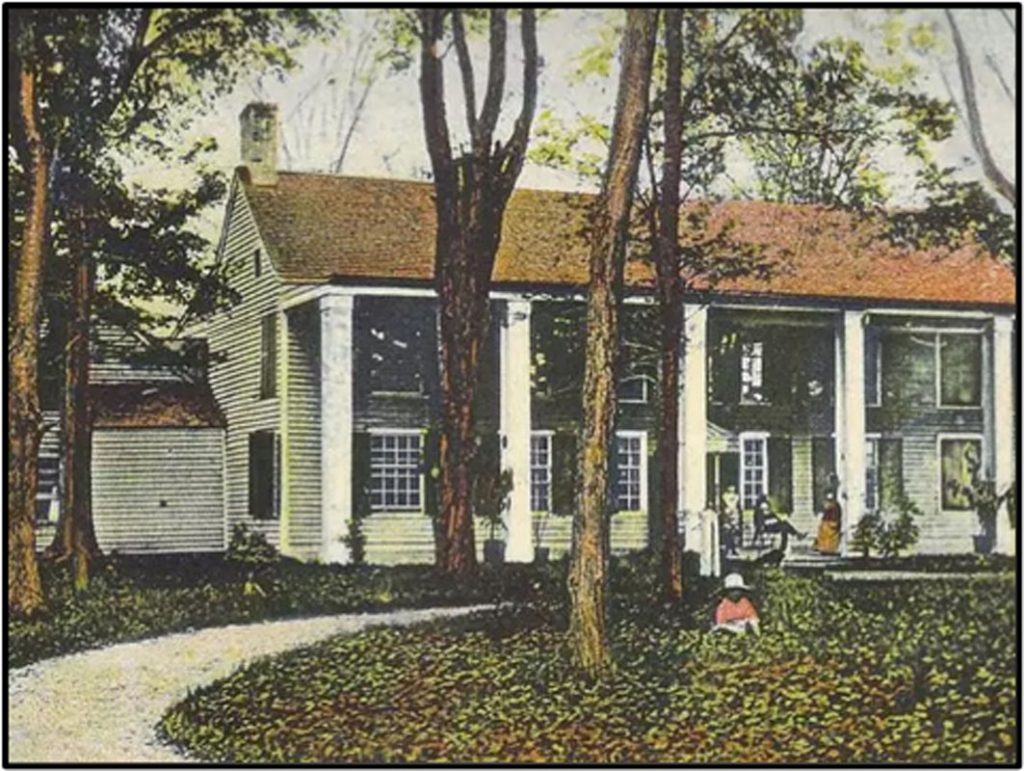
The Leland House – 275 Years Young


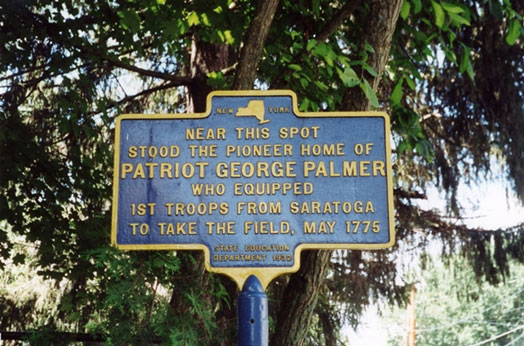
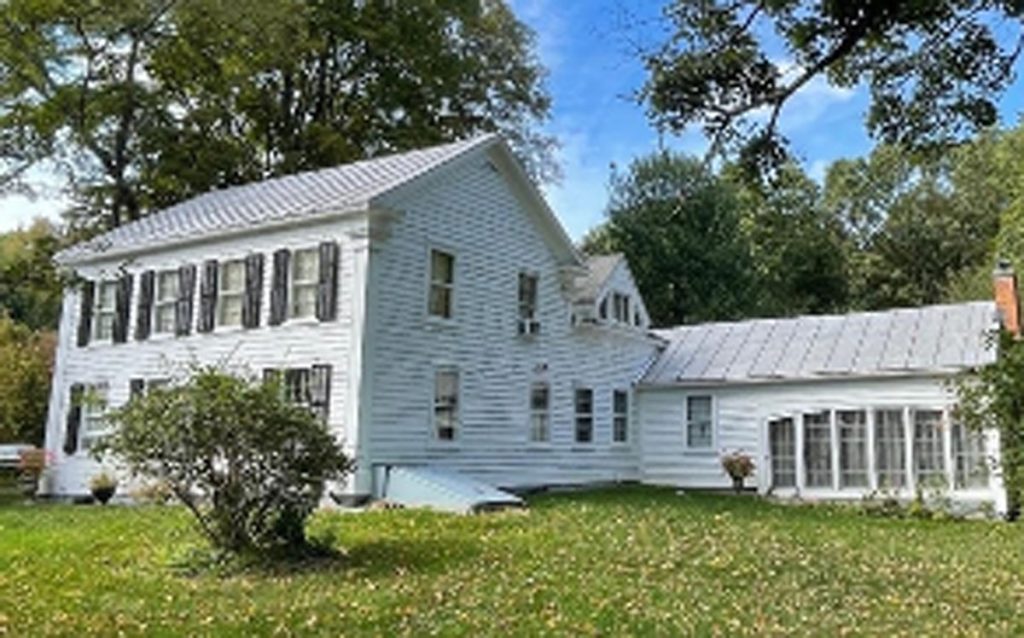
A historic marker along the Waterford Road denotes “Leland House: Raided by French and Indians in 1748, rebuilt in 1749, later the home of revolutionary patriot John Ten Broeck 1740-1822.”

The beautiful house that stands a short distance from the marker is indeed the one that was rebuilt 275 years ago.  It was built from lumber cut right there on the farm, with bricks made from clay obtained from the soil thereon.

But just what happened and why did it happen to the family that lived on that spot and farmed what has for many years been known as the Leland Farm back in 1748?  It was a sad occurrence, but by no means an isolated incident back in the 18th century here in our area.

As settlement by countries of Western Europe grew in this so-called New World, the English and Dutch were predominant in the areas along the Atlantic Coast, but France controlled Canada to the north and the wilderness lands to the west of the English territories.  Along with the English were colonists from the Netherlands, Scotland and Ireland.  The French befriended the native peoples, and worked with them to drive the encroaching settlers from their ancestral lands.

The first recorded claimants to the lands of the Mechanicville/Stillwater/Schaghticoke area were the Mohican Indians, ruled by Uncas, who claimed ownership of the entire upper Hudson Valley starting at a point near Cohoes.  This was Uncas’ very special hunting grounds, beginning near Waterford and running all the way to Schuylerville. While Uncas may not have actually lived right here, history does place him at Schaghticoke.  But his warriors did come this way as did those of other tribes.  All the Indian trails coming out of the St. Lawrence Valley crossed here for this was known as the dark and bloody neutral grounds that separated the Iroquois Confederacy of central New York from the territory of their ancient and hereditary enemies, the Algonquins of Canada.  Throughout time, there were many savage encounters among these tribes.

Indians had planted, hunted and fished on these lands for centuries, leaving behind stone implements and arrowheads which chronicled over 1,000 years of their civilization. The first Dutch settlers came into the Upper Hudson River valley in 1714. The newcomers hewed out a half dozen log huts in a forestland near Waterford north of the river’s confluence with the Mohawk and called it Half Moon.  Within a year, 101 people had settled here.

Situated in a flat river valley, with a major north/south route passing by it, on a road that would be called the King’s Highway, or eventually the Waterford to Whitehall Turnpike, what would become known in later years as the Leland House was part of that pioneer settlement.

Major Dirk Wessels (Ten Broeck) was commissioner of Indian affairs, a mayor of Albany and a trader and merchant. He owned a one-seventh share of the Saratoga Patent.  From this patent, the Ten Broeck family had obtained 700 acres of land along the river.  The substantial house was built on that property by 1732.  Land was cleared and farmed by not just the family occupying the house, but by the black slaves they owned.  At that time, the Albany Dutch community owned many slaves.

What is now Mechanicville sat smack on the edge of “the Paradise of Hunting Grounds” known as Sa-ra-gh-to-ga. The southern boundary of the hunting grounds was a creek that ran from Round Lake to the river and was known as Tien-en-da-ho. Eventually the Mohawks, the most powerful tribe of the Iroquois confederacy, drove out the Mohicans and took over this area.

Early settlers in Mechanicville in the area of Ensign Avenue unearthed evidence of a Mohawk village along the flatlands of the river.  Another encampment was located near the powerhouse where fish were plentiful. What would become known as the French and Indian War, which would ultimately secure this part of North America as a British colony, would not begin until 1755, but raids, killings and burnings by the French and their Indian allies were commonplace throughout this area in the early to middle years of the 18th century as they attempted to drive out the encroaching trappers and settlers from Britain and the Netherlands.

So it was that in 1748, the family that was living in the house and farming the land then owned by the Ten Broecks alongside the Hudson River was attacked in the night by a band of Mohawk Indians and their French allies.  The farmer, his wife and five children were killed and scalped.  Also murdered in the raid were their five black slaves. The house was burned.

Since that fateful day, this historic house, which was rebuilt in 1749, and its accompanying farm have seen many changes.  Originally belonging to the Ten Broecks, it was then occupied by Daniel Fort, sold to Scotsman John Strachan and then passed on through marriage or inheritance to the Lelands, the Leyerles and the Stevensons. The original Ten Broeck grant comprised 700 acres, but several hundred more acres were added by Strachan, so that the farm then occupied nearly two square miles of land.  Occupants of the house that was rebuilt after the massacre, in its more than 272 years of existence, have included lawyers, government officials, educators, engineers, farmers, horticulturists and caregivers.

The land itself has over the years been much diminished as with its prime location on a major river and north/south highway, it has been given over by sale or by government claim for two railroads, two major power lines, two canals, a dam, lock and hydroelectric plant and the Saratoga County sewer plant along with a number of homes and several businesses.  The house, once known as the mansion, was converted to apartments a half-century ago and several of the barns have been converted to houses.

But some things don’t change.  There were stories passed on for many years that the ghost of a headless Dutch woman frequently appeared in a well near the Leland House.  Perhaps she was that farmer’s wife, killed and scalped by a raiding party of French and Indians in 1748.  So spooked were subsequent occupants of the home by her frequent visitations that they filled in the well.  From some reports, however, that has not kept her away.