On Monday, August 3rd the New York Racing Association (NYRA) and Churchill Downs Incorporated announced the formation of the “Thoroughbred Championship Series.” A new season-long championship for 3-year-olds that will include six races across Saratoga Race Course, Belmont Park, and Churchill Downs Racetrack.
The inaugural season commences next year in 2027 which includes the Kentucky Derby and newly created Championship Race at the Churchill Downs Race Track, the Belmont Stakes and Matt Winn Stakes at Belmont Park, and the Jim Dandy Stakes and Travers Stakes at Saratoga Race Course.
This season-long championship is the first of its kind in horse racing, targeted at a younger generation of sports fans according to Churchill Downs Incorporated CEO Bill Carstanjen.
“Today’s fans experience sports differently than they did a decade ago. They want stories that unfold over time. They want rivalries, standings, and meaningful competition that builds from one event to the next. They want a championship they can follow throughout an entire season, and they want to see a champion crowned each year to celebrate.”
The Thoroughbred Championship Series aims to provide enticing storylines for fans; and a five-million-dollar prize pool to incentivize owners and trainers to participate.
This new championship series puts Saratoga in the spotlight of it all, using the Jim Dandy Stakes and Travers Stakes amid a larger championship.
Notably the Preakness, the second Stake in the racing calendar for the Tripple Crown is excluded from the Thoroughbred Championship Series.
Churchill Downs Incorporated tried to purchase the rights to the Preakness Stakes and Black-Eyed Susan Stakes last month. However, the former owner of both Stakes, 1/ST Maryland LLC had a deal that Maryland could match any offer to buy the rights, and that’s exactly what they did.
The Maryland Economic Development Corporation finalized the rights of the Preakness Stakes and Black-Eyed Susan Stakes for 85 million dollars. This came less than a week before NYRA and Churchill Downs Inc. announced the formation of the Thoroughbred Championship Series.
Time will tell if the Thoroughbred Championship Series establishes itself with the same prestige as the Tripple Crown, or if it will captivate a younger demographic.
As for Saratoga Race Course, each race in the series will be nationally broadcasted, furthering its reputation as a worldwide destination for premier horse racing.
GlobalFoundries and the United States Department of Commerce have entered into a letter of intent to accelerate research and development of next-generation silicon photonics. The U.S. Department of Commerce is expected to award 300 million dollars to GlobalFoundries under the CHIPS and Science Act.
The award will accelerate GF’s development of next-generation silicon photonics wafer technologies, novel optical materials and advanced packaging. This work builds directly on GF’s recently introduced SCALE™ (Silicon Photonics Co-Packaged Advanced Light Engine) platform, targeting industry-leading modularity, 400Gb/s performance and a 5x increase in energy efficiency over current-generation implementations.
In a separate agreement, the U.S. Department of Commerce will receive equity from Global Foundries, representing approximately 1 percent ownership as of July 29th.
Silicon photonics enables ultra-high bandwidth, energy-efficient data movement by transmitting information with light rather than electrical signals — delivering greater performance, higher interconnect density and lower power consumption as AI and data center workloads scale.
“Silicon photonics is essential to AI infrastructure. For a decade, the industry talked about the shift from copper to optical as something that was coming. Today it is here, moving data at higher bandwidth and improved power efficiency as workloads grow more complex,” said Tim Breen, CEO of GlobalFoundries.
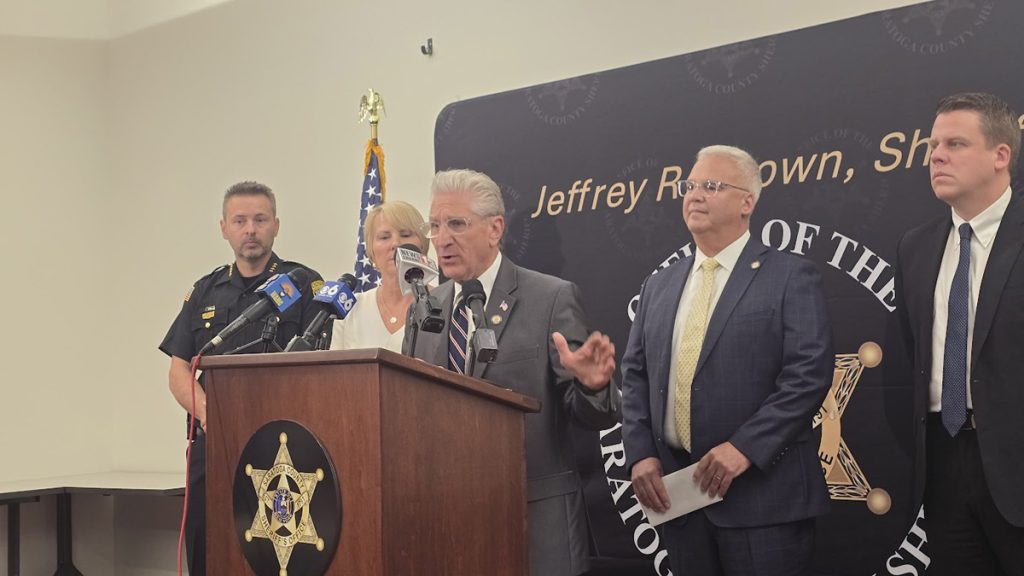
Legislators and local law enforcement officials held a press conference announcing new legislation that would stiffen penalties for child neglect. (Aidan Cahill)
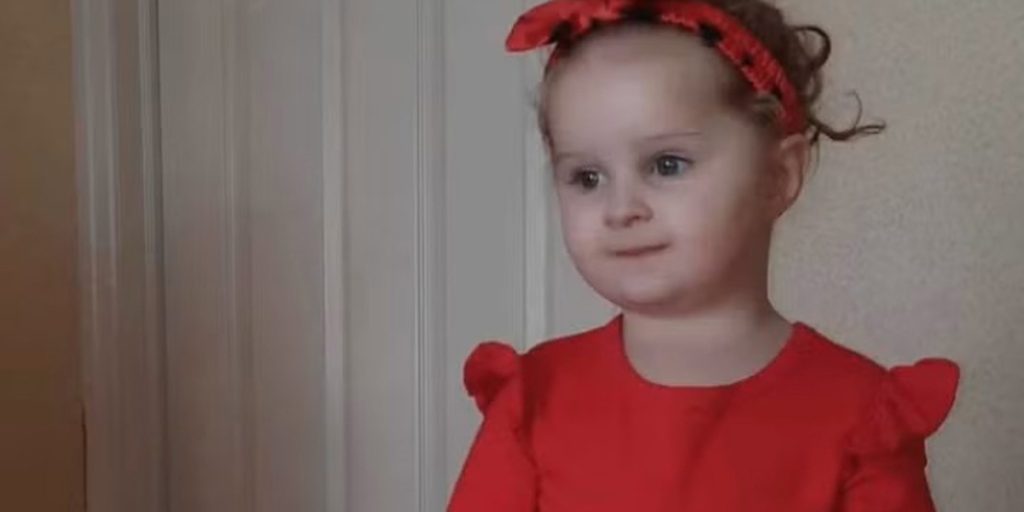
The Death of a three-year-old girl in Corinth has prompted members of the state legislature to push for a new law aimed at increasing penalties for Child Neglect.
The bill, named “Joycelynn’s Law,” is named for Joycelynn Ann Dylewski who died in February 2025 after being found covered in lice and struggling to breathe in Corinth.
The death of Joycelynn Ann Dylewski and subsequent outrage over the 1⅓ to four year sentence for her parents for causing her death prompted the new bills
After her death, Dylewski’s parents Matthew and Samantha were arrested and eventually plead guilty to criminally negligent homicide and lost custody of their other four children. In June, the two were sentenced to 1⅓ to four years in prison — the max penalty under New York Law.
This sentence is what prompted Senator Jim Tedisco and Assembly members Marry Beth Walsh and Matt Simpson to propose legislation that would enact severe penalties when a parent or guardian causes the death or injury of a child through neglect.
The proposed legislation would amend the current statute for endangering the welfare of a child by creating a new felony charge, aggravated endangering the welfare of a child, resulting in sentences of 25 years to life for causing the death of a child and 5 to 15 years for causing severe injury.
In a press conference held on Aug. 4, Senator Tedisco outlined the reasons for the law, arguing that the sentence didn’t provide justice for the three-year-old.
“What we’re trying to do is provide justice,” Senator Tedesco said. “We’re not going to get the justice for Jocelyn, but the only good thing maybe is we can get some justice from some other children, and possibly send a message to individuals who are going to provide this type of neglect, this type of care, this type of trauma to young children.”
Tedisco also talked about the condition that Dylewski was found in, emphasizing the need for new legislation.
“The child had not visited a doctor or a dentist in close to one year,” Senator Tedisco said. “Her teeth were decayed and blacking. Her body was full of lice. She was skin and bones not getting nutrition, and she was given clonidine, which is a drug not prescribed for her.”
The legislators were joined at the press conference by Saratoga County Sheriff Jeffery Brown and District Attorney Brett Eby, both of whom spoke about the case and offered support for the legislation. Brown said the legislation helps solve a gap in the current laws by introducing more accountability in the system.
“Accountability when we make an arrest, we get a conviction is important,” Brown said. “The laws simply do not allow these defendants charged with these types of fact patterns to be held appropriately accountable.”
Eby, meanwhile, expressed similar sentiments and also announced the creation of a new task force to deal with child abuse in Saratoga County.
“In the next few days, we’re going to be announcing the members of the Child Safety Review Commission, which is a multi-discipline effort that’s going to have Saratoga County residents that work in the school system, family court system, law enforcement, legislators to try to have a holistic approach to see where the gaps are in the system, so we can prevent future tragedies,” Eby said.
The bill has yet to receive a number in the assembly and is currently being reviewed by the Rules Committee of the State Senate. In addition, Senator Tedisco’s Office is circulating a petition on his website encouraging passage of the bill.
A photo of Bobby D’Andrea (left) with Senator Tedisco at the late Assemblyman’s home. (Courtesy of Senator Tedisco).
Coming into Saratoga on Union Avenue it’s easy to see the impact of the late former Assemblyman Robert D’Andrea.
Starting at Fish Creek, the road takes residents and visitors from the rural east side of the County and into the heart of downtown Saratoga Springs. It passes by both the quiet retreat of Yaddo and the thrilling spectacle at the Race Course before ending at Congress Park.
But before reaching those key landmarks, visitors traveling on Union Avenue and exiting Interstate 87 north have to cross a small bridge that will now bear the name of the man who represented the area for over 27 years.
The bill to rename the bridge was sponsored in the Senate by Senator Jim Tedisco (R,C) and in the Assembly by Assemblywoman Carrie Woerner (D). The bill passed both houses unanimously on June 2 and was signed by the Governor on July 31.
“Assemblyman Bobby D’Andrea was a good friend and an outstanding and dedicated public servant who was always accessible and visible to his constituents and a strong voice for them,” Senator Tedisco said in a statement. “I was proud to have served with Bobby in the Assembly and work to get this bill passed for his family and remember his legacy of service to others.”
Known as ‘Bobby,’ D’Andrea represented Saratoga Springs at the county level as Supervisor for seven years and as an assemblyman for 27. In the that time, he was known for his efforts in environmental conservation and staunch community support.
One of D’Andrea’s most notable was the expansion of New York’s recycling program so called ‘Bottle Bill’ which requires a five-cent deposit on many non-reusable containers in New York. D’Andrea was the sponsor of the bill, whose legacy can be seen on every bottle or can bearing “NY 5¢”
D’Andrea helped clean up the lakes of the state by introducing legislation requiring ice-fisherman to remove structures before the thaw and improving regulations for transporting horses in the state.
On a local level, D’Andrea secured funding for the Saratoga Springs Civic Center and intervened when Saratoga Central Catholic High School — at the time known as St. Peter’s Academy — was set for closure in the 1970s.
Outside of politics, D’Andrea owned the Kaydeross Amusement Park for 30 years. When the park closed, the hand carved carousel was sold to the City of Saratoga Springs where it was restored and placed in Congress Park.
Members gathered outside of NYS Military Museum and Veterans Research Center for unveiling of Augmented Reality Display (Courtesy of Adam Mason)
The New York State Military Museum and Veterans Research Center, located at 61 Lake Ave., has unveiled a new interactive augmented reality display featuring four prominent figures from the 1777 Battles of Saratoga, the turning point in the American Revolution.
Arrayed along the museum’s Revolutionary War section located just inside the entrance to the facility’s main exhibit floor, the display gives visitors the opportunity to use their smartphone to watch the 3D figures materialize and share personal perspectives on the events that played out along the Upper Hudson River in September and October 1777.
The Military Museum display is part of Saratoga 250’s ongoing county-wide commemorations leading up to next year’s semiquincentennial of the Battles of Saratoga, considered the turning point of America’s fight for independence. The victory at Bemis Heights prompted France to provide the fledgling United States with troops, materiel, money and naval assets, support that led directly to the British surrender at Yorktown in 1781.
Underwritten by a grant from the Rotary Club of Saratoga Springs, the augmented reality exhibit at the Military Museum is among several such interactive displays located at other venues in Saratoga County, including the Saratoga Springs Public Library, the Saratoga Springs History Museum at Canfield Casino and the Saratoga Springs Heritage Area Visitors Center.
“This display offers a fun and interesting way to interact with some of the most prominent figures from our history and hear from them, in their own words, about the role they played at Saratoga,” said Bill Teetor, Executive Director of the Campaign for Saratoga 250, Inc. “As we approach the 250th anniversary of America’s turning point, Saratoga 250 and our partner organizations will continue to educate and engage the public on the importance of preserving the battles’ significance with new generations, while at the same time introducing visitors to our region’s rich history.”
“We are so pleased here at the Military Museum to add these augmented reality banners that can give a voice to the history here in Saratoga,” said Richard Goldenberg, Director of Military History for the New York State Division of Military and Naval Affairs. “Our commemorations of the Battles of Saratoga are a community-wide event, and we are thankful to the Saratoga Rotary Club and the Campaign for Saratoga 250 for their support in bringing these banners to our Revolutionary War exhibit floor. As we celebrate the 250th anniversary of the Declaration of Independence this summer, we are reminded that the words put to paper in 1776 were secured by the victories at Saratoga in 1777.”
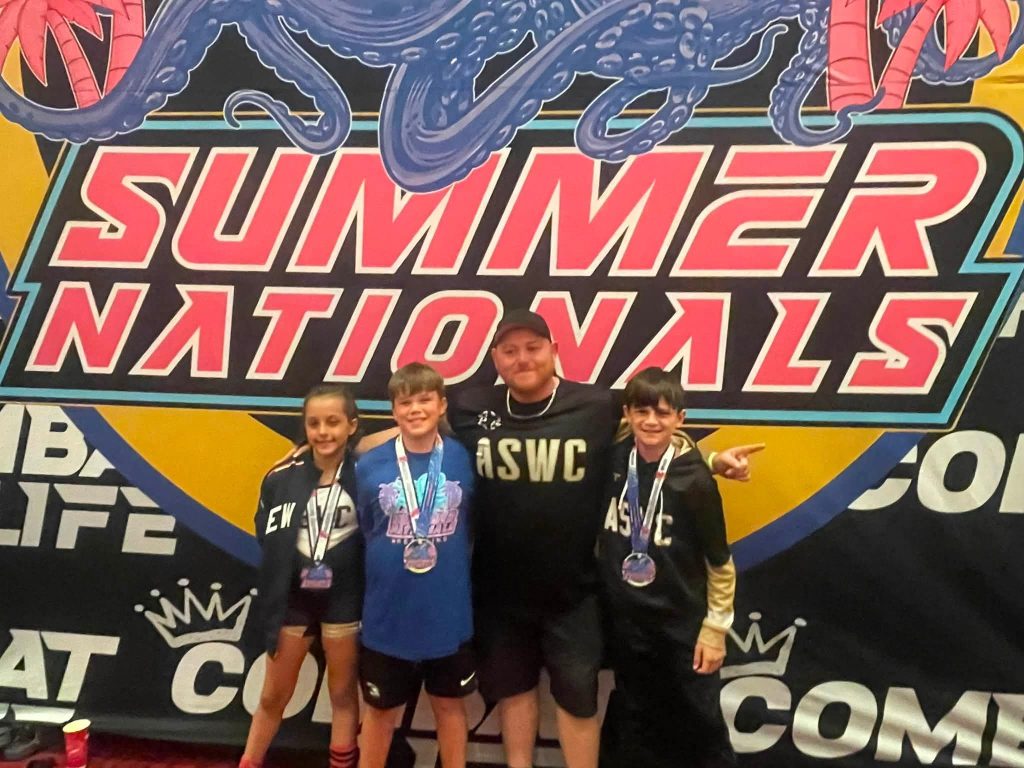
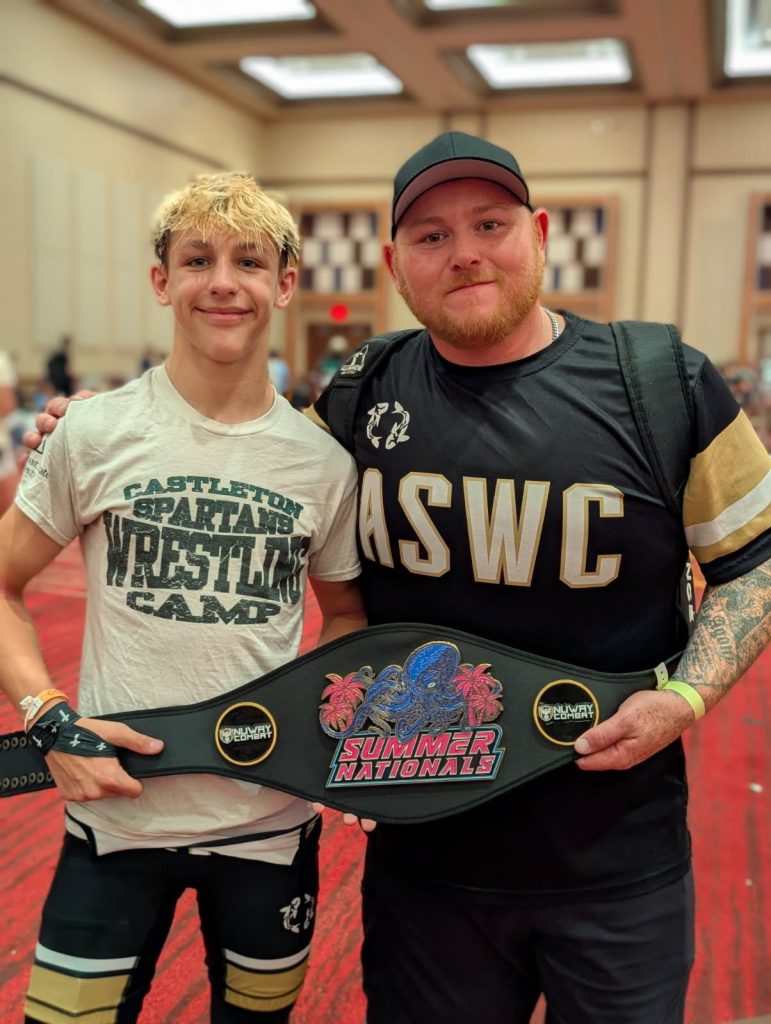
Olive Till, Jaxson Fittson, and Brenden Voland with Coach Dan Ladd (Dan Ladd)Damien Snyder with Coach Dan Ladd (Dan Ladd)
Alliance Saratoga Wrestling Club sent four of their students to Atlantic City on July 21st to compete in the NuWay Combat National Wrestling Championship. All four wrestlers made the podium and two are national champions.
Damian Snyder won the 135lb under 13 open division, going 3-0, including a thrilling triple overtime win with a late reversal.
Brenden Voland won the novice 10 and under 130lb division, going 3-0, with a pin in the final to win the division.
Jaxson Firstiun came in as runner-up in the Novice 12 and under 90-95lb division, going 3-1 with 2 pins on the day
Olive Till came in fourth in the girls 12 and under 90-95lb division, going 0-3. Till had a great match against former UFC lightweight champion Frankie Edgar’s daughter.
Till’s coach Dan Ladd, a black belt in Alliance Jiu-Jitsu had high praise for her outing: “Half of life is showing up and that girl grinds.”
All four athletes hold rank with Alliance Jiu Jitsu Saratoga and Snyder won the WBC Muaythai Championship last year.
Alliance Jiu Jitsu Saratoga recently expanded their training spaces to the Wilton Mall in 2023. Anyone interested in learning the art of self-defense through Brazilian Jiu Jitsu or any of the other arts they offer can sign up for classes at https://saratogajiujitsu.com.
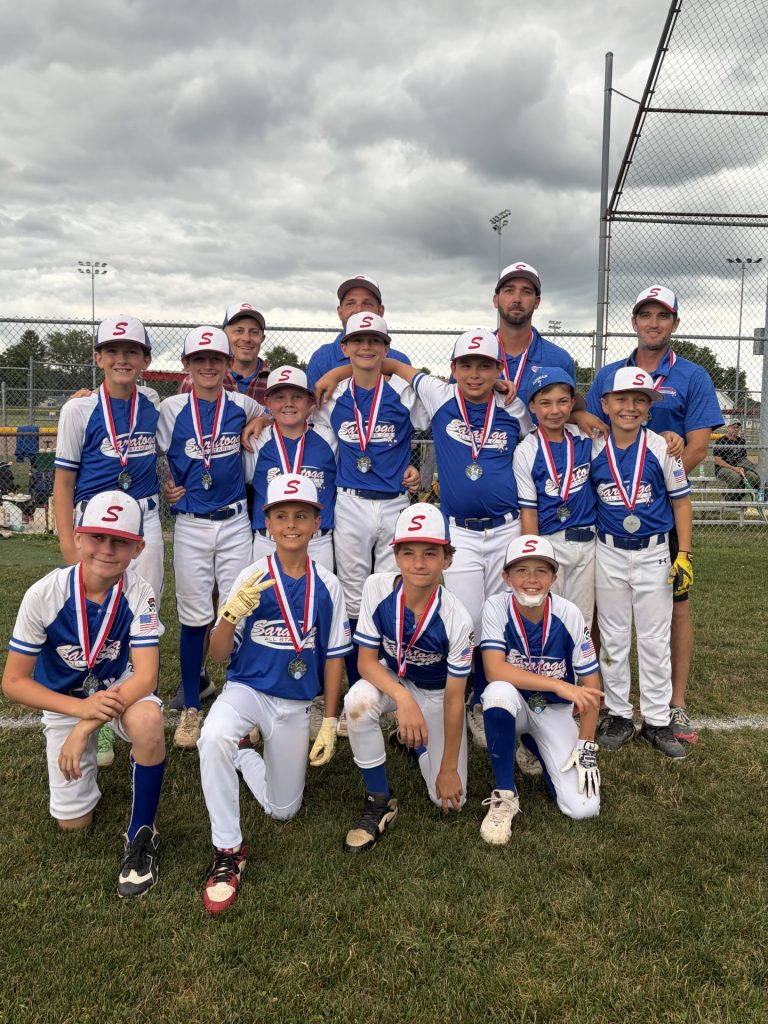
(Saratoga Springs All-Stars after winning Second in the State)
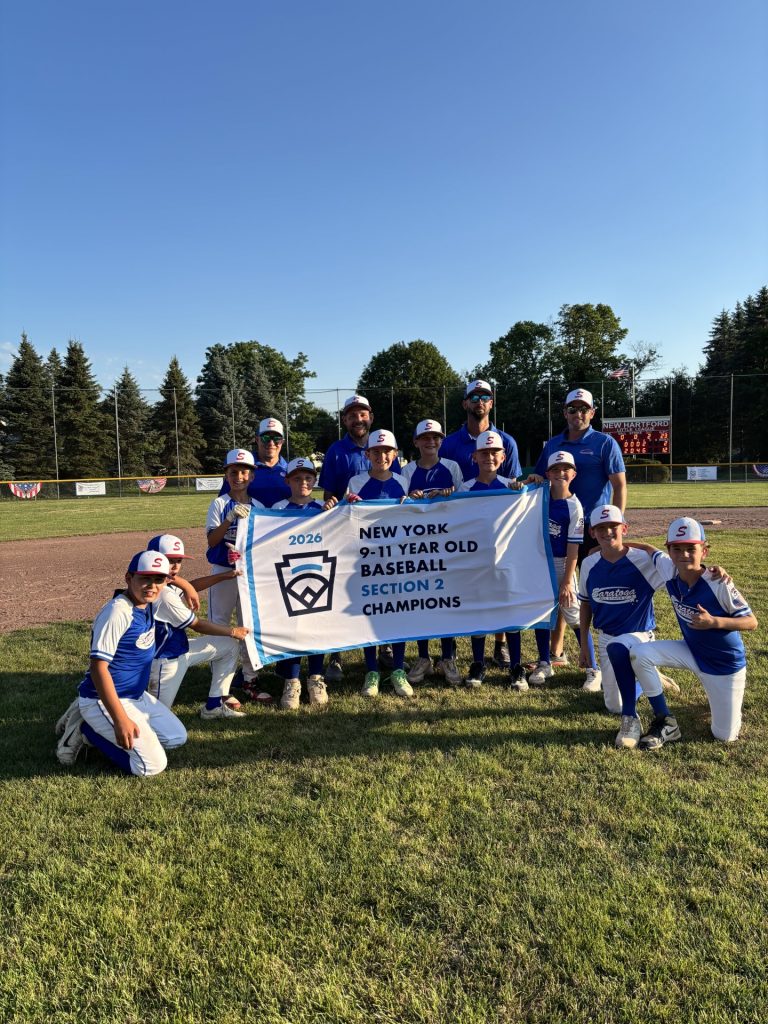
(Saratoga Springs All-Stars After Winning the Section)
(Saratoga Springs All-Stars After Winning the District)
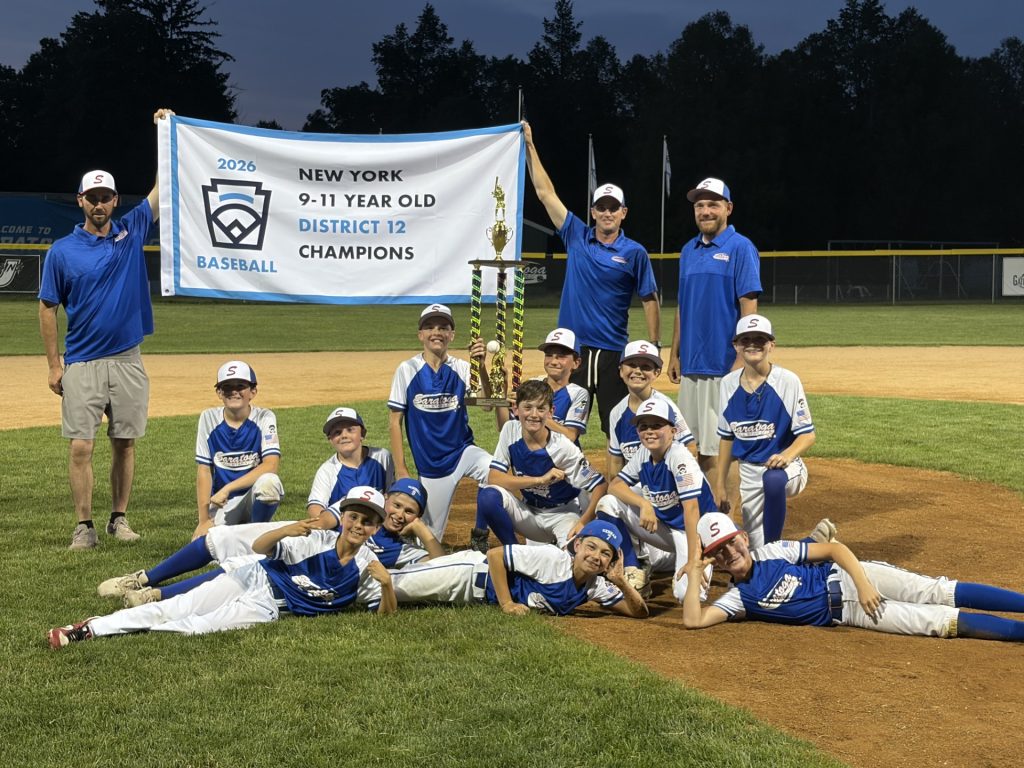
The Saratoga Springs Little League U11 all-stars came back home as New York State Little League Runners-Up. The group traveled to Baldwinsville last week to compete in the New York State Little League 9-11 Championship.
At the end of the spring season, an all-star team of 12 players is selected from the five little league teams in Saratoga. The kids and coaches then practice seven days a week in preparation for the win or go home tournament from late June through July.
The team first won in the divisional round against Rotterdam both home and away. Then the team traveled to Utica to compete for the Section 2 title. Saratoga completed a clean sweep, beating New Hartford and North Central to attain the Section 2 trophy.
The team then traveled to Baldwinsville to compete against the seven other sectional winners in the championship from Saturday, July 18th through Wednesday the 22nd.
“You were guaranteed at least two games, and then we just kept winning,” Coach Brandon Ture told Saratoga TODAY. “The families just kept extending their stay. Some days we wouldn’t even know if we would be staying until we finished the game at like 8 o’clock at night.”
Saratoga started off their tournament with a walk-off win against Pearl River. Max Annese tied the game 4-4 in the sixth with an RBI single to set up River Bianco to complete the comeback in the bottom of the seventh with another RBI single.
In the second round on Monday, July 20th, Saratoga lost to the eventual winners, Massapequa, sending them to the consolation bracket.
Later that Monday, the boy’s defense and pitching shined, beating Penfield Little League 2-1 in a cagey affair. Beck Miller and Ryder Pollock combined for an outstanding performance on the mound, allowing just one run while striking out six. Combined with flawless defense, turning a double play and committing no errors, the team advanced.
Then on Tuesday, both teams’ offences showed up to the plate, but a 5-run inning allowed the Saratoga boys to emerge victorious. The final score was 10-7 against the Great Kills. Beck Miller had a standout performance, going 3 for 3 at the plate with a home run, a double, single, and two RBIs.
In the semi-final, the Saratoga all-stars were on a roll and would not be denied a finals appearance, batting in 15 to Smithtown’s 4 to claw back from the consolation bracket.
Since the tournament was double elimination, Saratoga needed to beat Massapequa twice in a row to win the tournament. As fate would decide, Saratoga finished their outing in Baldwinsville as runners-up, a proud accomplishment and life-long memory.
Jesse Costa at Saratoga Race Course (Courtesy of Tony Podlaski)
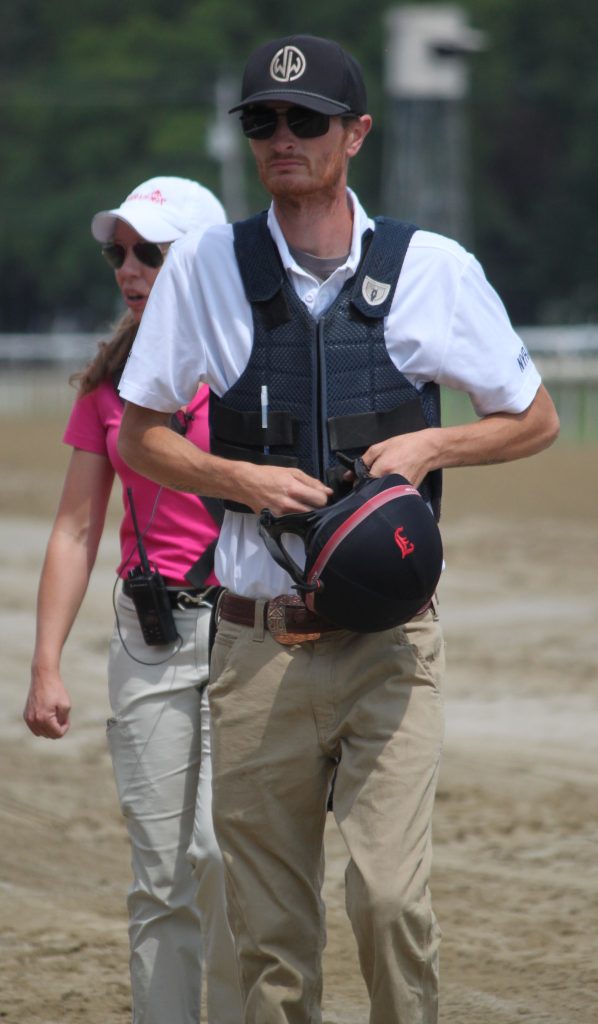
Jesse Costa has made a career out of his natural ability with horses, a gift that continues to shape his work at the racetrack and his hobby.
As an assistant starter for the New York Racing Association, Costa spends his mornings and afternoons helping horses into the starting gate. Outside the track, he participates in rodeo competitions and works with horses for riding.
“I got a good gift with horses,” the 29-year-old Saratoga Springs native said. “They talk back, but they don’t speak to you. They show you. You can read a horse. You will know exactly what they’re going to do.”
Although he never received any formal training, Costa learned about Thoroughbreds as a child at Belmont Park where family’s horses were trained by Dominic Schettino.
“Every weekend, I was at Belmont Park. That was my backyard. That was my playground,” Costa said. “I learned a lot underneath him about the racetrack life from the bottom up. Also, I sat around for long hours watching older guys. I picked up little things. It was just natural.”
At 18, Costa became a NYRA outrider. After about 18 months at Saratoga Race Course, Belmont Park, and Aqueduct, he was head outrider at Gulfstream Park for four years before returning to New York in January 2024.
About eight years ago, Costa faced a life-changing experience: trigeminal neuralgia, a chronic pain disorder. After three brain surgeries, he had an epiphany and decided it was time for a change.
“It felt like jumper cables were on my face,” he said. “There would be times when I got a flare up. Now, I’m pretty good, knock on wood. It took me a while to realize it … life is too short. I took a step back and realized the worked that I done at Gulfstream for four years. I missed a lot. Family and everybody was up here. I’m grateful for being down there. It was a great steppingstone.”
That steppingstone lead into his next career: an assistant starter.
During the Keeneland spring meet in 2020, Scott Jordan, NYRA’s current head starter, recruited Costa to serve as an assistant starter for the Kentucky Oaks and Kentucky Derby when his team was short-handed. Despite having no starting gate experience, Costa was successful; he was invited back to Churchill Downs for the following year.
This spring, Jordan offered Costa a position as an assistant starter. Costa believed this was part of his future.
“I like the gate. When I was a kid, I always hung around the gate,” he said. “Eventually, it was going to happen. I just didn’t know when. It was a pretty easy transition. These guys took me underneath their wings. It’s better on my body right now. It also gives me more time to do some other stuff.”
Outside the racetrack, Costa enjoyed team roping since he was 14 after learning the sport from rodeo legend Roger Stockton at his Ballston Spa ranch.
“When we were up here for the summers, he would always bring me up to his house where he had a roping arena and a bunch of horses,” Costa said. “I would help him, and he would teach me how to rope. That’s how I got a liking to it.”
Costa spends his time at Riding High in Warrensburg on Mondays, as well as the Painted Pony Championship Rodeo in Lake Luzerne on Wednesdays and the Lucky E Rodeo in Broadalbin on Thursdays – both part of the International Pro Rodeo Association and the Interstate Rodeo Association organization.
As a rookie in the IPRA and IRA circuit, he also participated in the team roping competition at the Saratoga County Fair on July 22. One of his riding partners is Robbie Erck of Fort Edward, the son of the former NYRA lead outrider Steve Erck. Like many aspiring rodeo riders, Costa dreams of advancing to that next level.
“I just like the adrenaline,” Costa said. “It’s the closest thing I kind of get right now to catch a loose horse. It’s you and your horse. It’s also you and your partner. If I can stick with it and keep on doing what I’m doing, I would like to eventually [compete at the next level].”
While a riding partner is important to team roping, Costa knows a dependable horse is just as essential. For the last five years, McCall has been that horse, a former Kentucky ranch horse he purchased while working as an outrider at Gulfstream Park and later transitioned into rodeo competition.
“During the meet, I didn’t want to put too much pressure on him,” Costa said. “I never took him to the rodeo … because I needed them here. Now that I’m not [outriding], it’s time for him to shine.”
Costa also has Smokey, a big white Quarter Horse that caught his attention after Hall of Fame trainer Bill Mott purchased him at Payson Park more than two years ago. After keeping Smokey for a year, he offered the former show horse to Costa shortly after Sovereignty won last year’s Kentucky Derby.
“I got over to his barn, sat down in his office, and he said, ‘Son, you got $10?’ There’s a horse in the next barn, he belongs to you,” Costa said. “He was a little-too-much horse for Bill. He was most of a catch horse rather than a stable pony.”
Because no one rode Smokey in two years, Costa needed patience with him.
“When I got on him, he almost bucked me off,” Costa said. “That night, I roped about 4-5 cows when I was on him. He’s a finished horse. It’s very hard to find horses that can do it all. I am blessed to have two of them.”
Besides McCall and Smokey, Costa recently rescued Elton, a palomino yearling in Texas for $850. He is hoping to develop Elton after the Saratoga meet.
“When I bought him, he was a runt,” Costa said. “That’s my new hobby now. He might be a stable pony. He might be a rope horse. He might be a barrel horse. He might just be an ornament. Who knows? I’ll see what he wants to do.”
Costa also assists other trainers with difficult horses, including two sent to him by Finger Lakes trainer Paul Barrow this spring that showed remarkable improvement in their temperament after about two months of work.
“They were a little too much for them at the moment,” Costa said. “One of them was bucking people off. He wasn’t bad. He had a personality. Once he figured you out, the bond was good. I sent them back and they couldn’t believe how good they were.”
Over the past 11 years, Costa has evolved from outrider to an assistant starter, pursued rodeo riding, and overcome a rare medical condition. These changes have shaped him.
“It’s a big change, but it was a good change,” he said. “I like it so far. Everything’s going smooth.”
The Saratoga Special Stakes for juvenile colts and fillies will be run on Saturday, August 1, and dates back to 1901. The race was conceived by William C. Whitney in the first year his consortium operated the Spa track. Mr. Whitney was fond of a fast horse and was proud to own a colt or filly that he deemed worthy of special appreciation and admiration, backing that up with a $500 subscription fee for the race.
What made it “Special” is the purse was “winner-takes-all,” a truly sporting gesture, which stated you believed your 2-year-old was the best of the best. Mr. Whitney’s bay colt, Goldsmith, won the initial running of the Saratoga Special with Hall of Fame jockey Nash Turner in the saddle.
A fine tradition and exclusive event that went along with the race was the Saratoga Association President hosting a dinner party on the eve of the running, for all those that had subscribed to the Saratoga Special.
Man o’ War’s trainer, Louis Feustel, had forgotten to pay the subscription, which left Big Red out of the “Special.” Other famous horses have won the Saratoga Special, such as Irish Lad, Sysonby, Roamer, Regret, Sun Briar, Morvich, Whirlaway, Native Dancer, Bold Forbes and Summer Squall. The sporting “winner-takes-all” purse structure was discontinued following the 1958 running.