461 Broadway: A Saratoga Christmas Tradition


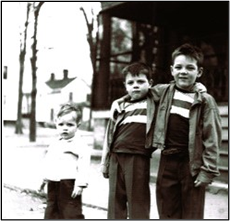
Glickman’s Men & Boys Shop 1929-1989                                                      George S Bolster Collection-Saratoga Springs History Museum

by Carol Godette  | Sponsored byThe Saratoga County History Roundtable

Contact The Saratoga County History Roundtable at: saratogacohistoryroundtable@gmail.com

G. Willikers: On This Spot

For generations, stepping inside 461 Broadway has been a sensory delight for Saratogians. Currently home to G. Willikers Toy Store, the address remains a hub of enchantment and community connection. For over 40 years, Linda Ambrosino and her husband have infused downtown Saratoga with holiday magic, captivating locals and visitors alike with their NYC-quality Christmas window displays.

This year’s display is no exception. The first window invites onlookers into a warm, nostalgic scene: a family gathered around a classic movie projector. The following windows come alive with intricate depictions of the films they are watching, drawing delighted murmurs from passersby. People pause to marvel, trying to identify each movie, their faces lighting up with childlike wonder. Inside the store, the enchantment continues. The upper shelves are adorned with snowy landscapes and whimsical woodland creatures, creating a magical atmosphere that makes every visitor feel like a kid again.

For Linda, these festive displays are a labor of love. She smiles when asked about her favorite Christmas window from the past four decades but admits that it’s an impossible choice. “They’re like children,” she says. “You love them all in different ways.”

But the magic of G. Willikers extends beyond its decor. The store’s charm is steeped in the history of its location. Before Linda brought toys and holiday cheer to 461 Broadway, the building housed another beloved family business that defined downtown Saratoga for 60 years: Glickman’s Men’s and Boys’ Shop.

A Look Back: Glickman’s Legacy

Founded in 1929 during the Great Depression by Henry and Pauline Glickman, Glickman’s Men’s and Boys’ Shop quickly became a downtown Saratoga institution. Specializing in men’s workwear, the store served local firemen, policemen, and tradespeople, offering durable clothing at fair prices with top-notch customer service. Over the decades, Glickman’s expanded its offerings under the guidance of Charlotte Glickman Albert, the founder’s daughter, who introduced women’s apparel to the store.

For local teenagers in the 1970s, Glickman’s was the go-to destination for fashion staples. “It was where we got our uniform of the day,” recalls one loyal customer. That uniform often included jeans or corduroys, a Northern Isle patterned sweater, a navy CPO jacket, and Converse sneakers. Kathy Wilson Cleary fondly remembers the rainbow stacks of cotton turtlenecks lining the store’s old wooden counters, while Weezie Foye describes weekly visits after cashing her paycheck at Adirondack Trust.

The sensory experience of shopping at Glickman’s remains vivid in the memories of many Saratogians. Entering through one of the two wooden and glass doors, customers were greeted by the hum of fluorescent lights and the distinct smell of mothballs from wool sweaters. The creak of wooden floors alerted the Glickman and Albert families to greet their next customer warmly.

A Family-Run Business with Heart

Glickman’s wasn’t just a store—it was a family operation that reflected the dedication and values of its owners. Henry Glickman worked well into his 80s, while his son-in-law, Jerry Albert, joined the business in 1958. The Alberts’ three daughters—Robyn, Sharon, and Alicia—helped out during summers and holidays. Alicia, the youngest, recalls being relegated to the basement to inventory Levi’s jeans, underwear, and other items, attaching handwritten price tags.

Upstairs, her grandmother managed the cash register with unmatched efficiency. Always dressed in a circle pin with an attached pen for writing receipts, she epitomized the professionalism and warmth that customers loved.

The family’s commitment to their business often meant long hours and few days off. Glickman’s was open six days a week, expanding to seven during the holiday season. Alicia remembers her father attending her high school graduation but leaving early to man the store, a moment captured in family graduation photos taken in front of the shop.

The personal touch extended to the customer experience. Bill Petit, a longtime Saratogian, recalls seeking advice from Mr. Albert for a wardrobe update. He left the store with a new outfit that boosted his confidence and even helped him impress the girl of his dreams that very night.

An Era Ends, A Legacy Continues

When Glickman’s closed its doors in January 1989, it marked the end of an era. A heartfelt editorial in The Saratogian lamented the loss of “homespun, meat-and-potato retail stores” that had long defined downtown Saratoga Springs.

Yet, the spirit of 461 Broadway lives on through G. Willikers Toy Store. While the creaky wooden floors and mothball-scented sweaters have given way to snow-dusted shelves and whimsical toys, the building continues to create cherished memories for generations of Saratogians.

At Christmastime, this legacy shines brightest of all. Whether it’s the nostalgic glow of the holiday windows or the timeless warmth of a family-run business, 461 Broadway remains a beacon of Saratoga’s enduring magic.

Mechanicville in 1902


by Sandy McBride  | Sponsored byThe Saratoga County History Roundtable

One of the fun things about living in a very old house is that every now and then, stashed away in a dark corner, you find a completely fascinating remnant of the past.  Such was the case when Bill and Bev Betts found a firemen’s convention booklet from 1902 in their 128-year-old Halfmoon farmhouse.  They have graciously shared it with us.

The convention was held in Mechanicville over Labor Day weekend. The commemorative booklet is loaded with pictures and ads not just from Mechanicville, but from neighboring communities as well.  Although many of the names ring a bell, none of the industries or businesses mentioned save the struggling Delaware and Hudson Railroad, has survived into this century.

When I began reading the text, I found myself laughing out loud.  Now, usually when you read one hundred year old material about such a prestigious event as this convention apparently was, you expect complete seriousness.  Not so.  Whoever penned the text for this booklet had a lively sense of humor. I quote: In the beginning God created the heavens and the earth, and the earth was without form and void, because Mechanicville did not yet appear on the face thereof.

Now, even the city’s most enthusiastic supporters would have to recognize that the writer’s tongue was firmly planted in his cheek when he wrote that line.

He also discussed discovery of the river on which Mechanicville lies, saying “During the anti-colonial days, a marine tramp by the name of Henry Hudson brought his schooner named the HalfMoon to the head of this tail race and to this day they have called it the Hudson River, and the choice part of the surrounding country Halfmoon.  The style of Hudson’s vessel left its impress on the nomenclature and size of drinking vessels, yet much used in Mechanicville.”

He was speaking humorously, of course, of the bars and saloons that graced the community back in its formative years, but in spite of the sharp wit, there is a great deal of marvelous local history contained in the booklet, a vivid picture of our fair city one hundred and twenty-two years ago. The writer talks about the building of canals, and indeed, the Champlain Canal did bisect the village.  The growth of railroads is discussed at length, beginning with the incorporation of the Rensselaer and Saratoga Railroad Company on April 14, 1832 which had tracks from Troy to Ballston through Mechanicville.  Photos, including the original depot near the canal bridge, the Delaware and Hudson (Union) Depot at Depot Square and the vast freight yards, show the energy these railroads provided our community in 1902.

The many mills that once dominated the city’s landscape, including the Duncan Company paper mill, American Linen Thread, Mechanicville Knitting Mill and the J. B. Orcutt Company are also represented. Three local brick manufacturers are advertised and their plants pictured, including the Champlain Brick Company, Mechanicville Brick Company and Best Brick Company.  Friction matches were also made in Mechanicville for a time, as were razor strops, flutes, fifes, Britannia teapots, whips, bolts and cistern pumps.

The village had its share of hotels . . .  Hotel Hawley, Hotel Leland, Hotel Ellsworth, and the Grand Central Hotel.  The First National Bank proudly proclaimed capital of $50,000 while the Manufacturers’ National Bank, which touted itself as “an institution which wields a powerful influence in the business affairs of this community . . .” claimed it had deposits of $325,000 and loans outstanding of  $320,000.

Within the village proper you could buy beef, pork, lamb, poultry and lard at H.B. Dugan’s Market, and there were numerous stores that variously featured groceries, fresh baked goods, cigars, shirts, collars and cuffs, horse harness, spring beds, ice cream and candy.  There was no shortage of places to eat, and no shortage of drug stores.  If you needed to travel, you could hire a horse and buggy at a livery stable on Mabbett Street, or you could have a wagon of your own built to order by Charles H. Burns, the village blacksmith on School Street.  Edward LaDoux would paint that wagon up for you, too.

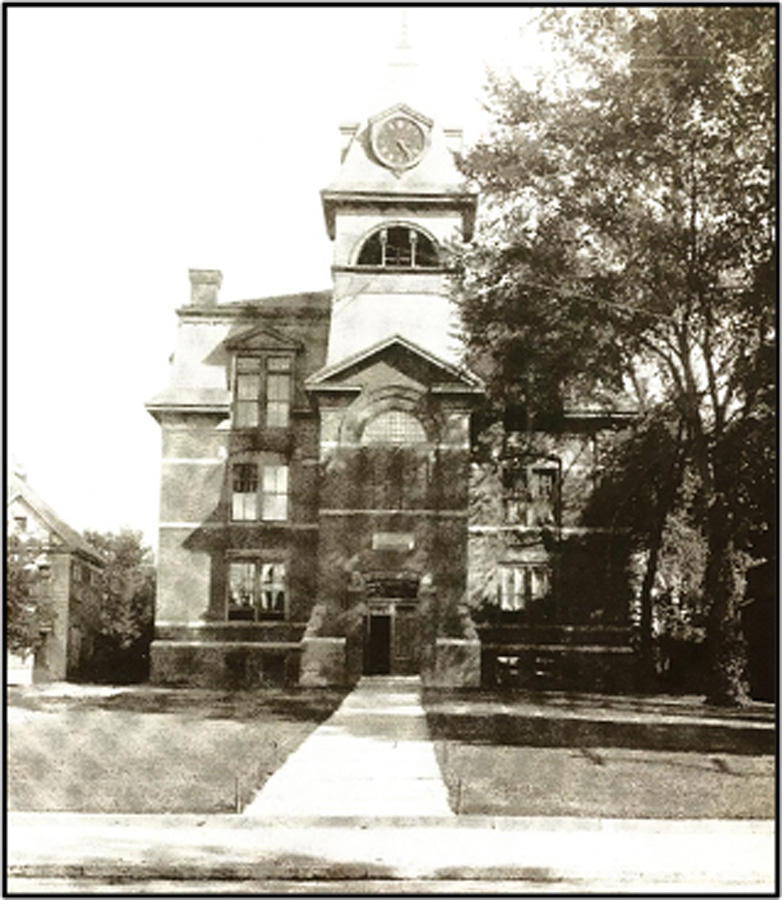
Residents of the village at the turn of the century were justifiably proud of the village’s three modern brick school buildings . . .  the high school on Main Street (on a site now occupied by the Mechanicville Area Community Services Center), School 2 on Chestnut Street and School 3 on Saratoga Avenue.  None of these school buildings are with us today.

William C. Tallmadge, who gave the city the lovely park bearing his name, had passed away in August of that year, not long after his 85th birthday.  A photo of Mr. Tallmadge seated on the porch of his Mechanicville home is shown, as is a shot of the park taken from the top of the hill.

William H.Van Ness sold pure milk and cream, C.A. Howland had an insurance office on Main Street, C.M. Fort and Son sold “groceries, crockery, glassware and lamps, wallpaper, paints and oils, field and garden seeds, trunks, bags, etc.” at their store on the corner of Park Avenue and Main Streets.  F. E. Partridge of Third Street was a carpenter and builder, as was W. D. Tweedy of Spring Street.  Golden’s Opera House Café was located at 50 Park Avenue, and A. Buchdahl sold clothing, caps and shoes in the Opera House block. If you picked up your phone and told the operator you’d like to call 26-A, you could order ice from Smith on Saratoga Avenue, and if you needed any staining, painting, glazing, varnishing, kalsomining or paperhanging done on short notice, P. A. Mawbey was your man.

All five of the village’s beautiful churches of that era are pictured, with both interior and exterior views.  Although each has been altered a bit, all of them remain to this day except for the Presbyterian Church which was demolished many years ago for a parking lot which now belongs to the CVS Pharmacy.

A number of elegant Victorian homes, street and river scenes, and panoramic views of the village grace the pages.   Proud railroaders standing alongside state-of-the-art steam engines, baseball teams, merchants, barbers, and folks on the street . . . faces of people who forged a thriving community . . . all are depicted in captured moments of a different time, giving us a vivid and nostalgic glimpse of the Mechanicville that used to be, one hundred and twenty-two short years ago.

Source: Souvenir of Mechanicville, New York: Tri-County Firemen’s Convention, Mechanicville, New York, August 30, 31, September l, 2. 1902. Publisher: Troy Times Art Press in Troy, NY

Sandy McBride is a native of Mechanicville, and lives in the Town of Halfmoon. Writing has always been her passion, and she has won numerous awards for her poetry.  For the past 17 years, she has written feature stories for The Express weekly newspaper and has published four books of feature stories and two poetry collections, and also a children’s historical novel on the Battles of Saratoga entitled “Finding Goliath and Fred”.

Annual Wreath Ceremony Dec. 6 at Ballston Spa Veteran’s Memorial 

BALLSTON SPA — The Ballston Spa House & Garden Club (BSH&GC) will host a Wreath Ceremony at the Veteran’s Memorial at noon on Friday, Dec. 6. 

The public is invited to attend the solemn event to honor deceased veterans during the holidays. 

The Veteran’s Memorial is located on Low Street, adjacent to the Ballston Spa Library. 

The ceremony is an annual event conducted by the Garden Club. For questions about this ceremony, contact Marilyn Stephenson, BSH&GC at: mcstephenson@nycap.rr.com. 

The Schuyler House:A Tale of Destruction and Rebirth


Schuyler House – Rebuilt 1777

by David Wickerham | Sponsored byThe Saratoga County History Roundtable. Contact The Saratoga County History Roundtable at: saratogacohistoryroundtable@gmail.com

As the 250th anniversary of the Battles of Saratoga approaches, the story of General Philip Schuyler’s house stands as a powerful testament to the resilience of early Americans during the Revolutionary War. Located in Schuylerville, New York, this historic estate embodies the struggle, sacrifice, and determination that shaped a new nation.

A Strategic Estate Destroyed The Schuyler House originally stood as a grand estate along the confluence of Fish Creek and the Hudson River. Built around 1763, it functioned as the fulcrum of Schuyler’s agricultural and milling empire, supporting local agriculture and the fledgling economy of the area. The Schuyler family was instrumental in developing the Village of Saratoga—now known as Schuylerville—into an agricultural and industrial hub that relied on milling, farming, and fishing. Fish Creek was central to this development, housing the milling and fishing operations that sustained the Schuyler estate and served the broader colonial community.

The Schuyler House endured its first destruction during King George’s War, demonstrating the vulnerability of such strategic sites during periods of conflict. However, it faced its most significant devastation during the American Revolutionary War. On October 10, 1777, British Lieutenant General John Burgoyne made a fateful decision after retreating from the defeat at the Battles of Bemus Heights; he ordered his troops to burn the Schuyler House and 24 surrounding buildings. This act was not random, but a calculated military strategy known as “scorched earth.” By destroying the estate, Burgoyne aimed to deprive American forces of valuable resources and damage their morale.

British Lieutenant William Digby noted that they burned the house “to prevent a lodgment being formed behind it.” The destruction was extensive, targeting the main house and the mills, barns, and storehouses crucial to the local community.

Rebuilding with Determination  No sooner had the smoke cleared than Schuyler began to plot the rebuilding of his home. In a letter to Colonel Varick dated October 12, 1777, Schuyler expressed the urgency of his mission. He wrote that he had sent enslaved individuals to the ruins of the burned house to salvage iron nails and other structural supplies essential for the construction of the new house, as iron was scarce during the war. Schuyler emphasized his commitment to rebuilding, stating, “I intend immediately to have my mills rebuilt and some house erected.”

Construction commenced a mere two weeks after Burgoyne’s surrender on October 17, 1777. Schuyler mobilized a diverse labor force, which included carpenters and engineers from American General Gates’ army, local craftsmen, prisoners of war, and enslaved individuals from his estate. The inclusion of enslaved individuals in this labor force highlights the complex and often painful legacy of slavery in American history. Their forced labor played a critical role in the reconstruction efforts, reminding us of the moral contradictions that characterized the pursuit of liberty during the Revolutionary era.

The salvage and reuse of materials from the ruins were vital; timber from the estate’s upper sawmill—the only structure left intact—provided the backbone for the new construction. Iron nails, hinges, and stone salvaged from the ruins were utilized, illustrating an early example of resourcefulness and respect for the historical significance of the original structure.

The rebuilding efforts were impressively rapid. It is reputed that the house was reconstructed in only ten to sixty days after the fire. This collaboration between Schuyler’s mobilized workforce and the military personnel underscores the community’s collective determination to restore what had been lost.

According to Schuyler’s letters, the house was completed in a rough state by November 30, 1777. On November 4, he informed Congress of his progress, saying, “In less than twenty days, I shall nearly complete a comfortable house for the reception of my family.” In a letter to a friend, Schuyler detailed the construction timeline: “On the first instant [November 1] I began a house, on the 19th I had two rooms and Cellar Kitchen finished, and on the 30th Instant I shall discharge my carpenters.” Furthermore, in a letter to John Jay in November 1777, he reflected on his aspirations for a quieter life, expressing his enthusiasm for country living and his intent to distance himself from the “noise and bustle” of public life.

The new house was notably different from the original; smaller and more modest, it measured just sixty by twenty feet. Schuyler described it as “cheaply and speedily erected.” In an incredible display of efficiency, he aimed to complete a “comfortable house for the reception of my family” within twenty days, demonstrating not only his determination but also his practical approach to rebuilding in the face of adversity.

A Complex Historical Landscape The rebuilding process reveals the complex social fabric of revolutionary America. The workforce included local laborers, captured British soldiers skilled in masonry, and enslaved individuals whose forced labor was critical to the construction. This nuanced history serves as a reminder that the pursuit of liberty coexisted with the brutal reality of slavery, and it compels us to recognize and honor the legacy of enslaved individuals whose contributions are often overlooked.

An Unexpected Diplomacy Perhaps most remarkable was Schuyler’s interaction with Burgoyne after the surrender. Despite the destruction of his estate, Schuyler hosted the defeated British general in his Albany mansion, demonstrating a remarkable sense of military honor and diplomacy typical of the era. This act was more than mere courtesy; by treating his enemy respectfully, Schuyler showcased the emerging American leadership’s commitment to principles beyond vengeance—a subtle but important strategy in garnering international support for the revolutionary cause.

A Living Memorial Today, the Schuyler House is a museum within Saratoga National Historical Park. Visitors can walk through a structure that literally contains layers of history—from the original stones and timbers to the marks of patriot labor, British craftsmanship, and the often-overlooked contributions of enslaved workers. The house is more than a building; it’s a microcosm of the Revolutionary era, embodying the complex interplay of military strategy, personal sacrifice, and the ongoing struggle for freedom.

A Legacy of Resilience As Saratoga approaches its 250th anniversary, the Schuyler House reminds us of the values that shaped our nation. It stands as a powerful symbol of resilience—of the ability to rebuild, adapt, and move forward in the face of tremendous challenges. The story of this house is ultimately a story of hope. It speaks to the unbreakable spirit of those who fought for independence, who saw beyond immediate destruction to a future of possibility. In its stones and timbers, we can still hear the echoes of a revolution that transformed a collection of colonies into a new nation.

As we commemorate this milestone, the Schuyler House invites us to remember not just the grand moments of history but also the daily acts of courage, adaptation, and resilience that truly define a people’s journey to freedom.

Gideon Hawley: The Father of Common Schools

Saratoga County has been blessed with many gifted educators, but none surpass in importance Gideon Hawley. Although born in Connecticut in 1785, his family moved to the Town of Ballston in 1794 and four years later relocated to a farm in the Town of Charlton. Gideon worked on the family farm until 1804 when in his own words “too infirm in health for farming”, he entered the newly established Ballston Academy to prepare for college. The Academy was founded by a fellow Charlton resident and a graduate of Union College, John W. Taylor. Taylor would later serve in the House of Representatives for twenty years and was twice elected Speaker of the House.

After a year of study at the Academy, Hawley entered Union College where he studied under the supervision of the renowned college president Eliphalet Nott. Gideon must have been an outstanding student because upon his graduation in 1809, he was invited to remain at Union as a tutor. At the same time, he “read” law under Henry Yates, brother of a future governor of New York State. As we shall see, this relationship would lead to his life’s work.

Education in New York State has no single starting point. People have always educated their children and those living on the frontier in New York 200 hundred years ago took responsibility for transmitting the skills and attitudes necessary for survival. Although the State of New York established the Board of Regents as early as 1784, its single duty was to govern Columbia University (formerly known as King’s College prior to the Revolution). Efforts from then until 1812 were inconsistent. That year the legislature passed an act entitled “An act for the establishment of Common Schools.”

Common schools were publicly funded, non-sectarian schools designed to teach the elementary skills of “reading, writing and rithmatic”. The law authorized the establishment of self-governing common school districts in each town and provided aid to each, based on the number of children from age 5 to 15. The districts would only receive the money if they held school three months a year and were required to match the state aid with local tax funds but were allowed to charge tuition (referred to as a Rate Tax) for additional expenses.

The law also created the position of State Superintendent of Schools. The first Superintendent was Gideon Hawley, from the Town of Charlton, Saratoga County, who is known as “The Father of Common Schools” in New York. Why was Hawley, only four years out of college, selected for this important position? Probably because he had the support of three important connections: President  Nott, who was so impressed with the young Hawley when he was at Union College, John Taylor, his old school master, now a member of the New York Assembly and the Yates-DeWitt Clinton faction of the Democratic-Republican party.

To understand the significance of Hawley’s contribution, one must remember that he had no precedents to guide him nor a bureaucracy to assist him. Yet, he created the system that distributed the school funds equitably to the towns, formed the structure for creating school districts and how they should be governed, and established a reporting system that allowed a single individual to manage common schools throughout the state. Somehow, he also found time to write the state’s first instructional syllabus. After only two years in the position, he was able to report to the Assembly on his achievements and convince them to incorporate his suggestions into the basic educational laws of the State that lasted until 1829.

The Town of Malta responded immediately. At the annual meeting of the Town Board held on April 6, 1813, three Commissioners were selected, four Inspector of Schools appointed and a resolution to provide $100 for the support of Common Schools approved. The Commissioners were to receive one dollar a day for their service, and they apparently got to work immediately because Spafford’s Gazetteer of 1813 reports that Malta had seven schoolhouses and a “small library”.

Hawley’s tenure as State Superintendent ended in 1821 as a result of a political battle between Governor Dewitt Clinton and Martin Van Buren. The Legislature was so upset by this “gross outrage” that they refused to fund the position, and the duties of Superintendent of Common Schools were assigned to the Secretary of State. This injustice did not end Hawley’s contributions to education because in 1814 he had been appointed Secretary of the Regents of the University, a position he held until 1841. As such, he was instrumental in the establishment of the State’s first Normal School for the preparation of teachers, the New York State College for Teachers at Albany (now SUNY at Albany). He served as a trustee for both the Albany Academy and the Albany Female Academy, both of which still exist today. He was appointed a Regent of The Smithsonian Institution upon its founding in 1846, probably due to his connection with Joseph Henry at Albany Academy, who was the first Secretary of The Smithsonian.

In addition to his many educational commitments, Hawley served as the Master of Chancery (administrator of the State’s Court System), Secretary of the Albany Insurance Company and director of the Mohawk and Hudson Railroad, the first railroad company in the state.

Gideon Hawley’s contributions to public education have been recognized by both his contemporaries and those who have followed him. In 1844, S.S. Randall said of Hawley ” To no individual in the State are the friends of Common school education more deeply indebted for the impetus given to the cause of elementary instruction in its infancy than Gideon Hawley.” Today, his alma mater, Union College, annually presents the Gideon Hawley Teacher Recognition Award to a secondary teacher nominated by a current Union student in appreciation. Certainly, a fitting tribute to the man known as The Father of Common Schools in New York.

 Ballston Spa’s Strange Inventions


Ballston Spa has always been proud of its industrious and enterprising citizens. The wealthiest and most successful individuals such as George West, Isaiah Blood, and Nicholas Low receive the most attention, but there are many others who have been immortalized in local histories, documents, and speeches. In his centennial address of 1907, village president Irving Wiswall summarized (and somewhat exaggerated) the accomplishments of some of the most famous residents:

“The first paper bags were made in this village, and the first paper collars and cuffs were made by L. M. Crane, who lived here, his mill being located about two miles north of the village. The telegraph instrument in universal use today and which supplemented the original Morse machines, was the invention of our townsman, Samuel F. Day, who also discovered the method of telegraphing with safety during thunderstorms. The first machine for making paper bags was invented in our village, and the first machine for combining paper with cloth was the invention of one of the proprietors of the Glen Paper Collar Company. The first household clothes-wringers were made in West Milton and sold in Ballston Spa.” 

Although the inventions listed above were important in their day, not all to come out of Ballston Spa were famous, or even very useful.

Minard Cooper invented a “new and improved mode of closing doors with or without the use of a catch” in 1852. It consisted of a bar and roller mounted on the inside wall which exerted pressure upon an open door that would force it to close.  While the mechanism design seems sound, it would be rather unsightly in one’s living room. There also appears to be a danger of people inadvertently hanging themselves if they walked through the door too quickly. Theodore Lipshuts and Daniel Jones invented a “Self-Acting Battery for Scaring Crows” in 1859. As the patent letter detailed, it consisted of a “battery with a number of chambers in connection with a gun barrel in such a manner that one of its chambers after the other is made to go off by its own action, and without the aid of a man, at regular intervals, and that by these reports, crows and other injurious animals are scared away.” Its lack of commercial success is not surprising considering the potential for injury if tampered with by curious children. It would also seem inconvenient to neighbors within a mile radius to hear gunfire at all hours of the day and night. 

Ivy Howell was one of Ballston Spa’s few female inventors before the Great Depression. She held two patents: a corset in 1917 (“designed for use by stout women for supporting their abdomen and to provide an absorbent shield”), and a directional sign, patented in 1920. The sign consisted of a disk with the words “Universal Comfort Service” surrounding a smaller circle with the words “Women” and “Men,” which apparently were supposed to guide people to the appropriate restroom.  

The focus of many Ballston Spa inventors from 1850 to 1950 related to industrial patents more than any other class of invention. These were by far the most successful, since many were put to practical use in the tool, paper, and textile factories for the production of goods.  

However, many inventions were simply impractical. In 1870, Frank Whalen tried to take advantage of the popularity of heating and cooking stoves by developing a new detachable caster leg. As detailed in his patent letter, “This invention relates to combining caster-legs with the main or supporting legs of a stove, in such a manner that the main legs can be removed, so that the stove can be rolled around from place to place.”  

It is unclear how often it would be necessary to move a stove, and the photos that accompany the patent cast doubts as to the strength of the caster mechanism. Moving a stove around in this manner would likely create deep gouges in any type of wood flooring.

Reuben Garrett patented one of the village’s few toy inventions in 1876. It was titled “Improvement in Combined Tops and Whirligigs,” and was claimed to “furnish an improved toy for children, which shall be so constructed that it may be used as a top or whirligig, as may be desired.”  It was a simple idea, having a loose pin, a forked handle, the top (or head that everything balanced upon), and a wind-up cord. Garrett was a prominent farmer in the town of Ballston who became a census taker for the 1900 census. 

Charles Heaton patented an improvement in medical compounds in 1879. He claimed it was “a remedy and method for the cure of corns and bunions…consisting in a compound of ammonia, alcohol, and honey, and tincture of cardamom.” 

There were hundreds of patents filed in the nineteenth century that consisted of home remedies for curing all sorts of ailments. Curiously, this was the only “cure” patented in Ballston. Considering the emphasis on health-related matters during the mineral spring water era of Ballston, one would assume that there would be other homemade recipes on file. 

Frederick Streever established the F. S. Streever Construction Company, which  was one of the few businesses to survive the Great Depression, operating into the 1940s. He was also part owner of the Hides-Franklin Spring. In 1936 he patented “an improvement in muzzles, particularly for dogs, to provide a device which will positively prevent the animal from biting, seizing, or tearing but which will interfere in no way with eating or drinking.” One would wonder what type of dogs Mr. Streever had around him that would require a semi-permanent muzzle that would allow them to eat and drink without attacking and biting visitors.

Perhaps Ballston’s most ghoulish patent was developed by Henry Mabbitt Crippen of Bloodville in 1906. His embalming catheter patent letter contained such descriptions as “[previous catheters] have the disadvantage that in the use thereof the hands of the operator frequently become covered with blood and other matter from the arteries due to the necessity of handling the flexible member of the structure to guide the same [into and out of the body].”  With Halloween upon us, perhaps this is the best example to conclude an article on strange inventions.

Glidden Auto Tour: Testing the Reliability of Early Automobiles

For the car enthusiast today, the term cross country rally recalls dust-covered cars testing skill and endurance by racing across endless landscapes of sand dunes and giant cacti. In the early days of automobiles, these contests were also held where the roads were poor, and the skills of drivers were pushed to the limit. Fortunately, the contestants did not have to travel the world to compete, as these early rallies were run on the bone-rattling roads of rural America.

One of the most well-known of these early contests was the Glidden Auto Tour, a public auto rally organized by the American Automobile Association to promote the reliability and practical use of this new form of transportation. The tour offered the public a chance to see automobiles as they passed through their communities driven in a safe and controlled manner. The maximum speed for the drivers in the Glidden Tour was twenty miles an hour on the open road and reduced to fifteen when they passed through residential areas. These speeds were verified at timed checkpoints and penalties were assessed against those who arrived ahead of the scheduled times.

Named for Charles Jasper Glidden, a telephone pioneer and automobile enthusiast, the first tour was held in 1904 to finish at the World’s Fair in St. Louis, Missouri. The rally that year had three starting points: Philadelphia, New York City, and Baltimore, which converged during the 1000-mile route to end in St. Louis. Of the 77 automobiles that left the starting line, only 66 passed the checkered flag eighteen days later.

The 1905 Glidden Tour again started in New York City, with all the contestants following the same route that headed north into New Hampshire. Before each race, representatives of the Glidden Tour would drive the roads along the course of the rally and create a route book for the contestants to use during the tour.

As this rally was organized as a reliability test, the route included steep inclines, culminating with a visit to New Hampshire’s White Mountains. The Buffalo Courier newspaper of July 30, 1905, gave this report on the climbing ability of these early automobiles:

Hills, which for years have been climbed only with a team of horses, including the Crawford Notch Hill with a 22 percent grade, the Hard Scrabble Hill near Bethlehem (NH) with a 25 percent grade, and the Saw Dust Hill near Chester with a grade of 28 percent at one point, were surmounted by car after car.

For 1906, the tour returned to the northeast, starting the sixteen-day race on July 12th in Buffalo, and heading east to Utica, into the Mohawk Valley, north to Saratoga, and then into the Eastern Adirondacks. In the days preceding the event, the organizers posted signs along the route to help the participants follow the course. In Fonda, a community along the Mohawk River ten miles west of Amsterdam, officials refused to allow the signs, and no details of food or facilities in Fonda that could assist the motorists were included in that year’s tour packet.

The roads between Utica and Saratoga were described by the contestants as “vile,” with the rough roads and thick dust churned up by the motor cars causing accidents that eliminated several entrants. Beyond Amsterdam the tour turned north, encountering a steep grade taking them away from the Mohawk River. When Crane’s Hollow Road, the designated route for the tour was found to be so narrow that it would be impossible to pass disabled vehicles, the tour was rerouted to nearby Swart Hill Road. This thirty percent three-quarter mile grade was a challenge for some of these early autos, with the stronger autos assisting others to bring all the contestants to the summit. By mid-afternoon, the tour cars came down Ballston Avenue in Saratoga Springs and ended their day in front of the Grand Union Hotel. As the tour arrived in Saratoga on Saturday and Sunday was a rest day, the contestants had time to relax and enjoy the sights of Saratoga Springs.

From Saratoga the tour headed north to Glens Falls, then into the Adirondacks, first following a plank road to Caldwell on Lake George and then passing through Warrensburg to Chestertown. Continuing north, the tour skirted the western shore of Schroon Lake, finally rolling into Elizabethtown to end the day. The only excitement during their time in Elizabethtown occurred when two of the participants could not find a room for the night. The problem was solved when the local sheriff offered to house them in the jail. After their cell was opened the next morning, the men said that they slept well, even though they were locked up with a murderer and a wife-beater.

Fifty of the contestants made it to their final stop in Quebec. Thirteen of these were given a perfect score based on delays from breakdowns and the cost and time for repairs. To break this tie, the group voted and chose the first-place finisher from the previous year, Percy P. Pierce, as the winner. Percy was the son of Pierce-Arrow Motor Car owner George Norman Pierce, and of course, for the tour that year he drove one of his father’s automobiles.

The White Mountains were again tackled during the 1906 tour, though this time with what could have been fatal results. Guy Vaughn, a champion of 24-hour auto races, lost control when he encountered a section of road in Crawford Notch that had been damaged by rain the night before and rolled his Sterns automobile. Though his machine was demolished, Vaughn escaped unharmed.

In 1907 the Glidden Tour again went through Glens Falls with a White Steamer auto acting as the pathfinder and pilot. The tour that year had started in New Hampshire with their final destination being Saratoga Springs. The 1908 Glidden Tour started in Buffalo and again ended in Saratoga. The last tour to go through New York State was held in 1911, going between Washington, D. C., and Ottawa, Canada. On their way north the tour passed through both Saratoga Springs and Glens Falls.

The final Glidden Tour was held in 1913, with the organizers acknowledging that the automobile had proven its value and reliability over the years of the competition. In recent years, the Vintage Motor Car Club has revived the Glidden Tours, with the 78th Revival Glidden Tour being held in September of 2024.

Edinburg’s WWII Soldiers and Gold Star Mothers


Rhoba Ferguson Robinson

The year 2024 marks the 85th anniversary of the beginning of World War II. On September 1, 1939, Germany invaded Poland, with Great Britain and France declaring war on Germany on September 3rd. Italy declared war on Great Britain and France on June 10, 1940. Germany invaded the Soviet Union on June 22, 1941 and Japan had occupied all of French Indochina by July 26, 1941. On December 7, 1941, Japan launched an attack on our US fleet at Pearl Harbor, Hawaii – “a day that will live in infamy”. President Franklin Delano Roosevelt declared war on Japan on December 8, 1941.

The next four years would change peoples’ lives forever. In that time 300,000 Americans gave their lives for our country. Men were called to duty by the draft board which had been established by the Selective Service System.

The town of Edinburg had 40 young men and 1 woman signed up to go to war. The Batchellerville and Fox Hill communities gave far more than their fair share of men to serve.

A partial list included Donald Barney, Albert Bills, Andrew Colson, Erwin Conklin, Jack Deming and brothers, Donald and Kenneth Edwards; Foster Edwards, Claude Farrington and brothers, Clifford, George and Herbert Jensen; LaPort brothers, Bert, Fred, Joseph and Oscar, as well as George Mason and John Olmstead – 18 in all from just Fox Hill and Batchellerville.

The rest of the 23 enlistees were from other parts of town. These men were Scott Downing, George Ferguson, Harry Frasier and brothers, Elwin and Erwin Geelan; Edward Green, Warren Hill and brothers, George and Lewis Jenkins; in addition, Floyd Knowlton, Keith Mudge, Robert Nourse, Ralph Olmstead and the Robinson brothers, Leland, Marshall and Ralph; also Channing Rockwell, Leslie Sauve, Howard Simpson and brothers, Luther and Joe Stockwell, and last but not least, Leonard Tryon. The only woman to enlist from Edinburg was Slava Malec, daughter of Marie and Alois Malec. Slava’s family had come to this country in 1911 from the old country. Her sister and brother – Lessie and Jaro – were born in Germany but Slava and her sister Grace were born in the US. Did her family’s feelings about Germany and Hitler have any bearing on Slava’s decision to support the USA?

Of Edinburg’s 42 service people, 2 lost their lives – George Ferguson and Leonard Tryon were killed in action.

After World War I, it became a custom in this country for families of servicemen to hang a banner called a “service flag” in a window of their homes. These flags held a star for each family member in the United States Armed Forces. A blue star represented living service members and a gold star represented those who had lost their lives.

I well remember as a child seeing one of these Gold Star banners in the window of our neighbor, Rhoba Stockwell Ferguson Robinson. Rhobie was the mother of George Ferguson, who had joined the army in 1943 at the age of 21 and was killed in action January 1945. Rhobie was a hard worker – widowed twice – spending hours each day sewing on gloves to add to the income from her small farm.

Rhoba Ferguson Robinson was Edinburg’s Gold Star mother often riding in the Decoration Day – now called Memorial Day – and the July 4th parades in Northville.

The war ended September 2, 1945 in Tokyo Bay on board the battleship, US Missouri, when the Japanese signed the formal surrender document.

It became a custom in many towns across America to display an Honor Roll board – usually in the center of town – listing all the service people from that given community. Edinburg was no exception.

In the mid-1940’s the shop class teacher at Northville Central School was Mr. Mendenhall, who lived on the lower end of Sinclaire Road. He constructed of wood Edinburg’s Honor Roll Board. It stood for many years at the 4-Corners. At some point it was taken down and stored in the old highway barn, now our Rural Museum. In 1991, when the barn was being cleaned out in preparation for the museum, the Honor Roll was re-discovered. The late Fred Trudy gave it a face lift and it was hung in our Nellie Tyrrell Museum. A few years ago, two more names that needed to be added were discovered. The Historical Society commissioned sign maker George Bailey of Edinburg to make a new sign. George donated all of his time and materials to creating the new Honor Roll, which is beautiful. Thank You, George! It is on display at the Nellie Tyrrell Museum.

Thank you and God Bless to all servicemen and women – past and present – for all that they have given for the United States of America!

Moving Day 1974:The Welches Begin Again in Vietnam

Early on July 6, 1974, my family and I boarded a China Airlines flight destined for the capital of the Republic of South Vietnam. I was just shy of my eighth birthday and delighted at the prospect of living in the same country as my father again. We’d been separated since July 1972 when he’d been transferred to the world’s hotspot of Saigon, and we’d been given “safe-haven” on the island of Taiwan.

Prior to that we’d lived all together in Seoul, Korea. My father had had a two-year PSYOP assignment there. Working as he did for the CIA and in psychological warfare, I was not privy to the nature of his work but certain clues indicate that he may have had something to do with Kissinger’s behind-the-scenes work to normalize relations with China. Today, we see in the news that our relationship with the “Middle Kingdom” is strained; back then even conversing with the communist country had been deemed impossible.

In March 1972 my mother wrote home to her parents:

“More than you could ever know, I wish I could tell you of our plans for this coming summer… Jim wrote a really fantastic paper… which was pouched to Washington and I hope that it gets to Mr. K and therefore to the president.

It was so good that our chief suggested that he would like Jim to go to DC to participate in the discussions regarding the future of this line of work in the role of the USA. (Well, Jim laughed to himself as he said someone at his level just would not be invited to “sit-in.”) 

I personally feel that Nixon, etc., will be so short-sighted that they will terminate this line of work which will mean that we will be coming home during the summer”

As it was, we would not return to the States in ‘72. Nixon went to China in February, and—after we finally got our marching orders—my mother wrote home in July:

            “A quickie! Suddenly all H has broken loose! Jim is due back here 15  July after a stopover in Taiwan. Taiwan cable today granted us safe haven there.  I’m delighted.”

And so from mid-1972-July 1974 the Welch family would live apart, my father coming  home to visit us every 5-6 weeks for a long weekend on the misty Grass Mountain just north of Taipei. Then, in early 1974, Saigon was deemed safe for families and thus it was 50 years ago that we set off for our final Southeast Asia post.

In recent years I’ve thought a lot about what a third move in four years must have meant to children between the ages of 4 and 15. The changes in schools, friends, and stability are hard enough at that age. Factor in the “vibe” of war and it’s hard to imagine just how we coped with it. Today’s awareness of social-emotional health was not prevalent at that time. I don’t recall any sort of support or understanding–or even discussion–about what was to come.

I recently read Craig McNamara’s memoir, “Because our Fathers Lied” in which I learned that his father, Robert S. McNamara, died fifteen years ago on July 6, 2009.  The elder McNamara was the eighth secretary of defense (1961-1968) and the man who, more than any other, was the leading architect of America’s involvement in the Vietnam War.

A single sentence in biography.com: captures the enigma of Robert McNamara:

“He is best known for helping lead the United States into the Vietnam War during the Kennedy Administration, an act for which he spent the remainder of his life wrestling with the moral consequences.”

In his book, Craig describes his struggle to come to terms with his father’s role in that “fumbled war” and moreover his father’s consistent silence on matters related to the conflict. I found myself filled with empathy for the author who both loved his father and hated his father’s actions in the war.

I felt a kinship with his struggle though our experiences are vastly different. We both had fathers involved with the war and eager to win it. I found myself feeling grateful that my father was not directly responsible for anyone’s death—at least not that I know of.

How will I ever know? In that, I have not progressed much farther than a child of seven who boarded a plane for her third home in a foreign land. In both instances there is so much unknown, so much that cannot be pinned down. Seeking answers, one often simply finds more questions.

Toward the end of Because Our Fathers Lied, I came across a sentence which made me stop what I was doing, paddling my kayak on the Hudson on a hot afternoon.

“I don’t think I could have put it into words back then, but in retrospect, I was clearly involved in a personal project of reshaping my family’s legacy. “

I was struck by what an effort that is on anyone’s part, and especially for someone with an earnest heart like Craig McNamara’s. On reflection, I’ve decided that I have not been trying to reshape a legacy with my writings but have been striving to pin down the exact nature of my father’s legacy.   He saved 1000 South Vietnamese people at the end of the war, but he had a family, too.

Fifty years ago, we embarked on a new adventure. This time, all nine of us, together. I don’t remember holding my father’s hand as we boarded the plane, but I like to think that maybe I did. Maybe I felt safe in that moment of crossing the tarmac, climbing the metal stairway, and settling into the seat beside him. Maybe I was happy. Maybe it seemed as if, together, our lives were now going to be better than ever.

Originally published on Substack on July 6, 2023

Brotherly Love

Maria Chapin Preston, born in 1842, was the sixth child of Dr. Calvin and Margaret Preston of East Street, Galway, New York.  Like her brothers, she exhibited musical talent early in life, playing the organ at the Presbyterian Church at the age of 14, keyboard instruments at social events, and teaching music.

She also shared their adventurous spirit exemplified by William and Platt, Gold Rush participants and eventual wealthy mill owners in Waitsburg, Washington; and Calvin, Union Soldier in the Civil War and survivor of the 1900 Galveston Hurricane.  Leaving a comfortable existence in Galway, she boarded the Transcontinental Railroad for San Francisco in the mid-1870s, traveling to Waitsburg by coastal steamer and finally stagecoach, joining her brothers and living with Platt while pursuing her interests in music.  In 1885 she married Alexander Stewart, a wealthy Waitsburg businessman.

Unfortunately, while their wealth supported a very comfortable life, Maria’s mental health gradually declined; in 1904 Mr. Stewart became seriously concerned about his wife’s deteriorating mental condition.  He “took her east and consulted eminent specialists on mental diseases in her behalf and…when he returned ….he stated nothing could be done for her”.

The combination of his wife’s illness, their advancing years, and the probability that Alex had chronic health issues of his own motivated him to pursue an arrangement with members of the Stewart family to provide for their care when they were both incapacitated.  His plan was to contract with them to provide care in exchange for transference of property owned by him and his wife.  A problem with the plan: some of the property he intended to transfer was owned separately by Maria, and as she was not mentally competent could not legally enter into a contract to transfer it.  Nevertheless, he had a deed transferring the properties to him drawn up and on April 20, 1906 it was executed by their signatures.

In 1911, Maria and Alex travelled to Idaho to stay with family members. During October of that year, Alex signed a contract with his relatives stipulating that, in return for property transferred to them in Florida and Washington the relatives would support and maintain him and his wife as long as they should live.   In September of 1912 they went to Miami, Florida, where Alex died in November.  At that time all his property and investments including that fraudulently transferred from Maria had already passed into control of the relatives, some of whom lived in that state. 

At about the same point in time William Preston became concerned that Maria’s well-being was in jeopardy. Elderly himself and not in condition for a long trip, strenuous activity, and dealing with legal issues, in February, 1913 he employed an attorney and the attorney’s wife, the latter to provide health care and personal supervision, to travel to Florida and return with Maria.  There they found her in “neglected, in pitiable and filthy condition; …….in feeble health and unable to care for herself…..almost without clothing and in the most abject want…kept in this abject condition by the relatives of her husband”.  One could reasonably conclude that she had been left on her own, to die.

Before permission could be obtained to return Maria to Washington State, the lawyer was required to sign a written contract with the relatives on behalf of William, which described the purpose of Maria’s journey as one of “paying a visit to her brother.” That visit could be terminated by the relatives at any time and  the terms of the original contract signed by Alex and his relatives would not be affected.

“After the contract was executed, suitable clothing was purchased for [Maria], and by easy stages and with the assistance of nurses and hospital attendants secured at various points along the road of travel brought [her] to [Waitsburg] where her health and physical condition …. rapidly improved although her mind [seemed] to be utterly gone.

The next step was to block any attempt by the Stewart family to return her to Florida, and recover her property in Washington.  William was in an awkward position to take the lead in these actions, having authorized signature of the contract prohibiting such, but friends in Waitsburg came to the rescue, applying to the superior court of Walla Walla county to appoint a guardian. The guardian then commenced legal action to recover Maria’s property against the Stewarts to whom the lots had been fraudulently conveyed.  After this action had begun, the Stewarts filed suit to have the guardian’s appointment vacated, and title to the properties restored to them.

The trial judge, upon reviewing the evidence found that the Stewarts were aware of Maria’s insanity when her property was transferred to her husband, issuing a decree setting aside the deeds in question and quieting the title on November 11, 1913.  He also dismissed the action to have the guardian’s appointment vacated.  The Stewarts appealed the actions to the Supreme Court of Washington State.

The Supreme Court decisions on both cases are dated April 20, 1915.  They concurred with the trial judge in both instances. Saving the most critical assessment of the appellant’s contentions for last, the justice opined in part:

 It was not until they [the Stewarts] were about to lose property interests they hoped to control in this state they concluded that their contract had been violated by Mr. Preston … It was then that they concluded that the courts of this state had no jurisdiction to appoint a guardian for Mrs. Stewart, or protect her interests and insisted that she be returned to the state of Florida.  Such contentions, under the facts here known, do not commend themselves to a court of justice.  The judgement is affirmed.”

And that ended the matter.  Maria Preston remained in Waitsburg in the care of William until her death on October 18, 1916.  Had it not been for William’s devotion and decisive actions, she would have died alone, in unspeakable conditions.  She is buried in Waitsburg Cemetery, along with brothers William, Platt and Calvin.

Elder abuse is unfortunately prevalent today. The most likely abuser is a family member and the abuse is frequently financial.