

History of Saratoga: CCC Workers Built Saratoga Battlefield Park
Stephen Williams was a reporter covering Saratoga County for the Daily Gazette for many years, and is the author of a collection of his columns, Off the Northway. He is the editor of History Lives Here!, the Saratoga County History Center newsletter. This article draws on a column included in his book
You might think that lands most of us now regard as sacred battlegrounds were always seen that way. But that wasn’t the case with the 2,500 acres today called the Saratoga National Historical Park.
Major ceremonies are planned as the 250th anniversary of the battles approaches in 2027, and the park has seen significant physical improvements and new attention in recent years. But for more than a century after the battles in the fall of 1777 they remained what they had been before the battles were fought: private farmland. There were fields and pastures, with a few new buildings.
The two battles in September and October of that year forced a British army from the field for the first time in history and turned the tide of the American Revolution. Despite their importance, the need to actively preserve the site wasn’t yet apparent to those who lived in and around the fields.
But as new automobiles and the roads to accommodate them began to change the American landscape during and after World War I, the need to preserve such worthy historic landscapes before they were altered began to become apparent. President Teddy Roosevelt began preserving national parks in the early 1900s, and President Woodrow Wilson created the National Park Service in 1916.
Beginning in 1923, a group of private citizens called the Saratoga Battlefield Association began buying up the lands where the battles were fought, including the Freeman farm. The state then purchased the Nielsen and Gannon farms, and Gov. Franklin D. Roosevelt subsequently declared the battlefield a state historical site in 1927. A celebration of the battles’ sesquicentennial on Oct. 8, 1927, included a three-hour parade attended by well over 100,000 spectators.
Just a few years after that came the Great Depression.
I’ve trod the fields, forests and campsites of New York state’s public parks for decades without giving much thought to those who built them. I should have realized turning raw land into a park is back-breaking work. Trees needed to be cut, land cleared, roads built. In the case of Saratoga Battlefield, non-historic structures would need to be removed.
The state and federal park system as we know today wouldn’t exist without the tumult of the Great Depression, which left many strong backs available to the new Civilian Conservation Corps.
For $30 a month, unemployed men ages 18 to 25 were put to good use during the 1930s at hundreds of sites across the nation, including Saratoga Spa State Park, Lake George, and Saratoga National Historic Park. There were thousands of work camps across the country – 207 in New York state alone.
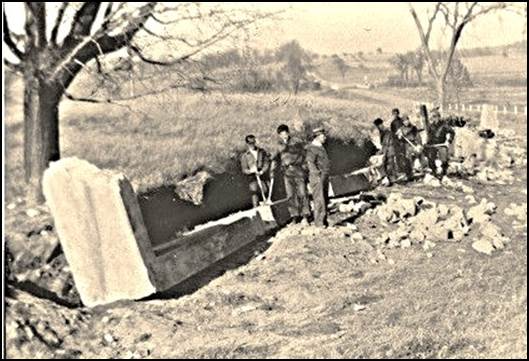
The CCC would arrive, quickly erect self-contained military-style barracks camps, and bring in a couple of hundred men who needed work. The men – and they were all men – were civilians, but the camps were overseen by military officers. The last new camp in New York, and probably one of the last in the nation, was built in 1939 in the village of Stillwater to provide manual labor for the construction of Saratoga Battlefield, which became a National Park Service site in 1938.
The Stillwater camp was located behind the American Legion post, where the village ballfields are now. Every morning, the men were trucked north to Bemis Heights, where the battlefield national park was being built.
“The work at the battlefield was very important,” Claire Haizlip of Stillwater told a gathering of the Stillwater Historical Society I attended in 2006. Her father, Col. George W. Martin, was the military commander of the camp.
Haizlip’s father was a World War I veteran and reservist, an engineer by training. Before coming to Stillwater, he supervised similar park-construction work at the scenic Letchworth Gorge Park in western New York. At the outbreak of World War II, he was called back to active duty, working on base construction in Newfoundland and in England, Haizlip said.
Most photos and most other documentation of the Stillwater camp were lost in a 1972 fire, so it was important to record the words of Haizlip and anyone else with direct memories of the era.
The battlefield park preserves the place where American and British forces clashed and made a hero – for a time – of battlefield commander Benedict Arnold. Today it’s a place to absorb history, watch deer, hear frogs, or quietly ponder the meaning of walking soil hallowed centuries ago by human blood.
But it wasn’t named a national park until 1938. The CCC arrived next year. In October 1940, President Roosevelt himself inspected the work, and selected the panoramic hilltop overlooking the battlegrounds where the visitors’ center was to be built. Long-time Stillwater residents recalled his motorcade and his open touring car as it made the journey up the west bank of the Hudson River to the battlefield highlands.
“I’ve been told children were let out of school for the day to line the route,” said Stillwater Town Historian Linda Sanders in 2006.
The CCC was Roosevelt’s idea for fighting the Depression, and was established by Congress in March 1933, within weeks after the new president took office. He thought it would achieve national conservation goals, while also dealing with the enormous unemployment problem then facing the country. As many as 600,000 men worked for it, serving for six-month stints. Those men built stronger bodies, had better morale, and learned skills that made them easier to employ, histories of the program say.
According to the National Park Service, at Stillwater “camp participants worked hard on many projects, including removing non-historic fences, roads and foundations; developing new roads through the Battlefield; clearing invasive plants; conducting archaeology; developing maps; managing landscapes through prescribed fire; and offering site interpretation for visitors.”
The CCC, originally called the far-less-alliterative Emergency Conservation Workers, was phased out when World War II replaced the Depression as the overriding national emergency. Work wrapped up at Saratoga Battlefield wrapped up in 1942.
The CCC’s legacy lingers on in the many parks and historic sites where their work was done, in the forests where an estimated three billion new trees were planted, and in such continuing nature conservation organizations as the Student Conservation Association, which to this day helps build and maintain trails in the Adirondacks.
In one sense, the land and legacy of this park will never change. However, its name has changed over time. In 1927 the state park was named Saratoga Battlefield Park, which became the Saratoga National Historical Park in 1938 under Federal ownership. Today there is legislation pending in Congress to rename it again, to the Saratoga National Battlefield Park.
Sources: Saratoga Town Historian Sean Patrick Kelleher, Substack; National Park Service; CCCLegacy.com; personal interviews. Photo: National Park Service