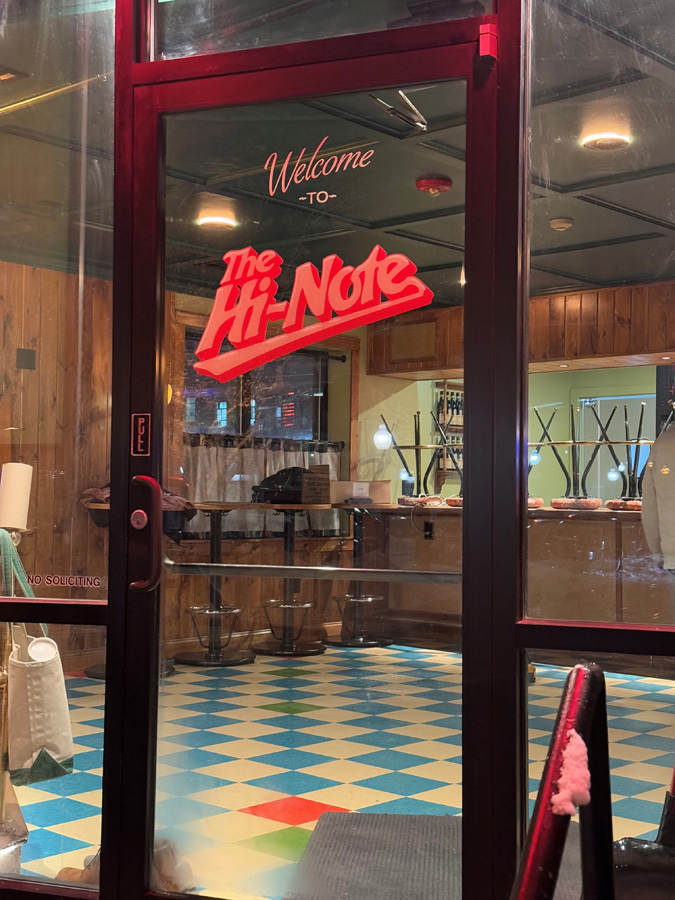
The exterior of Hi-Note, a new bar coming to 63 Putnam Street. Photo by Jonathon Norcross.
SARATOGA SPRINGS — Although January tends to be a slower month for Spa City businesses, much has been happening behind the scenes to launch, bolster, and revise existing eateries.
First, there is the somewhat mysterious Hi-Note Bar in the works at 63 Putnam Street, the former home of the Adirondack Cigar Shoppe. Publicly available details, including an opening date, are scant thus far, but the interior has a funky 70s-style vibe that is hard to miss when strolling down Putnam.
Next is news that Saratoga Arms’ restaurant has been officially named Three Daughters Kitchen & Cocktails, and it is now open for reservations to non-hotel guests. The restaurant is named for founder Kathleen Smith’s three daughters, each of whom has played a role in the family business over the years. “We always had family businesses, and the girls have always been involved in them,” Smith said in a social media announcement. “At six years old, they were behind breakfast buffets passing out melons. At twelve years old, Amy was making schedules. It’s a tribute to them.”
Standard Fare launched into the new year with a new menu and a new executive chef. The elevated comfort food eatery added Joseph Michaud as its culinary leader. “With years of experience in some of the area’s best kitchens—most recently at The Wishing Well—and as a member of the original Standard Fare opening team, Chef Joseph is the perfect fit for where we’re headed next,” the restaurant said in its announcement. “His creativity, passion, and deep connection to our roots have inspired a bold new menu. Think Standard Fare, just with the volume turned way up.” Standard Fare is also now serving brunch on Saturdays and Sundays, from 11 a.m. until 2 p.m.
Bear’s Cup Bakehouse celebrates its grand opening at 543 Broadway during a ribbon-cutting ceremony on Jan. 6. Photo provided by the Saratoga County Chamber of Commerce.
Fillis on Phila launched a new menu on Tuesday that includes everything from wings to deviled eggs to crab rangoon mozzarella sticks—not to mention a dozen varieties of wood stone pizzas. Fillies also revised its hours, with the new schedule also going into effect on Tuesday.
Then, of course, there’s Bear’s Cup Bakehouse, the super-popular, recently-opened bakery on Broadway that’s had lines out the door on many mornings. The Saratoga location, housed in the former home of Jacobsen Rugs, is now open from 8 a.m. to 2 p.m., Tuesday through Sunday. The artisanal bakery and coffee shop—known for its New York-style bagels, fresh-baked bread, and pastries—was initially based out of Bolton Landing, a hamlet that borders Lake George and is across from the Sagamore Resort. After the successful launch of its Spa City location, Bear’s Cup is now apparently interested in adding a third outpost in Wilton.
Last but not least is Bibulous’ new menu, which was revealed a few weeks ago. The restaurant—which focuses on deserts, cocktails, and appetizers—now offers dips, macaroni and cheese, three types of mini hot dogs, bourbon bread pudding, lemon olive oil cake, and more. “With the New Year coming, we are taking your requests into consideration and one of the main asks was for a few more ‘small plate’ options,” the restaurant said.
James Taylor and Pitbull images provided by Live Nation.
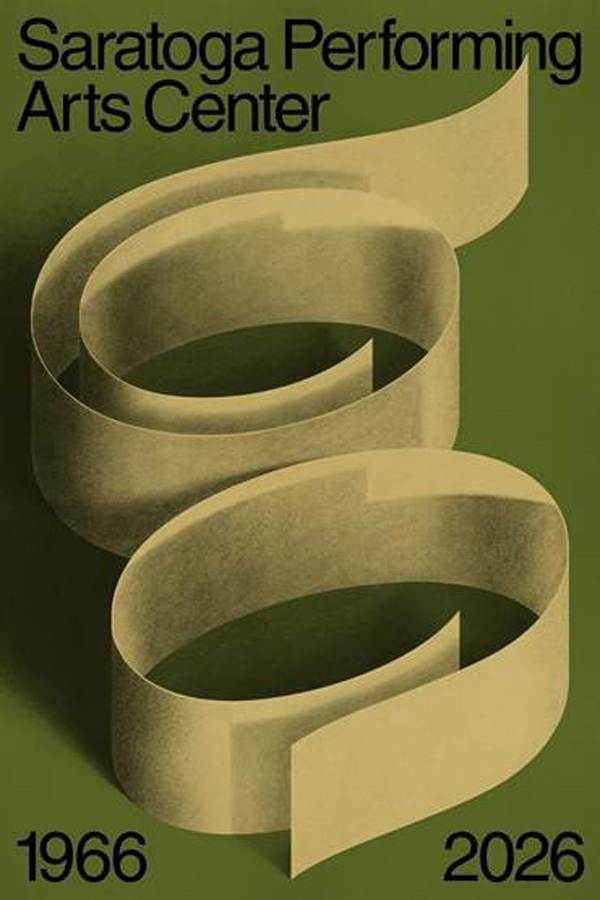
60th anniversary artwork provided by SPAC.
SARATOGA SPRINGS — It’s been a busy fortnight for the Saratoga Performing Arts Center (SPAC), which is gearing up for its historic 60th season.
James Taylor, a six-time Grammy-winning singer-songwriter, will take the SPAC stage alongside his All-Star Band on June 29, Live Nation recently announced. Taylor is perhaps best known for his originals “Fire and Rain” and “Sweet Baby James,” as well as his renditions of “You’ve Got a Friend” and “How Sweet It Is (To Be Loved by You).” His 1970 album “Sweet Baby James” nearly cracked the top 100 of Rolling Stone’s “500 Greatest Albums of All Time” list. His eponymous debut album was released by The Beatles’ Apple Records, and its track “Something in the Way She Moves” inspired the creation of “Something” by The Beatles. Taylor’s latest record, “American Standard,” won a Grammy for Best Traditional Pop Vocal Album.
Rapper Pitbull has sold more than 25 million studio albums worldwide and has amassed more than 15 billion views on YouTube, arguably making him one of the most popular musical acts on the planet. His debut album “M.I.A.M.I.,” released in 2024, was executive produced by Lil Jon, who will open for Pitbull during their joint SPAC performance on Sept. 2. Lil Jon’s hits “Get Low” and “Turn Down for What” have each garnered hundreds of millions of plays on Spotify (not to mention inspired countless meme videos).
SPAC also recently unveiled its official 2026 season artwork, designed by Shawn Carney (The New York Times Style Magazine, Wall Street Journal). As part of his creative process, Carney dug through SPAC’s archives, sifting through boxes and filing cabinets filled with thousands of items, such as newspaper clippings, booklets, ticket stubs, and posters.
“I wanted the artwork to acknowledge SPAC’s rich history without being a throwback,” Carney said. “After all, SPAC doesn’t just live in the archives—it’s very much alive today and flourishing in all sorts of new ways. Standing among the piles of paper however, it occurred to me that perhaps the illustration could be paper itself. That led to a more tactile approach, and I began sketching forms built from curled, hand-shaped sheets. The final design is intentionally tactile and handcrafted. My hope is that the artwork reflects the craft, labor, and human touch behind sixty seasons of live performance. It also highlights the subtle and poetic side of the venue and the experiences within its gates. The design feels classic and timeless, nods to SPAC’s history, but leaves open space for more of its future to be recorded.”
Additional announcements related to SPAC’s 60th anniversary season—including performances, special events, and commemorative initiatives—will be revealed throughout the year.
George R. R. Martin speaking at the 2013 San Diego Comic Con International. Photo by Gage Skidmore.
SARATOGA SPRINGS — “A Knight of the Seven Kingdoms,” the latest TV installment of the ever-growing “Game of Thrones” cinematic universe, premiered on Sunday to largely positive reviews. Author George R.R. Martin, who penned the novellas that served as the show’s source material, seemed delighted with the finished product.
But Martin, for well over a decade, has been constantly pulled in different directions, tasked with overseeing multiple film and TV projects while also chipping away at several long-overdue books. His busy schedule has been a source of frustration for the acclaimed fantasy author, who lamented in 2015 that he would be unable to return to Saratoga Springs.
In 2007, Martin was in the Spa City for the World Fantasy Convention (WFC), held at the City Center on Nov. 1-4. According to a pair of blog posts he wrote, Saratoga seemed to make a lasting impression on him.
In one March 2015 post, Martin announced that his packed calendar would prevent him from attending that year’s WFC in Saratoga. But he said that at the 2007 convention, he “had a great time. A terrific town, a wonderful con.”
A few months later, Martin again expressed regret over missing the 2015 event. “The last WFC in Saratoga was great fun, and I loved the city, and the train ride up the Hudson from NYC,” he wrote.
It would seem Martin made some lasting memories while here in Saratoga. In a 2022 conversation with fellow novelist David Anthony Durham, Martin reminisced about the first time they met, at the 2007 WFC.
“He displayed his courage because we were doing a mass autographing where all the authors sit all around the ballroom, and people line up to do them, and he was told by all his friends not to sit beside me,” Martin recalled. “But he did sit beside me anyway. A fearless fellow, and then we got to talking.”
The WFC hasn’t been held in the Spa City since 2015. Last year it was in England. In 2014, it took place in Niagara Falls.
SARATOGA SPRINGS — January tends to be a sleepy month in Saratoga.
The steady stream of eaters, drinkers, and shoppers who usually fill Broadway instead hibernate in their homes, perhaps weary from the holidays or wary of winter winds.
The Saratoga Film Showcase, which returns for its second year this weekend, is an invitation for 518-ers to hit the town, without having to spend too much time in the snow.
The festival, spearheaded by Spencer Sherry of Saratoga Arts and the 518 Film Network, includes in its 2026 lineup four blocks of short films (with each block running around 60 to 90 minutes), a special effects panel and demonstration featuring Oscar-winning makeup artist Annemarie Bradley, an opening night party with live music (Caity & the Gallaghers), a cocktail reception, and some secret off-the-books screenings.
“There will be a couple opportunities that pop up throughout the weekend, word-of-mouth only, to see some stuff that nobody’s ever seen before,” Sherry tantalizingly told Saratoga TODAY.
As a filmmaker himself, Sherry has attended countless festivals. Perhaps mentally taking notes to file away for a future opportunity, his experiences taught him what to do and what not to do. Some festivals demand that filmmakers pay hefty submission fees. Other fests are unable to house visiting filmmakers, making directors, writers, and actors less likely to appear in-person at screenings. And passes to film festivals can get pricey, presenting a barrier for cash-strapped artists who might’ve maxed out a credit card or two to finance their latest endeavor.
The Saratoga Film Showcase does things differently. The Holiday Inn in Saratoga donates rooms so that visitors have a place to warm up and snooze after a busy day of screenings and networking. There are no submission fees for those hoping to enter their work into the festival. Festival passes (good for the entire weekend) are sold at a sliding scale of anywhere from $10 to $100, making them affordable for nearly everyone. And free meals are dished out to filmmakers, who have access to their own lounge stocked with drinks and snacks.
“We try as much as possible to highlight [filmmakers] and showcase them and make it, structurally on our end of things, inherently worthwhile for them to be a part of this,” Sherry said. “We can bring filmmakers in from out of town that are hosted by our community, connect them with the local, independent filmmakers that are living and working here, and then all of that goodwill and energy goes directly towards inspiring the next generation of artists.”
It also doesn’t hurt that Spa City’s downtown is an ideal place to host a film festival, with multiple venues, restaurants, bars, and hotels all within short walking distances. This weekend, the showcase will be spread across Saratoga Arts, Putnam Place, and Harvey’s. If a festival attendee were to walk to all three locations in one go, it would take a grand total of about five minutes.
This year, the festivities begin at Putnam Place with “Shorts After Dark” on Jan. 23 at 7 p.m. The films include “La Diablesse,” written and directed by Grace Perez; “Kombucha!” directed by Jake Myers; “Bloodercream,” written and directed by Elise Valderrama; “Baby Fat,” a film by Elliot Frances Flynn (who played Zora in James Gunn’s hit series “Peacemaker”); “Affirmation,” directed by Emily Bennett (winner of a 2023 Fangoria Chainsaw Award); “Vanilla,” directed by the duo Nora Kaye and Nadia Nadim; and “The Man & the Scarecrow,” written and directed by Justin Knoepfel.
Sherry calls this block of films “weirder, more adult, or boundary-pushing.” Last year’s “Shorts After Dark” was apparently a hit, with headlining filmmaker Brit McAdams (director of the Saratoga-shot movie “Paint,” starring Owen Wilson) declaring it to be one of the best blocks of short films he’d ever seen at a festival.
Following “Shorts After Dark” is the showcase’s opening night party, which starts at 9 p.m. at Putnam Place.
Day two begins at noon at Saratoga Arts, with the “Coming to Terms” block. This lineup features “Golden Afternoon,” directed by Mathilde Suissa (whose film “Hidden” premiered at Cannes); “Unsaid,” directed by Monique Moses (the co-head writer and co-executive producer of season four of the HBO series “A Black Lady Sketch Show”); “Unidentified Caller,” directed by Alexander Cope; “The Resonance,” helmed by the husband-wife team of Paul Robinson and Sashia Dumont; “Seedless,” directed by Keenan Gray; and “So Long,” written and directed by Brendan Mascherino and Joey LaFrance.
“A lot of the themes of the movies are somebody facing either an unexpected moment, or a fear, or catharsis, or whatever it might be,” Sherry said. “It’s mostly drama, but there is a really fun comedy in there as well, and a couple spooky ones.”
Following “Coming to Terms” is the special effects panel discussion and demonstration, which begins at 2:45 p.m. at Saratoga Arts.
“[SFX makeup artist RJ Young] is going to come and actually apply a prosthetic to a model that has blood gags and bulge gags and air pockets and things in it,” Sherry said.
Next up after the demo is the “Art About Art” block, which starts at 4:30 p.m. One highlight of this lineup is “Portrait of God,” directed by Dylan Clark. This remarkable film went viral a couple years ago, accumulating millions of views on YouTube. It’s now being adapted into a feature helmed by Clark and produced by Jordan Peele and Sam Raimi. “I got to see it on a big screen with an audience—holy s**t, this thing is sick,” Sherry said.
Also featured in “Art About Art” is “Crying on Command,” directed by Nick Craven; “Cheat” directed by Jackie Mahoney; “You Don’t Say,” a musical short directed by Jeffrey D. Simon (who has worked in the art department of big-budget projects such as “Edge of Tomorrow” and “Spider-Man: Homecoming”); and “Apricot,” helmed by Frank Fascella, who has worked as a writers assistant on the TV shows “Tulsa King” and “Mayor of Kingstown.”
The showcase’s busy second day concludes with a 7 p.m. cocktail reception at Harvey’s Restaurant and Bar.
Last but certainly not least is the “Home-Grown” lineup of shorts on Jan. 25 at Saratoga Arts (the action begins at noon). These projects feature local filmmakers, familiar filming locations, and 518 cast and crew members. On the docket is “Pizza Cutter: A Bite Sized Slasher,” directed by Noah Manglapus; “2 Soldiers,” directed by Perrin Mercer (who lived in the Capital Region for more than a decade); “Dennis,” helmed by the Caldwell brothers; “Servants,” directed by Taylor Jarvis; “Hot Boy Summer,” a film by Albany High School senior Ian Roach; “Casualty,” by Juliette Monarch; “Born a Secret,” written by Miriam Russell; “The Family Coin,” by Jermaine Wells; and “Stakeout,” starring Seth Gillam (of “The Wire” and “Walking Dead” fame) and directed by Micah Khan, a prominent local filmmaker whose work was screened at last year’s showcase.
Perhaps the best thing about this mighty lineup is that, as of Jan. 19, the Saratoga Film Showcase broke even, meaning that all proceeds after that date will be sent straight to Camp Stomping Ground.
“The Saratoga Film Showcase aims to inspire the creation of more art in our community, and is proud to donate all profits to Camp Stomping Ground to continue making art more accessible to our youth,” the showcase states on its website.
A good cause, scary scenes, a jammin’ band, locals networking, and cinephiles tossing back a few—the Saratoga Film Showcase will have it all.
MALTA — The Eddie Fyvie Jiu-Jitsu Academy held its final class on Jan. 3, closing its doors after 13 years in business (Fyvie has joined the Spa City Jiu Jitsu Academy as a full-time teacher). But a new academy is already set to take its place, providing a home for local grapplers.
Kirby Ives is the head instructor of Malta Jiu Jitsu Academy, which is located next door to the old Eddie Fyvie location at 100 Saratoga Village Blvd. Ives is a black belt who trained under Fyvie, and his academy officially opens on Feb. 1 but is already accepting new students. Ives has been active in the local jiu jitsu scene for decades.
“I wanted to be a ninja when I was a little kid,” Ives told Saratoga TODAY. “I saw ‘Enter the Dragon’ when I was four years old and I was like, ‘That’s who I want to be.’”
With visions of Bruce Lee dancing in his head, Ives started wrestling in school and then took up boxing as a teenager before getting into jiu jitsu. One of his early mentors was Saratoga TODAY publisher Chad Beatty.
“Chad brought high-level jiu jitsu to Upstate New York,” Ives said. “After a few months of training in his basement, I was being exposed to unbelievable technique. I was meeting unbelievable guys that fought in Pride and UFC and Pancrase.”
At one point in his life, Ives was forced to navigate a challenging personal situation that left him feeling lost. But rather than turn towards unhealthy ways of dealing with his emotions, he instead found jiu jitsu.
“Jiu jitsu is something that absolutely empowers people and allows for a paradigm shift and gives people a sense of what is possible when you’re firing on all cylinders,” he said. “Your problem-solving skills are better, your sense of confidence is better. You move through space differently, in a physical way. You start to exude a certain vibe that people can recognize.”
For those interested in signing up with the Malta Jiu Jitsu Academy, a founder’s rate discount is available if they join prior to the Feb. 1 official opening.
There are a few ways to get in touch with the new academy: by phone (518-937-4899), email (maltajiujitsu@gmail.com), and Facebook (at the Malta Jiu Jitsu Academy page).
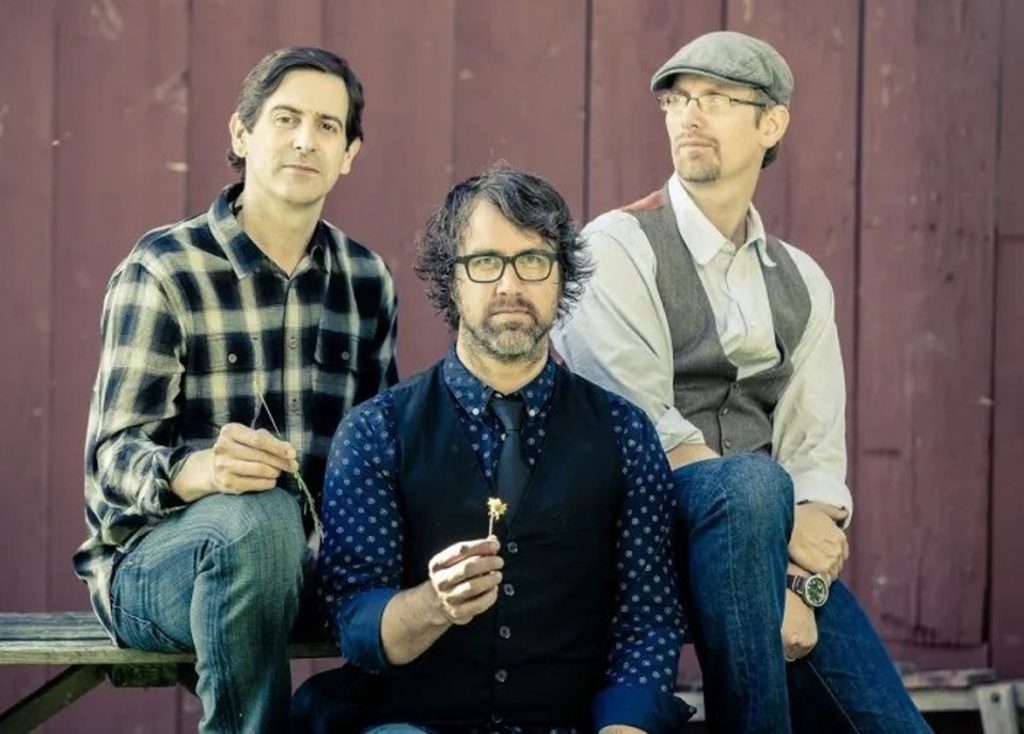
Photo of The Sweet Remains via the band’s website.
SARATOGA SPRINGS — The Sweet Remains—a folk-pop trio that has amassed more than 65 million streams on Spotify—will play a sold-out show at Caffe Lena on Jan. 22. The last time they played there, on July 11, 2025, they also sold out the famed folk venue. In other words, they’re kind of a big deal.
The group’s history is rich, with each band member having his own compelling origin story. One of those band members, Greg Naughton, spoke with Saratoga TODAY ahead of Sweet Remains’ stop in the Spa City.
Naughton seems to have been surrounded by artists and performers from the moment he entered the world. His father James Naughton starred in the “Planet of the Apes” TV series, won two Tony Awards for Best Performance by a Leading Actor in a Musical, and played Meryl Streep’s soon-to-be-ex-husband in “The Devil Wears Prada.” Greg’s wife Kelli O’Hara is a Broadway superstar and eight-time Tony Award nominee.
Greg himself has worn many hats, including filmmaker, actor, and musician. But as his directorial debut, “The Independents,” a 2018 film about The Sweet Remains, seems to indicate, music may be his greatest calling.
Saratoga TODAY’s interview with Greg Naughton is presented below in Q&A format, edited for length and clarity.
Saratoga TODAY: I guess now you’re coming up, maybe in the next year or two, on two decades with Sweet Remains. What keeps all of you coming back together? Is there some kind of secret to keeping a group intact this long?
Greg Naughton: The reason I started to write [“The Independents”] is because I was fascinated by this relationship I have with these two guys, which is more like brothers/spouses than other relationships I have with any other men. You have to have all the same things. You got to negotiate. There’s plenty of times, when you spend a lot of time with each other in small spaces and in each other’s creative space, you’re going to have hurt feelings. You’re going to have conflicts… We have a very similar sense of humor. I think that’s the main thing. Anytime things get difficult or uncomfortable for us, we just have a way of breaking through that with humor. It keeps it fun. If it wasn’t fun, we certainly wouldn’t be doing it. There’s enough to getting on the road with a band and trying to get into clubs in the snow and the whatever, and all of the details of that wouldn’t add up unless you were having fun.
ST: When you go into a studio, do you go into it trying to achieve something specific? Are you looking for a certain sound or hoping to accomplish a certain objective? What’s that process like of creating a new studio album?
GN: It has varied, and I think quite often, as with even writing a song, we go in with one objective, and it finds its ways around the preconceptions that we had and becomes something else. Most of the albums didn’t stick to a strong sense of, ‘We’re gonna make this kind of album this time.’ We have a couple of ideas for the future where we might try and stick more strictly to a certain thing. Like, what if we did a rock and roll album? These are pretty folk-rock, more roots, acoustic-oriented [albums]. That’s been our main genre and main output. But what if we did a rock album where it’s really rock and roll, and did it as a collaboration with another group that we like that does that sort of thing? Or, what if we did a kids album? We all have kids. Well, [Brian Chartrand] doesn’t have kids, but we have between us seven kids in the pan at this point. So, those are concepts that, we haven’t quite done them yet, but [they’re] things I would personally be excited to do at some point.
ST: Your upcoming show at Caffe Lena is sold out already. And I see you sold out the last time you performed here in July. What is it about playing these folk houses that kind of jives with your group?
GN: [Caffe Lena] is a special room. That room has defied the march of time… Since the pandemic, for sure, a lot of clubs like that one have not made it through. There’s a lot of reasons why a club like Caffe Lena shouldn’t make it. It’s kind of too small to make good money, I would imagine. But, I find that there’s a real enthusiasm with the audience there for being in that room and being that intimate with the music, which is infectious, I assume, as much for the audience as it is for us. That, and probably somebody who runs and owns the place cares and has managed to keep that alive.
ALSO COMING SOON TO CAFFE LENA:
The Dust Bowl Faeries will return for their second appearance at Caffe Lena on Jan. 25, playing with their new drummer and debuting new songs. Infused with dark humor, theatrical costumes, and mystical lyrics, Dust Bowl Faeries perform songs spun from the very fabric of faerie culture and lore. Hailing from the Hudson Valley, Dust Bowl Faeries present original songs nuanced by tango, flamenco, Klezmer, Balkan, and Romani swing music. Singing saw, accordion, bass, acoustic guitar, and drums combine to create the Dust Bowl Faeries’ unique sound.
The Wolff Sisters—a sibling-fronted Americana outfit from Boston—will perform at Caffe Lena on Feb. 5. Their gig in Saratoga is the first in a string of shows they’re playing around New England this winter. The group recently released their latest single, “Where Am I (To Call My Home)?” on all platforms, and just released a live music video to accompany it.
Two local events this weekend will pay tribute to the music of Bob Weir and the Grateful Dead. At Putnam Place on Jan. 17, the tribute band Bearly Dead will perform. At Yoga Mandali on Jan. 18, a celebration/memorial yoga class will be held in Weir’s memory. Images via Putnam Place and Natalli Amato, respectively.
SARATOGA SPRINGS — Grateful Dead co-founder Bob Weir faded away on Saturday, though, as any true Deadhead knows, his music will never stop.
Weir launched one of the most beloved bands in American history, one that inspired countless people to pile into vehicles and explore their country, trailing the Grateful Dead on tour. With the group’s improvisation, experimentation, and innovation also came new ways of performing and thinking about music. Their influence on American art and culture is vast and impossible to measure.
One could not truly experience the Dead without hearing them play live, in an environment that, more often than not, inspired warm feelings of community and, at times, even spirituality. The Grateful Dead’s very name seemed to suggest that although life is brief, it’s still an experience to appreciate (“Such a long, long time to be gone and a short time to be there,” sang Phil Lesh on “Box of Rain”).
The group made its mark almost everywhere, from its origins in San Francisco to the Giza pyramids in Egypt, the site of two 1978 Dead shows. It’s unsurprising then that the Dead’s influence can still be felt here in Saratoga Springs.
The band holds (and may forever hold) the record for the largest crowd to ever gather at the Saratoga Performing Arts Center (SPAC). In 1985, 40,231 Deadheads convened in the Spa State Park, surpassing the previously held attendance record (also set by the Grateful Dead) of 37,801.
Since then, both SPAC and Saratoga at large have become jam band hotspots. Phish and the Dave Matthews Band have played here dozens of times, stopping by almost every summer. Rising acts such as Goose, Dogs in a Pile, and Eggy have all performed in the Spa City multiple times. Grateful Dead tribute bands play here so frequently that one might think they’ve somehow stumbled into Haight-Ashbury circa 1967.
Weir brought Dead & Company (a successor group to the Grateful Dead that featured John Mayer on lead guitar) to Saratoga for the final time in the summer of 2023. He’d been here many times with several different bands. His sound—which could sometimes be joyful, haunting, tender, and invigorating all at once—seemed to fill the air of the park, swaying the leaves of towering trees and hovering above the ancient mineral springs. For those who enjoy this sound (Jerry Garcia famously compared the Dead to licorice, quipping, “Not everybody likes licorice, but the people who like licorice really like licorice”), witnessing Weir play in a bucolic setting was practically nirvana.
Though few can faithfully replicate Weir’s singular playing style, the songs he wrote and sung will be played long after his departure, which is exactly what he wanted.
On Jan. 17, Bearly Dead will take the stage at Putnam Place for an 8:30 p.m. show. The group describes itself as “not just another Grateful Dead cover band,” but rather, “a cosmic exploration of the Grateful Dead catalog.”
“I truly believe that Bob Weir is the most important rhythm guitar player in rock history,” wrote Bearly Dead guitarist Nick Swift in a social media tribute to Weir. “It’s amazing to me how he kept playing music and touring this long into his life. I keep reading tribute posts from musicians who knew him who cite his ‘need’ to play music – that it wasn’t just something fun to do, that it was something that filled a deep void in his soul and he couldn’t stop. He basically lived his life on stage, but not in some need to be an inauthentic celebrity. He just wanted to make music with people for people. And there’s something very magical about that… I look forward to finally getting to play again this Saturday in Saratoga. I’ll give it all I’ve got. We’ll miss you Bobby. We will do what we can to carry your spirit forward into the future.”
Another local tribute to Weir will come in the form of a special, celebratory memorial yoga class at Yoga Mandali on Jan. 18 at 5:30 p.m. The event, organized by yoga teacher and writer Natalli Amato, will send proceeds to the Rex Foundation, which was created by the Grateful Dead in 1983 to provide philanthropic grassroots support.
“I was born in the post-Jerry era,” Amato told Saratoga TODAY. “For me, the person at the spiritual center of the Dead has been Bob Weir. Over the past ten years, Dead and Company gave me some of the best memories and adventures of my adult life. But more important than that, loving this music has brought me into deeper connection with friends, family, and even strangers. Our yoga class Sunday is a place to celebrate that!”
BALLSTON SPA — The former Real McCoy Beer. Co. location in Ballston Spa will soon reopen as a Back Barn Brewing outpost, the company announced last Thursday.
The historic former home of Civil War General Abner Doubleday at 28 Washington Street will once again be the site of a brewery after the business’ six-year partnership with Real McCoy ended on Dec. 29.
“The connection we had when first meeting Mike and Bona Schaffer was immediate and positive with shared values, love for craft beer and history, and community relationships,” said Back Barn Brewing in its announcement. “The decision to bring Back Barn Brewing’s beer to Ballston Spa was an easy one. We are excited and look forward to becoming a part of Ballston Spa’s local community, and hopefully, you are as excited as we are! Stay tuned for opening dates and more.”
Back Barn is a farm brewery based out of a renovated barn in Delanson, a village in Schenectady County about 50 miles southwest of Saratoga.
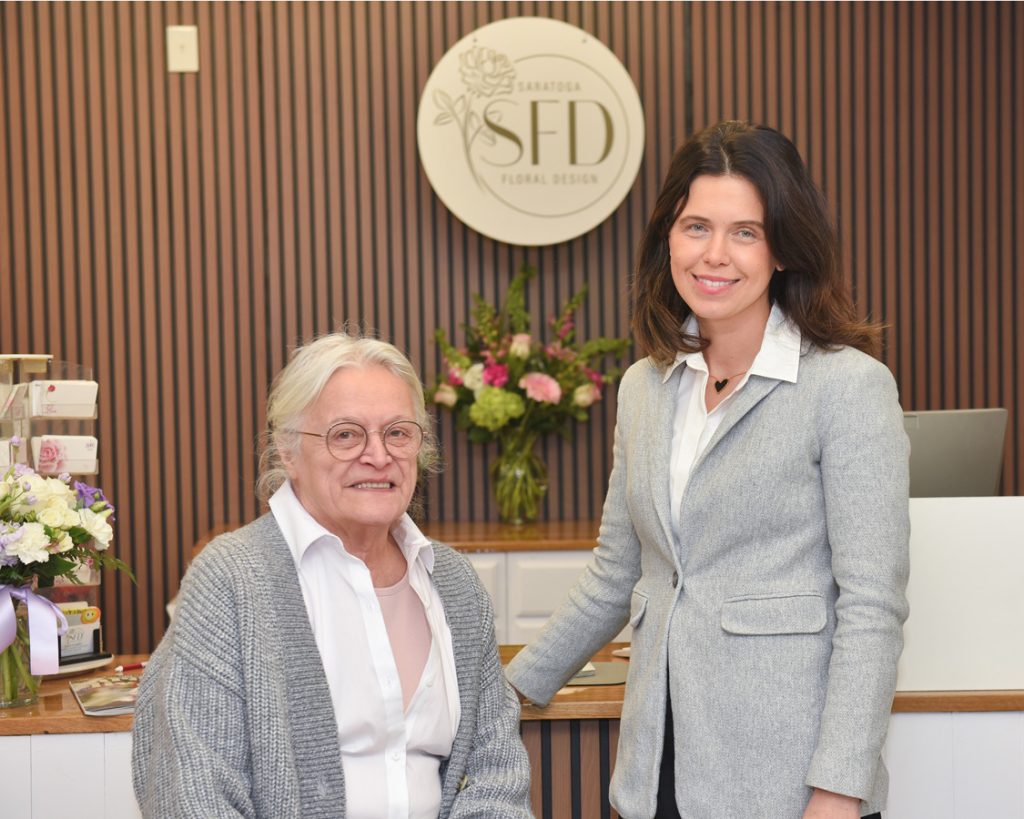
Photo of Paulina Hoag and Jan Murphy by Super Source Media for Saratoga TODAY.
SARATOGA SPRINGS — Founded in 2024, Saratoga Floral Design has recently undergone some significant changes, joining forces with Jan’s Florist and undergoing a five-month-long renovation.
The company officially merged with Jan’s in October of last year, opening a new storefront at 3 Marion Avenue in the Spa City. The transition brought together Jan Murphy’s decades of experience with a new vision for the shop under a new name. Murphy herself remains actively involved in the operation and continues to personally design floral arrangements alongside Saratoga Floral Design’s Paulina Hoag.
Originally from Poland, Hoag has been living in the United States for 17 years, building a life and career. Her design style is influenced by European floral traditions that emphasize natural movement, thoughtful composition, and refined simplicity.
“After years of supporting and managing businesses behind the scenes, I felt inspired to create something of my own—something rooted in creativity, hard work, and community,” Hoag told Saratoga TODAY. “When the opportunity arose to continue a beloved local flower shop, it felt like a meaningful next chapter in my journey.”
In addition to custom floral arrangements, Saratoga Floral Design offers a curated selection of gifts for all occasions, including products from small businesses such as baby gifts, items for dog and cat lovers, and specialty treats. The shop also hosts flower-arranging workshops.
“Above all, our goal is to be more than a flower shop—to be a place where people feel at home and part of the community,” Hoag said.
The Saratoga County Chamber of Commerce held a ribbon-cutting ceremony on Jan. 14 to celebrate the recent opening of KOS Sauna on Saratoga Lake. Photo by Jonathon Norcross.
SARATOGA SPRINGS — Ice-cold waters surrounded the KOS floating sauna on Saratoga Lake, threatening to cool its steamy inner core. But the chilly foes were fought off by KOS’ interior temperatures, which can reach as high as a sizzling 230 degrees.
KOS (pronounced “cozy” without the y) is a Norwegian word defined as a feeling of comfort, warmth, and togetherness. It is an apt description of New York State’s first public floating sauna, which was filled with local politicos and well-wishers on Wednesday afternoon at a ribbon-cutting ceremony celebrating the Finnish-style sauna’s recent opening.
The 15-person sauna is open year-round and offers everything from communal sessions to private rentals to annual memberships to classes and rituals.
A visit includes access to the sauna, roof terrace, and changing rooms, as well as an invigorating plunge into the lake (in winter, this experience may be for only the boldest of Saratogians). Water served at the sauna is sourced straight from the Spa City’s famed mineral springs. Saratoga’s ancient, mineral-rich agua was the primary reason KOS creator/owner Kate Butchart decided to open up shop here, she said at the ribbon cutting.
KOS is located at the marina near Lago by Druthers, at 550 Union Avenue. It’s open Wednesday through Sunday, from 7 a.m. until 10 p.m., with reservation slots available at 90-minute increments.