


Author: Kacie Cotter-Harrigan

News & Notes: Week 5 Events at Saratoga Race Course
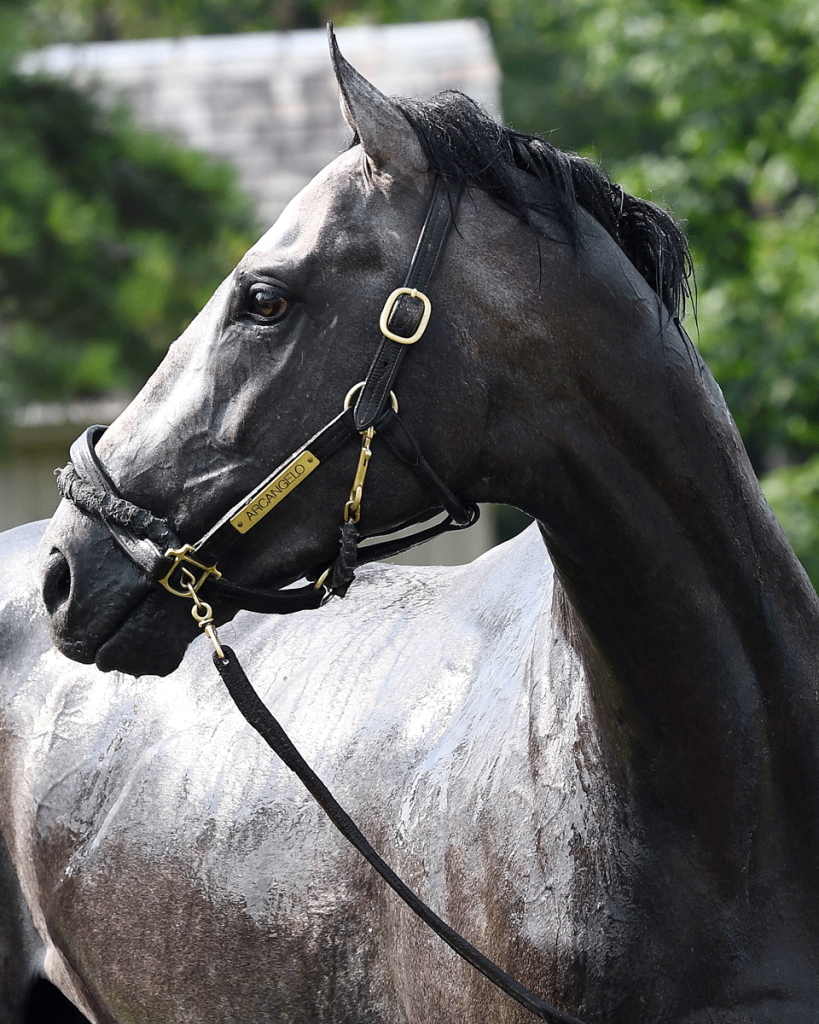
Photo by Susie Raisher
SARATOGA SPRINGS — The 2024 summer meet at Saratoga Race Course is underway and will continue through Monday, Sept. 2. Racing will be conducted five days a week, Wednesdays through Sundays, apart from the final week, when the meet will conclude on Labor Day. Admission gates will open for live racing at 11 a.m. First post time is 1:10 p.m.
week FIVE stake races
*Mondays and Tuesdays = Dark Days. No racing.
Friday, August 9
Evan Shipman Handicap (NYB):
3&UP, 1 Mile – Dirt, Purse $125,000
Union Avenue Handicap (NYB):
F&M 3&UP, 6 Furlongs – Dirt, Purse $125,000
Saturday, August 10
GI FanDuel Fourstardave Handicap (BC): 3&UP, 1 Mile – Turf, Purse $500,000
GII Saratoga Special: 2YO, 6 1/2 Furlongs – Dirt, Purse $200,000
GII Troy: 4&UP, 5 1/2 Furlongs – Turf, Purse $300,000
GI Saratoga Derby Invitational: 3YO, 1 3/16 – Turf, Purse $600,000
Galway: F3YO, 5 1/2 Furlongs – Turf, Purse $150,000
Sunday, August 11
Mahony: 3YO, 5 1/2 Furlongs – Turf, Purse $150,000
Wednesday, August 14
GI Jonathan Sheppard: 4&UP, 2 3/8 – Turf, Purse $150,000
Suzie O’Cain (NYB): F3YO, 1 1/16 – Turf, Purse $125,000
Thursday, August 15
Rick Violette (NYB): 3YO, 1 1/16 – Turf, Purse $125,000
purdy’s summer concert stage
The Purdy’s Summer Concert Stage will host live musical performances each afternoon of the season from popular local and regional bands.
Friday, August 9: The Swingin’ Palms
Saturday, August 10: IMI
Sunday, August 11: Twangbusters
Wednesday, August 14: Franklin Micare Band
Thursday, August 15: American Cafe
TASTE NY PAVILION:
Every Thursday-Sunday
beginning July 11
New York-made food and beverages will be available for sample and purchase at the Taste NY Pavilion, located inside Gate A at the Top of the Stretch, where fans can enjoy New York craft beers, wines, spirits, cheese and chocolate (must be 21 and over to sample and purchase alcoholic beverages). Featured products hail from Montauk to the Finger Lakes and the Hudson Valley to the Adirondacks as a showcase of the state’s robust food and beverage industry.
SARATOGA BREAKFAST AND BREEDING FARM TOUR:
Every Wednesday-Saturday and select Sundays,
beginning July 12
The popular Saratoga Breakfast and Breeding Farm tours, which were first introduced in 2022, will be expanded this summer to meet growing demand. The program will be offered Wednesday through Saturday (excludes July 13, Aug. 24), plus select Sundays, beginning Friday, July 12 through Saturday, August 31. This yearwill feature newcomer Sugar Plum Farm to supplement incumbents Song Hill Thoroughbreds and Old Tavern Farm.
Fans will enjoy a buffet breakfast during morning training at Saratoga Race Course before boarding a CDTA trolley to that day’s breeding farm before returning to the Spa for the afternoon’s races.
Tickets must be reserved in advance at NYRA.com. Each tour accommodates up to 52 guests. Admission to Saratoga Race Course is included in the package.
Adirondack Day
wednesday, august 14
Presented by the Adirondack Regional Tourism Council, the afternoon will include interactive exhibits highlighting the seven New York counties that comprise the Adirondack region, including beverages, cheese samples, apples, reenactors, live music and more as the attractions of the Adirondacks fill the Taste NY Pavilion.
Stewart’s Shops Day at the Races
wednesday, august 14
Stewart’s Shops will celebrate its longstanding partnership with Saratoga by providing free ice cream for fans in the backyard! Complimentary scoops will be available while supplies last.
Fans can also purchase NYRA Bets gift cards and Saratoga season passes at over 100 participating Stewart’s Shops locations.
Thoroughbred Aftercare Day
thursday, august 15
Thoroughbred Aftercare Day pays tribute to an array of organizations involved in finding new homes and careers for retired racehorses. The featured race will be the Rick Violette Stakes, named for the late NYTHA President who was a founding member of the Thoroughbred Aftercare Alliance (TAA).
Family Sundaysevery sundayFamily Sundays feature a wide variety of free family-friendly activities, games, attractions and educational activities each Sunday inside the backyard Family Zone, located near Gate A.

Dolores A. Nelson
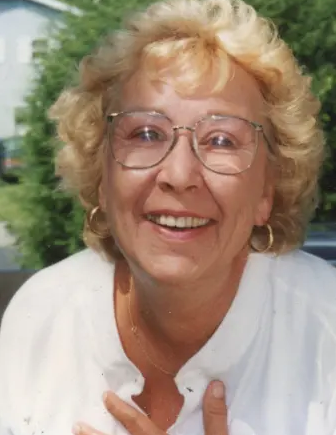
FAYETTEVILLE — Dolores A. Nelson, a beacon of love and resilience, passed away peacefully on August 2, 2024, at the age of 91, surrounded by her loving family. Born on April 19, 1933, to the late Howard and Evelyn (Magnussen) Van Jones, Dolores’s life was a testament to her unwavering spirit and the joy she brought to those around her.
Dolores was the cherished wife of the late Robert Nelson, who she adored until his untimely passing on April 1, 1987. Together, they navigated the life of a Navy family with grace and fortitude. Dolores’s role as a Navy wife entailed creating a nurturing and dynamic home for her four beloved children, Robert L. Nelson II (Donna), Donna Scrivener, Laura Ricardo (Peter), and Sandra Nelson, across various locales, including Japan. Her ability to instill a love for culture and knowledge in her children was unparalleled.
After settling in Burnt Hills, Dolores became a treasured member of her community, forming lasting friendships and engaging in work that mattered to her. She served with dedication as a certified tumor registrar at Saratoga Hospital and continued to share her expertise as a consultant, even in distant cities like San Diego and Monterey, California.
Despite the sorrow of losing her husband, Dolores continued to honor his memory, cherishing the life they shared while embracing new adventures and friendships. Her zest for life was infectious; she traveled the globe, from riding elephants to white water rafting on her 80th birthday. Dolores was the epitome of a social butterfly, often being the life of the party and effortlessly making new acquaintances.
Art and creativity were integral to Dolores’s life. She crafted beautiful dolls in Japan, was an active member of a craft painting club, and enjoyed the camaraderie of the Red Hat Society. Her competitive spirit shone through in her love for bridge, Mahjong, and Scrabble, where she was known to be unbeatable.
Music and dance were Dolores’s passions, and she reveled in the sounds of Frank Sinatra and big band music. Her encounters with Sinatra and Dean Martin were among her cherished memories, as was her love for dancing and singing.
Dolores’s compassionate heart led her to volunteer at the USO in Brooklyn during the Korean War, where she met her future husband. Her commitment to service continued in Japan, where she comforted Vietnam War servicemen as a Grey Lady, and later as a Hospice volunteer, providing solace to the terminally ill.
Above all, Dolores was an extraordinary mother and grandmother. She is survived by her children; Robert L. Nelson II (Donna), Donna Scrivener, Laura Ricardo (Peter), and Sandra Nelson grandchildren Robert Nelson III (Claudia), Rachel Nelson (Adam Rigg), Patrick Scrivener, Daniel Scrivener, Nelson Ricardo, and Neva Ricardo, and sisters Barbara Drollinger and Gina Ferranti. She leaves behind a legacy of love, strength, wisdom, and humor. Dolores was a pillar of support to her family, offering a warm hug and the reassurance that everything would be alright, no matter the circumstance.
Dolores faced life’s challenges with courage, inspiring all who knew her with her kindness and gentleness. A woman of deep faith, she departed this world with the confidence of being welcomed into eternal love by Heaven and those who preceded her in passing.
Calling hours for Dolores will be held today, Friday, August 9, from 10 a.m. – 12 p.m. at the Glenville Funeral Home, 9 Glenridge Road, Glenville. A funeral service will follow at 12 p.m. at the funeral home. Interment will be at St. Anthony’s Cemetery, Glenville.
In lieu of flowers, memorial donations in Dolores’s name may be made to a charity of one’s choice. Online condolences www.glenvillefuneralhome.com

Jewish War Vets at Opening Day
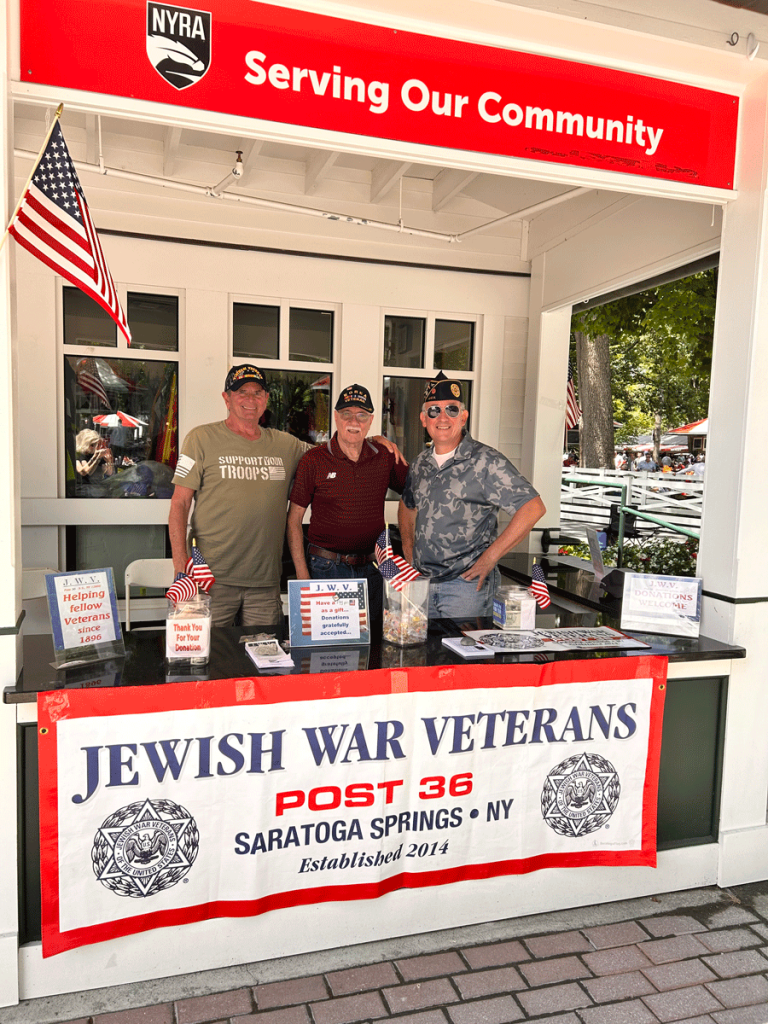
Jewish War Veterans Post 36 had a community outreach booth at Saratoga Race Course’s opening day on July 11. Pictured here are Post Commander Dr. Sam Gottesman, left, Post 36 member Allan Kasin, center, and Capital District Council Commander Richard Goldenberg, right. Post 36 regularly meets at Congregation Shaara Tfille in Saratoga Springs. Photo provided by JWV Post 36.

Comment from Former Commissioner of Public Safety
The December 17 edition of Saratoga Today included an interview with in-coming Commissioner of Public Safety James Montagnino. I congratulate Mr. Montagnino on his victory but I feel compelled to comment on some of his responses in the interview.
When asked why he ran for that office, he responded that the one thing that motivated him was the Darryl Mount Case and how it was treated, “How nobody in authority did anything that you would have hoped.” When asked if he would advocate for an investigation, either internal or external, at this point, he stated that ‘had there been an Internal Investigation done in a timely fashion where a report and the evidence upon which it was based were released to the public, depending on its thoroughness, I might say: We’re done. But, with all that’s happened, I can understand how many people have drawn the conclusion that there must be something to hide.”
As the person who in August 2013 was in authority at the time of Darryl Mount’s tragic injury, I feel that it is important to point out that, immediately after the incident, a thorough investigation took place. Saratoga Springs Police Department investigators dealt with the criminal investigation of the domestic violence which initiated the pursuit of Darryl Mount. Due to the irresponsible rhetoric of a local blogger who had no direct knowledge of the incident but insinuated on his blog that police officers caused Darryl’s injury in an alley, the investigators also focused on finding any evidence or inconsistency that might support the blogger’s contention. Many interviews were conducted. There were pages of documents and views from surveillance cameras which were produced but there has been no evidence of wrongdoing on the part of those officers that night. In fact, after the less than six-minute chase, when Darryl was found at the base of construction scaffolding, the officers assessed his injuries and immediately summoned the fire/EMS department to initiate emergency care.
Darryl sadly passed away in the Spring of 2014. The information from the criminal investigation was then released in June, 2014 when the Public Safety department held a press conference. There, all the evidence was released, with the exception of video of the act of physical domestic violence. Documents and videos from that June 20 press conference were subsequently made available on the City website. There was full transparency regarding the Darryl Mount incident. Nothing has been hidden.
Context is important. Family members and the local blogger insisted that there should be an outside investigation of the Darryl Mount incident. While I felt that the very thorough investigation conducted by our department was more than adequate, both Police Chief Veitch and I insisted that there would be full cooperation should an outside agency decide to conduct their own investigation. The family never asked for a formal Internal Investigation by our department. That term is reserved for situations where there is evidence of or charges by actual witnesses of wrongdoing on the part of the police. While I created some confusion when I unfortunately used the term ‘internal’ loosely when being pressed by Saratogian reporter Catilyn Morris about why I was not calling for an outside investigation, it was never anyone’s intention to misinform the public or the press about a formal ‘Internal Investigation’.
Saratogians in general and Commissioner-elect Montagnino in particular need to know that the Saratoga Springs Police Department and the Department of Public Safety acted responsibly regarding the Darryl Mount tragedy. Despite the terrible rhetoric that I have recently heard, residents and visitors should understand that we continue to have a great police department serving our City.
– Christian E Mathiesen (former Commissioner of Public Safety)
Copy of Local Hero Changed the Outcome at Pearl Harbor
Eighty years ago, on December 7, 1941, the Japanese forces launched a devastating surprise attack on Pearl Harbor, and a local man played a big role in defending against that attack. Furthermore, his actions have been credited with shortening the war in the Pacific.
That Sunday morning, hundreds of Japanese fighter planes descended on the naval base there and managed to destroy or damage nearly 20 American naval vessels, including eight battleships, and over 300 airplanes. More than 2,400 Americans died in the attack, including civilians, and another 1,000 people were wounded. The day after the assault, President Franklin D. Roosevelt asked Congress to declare war on Japan and formally enter World War.
Lawrence Ruff was born on 7 July 1905 in Troy, NY and grew up on Green Street in the village of Schuylerville. His father was a merchant of seed and flour on Spring Street. Ruff had a typical childhood; he was the bugler for the local Boy Scout troop and excelled academically in high school. He entered the US Navy in 1923. His intelligence was noted, and he was sent to the U. S. Naval Academy at Annapolis, Maryland. Ruff’s early career (10+ years) in the Navy had various ship-based assignments.
On that fateful Sunday morning in December, Lieutenant Ruff was assigned as the battleship USS Nevada’s communications officer. He was planning to attend church services on the hospital ship, USS Solace. Ruff and Father Drinnan took a small launch boat on a peaceful journey across the Pearl Harbor passing by all six Pacific fleet battleships. They arrived shortly before 7 a.m. Ruff was waiting for the church service on the hospital ship, when at 7:55 a.m., they heard the first bombs.
The Japanese made a completely surprise attack on the American fleet at Pearl Harbor. Ruff witnessed the battleship USS Arizona erupt in flames and smoke. He rushed back to the small launch boat and took a harrowing journey across the same Harbor including being strafed by a Japanese aircraft. At 8:10 a.m., the battleship USS Oklahoma rolls over, entombing 460 sailors.
When Ruff boarded the Nevada, around 8:25 a.m., he discovered that most of the Nevada’s senior officers were absent and that those present would have to assume duties for which they had not been trained. Ruff made his way to his station in the Nevada’s conning. Lt. Commander Thomas was the most senior officer present. However, Thomas was several decks below at his duty station.
As soon as they were able to communicate, they quickly agreed that Thomas should remain in charge of the ship below decks while Ruff took care of topside duties as Officer of the Deck. Ruff was ordered to “do his best to get them out of the harbor as quickly as possible, dispensing with the usual protocol.” Ruff assumed the conning of the ship as “Acting Navigator.” The Nevada started to raise enough steam to move the ship out of harm’s way at 8:32 a.m. This was just in time as an ocean of burning oil from the Arizona was slowly moving toward the Nevada’s bow, threatening to engulf her in flames.
The Japanese 2nd attack wave of airplanes arrived at 8:45 a.m. The Nevada continued to move out of the harbor, which rose the spirits of the American sailors fighting fires on many ships. Cheers could be heard as sailors saw the Nevada making a wake. However, the Japanese also noticed. From 9:40 to 9:50 a.m., the Japanese air attack focused on the Nevada with five 250kg bombs making direct hits on the ship and 10‐ 15 bombs missing the ship. This resulted in 11 fires burning out of control on the Nevada. At this point, Ruff helped steer this battleship out of the main shipping channel and beached the boat at Hospital Point.
The actions of Ruff’s and his crew resulted in the Japanese 2nd wave focusing on the Nevada rather than the American fuel supplies. Historians believe it would have cost the Americans at least a year if the Japanese had managed to destroy this fuel supply.
In addition, Ruff’s action to clear Nevada of the shipping lane allowed the Americans to make rapid use of the port to rebuild the Pacific fleet.
Ruff served in both the Second World War and the Korean War. He retired as a Rear Admiral and received the Bronze, Silver and Gold Star for his courage. His second career was as an educator in Long Beach, California. He made many family trips back to Schuylerville to visit his extended family (nine brothers and sisters). It is not rare in some circles to still hear Ruff family stories about Uncle Larry. He was a source of inspiration for the family to provide public services, including his niece, June Launder, who was a remarkable WAVE nurse in the Pacific during the war. Lawrence Ruff died on October 20, 1978 at the age of 73.
Note: Lawrence Ruff was played by long-time actor Ron Masak in the 1970 film Tora! Tora! Tora!
Sean Kelleher is the Vice President of the Saratoga County History Center and Historian for the town of Saratoga. He posts a daily blog to historianatsaratoga.wordpress.com. Sean may be contacted by email at historiantosaratoga@gmail.com
Local Hero Changed the Outcome at Pearl Harbor
Eighty years ago, on December 7, 1941, the Japanese forces launched a devastating surprise attack on Pearl Harbor, and a local man played a big role in defending against that attack. Furthermore, his actions have been credited with shortening the war in the Pacific.
That Sunday morning, hundreds of Japanese fighter planes descended on the naval base there and managed to destroy or damage nearly 20 American naval vessels, including eight battleships, and over 300 airplanes. More than 2,400 Americans died in the attack, including civilians, and another 1,000 people were wounded. The day after the assault, President Franklin D. Roosevelt asked Congress to declare war on Japan and formally enter World War.
Lawrence Ruff was born on 7 July 1905 in Troy, NY and grew up on Green Street in the village of Schuylerville. His father was a merchant of seed and flour on Spring Street. Ruff had a typical childhood; he was the bugler for the local Boy Scout troop and excelled academically in high school. He entered the US Navy in 1923. His intelligence was noted, and he was sent to the U. S. Naval Academy at Annapolis, Maryland. Ruff’s early career (10+ years) in the Navy had various ship-based assignments.
On that fateful Sunday morning in December, Lieutenant Ruff was assigned as the battleship USS Nevada’s communications officer. He was planning to attend church services on the hospital ship, USS Solace. Ruff and Father Drinnan took a small launch boat on a peaceful journey across the Pearl Harbor passing by all six Pacific fleet battleships. They arrived shortly before 7 a.m. Ruff was waiting for the church service on the hospital ship, when at 7:55 a.m., they heard the first bombs.
The Japanese made a completely surprise attack on the American fleet at Pearl Harbor. Ruff witnessed the battleship USS Arizona erupt in flames and smoke. He rushed back to the small launch boat and took a harrowing journey across the same Harbor including being strafed by a Japanese aircraft. At 8:10 a.m., the battleship USS Oklahoma rolls over, entombing 460 sailors.
When Ruff boarded the Nevada, around 8:25 a.m., he discovered that most of the Nevada’s senior officers were absent and that those present would have to assume duties for which they had not been trained. Ruff made his way to his station in the Nevada’s conning. Lt. Commander Thomas was the most senior officer present. However, Thomas was several decks below at his duty station.
As soon as they were able to communicate, they quickly agreed that Thomas should remain in charge of the ship below decks while Ruff took care of topside duties as Officer of the Deck. Ruff was ordered to “do his best to get them out of the harbor as quickly as possible, dispensing with the usual protocol.” Ruff assumed the conning of the ship as “Acting Navigator.” The Nevada started to raise enough steam to move the ship out of harm’s way at 8:32 a.m. This was just in time as an ocean of burning oil from the Arizona was slowly moving toward the Nevada’s bow, threatening to engulf her in flames.
The Japanese 2nd attack wave of airplanes arrived at 8:45 a.m. The Nevada continued to move out of the harbor, which rose the spirits of the American sailors fighting fires on many ships. Cheers could be heard as sailors saw the Nevada making a wake. However, the Japanese also noticed. From 9:40 to 9:50 a.m., the Japanese air attack focused on the Nevada with five 250kg bombs making direct hits on the ship and 10‐ 15 bombs missing the ship. This resulted in 11 fires burning out of control on the Nevada. At this point, Ruff helped steer this battleship out of the main shipping channel and beached the boat at Hospital Point.
The actions of Ruff’s and his crew resulted in the Japanese 2nd wave focusing on the Nevada rather than the American fuel supplies. Historians believe it would have cost the Americans at least a year if the Japanese had managed to destroy this fuel supply.
In addition, Ruff’s action to clear Nevada of the shipping lane allowed the Americans to make rapid use of the port to rebuild the Pacific fleet.
Ruff served in both the Second World War and the Korean War. He retired as a Rear Admiral and received the Bronze, Silver and Gold Star for his courage. His second career was as an educator in Long Beach, California. He made many family trips back to Schuylerville to visit his extended family (nine brothers and sisters). It is not rare in some circles to still hear Ruff family stories about Uncle Larry. He was a source of inspiration for the family to provide public services, including his niece, June Launder, who was a remarkable WAVE nurse in the Pacific during the war. Lawrence Ruff died on October 20, 1978 at the age of 73.
Note: Lawrence Ruff was played by long-time actor Ron Masak in the 1970 film Tora! Tora! Tora!
Sean Kelleher is the Vice President of the Saratoga County History Center and Historian for the town of Saratoga. He posts a daily blog to historianatsaratoga.wordpress.com. Sean may be contacted by email at historiantosaratoga@gmail.com
Does Compassion Have a Season?
It’s that time of year again when the focus shifts to the Code Blue Emergency Shelter for individuals experiencing street homelessness. Code Blue is a New York State mandate that says when the “Real Feel” temperature drops to 32 degrees, emergency, low barrier shelter for homeless individuals must be provided. In December of 2013, Nancy Pitts passed away in the freezing night which sparked a call to action to begin Code Blue operations in Saratoga Springs.
Frankly, the whole philosophy of Code Blue has often left me baffled. Why is it that we must hit a certain temperature before we take care of those who are most in need? Do we need the thermometer to tell us when we show compassion, kindness, and empathy? I have seen homeless individuals from ages 1 to well into their 80’s. I have seen veterans, persons with masters and Ph.D. degrees, daughters, sons, mothers, fathers, and even grandparents.
Maybe if we understood our homeless a bit more, that philosophy might change. Homelessness is not just a Saratoga problem; it has been an issue in our country and across the world for decades. There are many reasons why homelessness is such an issue. The contributing factors around homelessness are poverty, lack of affordable housing, addiction/substance use, and mental health challenges. In today’s society, we look at those who are suffering and instinctively assume that homelessness is of their own creation. Many people have been let down by our societal systems, and overcoming homelessness requires a support system many do not have. I can assure you that no person aspires to be homeless or at a Code Blue shelter.
Please, don’t get me wrong. I’ve been working at Shelters of Saratoga and in this wonderful community for 15 months. What I’ve seen since my arrival would make anyone proud. I’ve seen our businesses, city and county government officials want to be part of a solution. I’ve witnessed how much our community truly cares about some of today’s most controversial issues. Most notably are the dedicated staff and volunteers that give up their evenings and early mornings so that they can provide a hot meal, a warm cot, and more importantly, dignity and hope to our neighbors that have lost so much.
Last year we sheltered an average of 33 people a night at Code Blue, serving a total of 215 people for the season. Our volunteers served over 5,000 meals that were generously donated by local restaurants and community organizations. Code Blue is currently in full swing at our temporary Adelphi Street location and we are already on par to eclipse last year’s numbers.
There are multiple agencies working diligently to solve homelessness. Code Blue is a life-saving strategy, but not the answer to homelessness. We must work together on proven solutions to bring this human issue into the forefront of our minds and hearts. It’s time we discard the “thermometer philosophy” and take the next steps to expand year-round services at the navigation center and designate a permanent location for Code Blue. With these resources we can forge better pathways out of the despair of homelessness.
To learn more about Shelters of Saratoga’s work to end homelessness, please visit: sheltersofsaratoga.org
A President, an Assassin, and a Lawyer
The 20th President of the United States, James Garfield, was born in a log cabin in Ohio and was mule driver on the Ohio & Erie Canal. A graduate of Williams College, he later became an attorney and a skilled orator, and was elected to Congress in 1862. He then served as a Major General during the Civil War. In the 1880 election Garfield conducted a Front Porch Campaign and narrowly defeated another Civil War General and Gettysburg hero, Winfield Scott Hancock.
Charles Julius Guiteau was an American writer and attorney. Guiteau felt, falsely so, that his actions had contributed to Garfield’s successful campaign and sought a consulship position to either Vienna or Paris. Failing in his pursuit of this honor he decided to shoot Garfield, which he did, wounding him, on July 2, 1881. Garfield succumbed to the wound on September 19, 1881.
John K. Porter was a Waterford, New York attorney. Born in Waterford on January 12, 1819, he was educated in both the Waterford and Lansingburgh Academies, later graduating from Union College in 1837. Upon his death, the Albany Law Journal stated; In our opinion, Mr. Porter comes nearer to being a genius than any other man in our bar.
How did destiny bring together this former Ohio canaller, a crazed and disgruntled office seeker, and a near-genius Waterford native and lawyer?
John’s father, Dr. Elijah Porter, wanted John to follow in his footsteps. John was not interested in becoming a doctor but made a deal with his father that he would study medicine for six months. If he did not show a talent for it, his father would permit him to study law. At the end of that period John’s father said; “Son I don’t know what kind of lawyer you will make, but you’ll make a mighty poor physician, so I will let you study law.”
In 1846 John Porter, at the age of 27, was among those chosen to represent Saratoga County at the New York State Constitutional Convention. John became a leading lawyer in Waterford with a remarkable intellect, who was able to practice, in nearly every branch of the law. His skills soon made it possible for him to play on a larger stage.
In early 1865, Porter was appointed to the New York Court of Appeals to fill the vacancy caused by the resignation of Henry R. Selden. In November 1865, he was elected on the Republican ticket to the remaining six years of Selden’s term, but resigned on December 31, 1867, and returned to private practice, now in New York City.
His record as an attorney would have made Dr. Porter proud. Son John successfully defended Horace Greeley, editor of the New York Tribune, in a libel case brought by the Assembly Speaker DeWitt C. Littlejohn. In 1875, he represented Henry Ward Beecher in his case against Theodore Tilton, who, in one of the most scandalous cases of the post-civil war era, accused Beecher of adultery with Tilton’s wife. The jury could not reach a verdict. In February 1876, Porter defended Grant’s military secretary Orville E. Babcock, who had been indicted during the prosecution of the Whiskey Ring frauds. Babcock was acquitted.
In 1876, two weeks after voters went to the polls to choose between Rutherford B. Hayes and Samuel J. Tilden, the New York State Bar Association was founded, and Porter became the Association’s first president. He challenged the new organization to “exercise a collective and permanent influence” on the great issues of the day.
At this point in our story, late 1881, President Garfield was in Lake View Cemetery in Ohio, Guiteau is in a Washington D.C. jail awaiting trial, and the Honorable John K. Porter was retired, back home in Waterford.
The National Park Service reported the following on the trial of Charles J. Guiteau; At trial, the assassin Guiteau stated that “I did not kill the President. The doctors did that. I merely shot him.” The trial lasted nearly two months and often had a circus-like atmosphere. The U. S. Attorney General, Wayne MacVeagh, put together a 19th-century dream team to prosecute Guiteau, among them John Porter of Waterford.
Porter was not a specialist, he was a laborious, keen, strongly-equipped man in nearly every branch of the law. He was a formidable cross-examiner and a trustworthy counselor. Arthur and MacVeagh deemed him necessary to the team. On cross-examination, prosecutor Porter tried to suggest to jurors that what the defense claimed was evidence of insanity was instead only evidence of sin. He forced Guiteau to concede that he thought the assassination would increase sales of his autobiography. He demanded to know whether Guiteau was familiar with the Biblical commandment, “Thou shalt not kill.” Guiteau responded that in this case “the divine authority overcame the written law.” He insisted, “I am a man of destiny as much as the Savior, or Paul, or Martin Luther.”
Judge Porter’s cross-examination of Guiteau was so effective in defeating Guiteau’s insanity defense that Francis L. Wellman gave it a chapter in his classic work The Art of Cross-Examination. In its December 2, 1881, headline, the New York Times characterized the cross-examination as “Guiteau’s Day of Torture.”
As a result of the trial, the prosecution team won a conviction after Guiteau went through a series of defense attorneys, most arguing an insanity defense. Guiteau was found guilty in January 1882 and met the hangman on June 30, 1882. By that time John Porter had returned to his retirement in Waterford. According to The New York Times obituary, Porter’s “devotion to this case wore out his energy, and after its conclusion, he almost wholly gave up the practice of law.” Porter died on April 11, 1892, in Waterford.
Russ Vandervoort is the Waterford Town Historian and leader of the Waterford Canal and Towpath Society and can be reached at russvandervoort@gmail.com.