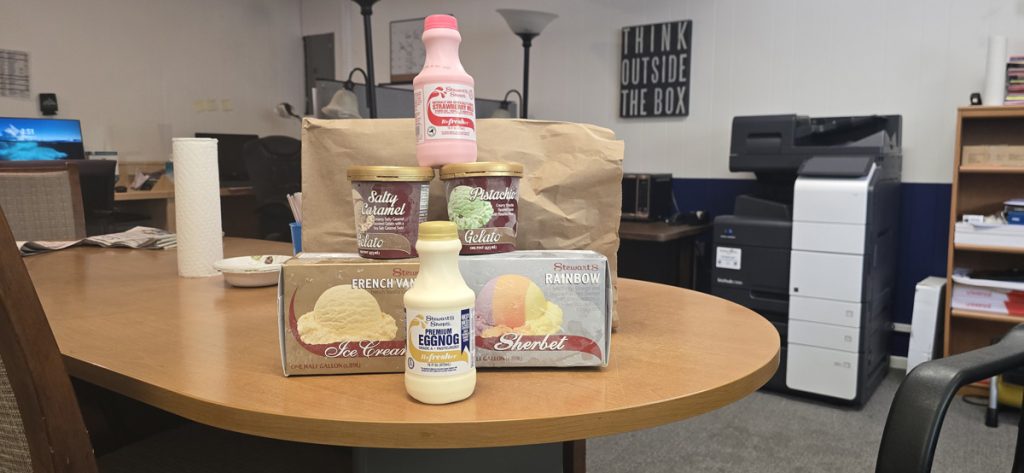
Some of the products which scored in the top three at the World Dairy Expo ( Aidan Cahill)
A staple of life in the Upstate New York, Ballston Spa’s own Stewart’s Shops is known for its milk and ice cream.
While this complete and udder excellence is common knowledge for residents, it’s now been recognized as being in the top 3 best dairy products 17 times — including top honors for sherbert, gelato, lactose free milk, open class flavored milk and strawberry milk — at the World Dairy Expo in Madison, Wisconsin.
“These awards are a testament to the skill and dedication of the 21 family farms, who supply our milk, and the partners, who are committed to producing the highest quality milk and ice cream at our plant in Greenfield, New York,” the company said in a press release.
For frozen treats, Stewart’s rainbow sherbert took home top honors in the category, while mango dragon fruit came in second. For Gelato, the top three was all Stewart’s with Pistachio coming in first while salty caramel and milk chocolate followed behind. In addition, Stewart’s French vanilla came in second place in the French vanilla category while their chocolate came in second for that category, Bark in the Dark came in third for dark chocolate, maple walnut came in second for ice cream with nuts, peanut butter pandemonium came in third for peanut butter ice cream and dirt cake came in third for open class.
In addition to Stewart’s, Schuylerville’s King Brothers Dairy came in second for the open class ice cream with caramel for their just take my money ice cream and second for peanut butter with their PBOMG! ice cream.
The World Dairy Expo will be held in Madison Wisconsin from Sept. 30 – Oct. 3.
Skidmore College soccer player Mara Grace, who scored her first-ever goal last weekend. Photo by Dswain Photography/Skidmore Athletics.
Football season officially began last weekend when the Saratoga Springs, Schuylerville, and Ballston Spa varsity squads all earned impressive week one victories. In other high school sports news, the Saratoga girls golf team defeated Queensbury, the Schuylerville boys soccer team tied Mechanicville, and the Spa Catholic girls soccer team tied Mekeel Christian Academy. At the collegiate level, Skidmore freshman soccer player Mara Grace earned her first-ever goal and the Skidmore volleyball team swept Johnson & Wales.
Schuylerville Annihilates Broadalbin-Perth
The 2024 state champion Schuylerville Black Horses galloped into the 2025 season with a dominant 57 to 0 victory over Broadlbin-Perth last Friday. The lopsided affair produced a series of impressive performances for the Horses:
• Senior quarterback Ben VanVegthen threw for 2 touchdowns and completed a 45-yard pass.
• Max Montgomery and Levi Michaud both ran for nearly 100 yards apiece, with Michaud netting 93 yards in just two carries.
• Junior Blake Cumm averaged 16 yards per carry, reaching the endzone twice.
• Sophomore Ernie DaCoasta caught 2 TDs and earned a sack on defense (one of three for the Horses).
Schuylerville will next play at Johnstown on Friday, Sept. 12.
Ballston Spa’s Shocking Come-from-Behind Victory
The Buffalo Bills weren’t the only Upstate football team to earn an almost surreal comeback last weekend. The Ballston Spa Scotties managed to defeat the Eastchester Eagles 21 to 20, despite trailing 20-0 at halftime. The scoring rampage began in the third quarter with a rushing touchdown that put 6 on the board for the Scotties. A two-point conversion attempt failed, leaving things at 20-6 heading into the final quarter. Then B-Spa blew up. A passing touchdown with 8 minutes to go was followed by a successful two-point conversion, putting the Scotties within 6. With 5 minutes on the clock, a colossal 74-yard TD reception evened the score at 20 apiece before the extra point kick sealed the deal.
The 1-0 Scotties will take on Shaker at home on Friday night.
Blue Streaks Beat Monroe-Woodbury
The Saratoga Springs varsity football squad defeated Monroe-Woodbury last Saturday in a non-conference game. Field conditions were wet with hundreds of fans reportedly in attendance. The first quarter was evenly matched, with neither team putting points on the board. Monroe nabbed an interception but couldn’t capitalize on the turnover. In the second quarter, Monroe blocked a Saratoga punt before earning a rushing touchdown to put them ahead, 7-0. Saratoga responded minutes later with a short passing TD to even the score. But Monroe took the lead heading into halftime after a 23-yard field goal. 10-7 at the half. In the third, the Blue Streaks offense gave up two more turnovers with a fumble and interception. Monroe couldn’t convert on offense, however, and the tally remained 10-7 heading into the fourth. Both teams elevated their play in the final stanza. The decisive quarter began with a Saratoga passing touchdown that put them ahead by 3. The extra point attempt was no good. Monroe quickly responded with a massive, 54-yard rushing TD. An extra point put them ahead 17 to 13. With just three minutes left in the contest, Saratoga closed out the game with a rushing touchdown and extra point. Final score: Saratoga 20, Monroe-Woodbury 17.
The Blue Streaks will face off against Burnt Hills-Ballston Lake at home on Friday night, Sept. 12.
Saratoga Catholic-Stillwater Falls to Mechanicville
The Saratoga Catholic-Stillwater varsity football team fell to Mechanicville, 29 to 21 last Friday. Stillwater held the Red Raiders in check in the first half, entering the break with just a one-point deficit. But Mechanicville exploded in the second half with 16 points. For the Warriors, senior quarterback Aidan Callanan threw for 169 yards with 2 touchdowns and 1 interception. He also led his team in rushing yards, with a total 70 in 22 carries (one of which earned him a trip to the endzone). Callanan’s receiving targets were varied, with four players netting around 40 yards apiece (seniors Caleb Vacula and Bryce Peterson each caught a TD). On the defensive end, senior John Williams grabbed an interception.
Spa Catholic-Stillwater will play Cambridge/Salem on Friday at home.
Spa Catholic Soccer Squad Ties Mekeel in OT Rivalry Game
The Saratoga Catholic girls soccer team, which was the subject of a feature story in last week’s edition of Saratoga TODAY, tied Mekeel Christian Academy last Friday in overtime, 1-1. Sophomore Julia Dejnozka scored the Saints’ lone goal. Spa Catholic and Mekeel have developed a healthy rivalry thanks to their close games last season, all three of which ended in Saints losses.
Saratoga Girls Golf Defeats Queensbury
The Saratoga Springs girls golf team defeated Queensbury in a non-league contest on Sept. 3 at the Hiland Park Country Club, 95 to 117. For the Blue Streaks, Sophia Jackson shot a 44 and Emma Kraszewski a 51.
Schuylerville Ties Mechanicville in Boys Soccer Showdown
Schuylerville hosted Mechanicville on Sept. 3 in an early season match. The Red Raiders came out and immediately applied pressure. 3 minutes in, they were rewarded when David DiSiena found the back of the net. Mechanicville continued to press, but eventually Schuylerville began to equalize the play. With 10 seconds remaining in the half, Mechanicville’s Graham Murphy finished an uncleared corner to make it 2-0. The majority of the second half belonged to the Horses as Thomas Tyler and Dean Barraclough scored to even it up midway through the half. Schuylerville would continue to press the back line but could not get the game winner. Final score: 2-2.
Freshman Thoroughbred Earns First Career Goal
Freshman Mara Grace scored her first collegiate goal in just the 2nd minute as the Skidmore College women’s soccer team battled Hartwick to a 1-1 tie on the road last Sunday afternoon. The Thoroughbreds (0-1-2) outshot the home team by a double-digit margin, 14-to-4, after taking the lead from seemingly the opening touch. However, it proved not enough as the Hawks (2-0-2) strung together just enough offense in the 14th minute to ultimately force the tie. The Thoroughbreds quickly took the lead 2 minutes into the match after Grace drilled a high-arching shot attempt from just outside the box that sailed past the arms of Hartwick’s goalie and through the top left of the net. In the 14th minute, the Hawks capitalized on a free kick sequence that saw the pass from Jenna Mierek initially ricochet off the head of Ella Grupe before ultimately finding an uncontested Millie Caldon in the left side of the goal for the shoot and score and tying the match at 1-1. At halftime, Skidmore again made a goalie change with sophomore Sophia Sayers taking over for senior Avery Rogers, who recorded a pair of saves through the first 45 minutes at goal. Skidmore outshot Hartwick by an 8-to-1 margin in the second half after largely dominating possession of the ball on the offensive third, however the Thoroughbreds failed to break through Hartwick for the go-ahead goal as time ran out. Grace led the offense with four shots in addition to her first career goal.
Skidmore Volleyball Squad Sweeps
The Skidmore College volleyball team swept Johnson & Wales (25-19, 25-16, 25-17) and lost 3-1 to SUNY Geneseo (19-25, 27-25, 25-15, 25-19) last Saturday at the Williamson Sports Center to finish the 2025 Skidmore Classic with a 2-1 record. First-year Chloe Heitman was Skidmore’s representative on the All-Tournament Team. She registered 30 kills and 24 digs with four blocks across three matches this weekend. Skidmore will next head to the Phoenix Invitational at Swarthmore College, Sept. 12–13. The Thoroughbreds will face a competitive field that includes nationally recognized opponents.
A Ballston Spa Man has been charged with a crime after attacking a vehicle with a hammer.
Christopher Brothers was arrested Sept. 7 in the Blue Herron Trail Apartment Complex in the Town of Ballston after deputies from the Saratoga County Sherriff’s Office were dispatched there around 2 pm for domestic disturbance.
According to the Sherriff’s Office, Brothers allegedly jumped on the vehicle and struck it with a hammer causing more than $1,500 in damage. Brothers allegedly selected the victim — who the Sherriff’s Office said is Black — based on perceived race.
Brothers has been arrested for criminal mischief in the second degree as a hate crime, a class C felony and first-degree criminal contempt, a class E felony. The Sherriff’s Office said that in carrying out the attack, Brothers Violated an order of protection. Brothers was arraigned and released to pre trial services.
Two Separate incidents in Malta have brought the total number of animal abuse incidents up to seven.
Eugene Willis, 69, of Malta was arrested by the Saratoga County Sheriff’s Office on Aug. 28 after deputies received a complaint of animal abuse that morning. Willis wasn’t the only one arrested recently as on Sept. 2, the Sheriff’s Office arrested Ashley Ross for animal abuse and falsifying business records.
According to the Sheriff’s Office, Willis allegedly kicked a black lab causing bruising and digestive issues. The dog and a brown lab found at the residence were seized by the Malta animal control officer. They were transported to the Saratoga County Animal Shelter and received medical treatment.
Ross’s case, meanwhile, stems from an incident that occurred Aug. 16 when she surrendered a pit bull to the Malta animal control officer. At the time of the surrender, Ross claimed the dog hadn’t bit anyone in the last 10 days, however the Sheriff’s Office said that the dog had bitten someone the previous day. In addition, the dog had bitten another pit bull at the residence causing an injury for which Ross failed to get treated. That dog has been transported to the Saratoga County Animal Shelter and is receiving treatment.
Both Willis and Ross were released on appearance tickets for their respective offenses.
Willis and Ross’ cases represent the sixth and seventh cases of animal abuse this year in Saratoga County. Last month, two people were arrested in Malta for abusing three dogs while there have been several high-profile cases across the county. Their charges bring the total 203rd misdemeanor count brought against residents by Sheriff’s Office.
In response to these incidents, The Saratoga County Board of Supervisors proposed legislation to create a registry of animal abusers and held a public hearing on the bill Sept. 10 — coverage of which can be found at saratogatodaynewspaper.com.
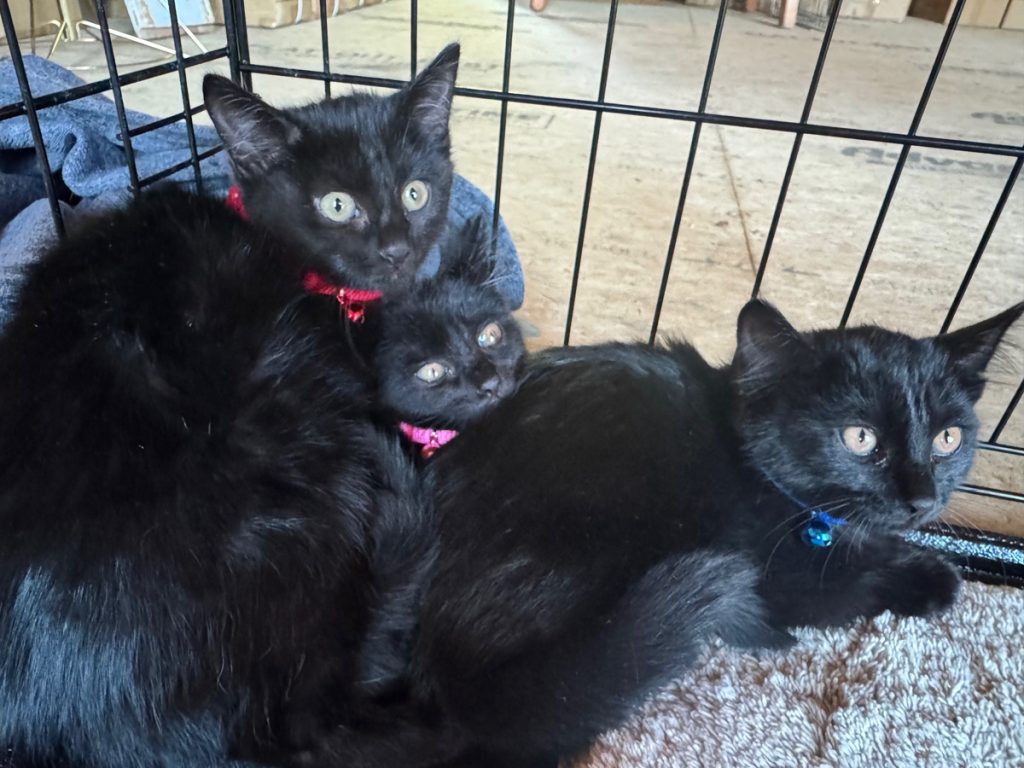
SARATOGA SPRINGS — A mother cat and her five kittens need new homes after they were discovered behind the Impressions of Saratoga store on Broadway. Those interested in adding a furry feline friend to their home can contact Kitten Angels at 838-292-5680.
The six cats, dubbed the Phila Felines, were found in late August by Jason Thomas, a local realtor who noticed a cat in the alley behind the Impressions building on Phila Street. Thomas called Kitten Angels, a local cat rescue group, to help catch the cats and get them to safety.
When Tom and Kristie Roohan of Roohan Realty were told about the cats, they offered to pay for vetting, a welcome gift for Kitten Angels, a small organization that relies solely on donations. After getting checked out by vets, all six kitties are now being fostered by members of the Impressions of Saratoga crew.
To keep with the Phila Feline theme, each cat has been named (at least temporarily until they’re adopted) after a business on Phila Street. Since there are six ladies, their names are Phila (mother cat), Hattie, Lena, Mimi, Magic, and Bailey.
Impressions will be posting Phila Feline photos and updates on social media, and all funds donated to the coin drops at both Impressions of Saratoga and The Dark Horse Mercantile will be given to the Kitten Angels to help offset the cost of care.
A Saratoga Springs man and two minors have been arrested after a police chase across Saratoga and Albany Counties.
Eugene Shaw, 21 was arrested for criminal possession of stolen property in the fourth degree, two counts of fourth degree criminal mischief, two counts of endangering the welfare of a child, reckless endangerment of property and other traffic violations, according to New York State Police.
The chase occurred Sept. 6. It started at 6:18 p.m. when a vehicle was reported stolen from Freeman Lane in Saratoga Springs. Within 10 minutes, the vehicle was spotted going southbound on I-87 in Malta. State Police as well as Deputies from the Saratoga County Sheriff’s Office attempted to stop the vehicle, leading to the chase.
The chase ended in Albany County when State Troopers elected to terminate pursuit due to public safety concerns. After the pursuit ended, the vehicle exited the interstate at exit six but didn’t make it far. Troopers said Shaw attempted to make a left turn onto Troy Schenectady Road but lost control of the vehicle and flipped over multiple times before coming to rest on the overpass.
Shaw, along with a 12- and 15-year-old exited the vehicle and attempted to flee on foot but were taken into custody. All three were taken to Albany Medical Center for evaluation. The two minors were arrested Sept. 8 for fourth degree criminal possession of stolen property.
After being released from the hospital, Shaw was taken into custody and issued an appearance ticket for Sept. 25.
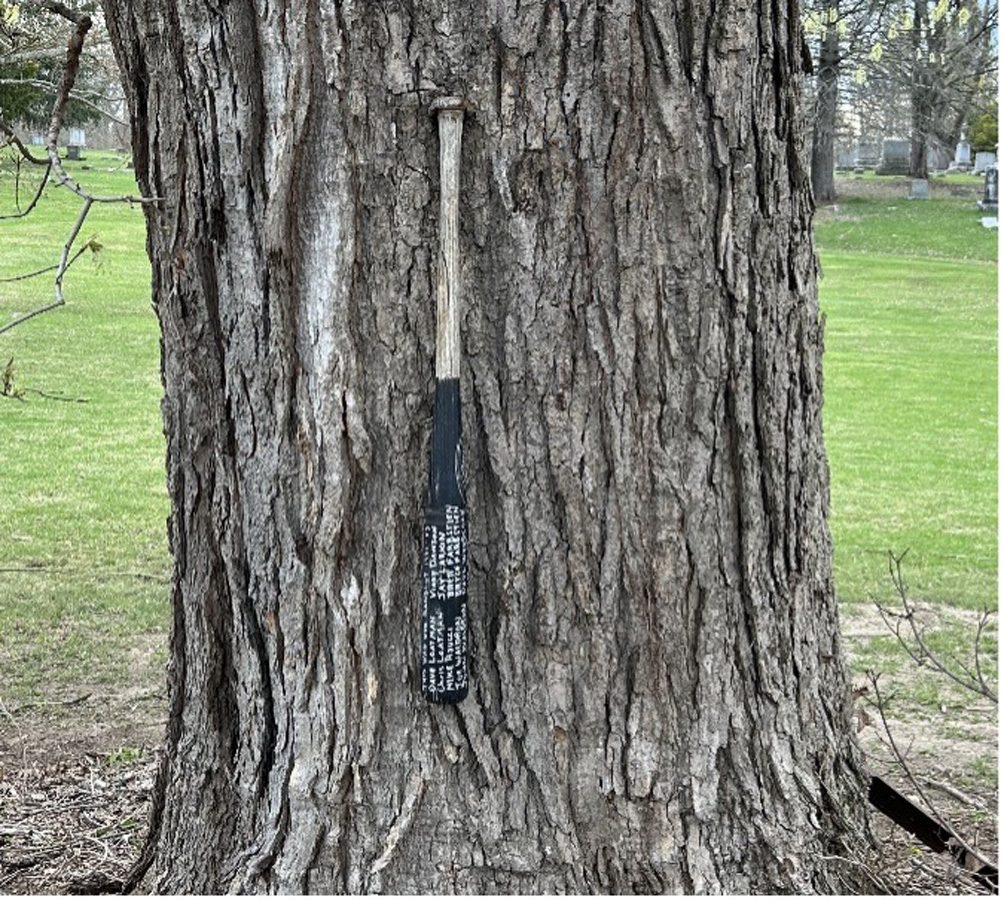
The bat at the Field of Dreams. Photo provided by The Saratoga County History Roundtable.
I love the movie Field of Dreams. I especially love the part where the spirits walk out of the cornfield to join in the baseball game. To me, it showed spirits in a whole new light. So, when Mike Sullivan tipped me off that in our own Hudson View Cemetery we might have had some spirited baseball going on some years back, I thought I’d check it out.
Mike is an avid historian, particularly interested in military history as well as local history. When, on one of his visits to Colonel Elmer E. Ellsworth’s grave, Mike spotted a baseball bat and helmet hanging from a massive maple tree, he was, of course, intrigued.
The message on the black bat reads “This bat is for all the great baseball games played here . . . 1982, 1983, 1984 . . . and the kids that played it”. Baseball games played here? In a cemetery?
Hudson View is a lovely old cemetery, with graves dating back at least to 1830. It sits on rolling ground at the crest of a hill overlooking the city, 76 acres of knolls and woods and wide expanses of green grass. There are old family plots, some with soaring monuments marking the resting places of once-prominent figures in the city’s history. There are neat rows of more recent gravesites. There are soldiers’ graves, babies’ graves, clustered graves of whole families, and often single and seemingly lonely graves. More than 6,000 folks have been buried here in Hudson View.
If you walk along the eastern side of the cemetery, along the top of the hill, you’ll come to the Old Section. A tall granite spire topped by a brass eagle and surrounded by a wrought iron fence marks the grave of Colonel Ellsworth, who was a dear friend of President Abraham Lincoln. The colonel was the first Union officer to die in the War Between the States.
Reared here in Mechanicville, Elmer was a boy who played at being a soldier, who wanted desperately to be a soldier. He dreamed, played, learned and worked on the streets of our town and probably in the fields that surrounded this little village at the time. One might wonder, as baseball was invented around the time he was born, reportedly by a man from our neighboring community of Ballston Spa, if Elmer ever gathered his buddies, a bat and a ball, and went to the top of the hill overlooking the canal and the railroad to play a game of pickup baseball.
The Ellsworth monument sits back in the quiet far reaches of Hudson View, and overlooks a small open field, a yet-to-be-used part of the cemetery. The field is a natural bowl amid the rolling knolls and is ringed with rows of granite and marble headstones. It was to this field, a “field of dreams”, so to speak, that these very-much-alive boys of summer came to play back in the early 1980s.
Caretaker Jim Doty, who was the caretaker back then, too, saw no harm in it, he says. They weren’t tipping tombstones; they weren’t desecrating graves. He says they were always respectful and considerate and picked up after themselves. They weren’t bothering a living soul. They were just indulging in the great American pastime, down there in a quiet, lonely field in the back part of the cemetery.
It was an era when Steve Carlton was baseball’s finest, when the St. Louis Cardinals, Baltimore Orioles and Detroit Tigers were World Series champs, when George Brett used too much pine tar on his bat. Michael Jackson’s “Thriller” was the album of choice, but there was no such thing as an iPod. Donkey Kong and PacMan were lighting up the screens at the video arcades. Few homes had computers, Game Boys didn’t exist, and not one kid owned a cell phone. But there was baseball.
Inscribed on the Louisville Slugger, which hangs to this day on the tree, in neatly painted silver letters are the names of 13 neighborhood boys from down the hill . . . boys now grown to men.
These boys dreamed, played, learned and worked here in the streets of our town. Most of them graduated from well-known colleges and universities. Some have remained here and have become respected and productive members of the community. Some have careers and families in other places. One became a professional athlete, and one is himself now buried here in the cemetery where he used to thrill to the crack of the bat.
Today, as always in the early days of autumn, the baseball playoffs are the talk of the sports world, and fans everywhere are eagerly anticipating the upcoming World Series. Some things never change.
But I like to think that back then, in the carefree summer and early autumn days of the mid-1980s, the spirit of young Colonel Ellsworth enjoyed watching those boys play baseball. I like to think that he and all the other spirits who rest here in the peace and quiet of Hudson View became baseball fans for just a few brief years, treated to the greatest game there is — kids playing ball just for the love of the game.
Flight-Medic Kevin Robert died while treating a patient. He was 55. (Courtesy of LifeNet)
First responders across Saratoga County are mourning one of their own this week after a flight medic suffered a fatal heart attack while treating a patient.
Kevin Robert died Aug. 27 after he suffered a heart attack while treating a patient on board a LifeNet 7-13 helicopter, based out of Ticonderoga. The helicopter diverted to Saratoga Hospital however medical crews were unable to revive Robert. He was 55.
“Our priority now is the well-being of our teammates and the continued support of Kevin’s family,” LifeNet said in a Facebook post. “The Ticonderoga base remains on safety stand-down as we allow our team the time and space they need to grieve.”
Robert had been with LifeNet for 15 years, according to his obituary. In addition to his work as a flight medic, he was a founding member of the John Ahearn Rescue Squad in Mechanicville and served in several EMS agencies throughout Saratoga County including the Clifton Park & Halfmoon Emergency Corps, Malta- Stillwater EMS and as a paramedic instructor at Hudson Valley Community College.
Tributes to Robert have poured in from across the county and beyond. In a statement, Saratoga County Board of Supervisors Chairman Phillip Barrett offered his condolences and said Robert served the county with professionalism and compassion. Similar sentiments were expressed by Clifton Park and Halfmoon Emergency Corps who said he was known for being one of the most talented EMS providers across the region.
Services for Robert were held at St. Edward the Confessor Church in Clifton Park. A Go Fund Me has been set for his family, which as of time of printing has raised over $17,000.
Those looking to donate can find the link in the online version of this story or on the Malta-Stillwater EMS Facebook page.