SARATOGA SPRINGS — Goose—an indie groove jam band performing at the Saratoga Performing Arts Center (SPAC) on July 3 and 4—will have a charity golf tournament at the Saratoga Spa Golf Course on the Fourth of July.
Dubbed “Red, White & Birdies,” the event is organized by the Western Sun Foundation, a fan-run charity that raised $7,500 from Goose fans two years ago at the “Goose on the Green” event and donated it to Therapeutic Horses of Saratoga. At the time, the amount was Western Sun’s “largest gift yet.”
In 2024, when Goose last performed at SPAC, Western Sun President Sarah Blazincic told Saratoga TODAY that Goose band members had been “very supportive” of the foundation’s initiative.
“We work with them side by side to make sure that we are doing things that they want to see,” Blazincic said.
On July 3 this summer, Goose will hit the SPAC stage with The Disco Biscuits as their opener. On July 4, they’ll be joined by Moe.
Goose’s history in Saratoga stretches back to at least 2018, when they opened for the Ryan Montbleau Band at Putnam Place. In 2013, the band’s keyboardist Peter Anspach attended a Phish concert at SPAC, camping out on the lawn with thousands of fellow fans. A decade later, when Goose hit the SPAC stage for the first time, Anspach told the crowd that “some of us have seen a lot of shows on that lawn right there and I’ll tell you what, it feels great to be on the stage. So, thank you so much for making it happen.”
For additional information about registering or sponsoring the “Red, White & Birdies” event, visit https://app.eventcaddy.com/events/2026-goose-golf-outing.
Photo provided by the Saratoga Performing Arts Center (SPAC).
SARATOGA SPRINGS — The Saratoga Performing Arts Center recently announced that The Adirondack Trust Company Festival of Young Artists will return for its ninth annual event on Sunday, May 31 from 2 p.m. to 5:30 p.m.
Following the theme Seasons, this year’s event will celebrate cycles of growth, transformation, reflection, and renewal, while also commemorating 60 years of SPAC and its blossoming into a year-round organization. The festival will celebrate the collaborative creativity of more than 700 of the Capital Region’s brightest young dancers, musicians, singers, poets, and visual artists—all in support of SPAC’s mission to provide free and accessible arts programming for local youth.
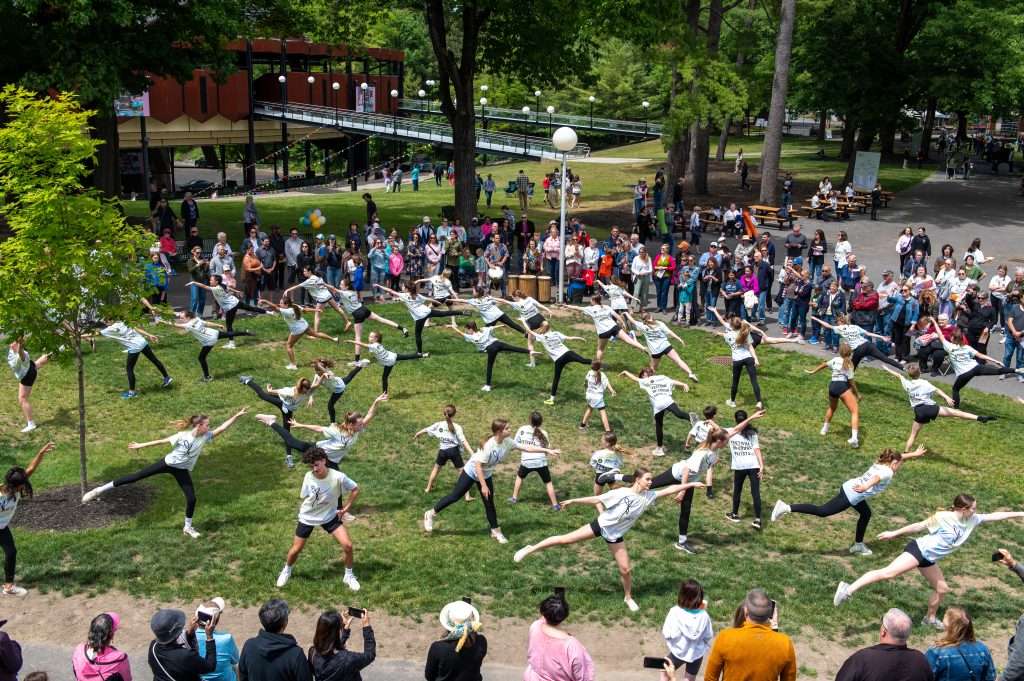
Featuring students from local schools and organizations such as Empire State Youth Orchestra (ESYO), Capital District Youth Chorale, Saratoga Springs Youth Ballet, Capital District Arts Initiative, and the SPAC School of the Arts, the afternoon will include individual pop-up performances and art displays, culminating in a large-scale, coordinated production on SPAC’s stage. As part of the production, an original musical composition by Kingston Czajkowski (Grade 12, Cairo-Durham High School), will premiere on the SPAC stage, performed by the ESYO Symphony Orchestra and recorded for a later broadcast by media sponsor WMHT.
“This year’s Festival of Young Artists carries a special energy as we build on exciting new traditions launched last year, including our partnership with WMHT and the return of the Student Composer Contest,” said Dennis Moench, SPAC’s VP of education, in a press release. “As we approach nearly a decade of this festival, it continues to reflect a deep commitment to inclusivity—spotlighting the artistic achievements of hundreds of students from across our region and creating space for every voice, discipline, and creative perspective to be seen and celebrated.”
Kicking off at 2 p.m., SPAC’s grounds will be transformed into a festive celebration and will feature individual pop-up performances by student ensembles from the Capital Region, fine art displays, food stands, poetry slams, lawn games and immersive art activities, plus free ice cream provided by Stewart’s Shops. At 4:45 p.m., hundreds of young artists will gather to present a celebratory concert on SPAC’s main stage, featuring large-scale productions that combine music, song, poetry, visual art, and dance.
The event is free for the community. However, registration is required for admission. Visit spacfoya.org for details.
MALTA — Bright Sighted Media—a podcast production company and creator studio located in the Innovation Center at Saratoga—is running a “Pitch Your Podcast” contest until May 21.
Creators are invited to step into the Bright Sighted studio to pitch their podcast idea on camera for a chance to win a 12-Month Momentum Studio Membership, a content creation package designed to help turn ideas into impactful, sustainable media brands.
The grand prize, valued at more than $2,100, includes: two professional 4K video & audio recording sessions per month, bi-monthly group coaching with a podcast expert, monthly trainings with CEO Christine O’Donnell and industry leaders, access to a full resource library (templates, rate cards, growth tools), membership in a private creator community, and exclusive discounts on additional production services.
Those interested in entering the contest can book a 15-minute studio session at Bright Sighted Media and deliver a two-minute recorded pitch answering three questions: What’s your show?; Who is it for?; and Why does it matter right now?
Each session includes a guided setup and coaching moment, a professionally recorded pitch, the option for a second take, and official submission into the contest.
“This is about more than winning,” said Christine O’Donnell, founder of Bright Sighted Media in a press release. “It’s about giving people a platform to share meaningful stories, build something sustainable, and realize that their voice matters. We’re looking for ideas that can truly grow into something impactful.”
For more information, visit brightsighted.com/pitchyourpodcastcontest.
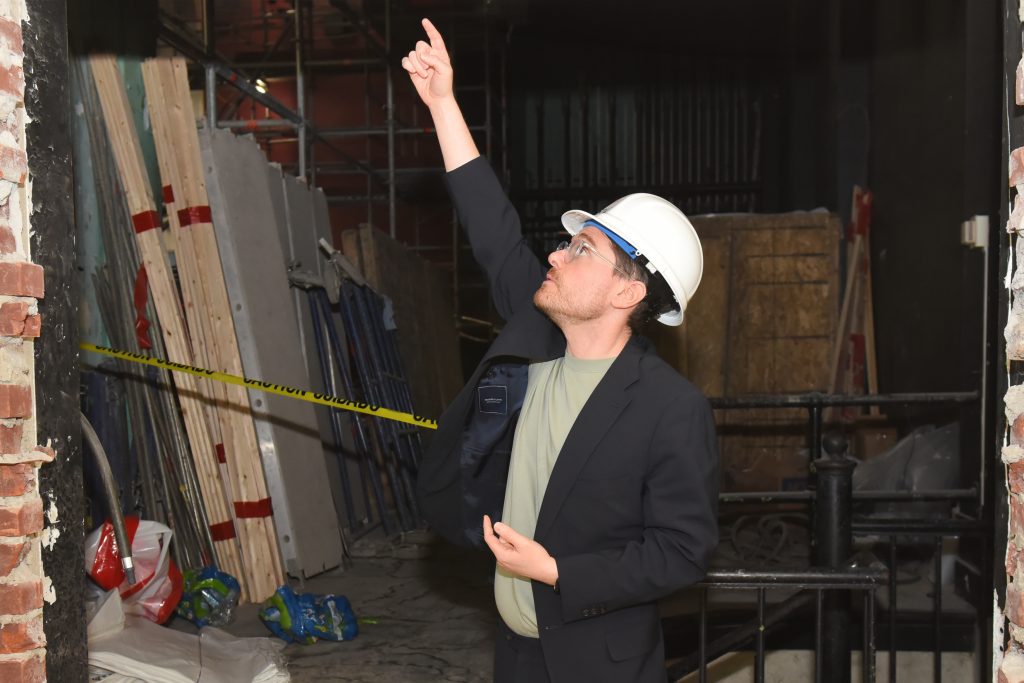
SPAC President Christopher Shiley leads a hardhat tour of the Spa Little Theater, which is currently in the midst of a year-long renovation and restoration project. A massive, floor-to-ceiling scaffolding system fills the theater space.
Photos by Super Source Media for Saratoga TODAY
SARATOGA SPRINGS — The Spa Little Theater looked a little different on Tuesday.
Where there had once been 500 90-year-old seats now stood a massive scaffolding system that reached all the way to the chandeliered ceiling.
It took a month just to build the scaffolds, which were necessary because it was too difficult to use lifts on the theater’s uneven floor.
The radical change in the theater’s appearance is part of an ongoing $12 million renovation project that began in January. The theater, originally built in 1935 and designed to be a lecture hall, was taken over by the Saratoga Performing Arts Center (SPAC) in 2022.
“Would you like to see the ceiling?,” asked SPAC President Christopher Shiley when Saratoga TODAY took a hardhat tour of the theater. “This may be the only time you’ll get to [be this close to] the ceiling of the Spa Little Theater.”
The answer was “yes.”
Roughly five flights of scaffold stairs up, a team of plasterers were patching and recoating the ceiling’s many cracks accrued over nearly a century. The chandeliers, original to the building, will be cleaned and restored.
The construction team will start with the ceiling and work their way down, eliminating layers of scaffolding as they descend to the floor. At the floor level, new seats will be installed. Those seats will be “more comfortable” replicas of the 90-year-old originals, Shiley said.
The theater will also get a major color overhaul, with the current weathered walls receiving a coat of deep red burgundy. The walls will also be partly covered with large, newly-created, Spa State Park-inspired woodland murals. Underneath the murals will be cove lighting that will “add a little bit of elegance,” Shiley said.
But the theater itself isn’t the only space undergoing big changes. A family restroom, patio, bar/cafe, and community room are all being created. The men’s room is also being expanded.
The cafe, formerly an artists’ room, will include windows overlooking the park, a bar, seating for about 50 people, and a total standing capacity of around 75 or 80.
“It’ll be a place where you can come in, get a drink, have a bite to eat, get ready for the show, and have more of a reason to get here early and experience the park and experience the theater,” Shiley said.
The community room will be a flex space, potentially used for artist meet and greets, special events, and overflow when additional concession space is needed. It’ll also lead out to the new patio.
The cafe and community room will allow community members to rent out space at the theater for events and meetings. Both rooms will be A/V equipped with speakers and monitors.
The greenroom and backstage space is being dramatically expanded, thanks in part to SPAC obtaining an area that used to be a breakroom for state park employees. The new greenroom will include a kitchenette, restroom and shower, an office, washer-dryer (no more midnight laundry runs), and two large dressing rooms that will have a total of 20 makeup stations ideal for theater and dance companies. A new loading entrance is also being created to make it easier for artists to bring their gear in and out.
All of this means that Spa Little Theater will be able to host larger and more frequent productions.
“When we presented dance companies in the past, I would spend a lot of time with them talking them through the space, getting them to think about how to adapt their shows, which is tricky [because] not every company is willing to do that,” Shiley said. “Their show is their show and not every company is able to take it and customize it for a space… Now, we’re much more readily available to accommodate their existing show as it is. That helps us do more programming as well because we can go from one show to the next much easier.”
The exterior entrance of the Spa Little Theater is also getting a facelift, though that project is being handled by the park, not SPAC. Work is expected to begin in June. Cracked infrastructure will be repaired and a permanent ADA ramp will be added. The ramp is one of several changes that will make the theater more ADA friendly to both guests and artists.
“The whole project is equal parts restoration and renovation,” Shiley said. “Everywhere we can, inside and out, [we’ll] keep original architecture, original fixtures, and elements. There are some places, as you can imagine with a 90-year-old building, where that just simply wasn’t possible. But certainly and particularly on the outside, our goal was to keep it as true to the original design and aesthetic as possible.”
The theater is on schedule for a planned December 2026 ribbon cutting.
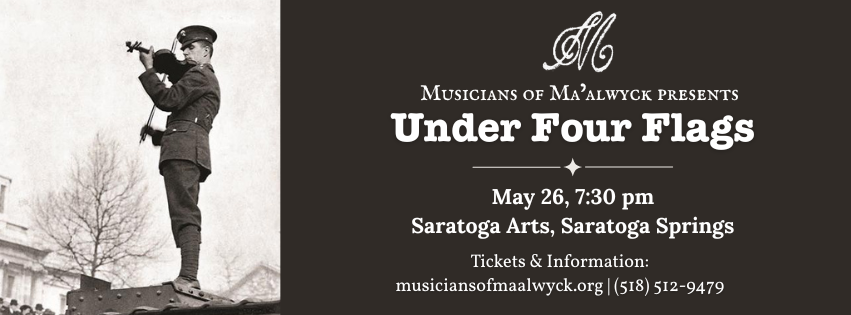
SARATOGA SPRINGS — From May 26 to 30, Musicians of Ma’alwyck will present “Under Four Flags” across New York State. The experience blends silent film with music shaped by World War I in honor of those lost in the conflict.
The film “Under Four Flags” (the flags represent America, France, Great Britain, and Canada) was shot in the summer of 1918, when Allied victory was far from assured. A new score by Max Caplan enhances the emotional progression of the film for today’s audience.
The concert opens with a work by Mihail Jora, written while he was recovering in a hospital after being wounded on the Eastern Front. His music is a personal response to the devastation of war.
The major work is Samuel Gardner’s piano quintet, composed after the death of violinist David Hochstein, who was killed on the Western Front in France in October 1918. Deeply heartfelt, the quintet serves as a musical memorial to Hochstein’s life. Gardner, an important violinist and recipient of the first Pulitzer Prize in Music in 1918, was also the grandfather of longtime Musicians of Ma’alwyck board member Eric Weiner.
“Under Four Flags” will be performed at Saratoga Arts on May 26. Tickets are available at https://secure.qgiv.com/for/concertticketing/event/underfourflags/.
Additional venues include: Temple Gates of Heaven in Schenectady (May 27), Star Theater in Cherry Valley (May 28), and Village Hall in Wyoming (May 30).
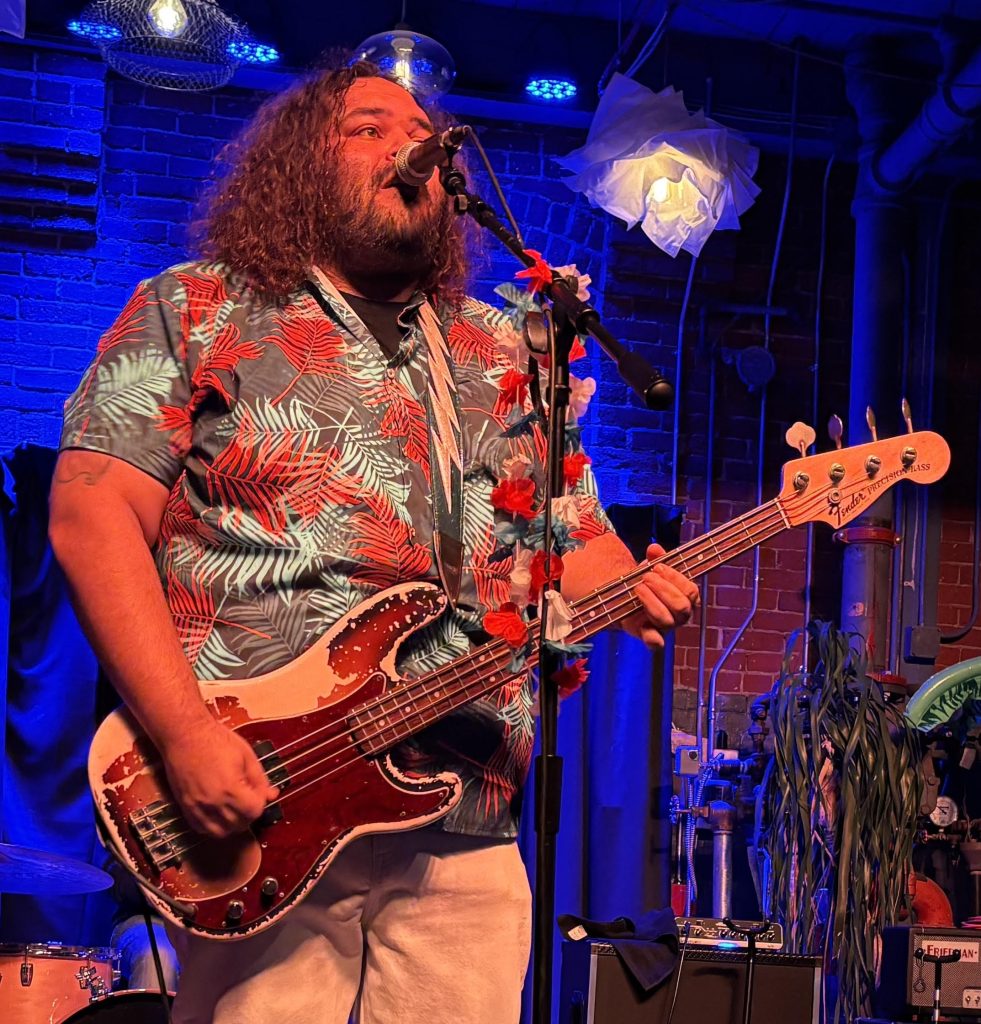
Photo of Jaymes Hendricks, bass player and founding member of Goldtooth, provided by the band. “Hurt Feelings” album cover also provided by Goldtooth.
SARATOGA SPRINGS — Goldtooth, a versatile band that traverses at least a handful of genres, releases its debut album “Hurt Feelings” on Friday, May 1.
Founding member and bassist/vocalist Jaymes Hendricks (aka Jimmy Hendricks) hails from none other than the Spa City.
“Hurt Feelings,” which Saratoga TODAY spun (or, technically clicked) for an early listen, veers into different directions sonically, allowing for more than a few surprises. The lead track, the cheekily named “Riffer Madness,” is catchy, angsty, and punk-ish. The second tune, “Bringing Her Down,” introduces an alt-country sound (there’s a reference to a pickup truck in the opening seconds).
“Gold Rush” is pop-punk and “Foolin’ You” takes an unexpectedly bluesy turn before things chill out with the acoustic-driven country ballad “Rodeo.” The album enters pop-country territory with “Emily” (which also sounds a bit reminiscent of the band Staind) before wrapping up with what could be described as a country-emo track, “All I Ever Wanted.”
No one can accuse “Hurt Feelings” of being ordinary (or boring).
Goldtooth, which labels itself as an alt-country/garage rock project, was built around Hendricks and guitarist/vocalist Jon Braught, who described his group’s debut album as “a big rock record with big guitars and singable songs, featuring collaborators from across New York and New England.” The album notes also describe “Hurt Feelings” as “party rock with a hangover of real-life melancholy.”
In addition to Hendricks and Braught, the band includes guitarist/vocalist Paul Martinez and drummer Dave Maclean.
“For the members of Goldtooth, ‘Hurt Feelings’ is the culmination of 20-plus years spent chasing songs, loading vans, and learning how much life can get in the way of a rock band—and why it is still worth fighting for,” the group said in a press release.
Goldtooth began as a long-distance project between Hendricks and Braught, who met as teenagers playing in New England. Their relationship survived Hendricks’ move to Saratoga Springs.
“Over three years of file swaps, rehearsals, and carefully planned sessions, eleven songs emerged that sounded like the record they’d always talked about making,” said the band. “Across the track list, you can hear four veterans of countless clubs and DIY rooms finally taking the time to get the songs right, despite careers, kids, and the geographic spread that makes every rehearsal a logistics puzzle.”
To celebrate the release of their debut album, Goldtooth is planning a series of performances across the Northeast. On May 2, they’ll take the stage at Harlow’s Pub in New Hampshire. For additional show announcements, fans can follow the band’s Instagram, @goldtoothstagram.
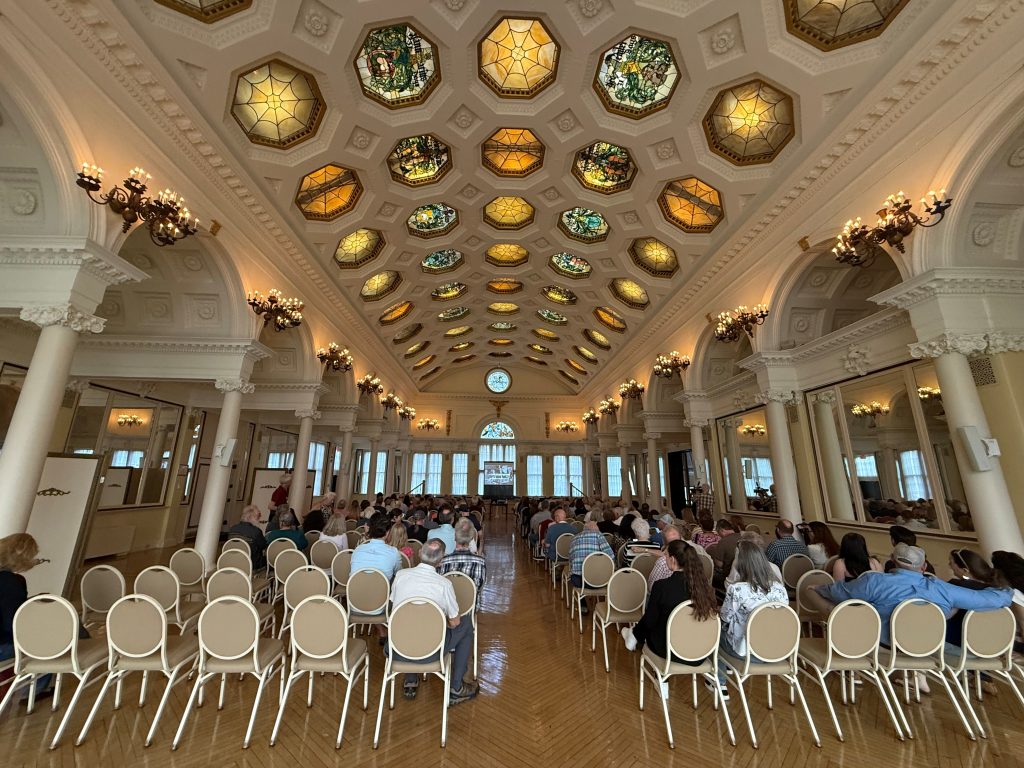
Attendees gather inside the Canfield Casino on April 16 for the Saratoga Springs History Museum’s “More Gangsters of Saratoga” program led by former Police Chief Greg Veitch. Photo by Jonathon Norcross.
SARATOGA SPRINGS — Perhaps it’s not something to boast of, but the Spa City’s gangster-ridden past connects it to the 1919 World Series “Black Sox” scandal, the creation of Las Vegas, “The Godfather Part II,” and the formation of the Mafia itself.
In two recent lectures—“More Gangsters of Saratoga” by former Police Chief Greg Veitch and “Fixing Things: Arnold Rothstein in Saratoga” by former Daily Gazette reporter Stephen Williams—Saratoga’s supporting role in the story of organized crime was explored.
Veitch packed the opulent Canfield Casino with spectators while Williams delivered his talk to an attentive crowd at the Greenfield Community Center.
Both lecturers detailed the history of The Brook Club, an illegal gambling den and nightclub opened by Arnold Rothstein in 1919. The Brook was located on Church Street on the west side of Saratoga Springs, near the intersection of Church, Brook Road, and Locust Grove Road.
“Arnold Rothstein was the grandfather of organized crime,” Veitch said. “He taught all the other gangsters how to operate casinos, including Charles “Lucky” Luciano, Meyer Lansky, Dutch Schultz, Joe Adonis, and Frank Costello, who all as young men worked for Rothstein at the Brook resort.” (For those interested in seeing a fictional depiction of this crew, Rothstein, Luciano, and Lansky are prominently featured in the HBO series “Boardwalk Empire.”)
According to Williams, Rothstein began visiting Saratoga during the summer months in the early 1900s, providing financial backing to local casino operators. By 1917, he was interested in opening his own establishment. Not long after, construction of The Brook began.
“This was a very grand and palatial kind of place, the kind of place where there were no prices on the menu,” Williams said. “[An] ‘if you have to ask, you can’t afford it’ kind of restaurant. They would have very well-known entertainers coming in. The food, by all accounts, was excellent. It was where rich people went and you could flaunt your wealth.”
Rothstein tasked Lansky, then his young protegee, with working at The Brook. Lansky likely spun roulette wheels and operated other table games at the Spa City gambling den. (The Hyman Roth character in ‘The Godfather Part II’ is based on Lansky, and the name Roth was a nod to Rothstein, a detail revealed in one of the film’s deleted scenes.)
Veitch said he believes that it was Lansky who introduced the idea of a casino-resort to Bugsy Siegel, who then brought the concept to Las Vegas (though, other sources believe that Siegel was more inspired by gambling operations in Galveston, Texas).
“The Las Vegas casino-resort model was born on Church Street in Saratoga Springs,” Veitch said.
The Brook on Church Street also played a role in the infamous 1919 World Series, which was fixed (allegedly) by Rothstein. During the sordid affair, eight members of the Chicago White Sox were accused of intentionally losing the series in exchange for payments offered by organized crime figures.
Mont (or Monte) Tennes—a gambler from Chicago who operated a sports news wire service—was at the Brook in August of 1919. It’s here that Tennes claimed he started hearing rumors that the upcoming World Series would be fixed.
“[Tennes] says he heard it from Rothstein,” said Williams. “I am skeptical that Rothstein was that careless. But there were other gamblers there who may well have talked to this guy because he was always snooping around for inside information.”
Tennes was among a handful of witnesses targeted for questioning by sportswriter Hugh Fullerton, who helped uncover the Black Sox scandal.
Although Rothstein has long been suspected of orchestrating the fixed World Series, his precise involvement has been difficult to definitively prove.
“He knew something,” Williams said. “At the very least, he knows there’s a fix.”
Rothstein was also accused of manipulating or fixing horse races, including the 1921 Travers Stakes in Saratoga, which was won by Sporting Blood, a horse owned by Rothstein.
Four years later, Rothstein sold The Brook to his associate Nat Evans, who was also allegedly involved in the 1919 World Series fix. In November of 1934, Evans took out an insurance policy on the Brook, Williams said. In December of 1934, the Brook burned down.
Decades later, in 1953, Lansky’s one and only prison stint was at the Saratoga County jail, where he was sentenced to serve three months. According to the Mob Museum in Las Vegas, Lansky’s time in prison “was an anomaly, even beyond the fact it was the only time served during his criminal career. The incarceration, and subsequent release, received little if any publicity, thus leaving that short period behind bars with a dose of mystery. A notation tucked within Lansky’s FBI file states…that during incarceration, in July 1953, ‘he was also treated for a kidney infection in the Saratoga hospital.’”
More Spa City mob stories can be found in Veitch’s books “A Gangster’s Paradise” and “All the Law in the World Won’t Stop Them.” Williams also includes a story involving Lansky in his book “Off the Northway.”
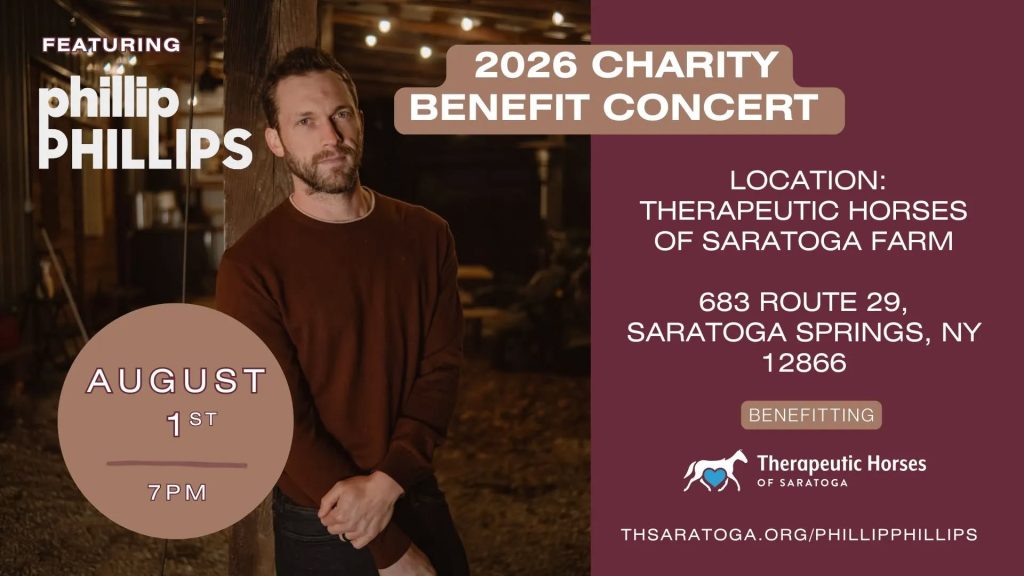
SARATOGA SPRINGS — Phillip Phillips will headline Therapeutic Horses of Saratoga’s annual Charity Benefit Concert on Aug. 1.
Best known for his five-times platinum hit “Home,” Phillips first captured the nation’s attention as the winner of “American Idol” season 11. Since then, he’s amassed more than 1.5 billion streams and 4.5 million monthly listeners on Spotify. Phillips has toured with John Mayer, the Goo Goo Dolls, and Gavin DeGraw.
“We are so excited to welcome Phillip Phillips to the farm this year,” said Meg Koloskie, development and communications manager at Therapeutic Horses of Saratoga. “This event has grown into something really special for our community, and bringing an artist like Phillip here feels like such a natural fit. It is going to be an incredible night, and at the end of it all, it supports the horses and the people who need this work the most.”
Opening for Phillips will be local acts The Wallies (featuring Gianna Robustiano) and Caity Gallagher.
The event’s lineup of food and beverage partners includes Franklin Square Market, Neighborhood Kitchen Pizza, Old Tavern Farm Winery & Distillery, and Druthers Brewing Company.
Previous Charity Benefit Concert headliners include the Spin Doctors (2025) and The Bacon Brothers (2024, featuring actor Kevin Bacon).
Tickets for the event go on sale June 1. For more info, visit thsaratoga.org/phillipphillips.
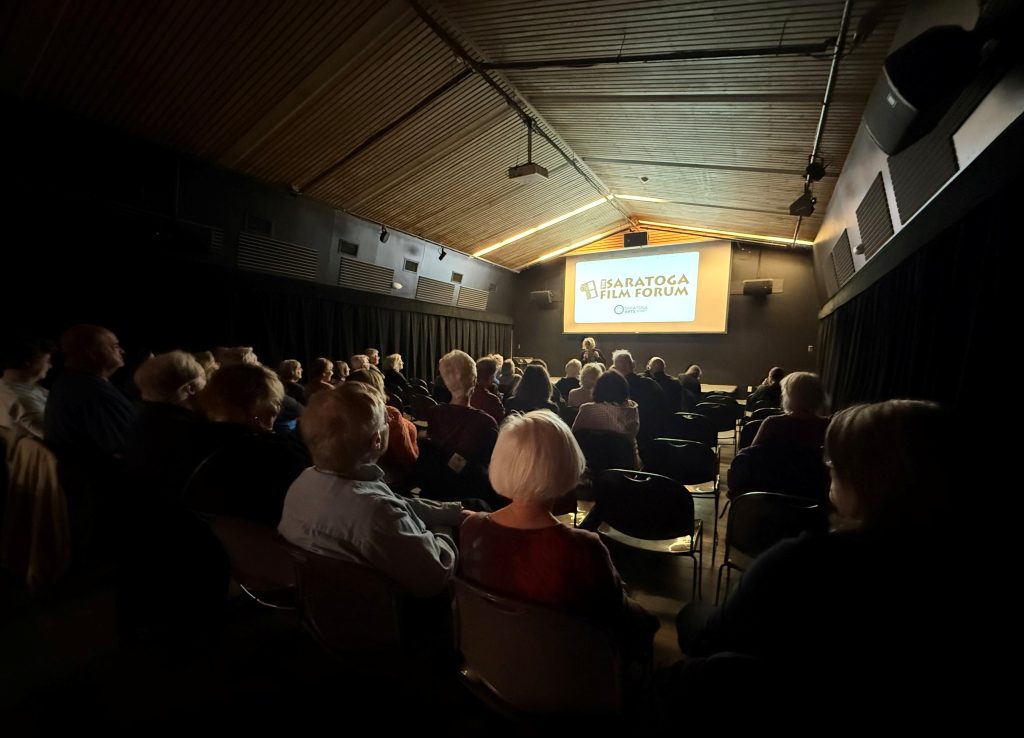
The Saratoga Film Forum, which hosts weekly independent film screenings at Saratoga Arts, brought in a sizable crowd for its April 23 showing of “Blue Moon,” a Richard Linklater film starring Ethan Hawke that received two Oscar nominations. Next up for the forum: “Sentimental Value” on April 30, “East of Wall” on May 7, “On Becoming a Guinea Fowl” on May 14, “Mr. Nobody Against Putin” on May 21, and “Lurker” on May 28. The forum’s initial 12-week pilot program will include four more screenings before wrapping (for now, at least) on June 25. Photo by Jonathon Norcross.
SARATOGA SPRINGS — Katherine Applegate, author of the #1 New York Times bestseller “The One and Only Ivan,” will appear at the Holiday Inn in Saratoga Springs for an author talk and book signing celebrating her newest novel, “Wombat Waiting.” The event is hosted by the Northshire Bookstore.
The middle grade standalone novel-in-verse is about compassion, resilience, and friendships, following a dog named Wombat in the aftermath of a catastrophic fire. Wombat isn’t actually a wombat—but when the homeless dog is discovered, singed and ash-covered after a terrible fire destroys a community, someone tags her with the nickname, and it sticks.
Applegate will stop by the Spa City on Sunday, May 10 at 1 p.m.
On Wednesday, May 13 from 5 to 7 p.m. at Northshire, an evening of professional development for educators will occur. Northshire’s team of expert children’s booksellers will share some of their favorite new books for preschoolers, children, and teens. The Adirondack Literacy Council will be on hand to certify professional development credit and will be raffling off prizes. The event is free, but reservations are encouraged to facilitate professional development credit.
On Monday, May 18 at 6 p.m. at Northshire, author Steve Sheinkin and graphic novelist Jon Chad will discuss “Diamond Fever!” their high-stakes true crime story set in the wild west.
Late one night, two travel-weary miners, Philip Arnold and John Slack, show up at a businessman’s office in San Francisco. The miners seem nervous. They’ve got something that needs to be locked in a safe overnight. What is it? Well, that really has to stay secret, but it’s…diamonds! And lots of them. When word of the find hits the streets, diamond fever sweeps the country. Wealthy investors are desperate to elbow Arnold and Slack aside and seize control—but can they persuade the miners to reveal the location of their bonanza? At the same time, thousands of prospectors fan out across the mountains and deserts of the West—will one of them find the site before greedy bankers grab everything for themselves?
Additional information and tickets for all Northshire Bookstore events are available at www.northshire.com/upcoming-events.