The State Police have asked for the public’s assistance after an accident killed a driver on I-87 in Clifton Park.
The accident occurred the night of Nov. 23 at around 8:11 p.m. in the southbound lanes of Interstate 87 just south of exit 11. The accident occurred when a vehicle was rear-ended and crashed into a guardrail on the left side of the highway. It was then struck by a second vehicle coming to rest on the guardrail facing north and partially in the left lane of travel according to New York State Police.
When the driver, identified by State Police as William Reichman, 71 of Ballston Lake, got out of the vehicle, he was struck by a tractor trailer heading south. Reichman then fell into the road and was struck two more times by other passenger vehicles, according to New York State Police. State Police said that the two vehicles stopped immediately and their drivers are cooperating in the investigation.
Reichman was declared dead at the scene by New York State Police.
After striking the driver, the tractor trailer left the scene and its whereabouts are unknown at this time. Troopers believe the truck is white and has significant front-end damage. They’re asking anyone with information about the accident or who may have captured the accident on dash camera to contact Troop G headquarters at 518-783-3211.
Six total vehicles were involved in the collision and there were no other injuries in the crash, according to a State Police blotter report.
A Mechanicville man was arrested on multiple charges after allegedly injuring a deputy during a hit and run crash.
Thomas Fogarty, 51, allegedly struck a deputy driving a marked Saratoga County Sheriff’s Patrol car with a Toyota pickup truck. The incident occurred at the intersection of Kinns and Peirce Roads in Clifton Park around 4:39 a.m. the morning of Nov. 22.
The deputy was transported to Saratoga Hospital with an arm injury and later released. After the collision, Fogerty is alleged to have fled the scene down Twilight Drive but was caught and arrested by deputies. He refused a chemical test at the time of his arrest.
“I am extremely grateful that our deputy wasn’t seriously injured,” said Sheriff Michael H. Zurlo. “The number of DWI arrests we have seen this year have been off the charts and a lot of them have been related to crashes. It’s a troubling trend; there is never a good reason to get behind the wheel of a vehicle intoxicated or impaired.”
Fogarty was charged with 5th degree possession of a controlled substance, leaving the scene of a personal injury motor vehicle crash, DWI, failure to stop at a stop sign, failure to yield right of way at a stop sign, and refusal to take a preliminary breath test. He was arraigned in Halfmoon Town Court and released on his own recognizance pending further proceedings.
Fogarty’s arrest was one of 10 DWI arrests county wide, between Friday Nov. 21 and Sunday 23 according to Saratoga County Sheriff’s Office press releases and blotter reports from the New York State Police.
The arrests come as the state increases DWI enforcement due to the Thanksgiving holiday.
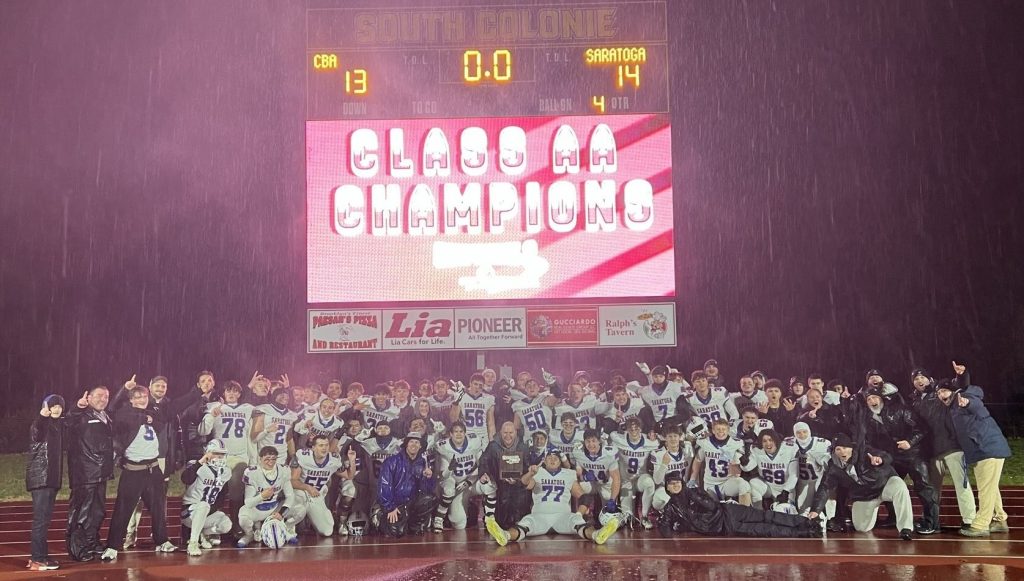
COLONIE — The Saratoga Springs varsity football team secured the Section 2 Class AA title last Saturday in a barnburner threatened by lightning and soaked with rain.
The Blue Streaks eked out the win against reigning champions Christian Brothers Academy (CBA), 14 to 13, relying on standout running back Benjamin Coryea, who rushed for 68 yards and a touchdown after a season in which he led all of New York State with more than 2,100 yards for an average of nearly 200 yards per game and nearly 9 yards per carry. Quarterback Bobby Morris also found the endzone, racking up 72 rushing yards of his own on just 7 carries.
After the game’s start time was delayed due to lightning, both of Saratoga’s touchdowns came quickly in a rainy first quarter. With less than six minutes left, Morris faked a handoff to Coryea and then scrambled 45 yards into the endzone. Then with just a tad over a minute left, a direct snap to Coryea on third and short resulted in a 46-yard rushing score.
A successful two-point conversion on a short pass from Morris, followed later by a missed extra point by CBA in the fourth quarter, added up to the decisive one-point difference that put Saratoga over the edge.
On the defensive end, Blue Streak senior Josh Simon earned 2 sacks while Caleb Brilling added another. Eliot Moglia led his unit with 16 total tackles.
Saratoga’s victory over CBA was decidedly an upset. CBA won the title last year and defeated Saratoga 40 to 21 earlier in the season. The last time Saratoga beat CBA was in 2018. The 2025 section title was also the Saratoga football program’s first in a decade.
Next up for the Blue Streaks is a Saturday, Nov. 22 state tournament quarterfinal game held at Colonie High School against Section 9’s Middletown.
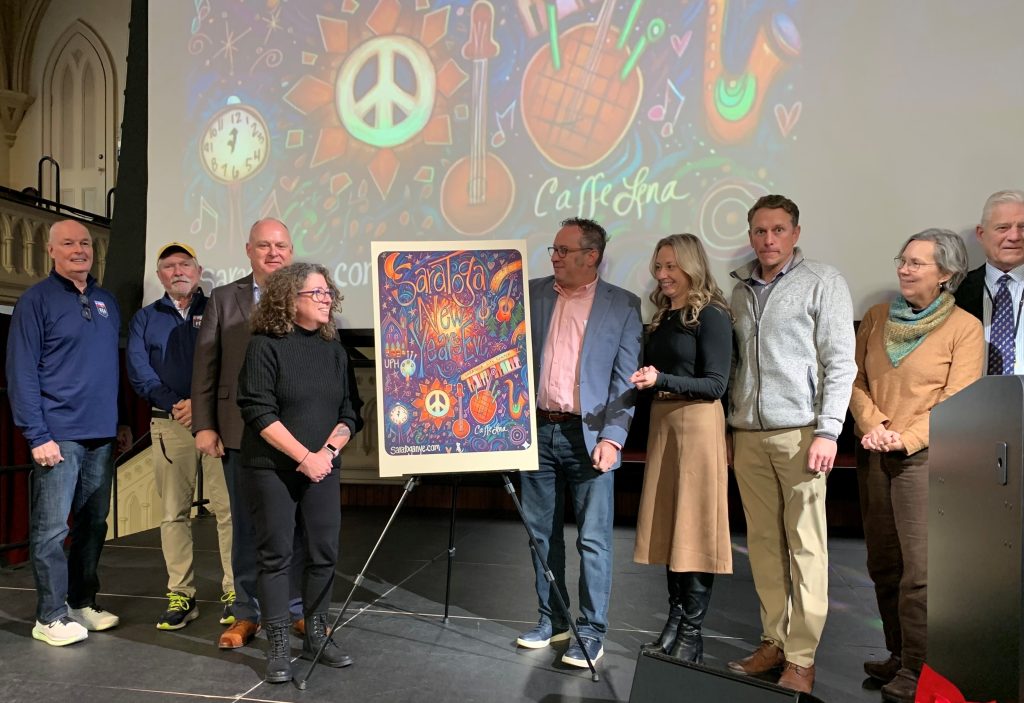
The poster for Saratoga New Year’s Eve 2026 is unveiled during a press event at the Universal Preservation Hall on Nov. 18. The poster was designed by Rebecca Vickery. Photo by Jonathon Norcross.
SARATOGA SPRINGS — The Allman Betts Band will headline Saratoga’s 2026 New Year’s Eve festivities as part of an all-night music lineup spread across three venues.
The largest venue, the Saratoga Springs City Center, will host Allman Betts (a Southern rock group that includes the sons of three members of the Allman Brothers Band), Ally the Piper (an internet-famous bagpipe player), Kieran Rhodes (a singer/pianist featured on “America’s Got Talent”), Doc Horton (a Capital Region pop-soul performer), Heard (a world music/jazz collective), Glass Pony (a “psychedelic groove circus” group from Albany), and Maggie Doherty (a Saratoga-based singer/songwriter).
Indie pop band the Nicotine Dolls will play at the Universal Preservation Hall, with Troy-based act The Belle Curves opening.
At Caffe Lena, indie-folk/Americana ensemble Reese Fulmer and the Carriage House Band will take the stage. The caffe’s Executive Director Sarah Craig described the group as a younger, up-and-coming version of the Allman Betts Band.
In addition to a full night of music, Saratoga’s New Year’s Eve festivities will launch (literally and figuratively) with a fireworks display at the City Center accompanied by DJ RVMBA outside on Ellsworth Jones Place. This portion of the event, held from 5 to 6:30 p.m., is family friendly and free to attend.
The ‘Toga party will wrap up on the morning of New Year’s Day with the Saratoga First Day 5K at 11 a.m. Participants can run and/or walk through Broadway, the city’s residential East Side, and the Spring Run Trail.
“From the festive fireworks to the First Day 5K – and a whole lot of outstanding entertainment options in between, Saratoga New Year’s Eve offers an incredible New Year’s celebration with something for everyone,” said Todd Shimkus, president of the Saratoga County Chamber of Commerce. “We hope folks will join us to ring in 2026 by partaking in this beloved Saratoga tradition.”
“Since moving the fireworks earlier, the New Year’s celebration accommodates both families as well as nightlife revelers to the wonderful hometown feel of our beautiful downtown,” said Saratoga Springs Mayor John Safford. “Come early or late; you will find New Year’s Eve in Saratoga Springs to be a singular unique experience.”
Tickets for the music acts are now on sale at www.saratoganye.com. Additional information, including a full entertainment schedule, is also available on the website.
Early online registration for the 5K is encouraged and available at fc4events.com. The registration fee includes an event shirt and competitive awards. Late registration opportunities will be available on the day of the race.
The U.S. Attorney’s Office and Saratoga County Sherriff’s Office have both put out warnings regarding scammers impersonating their officers.
The Saratoga County Sheriff’s Office has issued a warning regarding scammers impersonating their deputies after a resident was scammed out of $10,000.
The scam occurred on Wednesday, Nov. 12. According to the Saratoga County Sheriff’s Office, the person was contacted by an unknown individual who left a voice mail. Upon the victim recontacting the alleged scammer, the victim was told they had a warrant out for their arrest for missing jury duty.
The victim was then threatened with arrest, loss of custody of their children and harm if they didn’t get the money. After receiving these threats, the victim paid $10,000 to the scammer through Apple Pay.
“Scammers are exceptional at creating a false sense of urgency in people,” Saratoga County Sherriff Micheal Zurlo said. “That urgency should be the first clue that something is off. Slow down and take the time to call us before taking any action. It could save you from a significant financial loss and major emotional impact.”
The incident came one day before the U.S. Attorney’s Office for the Northern District of New York issued a warning regarding scams impersonating the Department of Justice.
According to their notice, the scammers focus on immigration-related matters and threaten victims if their demands aren’t met. They also spoof the phone number to appear as though they’re affiliated with the government.
In light of these scams, both the U.S. Attorney’s Office and Saratoga County Sherriff’s Office asserted that they would never contact someone to demand money under any circumstances. In addition, the U.S. Attorney’s Office stated that they would never ask for payment in the form of gift cards or ask someone for their credit card information.
They also listed numbers to call should you be the target of one of these scams. For the Sherriff’s Office, residents are encouraged to call (518) 885-6761 and for the U.S. Attorney’s Office, residents can call 315-448-0672.
While scams impersonating government aren’t new, it has been getting worse. The FBI Internet Crime report found that in 2024 there were 17,367 reports of government impersonation scams, compared to 14,190 in 2023 and 11,554 in 2022. These scams cost the victims $405,624,084 in 2024 — compared to $394,050,518 in 2023 and $240,553,091 in 2022.
In July, a scammer from Brooklyn targeted an elderly couple by claiming to be from Citizens Bank and stole $80,000 from them.
A Saratoga Springs principal has resigned after an investigation found that he stole thousands of dollars from a union he was a member of.
Scott Singer, principal of Maple Avenue Middle School, resigned on Nov. 13 after pleading guilty to charges of petit larceny stemming from allegations that he stole $12,298.63 from the Saratoga Administrators Association (SAA). At the time of the theft, Singer served as the treasurer of the SAA.
According to the criminal complaint, the theft was first uncovered by Johanna Friedman, an Assistant Principal at Saratoga Springs High School and the current treasurer of the SAA. In a deposition supporting the complaint, Friedman said her suspicions began when Singer closed an account run by the SAA — despite her requests not to — and subsequently deposited a check for $3600 into the account.
These suspicions led Freidman and Kevin Wolpert, the SAA co-president and Saratoga Springs High School Assistant Principal to begin investigating Singer’s actions as the union’s treasurer dating back to the start of his term in 2019. It was during this investigation that they found multiple cash withdrawals and checks made out to Singer which he signed for himself.
“Scott made unauthorized cash withdrawals and checks to himself from our association’s account,” Wolpert said in his deposition. “The potential number of misappropriations and unauthorized withdrawals amounts to $12,298.63. Scott appears to have attempted repayment but owes the association up to $4,682.03.”
Singer’s resignation was accepted by the Saratoga Springs City School District Board of Education on Nov. 13. In an email to parents, Superintendent Dr. Micheal Patton announced the resignation and asserted that the allegations were not related to his work at the school.
“In October, the district became aware of concerns regarding Mr. Singer’s conduct in his role as an elected official of the Saratoga Springs Administrators Association,” Dr. Patton said in the email. “These concerns were unrelated to his responsibilities as a building principal, his interactions with students, staff, or any misuse of district or taxpayer funds.”
Singer first joined the Saratoga Springs School District in 2002 as a special education teacher and served as a social studies teacher and assistant principal for both the middle and high school. He’s also served as the Treasurer of the New York State Middle School Association since 2019.
As for Maple Avenue Middle School, on Nov. 19, the Saratoga Springs City School District announced that Mark Fish will take over as the interim principal from Dec. 1 to April 2, 2026.
Mark Fish (seen here) will serve as interim principal of Maple Avenue Middle School after long-time principal Scott Singer resigned ( Courtesy of Saratoga City School District)
Fish previously served as the Superintendent of Greenwich Central School District and most recently served as Interim Superintendent of Galway Central School District from January- July 2025. Fish is also listed as the historian for the New York State Middle School Association.
“We are very confident that Mr. Fish’s extensive middle school leadership experience will provide strong support for our students, staff, and school community during this time of transition,” The announcement said.
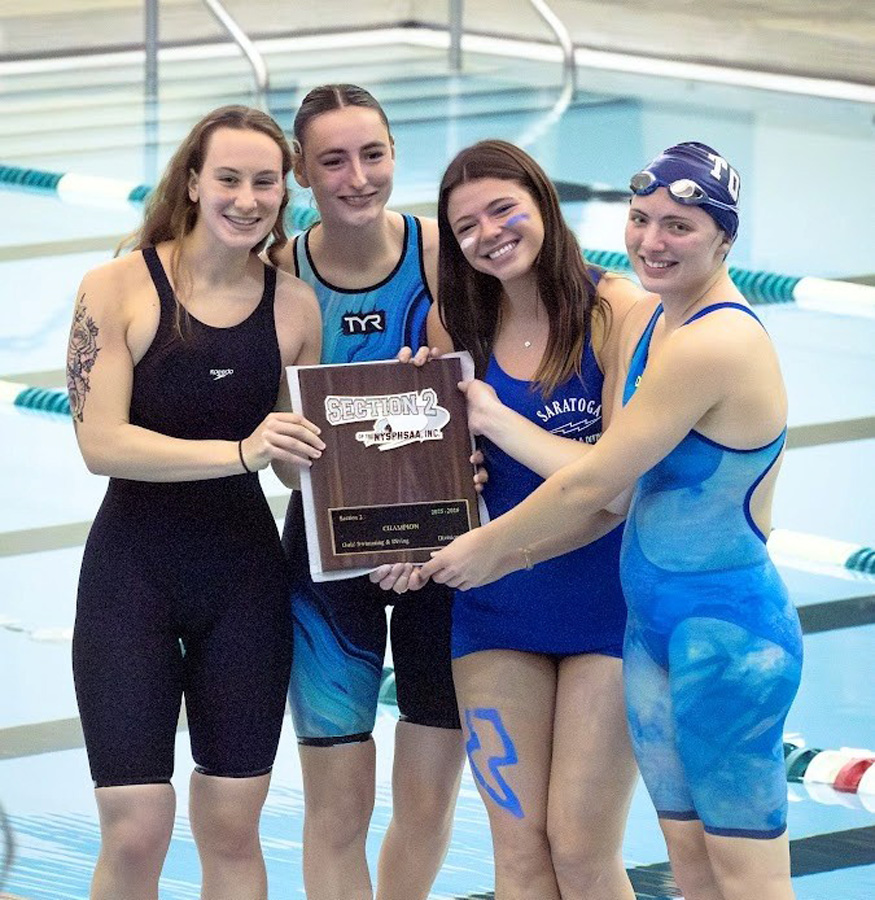
Saratoga Springs girls varsity swim and dive seniors pose with the Section 2 championship plaque. Photo provided by Joshua Muldner.
SARATOGA SPRINGS — In the career of an athlete or coach, moments of pure ecstasy can be few and far between, if indeed they happen at all. Perhaps someone who has devoted much of their life to baseball will experience the otherworldly sensation of a walk-off home run in the bottom of the ninth of a championship game. Maybe a football star will feel the thrill of catching a game-winning Hail Mary pass in the endzone as the final seconds of the fourth quarter tick off the clock. For many, these are just dreams. But for the Saratoga Springs girls swim and dive team, the fantasies have been fulfilled.
“There were points where we questioned whether we’d ever be able to bring home a championship for Saratoga,” said the team’s Head Coach Joshua Muldner. “Many of us were pretty teary after that… It was really, really emotional.”
The seemingly impossible moment arrived last weekend, when the swim and dive squad won its first Section 2 championship in 23 years after an undefeated regular season. The Blue Streaks defeated Niskayuna with a total score of 434, 70 points better than the runners-up. After securing the title, Muldner and his staff of volunteer coaches lept into the pool to join their victorious athletes.
It was the culmination of a season that opened with back-to-back victories against Niskayuna and Shenendehowa, two schools that historically have been tough challengers for Saratoga. Throughout the year, records were shattered and names were added to the history books, with eight athletes making the list of all-time top times.
“This was a magical team season,” Muldner said in a statement. “Although there are a lot of individual and relay highlights, I really believe the biggest accomplishment was getting contributions from every team member. We don’t beat Shen or Nisky in dual meets or at sectionals without extraordinary contributions from each member of the team. We did not focus on going undefeated or winning a sectional title. In fact, we never spoke about these things as a group. Instead, these athletes zeroed in on what they could control. They trusted the process, focusing on the little things, and the results followed.”
At sectionals, the Blue Streaks earned state-qualifying times in the 200-yard medley relay, the 100 backstroke, the 100 breaststroke, and diving. Victoria Lill will head to states after finishing second in the backstroke with a time of 58.95 seconds. Saturn Cogan will also make the trip to the state championship thanks to her 100-breaststroke time of 1:08.51. The medley relay team of Lill, Cogan, Cadhla Weil, and Catherine Kim also qualified. These four athletes joined divers Gianna DiMaggio and Amelia Covey in qualifying for the New York State Championship meet scheduled to take place on Nov. 21 and 22. (The last time Saratoga sent two divers to states was in 2019.)
Also at the sectional meet, senior DiMaggio scored a 531.70 at the 11-dive, which was more than 45 points higher than the diver who finished second. Covey scored an impressive 465.25, earning fifth place.
During the regular season, DiMaggio broke school records at both Schenectady (6-dive meet) and Bethlehem (11-dive meet). This is in addition to her shattering her own Saratoga Springs High School record. DiMaggio is now ranked 4th in the state for 6-dives and tied for 7th in New York for 11-dives. She has been recruited by the University of Richmond, where she will continue her diving career next fall as part of a Division 1 NCAA program.
“It’s funny, there weren’t as many nerves as I thought there would be with a brand new group of girls,” Muldner said. “They really stepped up. I think they were excited. I think they trusted each other.”
Trust is a crucial part of Muldner’s program, and his mantra is “trust the process.” He credited this “positive and team-oriented mindset” with helping the Blue Streaks acquire both their undefeated season and a sectional title.
“Throughout this season, the coaching staff was continually impressed by our team’s exceptional work ethic, their ability to listen and learn, and their willingness to trust the process,” Muldner said. “This was one of the most fun and rewarding teams [the coaches] ever had the privilege to coach.”
Muldner added: “The 2025 season will be remembered by coaches, athletes, and families as one of the most extraordinary in Saratoga Springs swim and dive history. A dynamic blend of experienced, high-performing veterans and a talented group of new athletes came together to form a unified, driven, and record-breaking team—one that truly embodies the best of what high school student athletics can be.”
Highlights from the 2025 swim and dive season included:
5 new freshman records
200 Medley Relay: 10/11/25 at Albany – Time: 1:59.64
Victoria Lill: 29.19
Skylar Panetta: 34.93
Catherine Kim: 28.87
Maeve Moynahan: 26.65
200 Free Relay – 09/30/25 at Skidmore – Time 1:48.16
Victoria Lill – 26.41
Maeve Moynahan – 27.38
Skylar Panetta – 28.01
Catherin Kim – 26.36
400 Medley Relay – 10/8/2025 at Schenectady – Time: 3:57.31
Skylar Panetta – 1:00.27
Victoria Lill – 59.32
Catherine Kim – 59.39
Maeve Moynahan – 58.33
100 Backstroke – 11/8/25 at Shen – Time: 58.95
200 IM – Skylar Panetta – 11/7/25 at Shen – Time: 2:15.29
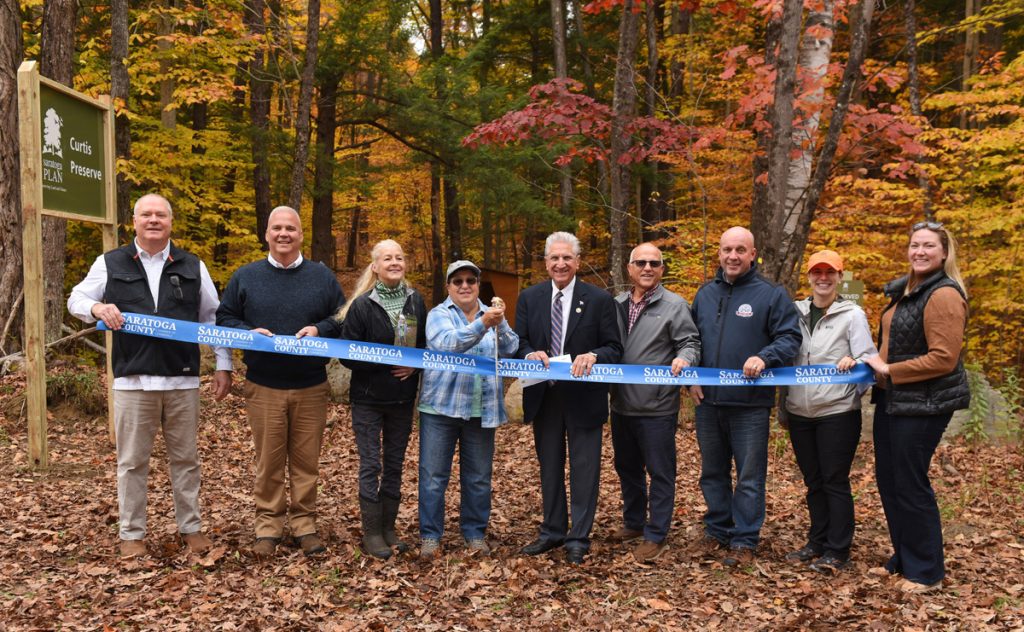
Saratoga PLAN and the Saratoga County Chamber of Commerce hosted a ribbon-cutting ceremony on Oct. 23 to celebrate the opening of the Curtis Preserve in Corinth. Photo by Super Source Media for Saratoga TODAY.
CORINTH — The Curtis Preserve—a 127-acre, permanently protected plot of land that includes three trails near the edge of Adirondack Park—was officially opened by Saratoga PLAN (Preserving Land and Nature) last month.
The preserve includes about 1.7 miles of trails, as well as a flowing brook that winds through a forest filled with red oak, white pine, and eastern hemlocks. Saratoga PLAN called the preserve a “critical wildlife habitat” that serves as an “important link for regional wildlife connectivity.”
The preserve was made possible thanks to a donation by Patricia LeClair and her family. LeClair and her neighbor Mary Curtis both loved the woods that connected their properties. After the Curtises passed away, LeClair inherited their land and later chose to donate 127 acres to Saratoga PLAN.
“I walked those woods for many years and I hope that people will enjoy them as much as I did,” LeClair said in a statement.
“The LeClair family has made an outstanding gift to the community, helping to ensure the property’s ecological, educational, historic, recreational, and scenic values are maintained for generations to come,” said Saratoga PLAN.
In addition to LeClair’s donation, Saratoga PLAN credited local community members and organizations with helping to create the preserve. The property’s three trails were built and marked by PLAN staffers and volunteers, including participants from Regeneron’s “Day for Doing Good” (Regeneron is a pharmaceuticals company that purchased the former Quad Graphics printing facility in Saratoga Springs last year).
Locals also provided feedback via surveys that helped inform decisions about public access. For example, the land had historically been used for horseback riding, and local equestrians helped ensure that the new preserve would continue to be available to horses.
Financial support for the project came from the Saratoga County Trails & Open Space Committee’s Farmland Protection and Open Space Grant Program, which contributed nearly $33,000 to cover transactional costs. The Nature Conservancy’s Climate Resilience Grant Program added another $25,000 toward future stewardship needs.
“The Curtis Preserve is a great example of how we can come together to protect land that connects people to nature,” said Rob Davies, executive director of Saratoga PLAN.
This preserve is open to the public from dawn to dusk for nature study, walking, snowshoeing, horseback riding, and cross-country skiing. To learn more about the preserve or to download a trail map, visit www.saratogaplan.org/curtispreserve.